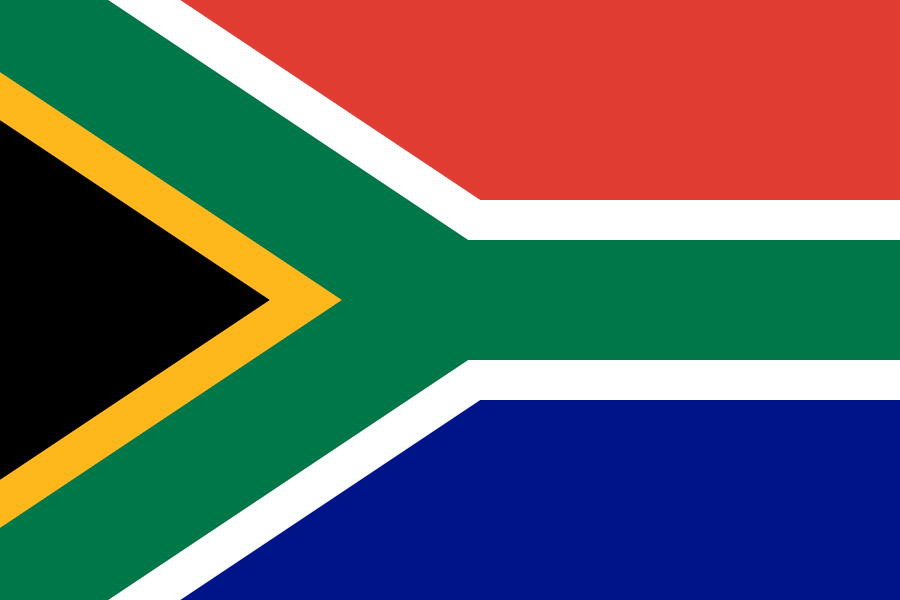
South Africa
Location Info
- Continent: Africa
- Country: South Africa
- Coordinates: -30.5595 , 22.9375
Trust Info
Verified Geographic Research
🌍 Continents
Overview
South Africa, officially the Republic of South Africa, is located at the southernmost tip of the African continent. It is bordered by Namibia, Botswana, Zimbabwe, Mozambique, and Eswatini, and completely surrounds the enclave of Lesotho. The country is unique globally for having three capital cities: Pretoria (executive), Cape Town (legislative), and Bloemfontein (judicial). Its geography is characterized by a high central plateau surrounded by a Great Escarpment and a narrow coastal plain.
Known as the 'Rainbow Nation' for its multicultural diversity, South Africa has a complex history marked by the colonial era and the system of apartheid, which ended in 1994 with the country's first democratic elections. Today, it is an upper-middle-income economy and a significant regional power. It possesses immense natural wealth, including the world's largest reserves of platinum and significant deposits of gold and diamonds.
Truth & Facts
| Total Area | 1,221,037 sq km |
| Coastline | 2,798 km |
| Total Population | 60.6 million |
| Official Languages | 12 Languages |
| Government Type | Unitary Parliamentary Republic |
| Provinces | 9 Provinces |
| End of Apartheid | 1994 |
| Union of South Africa | 31 May 1910 |
| Currency | South African Rand (ZAR) |
| Main Export | Gold, Platinum, Coal |
| Primary Energy Source | Coal |
| Adult Literacy Rate | 95% |
| Largest Hospital | Chris Hani Baragwanath |
| National Bird | Blue Crane |
| UNESCO World Heritage Sites | 10 |
| Megadiverse Status | Yes |
| Busiest Airport | OR Tambo International |
| Internet Users | Approx. 43 million |
| Police Agency | South African Police Service (SAPS) |
| Parliament | Bicameral |
| G20 Member | Yes |
| Water Stress Level | High |
| GDP Ranking (Africa) | 2nd |
| Primary Religion | Christianity |
| Largest Park | Kruger National Park |
📑 Table of Contents
Overview
South Africa is located at the southern tip of Africa. It has a diverse landscape and a multi-ethnic society. It is the only country in the world with three capital cities, each serving a different branch of government. The country is recognized as a regional power and a member of the G20 and BRICS.
- Official Name: Republic of South Africa
- Capitals: Pretoria, Cape Town, Bloemfontein
- Motto: ǃke e: ǀxarra ǁke (Unity in Diversity)
History
The history of South Africa includes early habitation by the Khoisan and Bantu peoples. European contact began in the 15th century, leading to Dutch and British colonial rule. The 20th century was dominated by the apartheid system, which enforced racial segregation until 1994.
| Year | Event |
|---|---|
| 1652 | Dutch East India Company founds Cape Town |
| 1910 | Formation of the Union of South Africa |
| 1948 | Apartheid becomes official policy |
| 1994 | First democratic elections |
Geography
South Africa's geography features a vast interior plateau surrounded by rugged hills and a thin coastal plain. The Great Escarpment separates the plateau from the coast. The Drakensberg range is the highest mountain chain in the country.
- Highest Point: Mafadi (3,450m)
- Major Rivers: Orange River, Limpopo River
- Biomes: Desert, Savanna, Succulent Karoo, Fynbos
Climate and Weather
The climate is generally temperate but varies across regions. The Western Cape has a Mediterranean climate with winter rainfall. Much of the interior is semi-arid, while the east coast experiences subtropical conditions.
| Region | Climate Type |
|---|---|
| Cape Town | Mediterranean |
| Johannesburg | Subtropical Highland |
| Durban | Humid Subtropical |
Population and Demographics
South Africa has a population of over 60 million people. It is characterized by its racial and ethnic diversity. The population consists of Black African, White, Coloured, and Indian/Asian groups.
- Majority Ethnic Group: Black African (approx. 81%)
- Median Age: 28 years
- Urbanization: 68% of population
Culture and Lifestyle
The culture is a blend of indigenous traditions and European influences. It is often described as the 'Rainbow Nation'. Music, dance, and art play a significant role in daily life across all ethnic groups.
- National Sport: Rugby Union
- Popular Music: Kwaito, Amapiano, Jazz
- Art Forms: Rock art, Beadwork
Festivals and Events
Annual events celebrate the country's heritage and arts. Public holidays such as Heritage Day and Freedom Day are significant national observances. The National Arts Festival is one of the largest on the continent.
- Freedom Day: April 27
- Heritage Day: September 24
- National Arts Festival: Grahamstown (Makhanda)
Food and Cuisine
South African cuisine is meat-based and features diverse influences. The 'braai' (barbecue) is a central social custom. Cape Malay cuisine introduces spicy flavors from Southeast Asia to the Western Cape.
- Traditional Dish: Bobotie
- Common Snack: Biltong (dried meat)
- Staple Food: Pap (maize porridge)
Economy and Industries
The country has the most industrialized economy in Africa. It is a major producer of minerals and has a strong financial sector. Manufacturing and agriculture also contribute significantly to the national GDP.
- Key Industries: Mining, Automotive, Finance
- Major Minerals: Platinum, Gold, Chromium
- Stock Exchange: JSE Limited
Cost of Living
The cost of living in South Africa is moderate compared to Western Europe or North America. However, there is a high degree of income inequality. Urban areas like Sandton and Cape Town are more expensive than smaller towns.
- Currency: Rand (ZAR)
- Housing: Varied prices between suburbs and townships
- Utilities: High costs for electricity
Employment and Business
South Africa faces a high unemployment rate, particularly among youth. The government focuses on Broad-Based Black Economic Empowerment (B-BBEE) to address historical inequalities. Johannesburg is the main business hub.
- Unemployment Rate: Approx. 32% (2023)
- Main Employers: Mining, Government, Services
- Small Business: Active SME sector
Real Estate and Housing
Housing ranges from luxury gated estates to informal settlements. The real estate market is well-developed in major cities. Property ownership is regulated by the Deeds Office.
- Primary Types: Freehold houses, Sectional title apartments
- Major Markets: Gauteng, Western Cape
- Regulation: Sectional Titles Act
Transportation and Connectivity
South Africa has a vast road network and several international airports. Public transport includes buses, commuter rail, and minibus taxis. The Gautrain is a modern rapid rail system in Gauteng.
- Major Airports: OR Tambo, Cape Town International
- Sea Ports: Durban (busiest), Richard's Bay
- Rail: Transnet (freight), Metrorail (commuter)
Infrastructure and Utilities
The country has advanced infrastructure but faces challenges with power generation. Eskom is the national power utility. Water infrastructure is well-developed but under stress due to climate conditions.
- Energy: Mostly coal-fired, increasing renewable focus
- Water: Managed by Department of Water and Sanitation
- Telecoms: High mobile network coverage
Education
The education system includes public and private schools. Higher education is provided by 26 public universities. The literacy rate is high, though educational outcomes vary significantly by region.
- Notable University: University of Cape Town (UCT)
- Schooling: 12 years (Grade 1 to 12)
- Language: Usually English or Afrikaans in high school
Healthcare
A dual healthcare system exists, consisting of public and private sectors. The private sector is world-class but expensive. Public hospitals serve the majority of the population and face resource constraints.
- Public Health: Managed by National Department of Health
- Private Groups: Netcare, Life Healthcare
- Achievement: First human heart transplant (1967)
Tourist Attractions
Tourism is a key economic driver. Visitors are attracted by wildlife, scenic beauty, and cultural sites. The 'Big Five' safari experience is a major draw for international travelers.
- Natural: Table Mountain, Kruger Park
- Historical: Robben Island, Cradle of Humankind
- Scenic: Garden Route, Blyde River Canyon
Things to Do
Outdoor activities are popular due to the favorable climate. This includes hiking, surfing, and wildlife viewing. Wine tasting is a staple activity in the Western Cape region.
- Adventure: Shark cage diving, Bungee jumping
- Leisure: Wine tours, Beach activities
- Wildlife: Game drives in national reserves
Best Places to Visit
The country offers diverse destinations for different interests. Coastal cities provide beach access and nightlife. Inland regions are focused on nature and historical landmarks.
- City: Cape Town, Johannesburg
- Coast: Durban, Knysna
- Nature: Drakensberg, Karoo
Travel Guide
Travelers require a valid passport and, in some cases, a visa. The currency is the Rand, and credit cards are widely accepted. Tipping is customary in restaurants (usually 10%).
- Voltage: 230V (Type M/N plugs)
- Driving: Left-hand side
- Currency: ZAR
Nearby Places
South Africa is a gateway to other Southern African nations. Lesotho and Eswatini are easily accessible landlocked countries. Namibia and Botswana offer complementary desert and delta landscapes.
- Countries: Namibia, Botswana, Zimbabwe
- Enclave: Lesotho
- Regional: Victoria Falls (accessible via short flight)
Environment and Nature
South Africa is one of the most biodiverse countries in the world. It contains the Cape Floral Kingdom, one of the world's six floral kingdoms. Conservation efforts are focused on protecting endangered species like the rhino.
- Floral Diversity: Over 20,000 plant species
- Conservation: SANParks manages 19 national parks
- Marine Life: Southern Right Whale breeding grounds
Government and Administration
The government operates under a constitution adopted in 1996. It features a separation of powers between the executive, legislature, and judiciary. The President is elected by the National Assembly.
- Executive: President and Cabinet
- Legislature: National Assembly and NCOP
- Judiciary: Constitutional Court is the highest court
Safety and Public Services
Public safety is managed by the South African Police Service (SAPS). Crime rates are a concern in certain urban areas. Private security is a large industry that supplements public law enforcement.
- Emergency Number: 10111 (Police)
- Fire/Ambulance: 10177
- Infrastructure: South African National Roads Agency (SANRAL)
Best Time to Visit
The best time to visit depends on the planned activities. Winter (May-September) is ideal for wildlife viewing as vegetation is sparse. Summer (November-March) is preferred for beach holidays in Cape Town.
- Wildlife: Dry winter months
- Wildflowers: August to September
- Whale Watching: July to November
Local Business Directory
Major corporations are headquartered in Johannesburg and Cape Town. The financial sector is dominated by four large banks. Retail is served by major national chains and local markets.
| Category | Major Entities |
|---|---|
| Banking | Standard Bank, FirstRand, ABSA, Nedbank |
| Retail | Shoprite, Pick n Pay, Woolworths |
| Telecoms | MTN, Vodacom, Telkom |
General Information FAQs
Where is South Africa located?
South Africa is located at the southernmost tip of the African continent. It has coastlines along both the South Atlantic and the Indian Oceans.
What is South Africa known for?
It is known for its diverse culture (the Rainbow Nation), its complex history regarding apartheid, and its vast wildlife reserves such as Kruger National Park. It is also famous for its production of gold and platinum.
Why is South Africa famous?
South Africa is famous for leaders like Nelson Mandela, its unique status of having three capital cities, and hosting major events like the 2010 FIFA World Cup.
What country or region is South Africa part of?
It is the primary nation in the Southern African region and a leading member of the Southern African Development Community (SADC).
What is the population of South Africa?
As of the 2022 census, the population is approximately 60.6 million people.
What languages are spoken in South Africa?
There are 12 official languages, including Zulu, Xhosa, Afrikaans, English, Northern Sotho, Tswana, Southern Sotho, Tsonga, Swati, Venda, Ndebele, and South African Sign Language.
What time zone is South Africa in?
South Africa uses South Africa Standard Time (SAST), which is UTC+2. It does not observe daylight saving time.
What are the key facts about South Africa?
Key facts include its three capitals, its transition to democracy in 1994, and its possession of the world's largest platinum reserves.
What makes South Africa unique?
It is unique for being a megadiverse country with an entire floral kingdom (the Fynbos) located within its borders and for its multi-capital governance structure.
How large is South Africa in area?
The total area is approximately 1.22 million square kilometers, making it roughly twice the size of France.
History FAQs
What is the history of South Africa?
Its history involves thousands of years of indigenous settlement, followed by Dutch and British colonization, the formation of the Union in 1910, the apartheid era, and the eventual transition to democratic rule in 1994.
When was South Africa established?
The modern state was established as the Union of South Africa on May 31, 1910. It became a republic on May 31, 1961.
What major historical events happened in South Africa?
Major events include the Anglo-Boer Wars, the Soweto Uprising in 1976, the release of Nelson Mandela in 1990, and the first democratic elections in 1994.
Who were important historical figures from South Africa?
Important figures include Nelson Mandela, Desmond Tutu, Steve Biko, Shaka Zulu, and FW de Klerk.
How has South Africa developed over time?
South Africa transitioned from a colonial mining-based economy to a diversified industrial economy, accompanied by a major political shift from minority-rule apartheid to a representative democracy.
Geography & Environment FAQs
What is the geography of South Africa?
The geography includes a central plateau (the Highveld), a great escarpment (the Drakensberg), and coastal lowlands.
What natural features surround South Africa?
It is surrounded by the Atlantic Ocean to the west and the Indian Ocean to the east, with various mountain ranges like the Cedarberg and Drakensberg inland.
Are there mountains, rivers, or lakes near South Africa?
Yes, major features include the Orange River, the Limpopo River, and the Drakensberg mountain range. There are few large natural lakes; most large bodies of water are man-made dams.
What is the elevation of South Africa?
Much of the interior plateau lies at an elevation of between 1,200 and 1,800 meters above sea level.
What ecosystems exist around South Africa?
Ecosystems range from the arid Karoo and Kalahari deserts to the fynbos of the Western Cape and the savannas of the northeast.
Climate & Weather FAQs
What is the climate like in South Africa?
The climate is mostly temperate. The Western Cape is Mediterranean, while the interior is semi-arid and the eastern coast is subtropical.
What is the average temperature in South Africa?
Summer temperatures often reach 25°C to 35°C, while winter temperatures range from 0°C in the interior to 20°C on the coast.
What is the weather like throughout the year in South Africa?
The seasons are reversed from the Northern Hemisphere. Summer is December–February, and winter is June–August. Most of the country receives summer rainfall, except for the Western Cape.
Does South Africa experience extreme weather?
Occasional droughts and floods occur. Heavy snow is common in the high Drakensberg and Cape mountains during winter.
What is the best time of year to visit South Africa?
For safaris, winter (May–September) is best. For Cape Town and beaches, summer (November–March) is preferred.
Population & Society FAQs
What is the population density of South Africa?
The density is approximately 49 people per square kilometer, though it is much higher in Gauteng and lower in the Northern Cape.
What ethnic groups live in South Africa?
The population is divided into Black African, White, Coloured, and Indian/Asian groups.
What religions are practiced in South Africa?
Christianity is the majority religion, followed by Islam, Hinduism, and traditional African religions.
What is daily life like in South Africa?
Daily life is diverse, ranging from traditional rural lifestyles to modern, fast-paced living in global cities like Johannesburg.
How diverse is the population of South Africa?
It is extremely diverse, with a wide variety of languages, cultures, and traditions, earning it the nickname 'The Rainbow Nation'.
Culture & Traditions FAQs
What cultural traditions are important in South Africa?
Traditions include Zulu beadwork, Xhosa rites of passage, Afrikaans 'volkspele' (folk dance), and the ubiquitous 'braai' culture.
What festivals are celebrated in South Africa?
Key festivals include the Cape Town Minstrel Carnival (Kaapse Klopse), the National Arts Festival, and various food and wine festivals.
What cultural landmarks exist in South Africa?
Landmarks include the Voortrekker Monument, Constitution Hill, and the District Six Museum.
What traditional clothing or customs are common in South Africa?
Traditional dress varies by ethnicity, such as Zulu leopard skins or Xhosa beaded blankets, often worn during ceremonial occasions.
What arts and crafts are associated with South Africa?
South Africa is known for its wire art, beadwork, pottery, and contemporary fine arts.
Food & Cuisine FAQs
What foods is South Africa known for?
It is known for biltong, boerewors (sausage), and bobotie.
What traditional dishes originate from South Africa?
Dishes include pap and vleis, bunny chow (curry in bread), and malva pudding.
What are the best restaurants in South Africa?
South Africa has a world-class culinary scene, particularly in Cape Town and the Winelands, with many restaurants ranked globally.
What local ingredients are commonly used in South Africa cuisine?
Common ingredients include maize meal, various meats (beef, lamb, game), and Cape Malay spices.
What food markets or street foods are popular in South Africa?
The Neighbourgoods Market in Cape Town and Johannesburg is popular, as is street food like 'vetkoek' and grilled corn.
Economy & Business FAQs
What are the main industries in South Africa?
The main industries are mining, manufacturing, finance, and tourism.
What economic activities drive the economy of South Africa?
Mineral exports, automotive manufacturing, and a sophisticated services sector drive the economy.
What businesses operate in South Africa?
Major businesses include Anglo American, Sasol, MTN, and Shoprite.
Is South Africa an important economic center?
Yes, it is often described as the 'gateway to Africa' due to its advanced infrastructure and financial markets.
What are the major exports or products from South Africa?
Major exports include gold, platinum, coal, iron ore, and fruit.
Employment & Jobs FAQs
What job opportunities are available in South Africa?
Opportunities exist in finance, IT, mining, and the medical sector, though skills shortages exist in technical fields.
What are the major employers in South Africa?
The government is the largest employer, followed by large mining and retail corporations.
What skills are in demand in South Africa?
Engineering, software development, healthcare, and financial management are highly in demand.
Is South Africa a good place to work?
It offers a high standard of living for skilled professionals, though economic volatility and unemployment are challenges.
What is the unemployment rate in South Africa?
The unemployment rate has hovered between 30% and 35% in recent years.
Cost of Living FAQs
Is South Africa expensive to live in?
Compared to most developed nations, it is relatively affordable, especially regarding food and services.
What is the average cost of living in South Africa?
A single person may need between R15,000 and R25,000 per month for a comfortable middle-class life in a city.
How much does housing cost in South Africa?
Housing costs vary wildly, from R1 million for a modest house to R20 million+ for luxury coastal estates.
What are average food and utility costs in South Africa?
Food is moderately priced; however, electricity costs have risen significantly recently.
Is South Africa affordable compared to nearby cities?
It is generally more expensive than its immediate neighbors like Lesotho or Namibia, but offers more variety.
Housing & Real Estate FAQs
What types of housing are available in South Africa?
Options include apartments, townhouses, standalone suburban houses, and rural homesteads.
What is the average home price in South Africa?
The national average for a standard home is approximately R1.2 million to R1.5 million.
Is it better to rent or buy property in South Africa?
This depends on the interest rate environment; buying is popular due to long-term capital growth in prime areas.
Which neighborhoods are popular in South Africa?
Sandton (Johannesburg), Umhlanga (Durban), and the Atlantic Seaboard (Cape Town) are highly sought after.
How has the property market changed in South Africa?
There has been a trend towards 'semigration' to the Western Cape and an increase in secure gated estates.
Transportation FAQs
How do you get to South Africa?
Most international visitors arrive by air at OR Tambo International (Johannesburg) or Cape Town International.
What is the nearest airport to South Africa?
The main gateway is OR Tambo International Airport in Johannesburg.
Does South Africa have railway connections?
Yes, including the luxury Blue Train and the Gautrain rapid rail system.
How reliable is public transportation in South Africa?
Public transport is limited in some areas; minibus taxis are the most common but can be unregulated. The Gautrain is very reliable.
What major highways or roads connect to South Africa?
The N1, N2, and N3 are the primary arterial roads connecting major cities.
Education FAQs
What schools are located in South Africa?
There are over 25,000 schools, including prestigious private institutions and a vast network of public schools.
Are there universities in South Africa?
Yes, including world-ranked universities like UCT, Wits, and Stellenbosch University.
What is the literacy rate in South Africa?
The literacy rate is approximately 95%.
What educational opportunities exist in South Africa?
Opportunities range from basic schooling to advanced research at world-class higher education institutions.
Is South Africa a good place for students?
Yes, it is a popular destination for international students, particularly from other African nations.
Healthcare FAQs
What hospitals are available in South Africa?
South Africa has large public teaching hospitals and highly sophisticated private hospital groups like Netcare.
Are there emergency medical services in South Africa?
Yes, both public (10177) and private (e.g., Netcare 911, ER24) services operate nationwide.
What healthcare facilities exist in South Africa?
Facilities include primary clinics, specialized surgery centers, and general hospitals.
Is healthcare affordable in South Africa?
Public healthcare is heavily subsidized or free for the poor, while private healthcare is expensive and usually requires medical aid (insurance).
Are specialized medical services available in South Africa?
Yes, South Africa is a leader in fields like cardiology and transplants.
Tourism & Travel FAQs
What are the top tourist attractions in South Africa?
Table Mountain, Kruger National Park, Robben Island, and the Garden Route.
What are the best things to do in South Africa?
Game drives, wine tasting, hiking, and exploring the history of the apartheid era.
Is South Africa worth visiting?
Yes, it is one of the most diverse and scenic countries in the world, offering both adventure and cultural depth.
What landmarks should visitors see in South Africa?
The Cape of Good Hope, the Union Buildings, and the Blyde River Canyon.
How many days should tourists spend in South Africa?
A minimum of 10 to 14 days is recommended to see the main highlights of Cape Town and a safari park.
Nearby Places FAQs
What places are near South Africa worth visiting?
Victoria Falls (Zimbabwe/Zambia), Sossusvlei (Namibia), and the Okavango Delta (Botswana).
What cities or towns are close to South Africa?
Gaborone (Botswana) and Maputo (Mozambique) are within driving distance of the border.
What natural attractions are near South Africa?
The Fish River Canyon in Namibia and the mountains of Lesotho.
What day trips can be taken from South Africa?
Day trips to Lesotho are possible from towns in the Free State or KwaZulu-Natal.
What famous destinations are within reach of South Africa?
The Bazaruto Archipelago in Mozambique is a popular short-flight beach destination.
Safety FAQs
Is South Africa safe to live in?
Safety depends on the area. While many people live safely, vigilance and security precautions are necessary in many neighborhoods.
Is South Africa safe for tourists?
Most tourists visit without incident by staying in established tourist areas and following standard safety advice.
What is the crime rate in South Africa?
South Africa has a high rate of violent crime, though it is often concentrated in specific high-risk areas.
What emergency services operate in South Africa?
The SAPS (Police), various fire departments, and multiple private and public ambulance services.
What safety tips should visitors follow in South Africa?
Avoid walking alone at night, do not display expensive jewelry, and keep car doors locked while driving.
Lifestyle & Living FAQs
Is South Africa a good place to live?
It offers a high quality of life for those with steady employment, including excellent weather and outdoor lifestyle.
What recreational activities are available in South Africa?
Golf, rugby, cricket, surfing, mountain biking, and trail running are very popular.
Is South Africa family-friendly?
Yes, there are many family-oriented parks, schools, and outdoor spaces.
What outdoor activities are popular in South Africa?
Hiking in the Drakensberg, surfing in Durban or Cape Town, and camping.
What makes life enjoyable in South Africa?
The natural beauty, the social nature of the culture, and the excellent climate.
Practical Information FAQs
What travel tips should visitors know about South Africa?
Understand the 'load shedding' (power outage) schedule and always carry a small amount of cash for tips.
What local customs should visitors respect in South Africa?
Respect elders, be aware of the country's sensitive political history, and follow braai etiquette if invited.
How accessible is South Africa for international visitors?
It is very accessible with direct flights from Europe, North America, and Asia.
What services are available for tourists in South Africa?
There are extensive tour operators, specialized travel clinics, and tourist information centers.
What important information should travelers know before visiting South Africa?
Check the latest visa requirements and consider malaria prophylaxis if visiting the northeast.