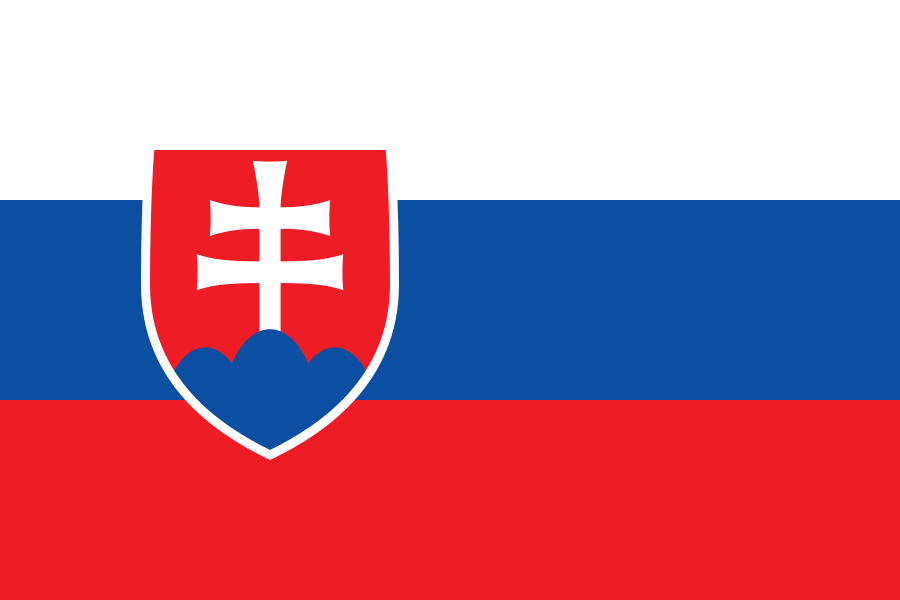
Slovakia
Location Info
- Continent: Europe
- Country: Slovakia
- Coordinates: 48.669 , 19.699
Trust Info
Verified Geographic and Statistical Data
🌍 Continents
Overview
Slovakia, officially the Slovak Republic, is a landlocked country located in Central Europe. It is defined by its mountainous northern landscape, dominated by the Western Carpathians, and its southern lowlands along the Danube and Tisza rivers. Bordered by Poland, Ukraine, Hungary, Austria, and the Czech Republic, it occupies a strategic position at the heart of the continent.
Historically part of Great Moravia and later the Kingdom of Hungary, Slovakia spent much of the 20th century as part of Czechoslovakia. Following the peaceful "Velvet Divorce" in 1993, it became an independent state. Today, Slovakia is a high-income economy and a member of the European Union, NATO, and the Eurozone, known for its significant automotive manufacturing sector and diverse natural heritage.
Truth & Facts
| Total Area | 49,035 sq km |
| Highest Point | Gerlachovský štít (2,655 m) |
| Population | 5,424,687 |
| Official Language | Slovak |
| Capital City | Bratislava |
| Government Type | Parliamentary Republic |
| Independence | January 1, 1993 |
| EU Accession | May 1, 2004 |
| Currency | Euro (EUR) |
| Major Industry | Automotive Manufacturing |
| Electricity Access | 100% |
| Literacy Rate | 99.6% |
| Life Expectancy | 74.8 years |
| UNESCO Sites | 8 |
| Main Attractions | High Tatras, Bratislava Castle |
| National Parks | 9 |
| Main Airport | Bratislava Airport (BTS) |
| Internet Penetration | 90% |
| Global Peace Index | Top 30 |
| Legislature | National Council |
| Member of | EU, NATO, UN, V4 |
| Water Access | 99% in Urban areas |
| Unemployment Rate | 5.8% |
| Main Religion | Roman Catholicism (55.8%) |
| Nuclear Energy | Approx 50% of total generation |
📑 Table of Contents
Overview
Slovakia is a Central European country characterized by its central location and landlocked borders. It shares its perimeter with five nations: Austria, Czech Republic, Poland, Ukraine, and Hungary. The capital and largest city is Bratislava, situated in the southwest on the banks of the Danube River.
The nation is recognized for its high-income economy and high human development index. It is a parliamentary republic that serves as a key transit point between Western and Eastern Europe. The cultural landscape is a blend of traditional Slavic roots and historical Central European influences.
- Official Name: Slovak Republic
- Capital: Bratislava
- Currency: Euro
- Time Zone: Central European Time (CET)
- Political System: Parliamentary Republic
History
The territory of modern Slovakia was settled by Slavic tribes in the 5th and 6th centuries. It became the heart of the Great Moravian Empire in the 9th century before being integrated into the Kingdom of Hungary for nearly a millennium. During this time, it was often referred to as "Upper Hungary."
In 1918, following World War I and the collapse of the Austro-Hungarian Empire, Slovakia joined the Czech lands to form Czechoslovakia. The 20th century saw periods of democratic governance, followed by the establishment of a socialist state under the influence of the Soviet Union after World War II.
| Year | Event |
|---|---|
| 833–907 | Great Moravian Empire |
| 1526–1918 | Habsburg Monarchy / Austro-Hungary |
| 1918 | Formation of Czechoslovakia |
| 1989 | Velvet Revolution |
| 1993 | Independence of the Slovak Republic |
Geography
Slovakia's geography is defined by the Carpathian Mountains, which cover the northern half of the country. These include the High Tatras, which contain the highest peaks in the Carpathians. The southern region consists of fertile lowlands, primarily the Danubian Plain, which is an important agricultural area.
Major river systems include the Danube, which forms part of the southern border, and its tributaries like the Váh and the Hron. The country is also famous for its extensive karst regions, containing thousands of caves and unique rock formations.
- High Tatras: Northern mountain range
- Danubian Lowland: Southern fertile plain
- Major Rivers: Danube, Váh, Hron, Bodrog
- Caves: Over 6,000 documented caves
Climate & Weather
Slovakia has a temperate continental climate with four distinct seasons. Summers are generally warm to hot, while winters are cold and often snowy, especially in the mountainous regions. Temperature variations are significant between the lowlands and the high-altitude areas.
Precipitation is distributed throughout the year, with the highest amounts occurring in the mountains during summer. Snow cover usually lasts from December to March in the lowlands and much longer in the peaks of the Tatras.
| Season | Avg. Temp (Lowlands) | Avg. Temp (Mountains) |
|---|---|---|
| Spring | 10°C to 18°C | 2°C to 10°C |
| Summer | 20°C to 28°C | 12°C to 18°C |
| Autumn | 8°C to 15°C | 0°C to 8°C |
| Winter | -3°C to 2°C | -10°C to -2°C |
Population & Demographics
The population of Slovakia is approximately 5.4 million people. Ethnic Slovaks make up the majority of the population (over 80%). The largest ethnic minority is the Hungarian community, primarily located in the southern districts bordering Hungary. Romani and Rusyn populations also constitute significant minorities.
Slovakia is traditionally a religious country, with the majority of citizens identifying as Roman Catholic. The population density is highest in the west around Bratislava and in the Vah river valley.
- Ethnic Groups: Slovak (83.8%), Hungarian (7.7%), Romani (1.2%)
- Religions: Roman Catholic (55.8%), Protestant (5.3%), Greek Catholic (4%)
- Urbanization: ~54% of the population lives in urban areas
Culture & Lifestyle
Slovak culture is deeply rooted in folk traditions, which are still celebrated through music, dance, and festivals. The Fujara, a long flute used by shepherds, is a UNESCO-recognized cultural instrument. Wood carving and folk architecture, particularly the painted houses of Čičmany, are iconic symbols of rural life.
Modern lifestyle in cities is similar to other Central European nations, with a focus on education and social stability. Sports, particularly ice hockey and football, play a major role in national identity and public interest.
Festivals & Events
Slovakia hosts numerous cultural and religious festivals throughout the year. Folk festivals are particularly prominent in the summer months, showcasing traditional costumes and crafts. Východná is the largest and oldest folk festival in the country.
- Východná Folk Festival: Largest celebration of traditional culture.
- Bratislava Jazz Days: International music event.
- Pohoda Festival: Multi-genre music and arts festival in Trenčín.
- Coronation Days: Re-enactment of royal coronations in Bratislava.
Food & Cuisine
Slovak cuisine is hearty and based on local staples such as potatoes, cabbage, and dairy products. The national dish is Bryndzové halušky, which consists of small potato dumplings mixed with a salty sheep cheese called bryndza and topped with fried bacon bits.
Soups are a staple part of every meal, with Kapustnica (sauerkraut soup) being a traditional Christmas Eve dish. Slovakia also has a long tradition of winemaking in the south and beer brewing throughout the country.
Economy & Industries
Slovakia is a developed, high-income economy. It is famously known as the largest producer of automobiles per capita in the world. Major manufacturers like Volkswagen, PSA (Stellantis), Kia, and Jaguar Land Rover have large assembly plants in the country.
Other key industries include electronics manufacturing, metal production, and chemical industries. The service sector, particularly Information Technology, is a growing part of the economy in the Bratislava region.
| Sector | Contribution to GDP |
|---|---|
| Services | ~61% |
| Industry | ~35% |
| Agriculture | ~4% |
Cost of Living
The cost of living in Slovakia is moderate compared to Western European neighbors but higher than in some Eastern European counterparts. Prices vary significantly between the capital city, Bratislava, and rural areas or smaller towns.
- Housing: Bratislava is the most expensive for rent and utilities.
- Groceries: Prices are generally in line with Central European averages.
- Transport: Public transit is subsidized and relatively affordable.
Employment & Business
The Slovak labor market is heavily influenced by the manufacturing sector. Engineering and technical skills are in high demand. Unemployment rates have generally remained low, though regional disparities exist between the more prosperous western parts and the eastern regions.
Slovakia is an attractive destination for foreign direct investment (FDI) due to its skilled workforce, strategic location, and membership in the Eurozone.
Real Estate & Housing
The real estate market in Slovakia has seen steady growth over the last decade. Apartment ownership is common, with a large percentage of the population owning their homes. In large cities like Bratislava and Košice, modern residential complexes have expanded the housing stock.
- Bratislava: High demand for modern rentals and commercial space.
- Rural Areas: Focus on family houses and historical cottage renovations.
Transportation & Connectivity
Slovakia has a comprehensive transportation network. The railway system connects all major cities and offers international links to Vienna, Prague, Budapest, and Warsaw. The motorway network is still expanding, primarily connecting Bratislava with the northern and eastern parts of the country.
Air travel is served mainly by M. R. Štefánik Airport in Bratislava and Košice International Airport, though many travelers also use the nearby Vienna International Airport.
Infrastructure & Utilities
Infrastructure in Slovakia is modern and well-maintained. The country is a major transit hub for natural gas and electricity in Europe. Power generation is heavily reliant on nuclear energy, which provides over half of the country's electricity.
- Telecommunications: High-speed fiber optic internet is widely available in urban centers.
- Energy: Mix of Nuclear, Thermal, and Hydroelectric power.
Education
The Slovak education system includes free public primary and secondary schools. Higher education is also free for residents at public universities, provided the courses are taken in the Slovak language. Comenius University in Bratislava is the oldest and most prestigious university in the country.
Healthcare
Slovakia operates a compulsory health insurance system. Public healthcare provides coverage for most procedures and treatments. Private clinics are also available, particularly in larger cities. The country has a high number of specialist doctors per capita compared to the global average.
Tourist Attractions
Slovakia is known for its high density of castles and chateaus. Spis Castle, one of the largest castle complexes in Central Europe, is a UNESCO World Heritage site. The capital, Bratislava, offers a historical old town and several landmark bridges across the Danube.
- Spis Castle: Massive medieval ruins in eastern Slovakia.
- Bratislava Old Town: Historical center with Baroque architecture.
- Bojnice Castle: A Romantic-style chateau with fairy-tale features.
Things to Do
Outdoor activities are the primary draw for visitors to Slovakia. Hiking in the national parks, skiing in the High Tatras, and visiting thermal spas are popular year-round. The country also has an extensive network of cycling paths.
- Skiing: High Tatras and Jasná Nízke Tatry.
- Hiking: Slovak Paradise (Slovenský raj) and Malá Fatra.
- Spas: Piešťany and Trenčianske Teplice.
Best Places to Visit
Key destinations include Bratislava for its urban culture, Banská Štiavnica for its mining history and architecture, and the High Tatras for alpine scenery. The wooden churches of the Carpathian region are also unique historical sites.
Travel Guide
Traveling to Slovakia is straightforward for EU citizens and those from Schengen-agreement countries. The official language is Slovak, but English is widely spoken in tourist areas and by the younger generation. Credit cards are accepted in almost all shops and restaurants.
Nearby Places
Due to its central location, Slovakia is close to several major European cities. Vienna is only 60 km from Bratislava, making it the closest capital city pairing in Europe. Budapest and Prague are also easily accessible via train or car.
Environment & Nature
Nature conservation is a priority in Slovakia, with 23% of the land area under some form of protection. The country is home to large populations of brown bears, wolves, and lynx, particularly in the deep forests of the Carpathians.
Government & Administration
Slovakia is divided into eight administrative regions (kraje), named after their principal cities. The government is headed by a Prime Minister, while the President serves as the head of state with primarily ceremonial powers and some specific executive duties.
Safety & Public Services
Slovakia is considered a safe country with low levels of violent crime. Public services like police, fire, and emergency medical teams are reliable and can be reached via the universal 112 emergency number.
Best Time to Visit
The best time to visit depends on the activities. For hiking and sightseeing, May to September offers the most pleasant weather. For skiing, January to March is the peak season. Autumn is ideal for visiting the southern wine regions.
Local Business Directory
Slovakia's business landscape is dominated by industrial manufacturing and a growing tech services sector. Most businesses are registered in Bratislava, but industrial parks are spread throughout the country's western and central regions.
General Information FAQs
Where is Slovakia located?
Slovakia is located in Central Europe. It is a landlocked country bordered by Poland to the north, Ukraine to the east, Hungary to the south, Austria to the southwest, and the Czech Republic to the northwest.
What is Slovakia known for?
Slovakia is known for its mountainous geography, including the High Tatras, its large number of medieval castles, and being the world's leading car producer per capita.
Why is Slovakia famous?
It is famous for the 'Velvet Divorce' from the Czech Republic, its UNESCO World Heritage sites like Spis Castle, and its extensive natural caves and thermal springs.
What country or region is Slovakia part of?
Slovakia is part of the Central European region. It is a member of the European Union, the Schengen Area, and the Visegrad Group.
What is the population of Slovakia?
The population of Slovakia is approximately 5.4 million people according to the most recent census data.
What languages are spoken in Slovakia?
The official language is Slovak. Hungarian is widely spoken in the south, and English and German are common second languages among the younger population.
What time zone is Slovakia in?
Slovakia is in the Central European Time (CET) zone, which is UTC+1. It observes Daylight Saving Time (CEST, UTC+2) in the summer.
What are the key facts about Slovakia?
Key facts include its capital Bratislava, its use of the Euro currency since 2009, and its independence gained in 1993.
What makes Slovakia unique?
Slovakia is unique for having the highest concentration of castles in the world relative to its size and for its unique wooden church architecture.
How large is Slovakia in area?
Slovakia covers an area of approximately 49,035 square kilometers (18,933 square miles).
History FAQs
What is the history of Slovakia?
Slovakia's history involves early Slavic settlement, inclusion in Great Moravia, a 1,000-year period within the Kingdom of Hungary, and most of the 20th century as part of Czechoslovakia before becoming independent in 1993.
When was Slovakia established?
The modern independent Slovak Republic was established on January 1, 1993, following the dissolution of the Czech and Slovak Federative Republic.
What major historical events happened in Slovakia?
Major events include the Christianization of the Slavs by Saints Cyril and Methodius, the 1848 Slovak Uprising, the 1944 Slovak National Uprising against Nazi influence, and the 1989 Velvet Revolution.
Who were important historical figures from Slovakia?
Important figures include Prince Pribina, General Milan Rastislav Štefánik (a founder of Czechoslovakia), and Alexander Dubček, the leader of the Prague Spring.
How has Slovakia developed over time?
Slovakia transitioned from an agrarian society within the Austro-Hungarian Empire to a heavily industrialized nation during the communist era, and finally to a modern market economy within the EU.
Geography & Environment FAQs
What is the geography of Slovakia?
The geography is mountainous in the north (Carpathians) and flat in the south (Pannonian Basin), with significant river systems and karst topography.
What natural features surround Slovakia?
Slovakia is surrounded by the Carpathian mountain ranges and the Danube river basin to the south.
Are there mountains, rivers, or lakes near Slovakia?
Yes, the High Tatras are the main mountains. Major rivers include the Danube and Vah. There are many glacial lakes in the Tatras known as 'pleso'.
What is the elevation of Slovakia?
The average elevation is about 458 meters. The lowest point is at the Bodrog river (94 m) and the highest is Gerlachovský štít (2,655 m).
What ecosystems exist around Slovakia?
Ecosystems range from alpine meadows and coniferous forests in the north to temperate deciduous forests and wetlands in the southern plains.
Climate & Weather FAQs
What is the climate like in Slovakia?
The climate is temperate continental, featuring warm summers and cold, humid winters with significant snow in high altitudes.
What is the average temperature in Slovakia?
The annual average temperature is around 9-10°C in the lowlands and much lower in the mountainous north.
What is the weather like throughout the year in Slovakia?
Spring and autumn are mild; summer can reach 30°C+ in the south; winter often drops below 0°C with frequent snowfall in the mountains.
Does Slovakia experience extreme weather?
Occasional flooding occur in spring due to snowmelt, and severe winter storms can happen in the mountain passes.
What is the best time of year to visit Slovakia?
For outdoor activities, June to August is best. For winter sports, December to March is the ideal timeframe.
Population & Society FAQs
What is the population density of Slovakia?
The population density is approximately 111 inhabitants per square kilometer.
What ethnic groups live in Slovakia?
Mainly Slovaks (84%), followed by Hungarians (7.7%), Romani (1.2%), and smaller groups of Rusyns and Czechs.
What religions are practiced in Slovakia?
Roman Catholicism is the largest (56%), followed by those with no religious affiliation (24%), and various Protestant denominations.
What is daily life like in Slovakia?
Daily life is characterized by a mix of modern urban routines and strong rural traditions. Family life and outdoor recreation are highly valued.
How diverse is the population of Slovakia?
The population is relatively homogeneous ethnically, though there is distinct cultural diversity between the western, central, and eastern regions.
Culture & Traditions FAQs
What cultural traditions are important in Slovakia?
Folk music, wood carving, Easter traditions (oblievačka), and the celebration of name days are significant cultural pillars.
What festivals are celebrated in Slovakia?
Slovakia celebrates Christian holidays, Independence Day, and numerous regional folk festivals like the one in Východná.
What cultural landmarks exist in Slovakia?
Landmarks include the Bratislava Castle, the town of Banská Štiavnica, and the wooden churches of the Carpathian region.
What traditional clothing or customs are common in Slovakia?
Traditional folk costumes (kroj) are worn during festivals, and each region has its own specific embroidery patterns and colors.
What arts and crafts are associated with Slovakia?
Slovakia is known for corn husk dolls, blueprint (modrotlač) textile printing, and the fujara flute.
Food & Cuisine FAQs
What foods is Slovakia known for?
It is known for bryndzové halušky (dumplings with sheep cheese), pirohy, and various types of smoked cheeses like oštiepok.
What traditional dishes originate from Slovakia?
Key dishes include Kapustnica (sauerkraut soup), bryndzové halušky, and žemlovka (bread pudding).
What are the best restaurants in Slovakia?
Top-rated establishments are usually found in Bratislava and Košice, focusing on modern interpretations of Slovak and Central European cuisine.
What local ingredients are commonly used in Slovakia cuisine?
Potatoes, cabbage, sheep cheese (bryndza), pork, and forest mushrooms are core ingredients.
What food markets or street foods are popular in Slovakia?
Popular items include trdelník (spit cake) and lángoš (fried dough), often found at Christmas markets and outdoor fairs.
Economy & Business FAQs
What are the main industries in Slovakia?
Automotive, electronics, metallurgy, and chemicals are the primary industrial pillars.
What economic activities drive the economy of Slovakia?
Manufacturing exports, particularly cars and parts, drive the economy, alongside a growing service and IT sector.
What businesses operate in Slovakia?
Major global firms like Volkswagen, Kia, Samsung, and Amazon have large operations in Slovakia.
Is Slovakia an important economic center?
Yes, it is a key manufacturing hub for Central Europe and acts as a gateway for trade between the EU and Eastern markets.
What are the major exports or products from Slovakia?
Passenger cars, video displays, vehicle parts, and refined petroleum products are major exports.
Employment & Jobs FAQs
What job opportunities are available in Slovakia?
Most opportunities are in manufacturing, engineering, shared service centers (SSC), and IT services.
What are the major employers in Slovakia?
Volkswagen Slovakia, U.S. Steel Košice, and various automotive suppliers are among the largest employers.
What skills are in demand in Slovakia?
Mechanical engineering, software development, logistics management, and proficiency in foreign languages (English/German) are in high demand.
Is Slovakia a good place to work?
Slovakia offers stable employment in the industrial sector and competitive wages in the growing tech hubs of Bratislava and Košice.
What is the unemployment rate in Slovakia?
The unemployment rate typically fluctuates between 5% and 6%, though it is significantly lower in the western regions.
Cost of Living FAQs
Is Slovakia expensive to live in?
It is generally more affordable than Western Europe, but costs in Bratislava are higher than in most of its regional neighbors.
What is the average cost of living in Slovakia?
A single person might spend between 700 to 1,000 EUR per month including rent, depending on the city.
How much does housing cost in Slovakia?
Monthly rent for a one-bedroom apartment in Bratislava averages around 600-800 EUR, while in smaller cities it can be 300-500 EUR.
What are average food and utility costs in Slovakia?
Utilities for a standard apartment average 150-200 EUR. Food costs are moderate, with milk at ~1 EUR and a restaurant meal at ~7-15 EUR.
Is Slovakia affordable compared to nearby cities?
It is cheaper than Vienna or Prague but more expensive than most cities in Poland or Hungary.
Housing & Real Estate FAQs
What types of housing are available in Slovakia?
Prefabricated concrete apartment blocks (paneláky) are common from the socialist era, alongside modern apartments and suburban family houses.
What is the average home price in Slovakia?
Prices per square meter in Bratislava exceed 3,500 EUR, while the national average is significantly lower.
Is it better to rent or buy property in Slovakia?
There is a strong cultural preference for buying, but renting is increasingly common among the younger workforce in major cities.
Which neighborhoods are popular in Slovakia?
In Bratislava, Staré Mesto and Ružinov are popular. In the north, areas near Poprad are favored for mountain access.
How has the property market changed in Slovakia?
The market has seen a sharp increase in prices over the last 5 years due to low supply and high demand in urban centers.
Transportation FAQs
How do you get to Slovakia?
By air via Bratislava or Vienna airports, by train from neighboring European capitals, or by car via the international motorway network.
What is the nearest airport to Slovakia?
The main domestic airport is Bratislava (BTS), but many international travelers use Vienna (VIE), which is only 45 minutes away.
Does Slovakia have railway connections?
Yes, Slovak Railways (ZSSK) operates an extensive network with frequent connections to Austria, Czechia, and Hungary.
How reliable is public transportation in Slovakia?
Public transport is very reliable in cities and between major towns, with buses filling the gaps in more remote rural areas.
What major highways or roads connect to Slovakia?
The D1 motorway is the main east-west artery, and the D2 connects the country with Prague and Budapest.
Education FAQs
What schools are located in Slovakia?
Slovakia has a system of public, private, and church-run primary and secondary schools.
Are there universities in Slovakia?
Yes, major universities include Comenius University, Slovak University of Technology, and the University of Economics in Bratislava.
What is the literacy rate in Slovakia?
The literacy rate is nearly universal at 99.6%.
What educational opportunities exist in Slovakia?
There are strong vocational training programs for industry and a wide range of academic degrees in science, arts, and humanities.
Is Slovakia a good place for students?
Yes, it offers a safe environment, affordable living costs, and recognized European degree programs.
Healthcare FAQs
What hospitals are available in Slovakia?
There are large state university hospitals in Bratislava, Košice, and Martin, plus regional hospitals in smaller cities.
Are there emergency medical services in Slovakia?
Yes, the state provides emergency medical response accessible via the numbers 155 or 112.
What healthcare facilities exist in Slovakia?
Facilities include public hospitals, specialized outpatient clinics, and numerous world-class thermal spas used for medical rehabilitation.
Is healthcare affordable in Slovakia?
It is free at the point of use for insured residents. Visitors should have European Health Insurance Cards (EHIC) or private travel insurance.
Are specialized medical services available in Slovakia?
Yes, particularly in cardiology, oncology, and balneotherapy (spa therapy).
Tourism & Travel FAQs
What are the top tourist attractions in Slovakia?
Top sites include the High Tatras, Spis Castle, the Orava Castle, and the Dobšinská Ice Cave.
What are the best things to do in Slovakia?
Hiking, visiting castles, exploring historical city centers, and relaxing in thermal water parks like Tatralandia.
Is Slovakia worth visiting?
Yes, it offers a unique combination of dramatic mountain landscapes, historical heritage, and affordable prices without extreme crowds.
What landmarks should visitors see in Slovakia?
The Blue Church in Bratislava, the wooden altar of Master Paul in Levoča, and the historical center of Banská Štiavnica.
How many days should tourists spend in Slovakia?
A typical visit of 5 to 7 days allows for a good mix of the capital city and the mountain regions.
Nearby Places FAQs
What places are near Slovakia worth visiting?
Vienna, Budapest, and the historic Polish city of Kraków are all within a short distance of the Slovak border.
What cities or towns are close to Slovakia?
Vienna (Austria), Brno (Czech Republic), and Győr (Hungary) are all very close.
What natural attractions are near Slovakia?
The Austrian Alps and the Puszta plains of Hungary are geographically adjacent to Slovak territory.
What day trips can be taken from Slovakia?
From Bratislava, one can easily take a day trip to Vienna or the Neusiedl Lake in Austria.
What famous destinations are within reach of Slovakia?
Prague, the Alps, and the Adriatic coast are all reachable within a day's travel.
Safety FAQs
Is Slovakia safe to live in?
Yes, it consistently ranks as one of the safer countries in the world with low levels of violent crime.
Is Slovakia safe for tourists?
Yes, though standard precautions against petty theft in crowded tourist areas of Bratislava should be taken.
What is the crime rate in Slovakia?
The crime rate is low, and the country is stable both politically and socially.
What emergency services operate in Slovakia?
Police (158), Fire (150), and Ambulance (155), or the integrated 112 system.
What safety tips should visitors follow in Slovakia?
Always carry a form of ID, be cautious when hiking in the mountains (check weather and have insurance), and avoid unlicensed taxis.
Lifestyle & Living FAQs
Is Slovakia a good place to live?
Slovakia offers a high quality of life, particularly for those who value nature, safety, and a Central European culture.
What recreational activities are available in Slovakia?
Hiking, mountain biking, skiing, football, and attending cultural theater or opera performances.
Is Slovakia family-friendly?
Extremely so, with many parks, child-friendly attractions, and a culture that emphasizes family values.
What outdoor activities are popular in Slovakia?
Trekking in the national parks, cycling along the Danube, and foraging for mushrooms in the autumn.
What makes life enjoyable in Slovakia?
The accessibility of nature, the slower pace of life in small towns, and the vibrant cultural scene in the cities.
Practical Information FAQs
What travel tips should visitors know about Slovakia?
Tipping is usually around 10%, water from the tap is safe to drink, and shops are mostly closed on public holidays.
What local customs should visitors respect in Slovakia?
Remove your shoes when entering someone's home and be prepared for formal greetings in professional settings.
How accessible is Slovakia for international visitors?
Highly accessible via major European transport corridors and the common Euro currency.
What services are available for tourists in Slovakia?
Tourist information centers are located in all major towns and national parks, offering maps and guidance.
What important information should travelers know before visiting Slovakia?
Ensure you have a vignette for motorways if driving and always validate your ticket on public transport before starting your journey.