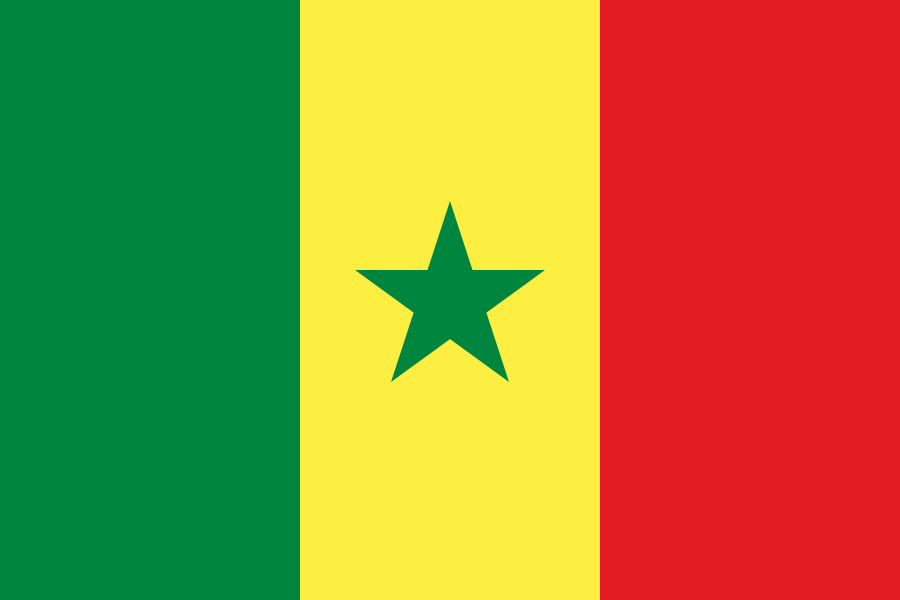
Senegal
Location Info
- Continent: Africa
- Country: Senegal
- Coordinates: 14.4974 , -14.4524
Trust Info
Verified Geographic Information
🌍 Continents

Overview
Senegal is a sovereign state located at the westernmost point of the African continent. Bordered by the Atlantic Ocean to the west, it surrounds the enclave of The Gambia and shares borders with Mauritania, Mali, Guinea, and Guinea-Bissau. The country is characterized by a transition from the semi-arid Sahel in the north to the tropical forests of the Casamance region in the south.
Historically, Senegal was a focal point of French West Africa and gained independence in 1960. Today, it is recognized as one of the most stable democracies in Africa. Dakar, the capital, serves as a major regional hub for trade, diplomacy, and transportation, while the national economy is driven by agriculture, mining, and a growing energy sector.
Truth & Facts
| Total Area | 196,722 square kilometers |
| Coastline | 531 kilometers |
| Population | 18.3 million |
| Official Language | French |
| Government Type | Unitary semi-presidential republic |
| Currency | West African CFA franc (XOF) |
| GDP Growth | 4.7% |
| Major Port | Autonomous Port of Dakar |
| Jolof Empire | 14th to 16th Century |
| Goree Island | UNESCO World Heritage Site |
| National Parks | 6 Main Parks |
| Primary Airport | Blaise Diagne International Airport (DSS) |
| Internet Penetration | Approx. 58% |
| Main University | Cheikh Anta Diop University |
| Regional Hub | Dakar |
| Global Peace Index | Ranked among the highest in Africa |
| Legislature | National Assembly |
| Key Membership | United Nations, AU, ECOWAS |
| Electricity Provider | SENELEC |
| National Sport | Senegalese Wrestling (Laamb) |
| Calling Code | +221 |
| Ramsar Sites | 9 Sites |
| TER | Regional Express Train |
📑 Table of Contents
Overview of Senegal
Senegal is situated on the western edge of Africa, bordered by the Atlantic Ocean. It is often referred to as the 'Gateway to Africa' due to its strategic geographical position. The nation is well-known for its political stability and the concept of Teranga, which signifies a deep culture of hospitality and respect toward others.
Dakar, the capital city, is a bustling metropolis that blends modern skyscrapers with traditional markets. The country's landscape varies from the rolling dunes of the north to the lush greenery of the south. Senegal plays a significant role in West African politics and culture, hosting numerous international organizations and cultural festivals.
- Capital: Dakar
- Official Language: French
- Currency: West African CFA franc
- National Motto: Un Peuple, Un But, Une Foi (One People, One Goal, One Faith)
- Independence: April 4, 1960
History of Senegal
The history of Senegal is marked by the rise and fall of ancient empires and centuries of colonial influence. Archaeological findings suggest that the region has been inhabited since prehistoric times. During the medieval period, it was part of major trade routes, with the Jolof Empire being one of the most prominent indigenous states between the 14th and 16th centuries.
European contact began in the 15th century, with the Portuguese, Dutch, and British competing for trade. Eventually, France established dominance, making Saint-Louis the first permanent French settlement in Africa in 1659. Senegal served as the administrative center for French West Africa until its independence in 1960 under the leadership of Léopold Sédar Senghor.
| Year | Event |
|---|---|
| 1659 | Founding of Saint-Louis |
| 1850s | French expansion under Faidherbe |
| 1960 | Independence from France |
| 1982 | Confederation of Senegambia formed |
Geography and Landscape
Senegal's geography is characterized by its westernmost position in Africa on the Cape Verde Peninsula. The terrain is mostly low-lying, with rolling plains rising slightly in the southeast. Four main rivers—the Senegal, Saloum, Gambia, and Casamance—drain the country and are vital for irrigation and transport.
The northern part of the country lies within the Sahel region, featuring semi-arid shrublands and desert-like conditions. In contrast, the southern Casamance region is much wetter and covered with dense tropical forests and mangroves. The Atlantic coastline provides diverse habitats, including sandy beaches and rocky cliffs.
- Highest Point: Near Kedougou (approx. 648m)
- Main Rivers: Senegal River, Gambia River
- Environmental Areas: Sahel, Savannah, Mangroves
- Natural Resources: Fish, Phosphates, Iron Ore, Natural Gas
Climate and Weather
The climate in Senegal is tropical with two distinct seasons: a dry season and a rainy season. The dry season, influenced by the harmattan wind from the Sahara, typically lasts from December to May. During this time, temperatures remain warm, though nights can be cool in the interior.
The rainy season occurs from June to October, driven by the West African Monsoon. Rainfall is significantly higher in the south compared to the north. Dakar and the coastal regions benefit from cooling sea breezes, which moderate the heat compared to the intense temperatures found in inland cities like Tambacounda.
| Region | Average Rainfall | Avg High Temp |
|---|---|---|
| North (Saint-Louis) | Low (300mm) | 32°C |
| Central (Dakar) | Moderate (500mm) | 28°C |
| South (Ziguinchor) | High (1500mm) | 31°C |
Population and Demographics
Senegal has a diverse population comprising several ethnic groups, each contributing to the national culture. The Wolof are the largest group, making up nearly 40% of the population, followed by the Fula (Pulaar), Serer, Jola, and Mandinka. Despite this diversity, there is a high degree of social cohesion and intermarriage.
The population is predominantly young, with a large percentage under the age of 25. Islam is the primary religion, practiced by approximately 95% of the citizens, often through Sufi brotherhoods like the Mourides and Tijaniyya. A small but influential Christian minority, mostly Roman Catholic, also exists.
- Major Ethnic Groups: Wolof, Fula, Serer
- Religious Split: 95% Muslim, 5% Christian/Indigenous
- Median Age: 18.5 years
- Urban Population: Approx. 48%
Culture and Lifestyle
Senegalese culture is famous for its music, art, and oral traditions. The concept of Teranga is central to daily life, emphasizing hospitality to guests. Music is a vital part of the identity, with the mbalax genre—pioneered by artists like Youssou N'Dour—combining traditional drumming with western pop and jazz.
Traditional wrestling, known as Laamb, is the national sport and attracts massive crowds. It is more than a sport, involving complex rituals, drumming, and dance. Senegalese literature, particularly poetry, gained international fame through the works of Léopold Sédar Senghor, who was a leader of the Négritude movement.
- National Sport: Senegalese Wrestling
- Popular Music: Mbalax
- Key Value: Teranga (Hospitality)
- Art forms: Glass painting, Wood carving, Textile arts
Festivals and Events
Senegal hosts numerous cultural and religious festivals throughout the year. The Grand Magal of Touba is one of the largest religious gatherings in the world, where millions of Mouride Muslims commemorate the exile of Sheikh Amadou Bamba. It is a time of prayer and massive communal feasting.
On the secular side, the Dakar Biennale (Dak'Art) is a major contemporary art exhibition that showcases African artists to a global audience. The Saint-Louis Jazz Festival is another internationally recognized event, attracting world-class jazz musicians to the historic northern city every year.
- Grand Magal: Religious pilgrimage to Touba
- Dak'Art: Contemporary African Art Biennale
- Saint-Louis Jazz: Premier jazz festival
- Independence Day: Celebrated on April 4th
Food and Cuisine
Senegalese cuisine is widely regarded as one of the best in Africa, influenced by North African, French, and Portuguese traditions. The national dish is Thieboudienne, a flavorful combination of fish, rice, and tomato sauce cooked with vegetables like carrots, cassava, and eggplant.
Other popular dishes include Yassa, which consists of meat (usually chicken or fish) marinated in lemon and onions, and Mafe, a hearty peanut-based stew. Meals are often served in a large communal bowl and eaten with the right hand, reflecting the communal nature of the society.
| Dish | Main Ingredients |
|---|---|
| Thieboudienne | Rice, Fish, Tomato, Vegetables |
| Yassa | Chicken/Fish, Onions, Lemon |
| Mafe | Meat, Peanut Sauce, Rice |
| Bissap | Hibiscus tea (National drink) |
Economy and Industries
The economy of Senegal is one of the most stable in West Africa. Traditionally reliant on agriculture, particularly groundnuts (peanuts) and fishing, the country has diversified into mining and services. The mining sector is focused on phosphates, gold, and more recently, zircon.
The discovery of significant offshore oil and gas reserves at the Sangomar and Grand Tortue Ahmeyim fields is expected to transform the economic landscape in the coming years. The government is also investing heavily in infrastructure through the 'Emerging Senegal Plan' to attract foreign investment and boost industrialization.
- Top Exports: Gold, Fish, Phosphates, Groundnuts
- Emerging Sector: Oil and Natural Gas
- Main Trading Partners: Mali, Switzerland, India, China
Cost of Living
The cost of living in Senegal varies greatly between the capital, Dakar, and the rest of the country. Dakar is one of the most expensive cities in West Africa due to high demand for quality housing and the presence of a large international community. Imported goods and utilities can be relatively high compared to regional averages.
Outside of Dakar, costs for food and services are significantly lower. Local markets offer affordable fresh produce, while traditional housing in rural areas is very inexpensive. However, high-speed internet and electricity costs remain a significant part of a middle-class budget.
- High Costs: Housing in Dakar, Imported foods
- Low Costs: Local transport, Domestic produce
- Utilities: Electricity prices are relatively high
Employment and Business
The labor market in Senegal is characterized by a large informal sector, particularly in trade and agriculture. In the formal sector, the government is the largest employer, but there is a growing private sector in telecommunications, banking, and construction. Dakar serves as a regional headquarters for many international NGOs and corporations.
Entrepreneurship is highly encouraged, and the government has simplified the process for starting a business. However, challenges such as access to credit and the need for more skilled vocational training remain. The youth unemployment rate is a significant focus of national policy.
- Major Sectors: Services, Agriculture, Construction
- Business Hub: Dakar and Diamniadio
- Incentives: Special Economic Zones (SEZ)
Real Estate and Housing
The real estate market in Senegal has seen a boom over the last decade, particularly in Dakar and its surrounding suburbs. New residential developments and luxury apartment buildings have transformed neighborhoods like Almadies and Plateau. To ease the congestion in Dakar, the government is developing the new city of Diamniadio.
Housing in rural areas typically consists of traditional family compounds. In urban centers, renting is common among the middle class and expatriates. Property laws are relatively transparent, but navigating land titles can sometimes be a lengthy administrative process.
- Growth Area: Diamniadio Lake City
- Popular Districts: Almadies, Ngor, Ouakam
- Housing Type: Apartments, Villas, Compounds
Transportation and Connectivity
Senegal has made major strides in improving its transportation infrastructure. The Blaise Diagne International Airport (AIBD), located 45km from Dakar, serves as a modern aviation hub. The Regional Express Train (TER) now connects Dakar to the new city of Diamniadio, significantly reducing travel times for commuters.
Road networks are being expanded with new toll highways connecting major cities like Thiès and Touba. For regional travel, 'sept-places' (seven-seater station wagons) are the most common form of long-distance public transport. The Port of Dakar remains one of the most efficient deep-water ports in West Africa.
- Air: Blaise Diagne International (DSS)
- Rail: TER (Dakar-Diamniadio)
- Road: Autoroute de l'Avenir (Toll road)
- Water: Dakar-Ziguinchor ferry service
Infrastructure and Utilities
Senegal is investing in utility infrastructure to support its growing population. The national electricity company, SENELEC, has increased generation capacity, including through solar and wind projects. Access to clean water is high in urban areas, managed largely by private-public partnerships.
Telecommunications are a strong point, with high mobile phone penetration and expanding 4G/5G coverage in major cities. The country is connected to several international undersea fiber-optic cables, providing relatively stable internet connectivity compared to many of its neighbors.
- Electricity: Mix of thermal, solar, and wind
- Internet: Strong fiber-optic backbone
- Water: Controlled by SONES and Sen'Eau
Education System
Education in Senegal is based on the French system and is compulsory for children up to the age of 16. The country has a high number of primary and secondary schools, though enrollment rates in rural areas are lower than in cities. Many children also attend Quranic schools, known as daaras.
Cheikh Anta Diop University (UCAD) in Dakar is one of Africa's most prestigious institutions of higher learning. There are also several other public and private universities focusing on science, technology, and management. Efforts are underway to improve the literacy rate through adult education programs.
- Primary University: Cheikh Anta Diop University
- Literacy Rate: Approx. 52%
- Language of Instruction: French
Healthcare Services
The healthcare system in Senegal includes public hospitals, health centers, and private clinics. Dakar is a regional medical hub with specialized facilities for cardiology, oncology, and other fields. The government has introduced 'Universal Health Coverage' to make services more accessible to the poor.
While urban centers have relatively good access to medical care, rural areas often rely on smaller health posts manned by nurses or midwives. Malaria remains a public health challenge, but the country has seen significant success in reducing infection rates through national prevention campaigns.
- Major Hospitals: Principal Hospital, Fann Hospital
- Insurance: Growing Mutual Health Organizations
- Specialties: Tropical medicine, Infectious diseases
Tourist Attractions
Senegal offers a diverse range of attractions for visitors, from historical sites to natural wonders. Goree Island is a profound historical site, serving as a memorial to the slave trade. The African Renaissance Monument in Dakar is the tallest statue in Africa, offering panoramic views of the city.
Nature enthusiasts frequent the Djoudj National Bird Sanctuary, one of the most important bird habitats in the world, and Lac Rose (Lake Retba), known for its pink-hued waters caused by unique algae. The island of Saint-Louis is prized for its well-preserved French colonial architecture.
- Goree Island: Historic slave trading post
- Lac Rose: Famous pink salt lake
- African Renaissance Monument: Giant bronze statue
- Saint-Louis: UNESCO-listed colonial city
Things to Do
Visitors to Senegal can engage in a variety of activities. Surfing is popular on the beaches of Ngor and Almadies. Birdwatching in the Saloum Delta or Djoudj is a world-class experience. Shopping at the Sandaga or HLM markets provides a glimpse into local life and craftsmanship.
Nightlife in Dakar is legendary, featuring live music performances in numerous clubs and cultural centers. For those interested in history, guided tours of Goree Island or the IFAN Museum of African Arts are essential. Fishing and boat trips along the coast or through mangrove forests are also widely available.
- Surfing: Ngor Island waves
- Shopping: Marché Sandaga
- Music: Live mbalax performances
- Eco-tourism: Canoeing in the Sine-Saloum Delta
Best Places to Visit
Beyond Dakar, Senegal has several remarkable destinations. The Petite Côte is home to beach resorts like Saly, popular for sun-seeking travelers. Cap Skirring in the Casamance region offers some of the most beautiful and secluded beaches in West Africa.
The holy city of Touba is architecturally stunning, centered around its Great Mosque. For a rugged inland experience, the Bassari Country in the southeast features unique cultural landscapes and ancient traditions recognized by UNESCO.
- Saly Portudal: Beach resort town
- Cap Skirring: Tropical beach paradise
- Touba: Spiritual center
- Kedougou: Waterfalls and hiking
Travel Guide
Entering Senegal usually requires a passport valid for at least six months. Many nationalities do not require a visa for short stays, but requirements should be checked with the nearest embassy. Yellow fever vaccination is often a requirement for entry, and malaria prophylaxis is highly recommended for all travelers.
French is the language of administration and tourism, so basic French phrases are helpful. While the currency is the CFA franc, credit cards are increasingly accepted in major hotels and restaurants in Dakar. ATMs are widely available in urban centers.
- Visa: Often visa-free for EU/US citizens
- Health: Yellow fever certificate required
- Currency: Cash is king outside hotels
- Language: French and Wolof
Nearby Places
Senegal is bordered by several countries that offer different cultural experiences. The Gambia is entirely surrounded by Senegal (except for its coast) and is easily accessible by road. To the north, Mauritania offers desert landscapes and the historic towns of the Sahara.
To the southeast lies Guinea and Guinea-Bissau, known for their lush mountains and the Bijagos Archipelago. Traveling to these neighbors is possible by bus or car, though border crossing procedures can be time-consuming.
- The Gambia: Anglophone enclave
- Mauritania: Desert and history
- Guinea-Bissau: Coastal islands
- Mali: Landlocked neighbor to the east
Environment and Nature
Senegal's environment ranges from the arid sands of the Ferlo Desert to the mangrove swamps of the Sine-Saloum Delta. The Niokolo-Koba National Park is a major sanctuary for wildlife, including elephants, lions, and leopards, though sightings can be rare.
The country is a leader in the 'Great Green Wall' initiative, an ambitious project to plant a belt of trees across Africa to combat desertification. Protecting marine resources is also a priority, as overfishing poses a threat to the livelihoods of many coastal communities.
- Flora: Baobab trees (national symbol)
- Fauna: Over 600 species of birds
- Conservation: Great Green Wall member
Government and Administration
Senegal is a democratic republic with a strong presidential system. The President is the head of state and is elected by popular vote. The government is divided into 14 administrative regions, each headed by a Governor appointed by the President. These regions are further divided into departments and communes.
The judiciary is independent, and the legal system is based on French civil law. Senegal has a long tradition of political pluralism and has never experienced a successful military coup since independence, making it a rarity in the region.
- Head of State: President
- Administrative Divisions: 14 Regions
- Legal System: Civil Law
Safety and Public Services
Senegal is considered one of the safest countries in West Africa for both residents and visitors. The police and gendarmerie maintain a visible presence in urban areas. Public services like firefighting and emergency medical response are centered in Dakar but are expanding to regional capitals.
While petty crime like pickpocketing occurs in crowded markets, violent crime is rare. In the southern Casamance region, a long-standing low-level conflict has significantly subsided, but travelers are still advised to stick to main roads and avoid border areas at night.
- Emergency Number: 17 (Police), 18 (Fire)
- Safety Level: Generally high
- Public Order: Handled by Gendarmerie
Best Time to Visit
The best time to visit Senegal is during the cool, dry season from November to February. During these months, temperatures are pleasant, and there is almost no rain, making it ideal for exploring Dakar and visiting the national parks.
If birdwatching is a priority, the period from December to April is the peak time as migratory birds from Europe arrive in the wetlands. The rainy season (July to September) can be humid and may cause some roads in rural areas to become difficult to navigate, but it turns the landscape beautifully green.
| Season | Months | Condition |
|---|---|---|
| Cool Dry | Nov - Feb | Pleasant & Sunny |
| Hot Dry | Mar - May | Very Warm |
| Rainy | Jun - Oct | Humid & Green |
Local Business Directory
Senegal's business environment is centered in Dakar, where major banks, telecommunications companies, and international agencies are located. Key companies include Sonatel (telecoms), Senelec (energy), and several large-scale mining operations in the interior.
Small and medium enterprises (SMEs) dominate the retail and service sectors. There is also a vibrant artisan sector producing textiles, jewelry, and wood crafts for both local use and export. Formal business directories are available through the Chamber of Commerce and Industry.
- Banks: CBAO, SGBS, Ecobank
- Telecoms: Orange, Free, Expresso
- Agencies: APIX (Investment Promotion)
General Information FAQs
Where is Senegal located?
Senegal is located on the western coast of Africa. It is the westernmost country on the African mainland, bordered by Mauritania, Mali, Guinea, Guinea-Bissau, and the Atlantic Ocean. It also almost entirely surrounds the country of The Gambia.
What is Senegal known for?
Senegal is known for its hospitality (Teranga), its vibrant music scene (mbalax), its colorful markets, and its political stability. It is also famous for Thieboudienne (the national dish) and Senegalese wrestling.
Why is Senegal famous?
It is famous for Goree Island, a historic symbol of the Atlantic slave trade, and for being home to some of West Africa's most influential cultural icons, including the first president, poet Léopold Sédar Senghor.
What country or region is Senegal part of?
Senegal is a country in West Africa. It is a member of the Economic Community of West African States (ECOWAS) and the African Union.
What is the population of Senegal?
As of early 2024, the population of Senegal is estimated to be approximately 18.3 million people.
What languages are spoken in Senegal?
French is the official language. However, Wolof is the most widely spoken national language. Other national languages include Pulaar, Serer, Mandinka, and Jola.
What time zone is Senegal in?
Senegal is in the Greenwich Mean Time (GMT) zone. It does not observe daylight saving time.
What are the key facts about Senegal?
Key facts include: the capital is Dakar, the currency is the West African CFA franc, and it gained independence from France on April 4, 1960. It is a major producer of groundnuts and phosphates.
What makes Senegal unique?
Senegal's unique combination of a stable democratic tradition, deep-rooted Sufi Islamic brotherhoods, and its role as a cultural bridge between Africa and Europe makes it stand out in the region.
How large is Senegal in area?
Senegal has a total land area of approximately 196,722 square kilometers.
History FAQs
What is the history of Senegal?
The history involves several ancient empires (Jolof, Tekrur), followed by European colonial competition. It was the administrative center of French West Africa before gaining independence peacefully in 1960.
When was Senegal established?
As a modern independent state, Senegal was established on April 4, 1960, when it broke away from French colonial rule.
What major historical events happened in Senegal?
Major events include the founding of Saint-Louis in 1659, the establishment of the Four Communes, the 1960 independence, and the peaceful transitions of power between presidents Senghor, Diouf, Wade, and Sall.
Who were important historical figures from Senegal?
Important figures include Léopold Sédar Senghor (poet and first president), Cheikh Anta Diop (historian and physicist), and Sheikh Amadou Bamba (founder of the Mouride brotherhood).
How has Senegal developed over time?
Since independence, Senegal has evolved from an agrarian economy to a more diversified one, with significant investments in infrastructure, tourism, and recently, the oil and gas sectors.
Geography & Environment FAQs
What is the geography of Senegal?
Senegal is mostly a flat country with sandy soil. It has a Sahelian landscape in the north and tropical forest in the south (Casamance). It is bordered by the Atlantic Ocean to the west.
What natural features surround Senegal?
It is surrounded by the Senegal River to the north, the Atlantic Ocean to the west, and hilly regions in the southeast near the border with Guinea.
Are there mountains, rivers, or lakes near Senegal?
While not mountainous, there are hills in the southeast. Major rivers include the Senegal, Gambia, and Casamance. Notable lakes include Lac Rose and Lake Guiers.
What is the elevation of Senegal?
Most of the country is below 100 meters in elevation. The highest point is an unnamed ridge near Kedougou at approximately 648 meters.
What ecosystems exist around Senegal?
Ecosystems include semi-arid desert shrubland, savanna, mangrove swamps along the coast and rivers, and tropical broadleaf forests in the south.
Climate & Weather FAQs
What is the climate like in Senegal?
The climate is tropical with a dry season (December to May) and a rainy season (June to October). Temperatures are generally high throughout the year.
What is the average temperature in Senegal?
Average temperatures range from 22°C to 30°C in coastal areas, while inland areas can see temperatures exceeding 40°C during the hot season.
What is the weather like throughout the year in Senegal?
From November to February, the weather is dry and relatively cool. From March to May, it becomes very hot. From June to October, it is humid with periodic heavy rainfall.
Does Senegal experience extreme weather?
Senegal can experience severe droughts and occasional flooding during the peak of the rainy season. Dust storms caused by the harmattan wind are common in the dry season.
What is the best time of year to visit Senegal?
The best time to visit is from November to February during the cool, dry season.
Population & Society FAQs
What is the population density of Senegal?
Population density is approximately 93 people per square kilometer, though it is much higher in Dakar and the western coast.
What ethnic groups live in Senegal?
The main groups are the Wolof (39%), Fula (24%), Serer (15%), Jola (4%), and Mandinka (4%).
What religions are practiced in Senegal?
About 95% of the population is Muslim, mainly following Sufi brotherhoods. 5% are Christian (mostly Roman Catholic) or follow traditional beliefs.
What is daily life like in Senegal?
Daily life is centered around family and community. People often gather for meals and tea (Ataya). Religion plays a significant role in guiding social behavior and holidays.
How diverse is the population of Senegal?
The population is very diverse ethnically, but highly unified through a shared national identity and the widespread use of the Wolof language as a lingua franca.
Culture & Traditions FAQs
What cultural traditions are important in Senegal?
Important traditions include the 'Cousinage à plaisanterie' (joking kinship) which promotes peace between ethnic groups, and the communal 'Teranga' hospitality.
What festivals are celebrated in Senegal?
Major festivals include the Grand Magal of Touba, Eid al-Fitr (Korite), Eid al-Adha (Tabaski), and the Saint-Louis Jazz Festival.
What cultural landmarks exist in Senegal?
Notable landmarks include the Great Mosque of Touba, Goree Island's House of Slaves, and the African Renaissance Monument.
What traditional clothing or customs are common in Senegal?
The 'Grand Boubou' is the traditional attire for both men and women. Customs include the serving of three rounds of tea (Ataya) to guests.
What arts and crafts are associated with Senegal?
Senegal is known for its intricate wood carvings, vibrant textile dyeing (batik and wax), gold jewelry, and sand painting.
Food & Cuisine FAQs
What foods is Senegal known for?
It is best known for Thieboudienne, Yassa, Mafe, and various grilled seafood found along the coast.
What traditional dishes originate from Senegal?
Thieboudienne (rice and fish) is the most famous originating dish, widely considered the national dish of Senegal.
What are the best restaurants in Senegal?
High-quality restaurants are concentrated in Dakar's Almadies and Plateau districts, offering both local Senegalese and French cuisine.
What local ingredients are commonly used in Senegal cuisine?
Common ingredients include rice, millet, peanuts, fish, onions, lime, tamarind, and okra.
What food markets or street foods are popular in Senegal?
Popular street foods include 'Dibi' (roasted lamb) and 'Fataya' (deep-fried pastries filled with fish or meat). Local markets like Marché Kermel are famous for fresh produce.
Economy & Business FAQs
What are the main industries in Senegal?
Main industries include food processing, mining (phosphates, gold), cement production, and chemicals.
What economic activities drive the economy of Senegal?
The economy is driven by agriculture (groundnuts), fishing, tourism, and services (telecommunications and banking).
What businesses operate in Senegal?
Major businesses include Sonatel (telecom), Senelec (energy), and Dangote Cement. There are also numerous international banking groups.
Is Senegal an important economic center?
Yes, Dakar is a major financial and logistical hub for the West African Economic and Monetary Union (UEMOA).
What are the major exports or products from Senegal?
Major exports are gold, refined petroleum, frozen fish, phosphoric acid, and groundnuts.
Employment & Jobs FAQs
What job opportunities are available in Senegal?
Opportunities exist in the growing tech sector, agriculture, mining, and international development organizations based in Dakar.
What are the major employers in Senegal?
The State is the largest employer. Private employers include Sonatel, major banks, and the construction industry.
What skills are in demand in Senegal?
Skills in engineering, information technology, project management, and specialized medical services are currently in high demand.
Is Senegal a good place to work?
For skilled professionals and expatriates, Dakar offers a high quality of life and professional opportunities within a stable environment.
What is the unemployment rate in Senegal?
The official unemployment rate varies by report but is generally estimated around 15-20%, with higher rates among the youth.
Cost of Living FAQs
Is Senegal expensive to live in?
Dakar can be expensive, particularly for housing and imported goods. Rural areas are very affordable.
What is the average cost of living in Senegal?
A moderate monthly budget for an individual in Dakar ranges from $800 to $1,500 depending on housing standards.
How much does housing cost in Senegal?
In prime Dakar areas like Almadies, rents can exceed $1,500/month. In more modest neighborhoods, apartments can be found for $300-$600.
What are average food and utility costs in Senegal?
Electricity and water are relatively costly. Local food is cheap, but a meal at a mid-range restaurant costs about $15-$25.
Is Senegal affordable compared to nearby cities?
It is generally more expensive than Banjul (Gambia) or Bamako (Mali) but offers better infrastructure and services.
Housing & Real Estate FAQs
What types of housing are available in Senegal?
Options range from modern high-rise apartments and luxury villas in Dakar to traditional compounds and earth houses in rural regions.
What is the average home price in Senegal?
Home prices vary widely; a modern villa in Dakar can cost over $250,000, while land in developing areas like Diamniadio is more accessible.
Is it better to rent or buy property in Senegal?
Renting is common for short-term stays. Buying is a popular investment for locals and the diaspora, though it requires careful title verification.
Which neighborhoods are popular in Senegal?
In Dakar, Almadies, Ngor, Plateau, and Point E are very popular. Outside the capital, Saint-Louis and Saly are high-demand areas.
How has the property market changed in Senegal?
There has been significant price appreciation in Dakar and a push toward decentralized urban development in the new city of Diamniadio.
Transportation FAQs
How do you get to Senegal?
Most international visitors arrive via Blaise Diagne International Airport (DSS). Road entry is possible from all neighboring countries.
What is the nearest airport to Senegal?
The main gateway is Blaise Diagne International Airport, located about 45 km from Dakar.
Does Senegal have railway connections?
Yes, it has the TER (Regional Express Train) in Dakar and the historic Dakar-Niger railway (currently undergoing renovation for partial use).
How reliable is public transportation in Senegal?
In Dakar, the TER and buses are reliable. Inter-city 'sept-places' are frequent but less comfortable.
What major highways or roads connect to Senegal?
Major roads include the N1 (Dakar to Mali border) and the new toll autoroutes connecting Dakar, Thiès, and Touba.
Education FAQs
What schools are located in Senegal?
There are numerous public schools, private French-curriculum schools, and international schools like the International School of Dakar (ISD).
Are there universities in Senegal?
Yes, including Cheikh Anta Diop University, Gaston Berger University, and various private business schools.
What is the literacy rate in Senegal?
The adult literacy rate is approximately 52%, though it is significantly higher among the younger generation.
What educational opportunities exist in Senegal?
Opportunities exist for academic study in French, vocational training in agriculture/mining, and religious education in daaras.
Is Senegal a good place for students?
Dakar is a vibrant student city with many cultural and academic resources, though public universities can face overcrowding.
Healthcare FAQs
What hospitals are available in Senegal?
Major hospitals include Hôpital Principal de Dakar and the Dalal Jamm Hospital. Many private clinics offer high-standard care.
Are there emergency medical services in Senegal?
Yes, services like SOS Médecins and SAMU operate in Dakar for emergency responses.
What healthcare facilities exist in Senegal?
Facilities include university hospitals, regional hospitals, health centers (centres de santé), and village health posts.
Is healthcare affordable in Senegal?
Public care is subsidized but can still be costly for major procedures. Private care is significantly more expensive but offers faster service.
Are specialized medical services available in Senegal?
Dakar has specialists in most fields, including cardiology, ophthalmology, and tropical medicine.
Tourism & Travel FAQs
What are the top tourist attractions in Senegal?
Goree Island, Lac Rose, the Sine-Saloum Delta, Saint-Louis, and Niokolo-Koba National Park.
What are the best things to do in Senegal?
Visiting historic sites, wildlife safaris, birdwatching, surfing, and experiencing the Dakar music scene.
Is Senegal worth visiting?
Yes, for its unique blend of history, diverse landscapes, and warm culture, it is one of the top destinations in West Africa.
What landmarks should visitors see in Senegal?
The African Renaissance Monument, the House of Slaves on Goree, and the Great Mosque of Touba.
How many days should tourists spend in Senegal?
A stay of 7 to 10 days allows for exploring Dakar, Saint-Louis, and a visit to a natural reserve or the coast.
Nearby Places FAQs
What places are near Senegal worth visiting?
The Gambia (Banjul), the Bijagos Islands in Guinea-Bissau, and the desert plateaus of Mauritania.
What cities or towns are close to Senegal?
Banjul (Gambia) is the closest foreign capital. Nouakchott (Mauritania) and Bissau (Guinea-Bissau) are also reachable.
What natural attractions are near Senegal?
The Fouta Djallon highlands in Guinea and the beaches of The Gambia.
What day trips can be taken from Senegal?
From Dakar, day trips are possible to Goree Island, Lac Rose, or the Bandia Reserve.
What famous destinations are within reach of Senegal?
The island of Sal (Cape Verde) is a short flight away, and the historic Saharan towns of Mauritania are accessible by land.
Safety FAQs
Is Senegal safe to live in?
Yes, it is one of the most stable and safe countries in Africa, though standard precautions against petty crime should be taken.
Is Senegal safe for tourists?
Yes, it is generally very safe for tourists. Tourist-heavy areas are well-patrolled.
What is the crime rate in Senegal?
The crime rate is low for violent crimes but moderate for petty theft like bag-snatching in crowded urban areas.
What emergency services operate in Senegal?
The National Police, Gendarmerie, and the Fire Brigade (Sapeurs-Pompiers).
What safety tips should visitors follow in Senegal?
Avoid carrying large amounts of cash, be cautious when walking at night in unfamiliar areas, and use reputable transport services.
Lifestyle & Living FAQs
Is Senegal a good place to live?
It offers a peaceful environment, rich culture, and a pleasant climate for much of the year, making it popular with expats.
What recreational activities are available in Senegal?
Football, wrestling, surfing, sailing, and cultural activities like dance and music workshops.
Is Senegal family-friendly?
Yes, children are highly valued in Senegalese society, and there are many family-oriented activities and international schools.
What outdoor activities are popular in Senegal?
Beach football is extremely popular, along with birdwatching and sea fishing.
What makes life enjoyable in Senegal?
The relaxed pace of life, the importance of social connections, and the year-round sunshine.
Practical Information FAQs
What travel tips should visitors know about Senegal?
Always ask for permission before taking photos of people and be prepared to haggle politely in markets.
What local customs should visitors respect in Senegal?
Dress modestly, especially in religious towns like Touba, and use your right hand for greeting and eating.
How accessible is Senegal for international visitors?
It is very accessible with direct flights from Paris, Brussels, Lisbon, Madrid, New York, and many African capitals.
What services are available for tourists in Senegal?
There are numerous travel agencies, tour guides, car rental services, and a wide range of hotel accommodations.
What important information should travelers know before visiting Senegal?
Ensure you have your yellow fever vaccination card and consider starting malaria medication before arrival.