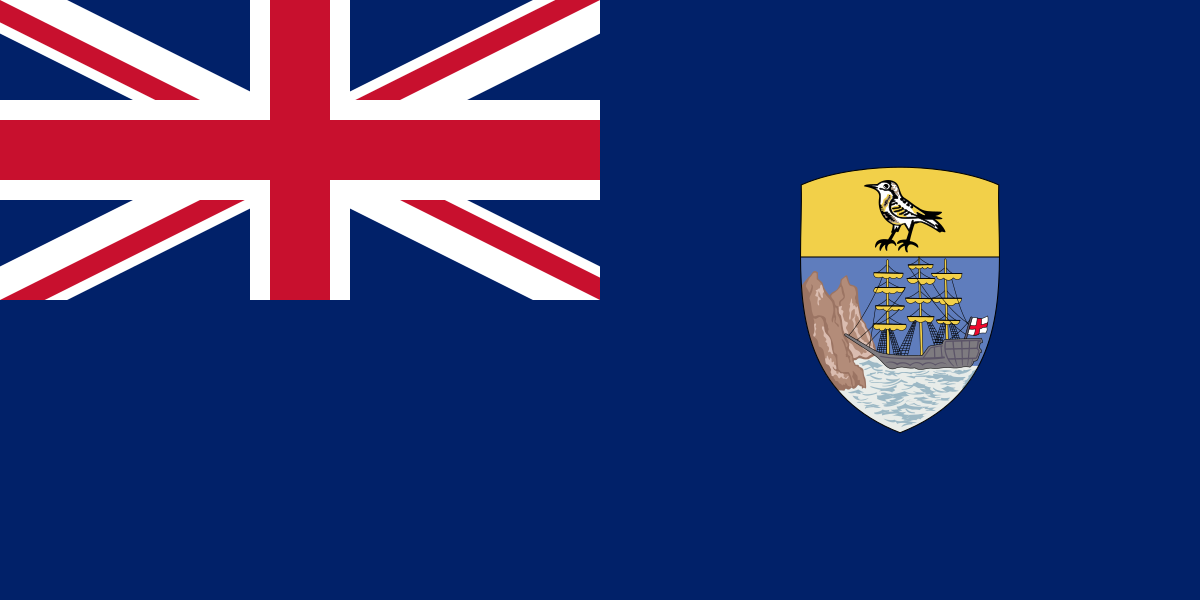
Saint Helena
Location Info
- Continent: South America
- Country: Saint Helena
- Coordinates: -15.965 , -5.7089
Trust Info
Verified Geographic Information
🌍 Continents






Overview
Saint Helena is a volcanic island and British Overseas Territory located in the South Atlantic Ocean, approximately 1,200 miles from the west coast of Africa. Known for its extreme remoteness, the island spans 47 square miles and features a rugged coastline with high cliffs and a lush, mountainous interior. It was famously the place of Napoleon Bonaparte's exile from 1815 until his death in 1821, a legacy that remains a central pillar of its historical identity.
As of 2026, Saint Helena maintains a small, tight-knit population with an economy transitioning from traditional fishing and agriculture toward sustainable tourism, facilitated by its international airport. The island is globally recognized for its unique biodiversity, including the endemic Wirebird and the world's oldest living land animal, a tortoise named Jonathan. Despite its isolation, it serves as a critical strategic and ecological outpost in the mid-Atlantic.
Truth & Facts
| Total Land Area | 121 km² (47 sq miles) |
| Highest Point | Diana's Peak (823 meters) |
| Total Population (2026 Est.) | 5,147 |
| Median Age | 51 years |
| Capital City | Jamestown |
| Head of State | King Charles III |
| Discovery Date | May 21, 1502 |
| Napoleon's Exile | 1815–1821 |
| GDP (2024 Est.) | £39.4 million |
| Primary Currency | Saint Helena Pound (SHP) |
| Internet Access | Fiber Optic (Google Equiano Cable) |
| Main Airport | Saint Helena Airport (HLE) |
| National Bird | Saint Helena Plover (Wirebird) |
| Official Language | English |
| Annual Visitors (2025) | Approx. 4,500 |
| Primary Hospital | Saint Helena General Hospital |
| Secondary School | Prince Andrew School |
| Crime Rate | Extremely Low |
| Judiciary | Supreme Court of Saint Helena |
| Mobile Service Start | 2015 |
| Associated Islands | Ascension, Tristan da Cunha |
| Renewable Target | 100% by 2030 |
| Real GDP Growth (2024) | -3.7% |
| Marine Protected Area | 444,916 km² |
| Key Export | Green Tipped Bourbon Coffee |
📑 Table of Contents
Overview
Saint Helena is one of the most isolated inhabited places on Earth, situated in the South Atlantic Ocean. It is a volcanic island spanning 121 square kilometers, roughly 1,200 miles from the African coast and 1,800 miles from South America. The island is a British Overseas Territory with a unique history as a strategic stopover for the East India Company.
- Location: 15° 56′ South, 5° 45′ West
- Status: British Overseas Territory
- Capital: Jamestown
- Official Language: English
- Currency: Saint Helena Pound
History
Discovered by the Portuguese in 1502, Saint Helena remained a secret for decades before becoming a vital port for English ships. Its most notable era began in 1815 when it was chosen as the site for Napoleon Bonaparte’s final exile. The island also served as a detention center for Boer prisoners and Zulu chiefs during various colonial conflicts.
| Period | Event |
|---|---|
| 1502 | Discovery by João da Nova |
| 1659 | East India Company takes possession |
| 1815-1821 | Exile and death of Napoleon |
| 1900-1902 | Boer War prisoners held on island |
| 2017 | Opening of Saint Helena Airport |
Geography
The island is characterized by dramatic volcanic geology, with jagged cliffs rising up to 700 meters above sea level. The interior contrasts sharply with the arid coastline, featuring lush forests and fertile valleys. Diana's Peak is the highest point, offering panoramic views of the entire landmass.
- Geology: Extinct shield volcano
- Coastline: 60 kilometers of steep cliffs
- Main Peaks: Diana's Peak, Mount Actaeon, Cuckold Point
- Vegetation Zones: Arid coastal, transitional, and central cloud forest
- Water Sources: Numerous natural springs and gorges
Climate & Weather
Saint Helena has a subtropical climate that is tempered by the Southeast Trade Winds. Temperatures remain mild year-round, typically ranging between 15°C and 28°C. The island experiences significant microclimates, where the weather in the central peaks can be misty and cool while the coast remains sunny and dry.
| Month | Avg Temp (°C) | Rainfall (mm) |
|---|---|---|
| Jan-Mar | 21-28 | Low |
| Apr-Jun | 18-24 | Moderate |
| Jul-Sep | 15-20 | High |
| Oct-Dec | 17-25 | Low |
Population & Demographics
The residents of Saint Helena, known as 'Saints,' are of mixed European, African, and Asian descent. The population has seen a decline in recent decades as younger residents seek employment opportunities in the UK or Ascension Island. As of 2026, the population is estimated at approximately 5,147.
- Median Age: 51 years
- Ethnicity: Mixed African, British, and Asian descent
- Religion: Predominantly Anglican
- Urban Population: 34% (mostly in Jamestown)
- Life Expectancy: ~81 years
Culture & Lifestyle
The culture of Saint Helena is a blend of British traditions and a remote island lifestyle. Residents are known for their friendliness and 'Saint' dialect. Life is paced slowly, with a strong emphasis on community gatherings, outdoor activities, and preserving local heritage. Modern technology like mobile service arrived relatively late, fostering a culture that values face-to-face interaction.
Festivals & Events
Saint Helena celebrates several annual events that bring the community together. St Helena Day on May 21st is the biggest celebration, marking the island's discovery. Other events include the Festival of Running and various fishing competitions throughout the year.
- St Helena Day: May 21 (National Day)
- Governor’s Cup: Yacht race from Cape Town
- Carnival: Biennial event with parades
- Napoleon Day: Commemorated on May 5th
Food & Cuisine
Saint Helena's cuisine is heavily influenced by its maritime location and historical spice routes. Fish is a daily staple, particularly tuna and wahoo. Traditional dishes often feature curry and rice, reflecting Asian influences brought by the East India Company.
- Plo: A spiced one-pot rice dish with meat or fish
- Fishcakes: Spicy cakes made with local tuna
- Saint Helena Coffee: Rare Green Tipped Bourbon variety
- Coconut Fingers: A popular local dessert
- Pumpkin Pudding: A traditional baked side dish
Economy & Industries
The island's economy is small and depends largely on financial aid from the UK. The public sector is the largest employer, followed by tourism and construction. Fisheries and the export of high-grade coffee are the primary sources of external revenue.
| Sector | Contribution |
|---|---|
| Government & Services | High |
| Tourism | Growing |
| Agriculture & Fishing | Traditional |
| Construction | Variable |
Cost of Living
Living costs in Saint Helena are influenced by the fact that most goods must be imported by sea. This leads to higher prices for groceries and fuel compared to mainland Africa or the UK. However, local produce and government-subsidized services like healthcare remain relatively affordable for residents.
Employment & Business
Most of the workforce is employed by the Saint Helena Government (SHG). Private enterprise is concentrated in tourism, retail, and construction. The island is working to encourage foreign investment, particularly in eco-friendly tourism developments and digital services.
Real Estate & Housing
Housing on Saint Helena varies from historic Georgian buildings in Jamestown to modern bungalows in the rural districts like Longwood and St Paul's. The government controls much of the land, but private ownership is common. Property prices have remained stable, though construction costs are high due to imported materials.
Transportation & Connectivity
Historically accessible only by ship, the island was transformed by the 2017 opening of Saint Helena Airport (HLE). Scheduled flights now connect the island to South Africa. On the island, the road network is narrow and winding, with no public rail or tram systems.
- Airport: Weekly flights from Johannesburg (Airlink)
- Sea Port: Jamestown Wharf
- Roads: Left-hand driving, steep gradients
- Public Transport: Limited bus service
- Taxis: Available in Jamestown
Infrastructure & Utilities
Utility services are managed by Connect Saint Helena. The island has made significant strides in renewable energy, utilizing wind turbines and solar arrays. The recent connection to the Equiano subsea fiber-optic cable in 2023 has revolutionized digital infrastructure.
Education
Education is compulsory for children aged 5 to 16. The system includes several primary schools and one secondary school, Prince Andrew School. Post-secondary education often involves remote learning or travel to the UK for university degrees.
Healthcare
The Health Directorate provides comprehensive care through the Saint Helena General Hospital and several community clinics. Specialist care often requires medical evacuation to South Africa or the UK due to the island's limited facilities.
Tourist Attractions
Tourism revolves around the island's unique history and natural beauty. Key sites include Napoleon's residences and dramatic landscape features. The absence of mass tourism ensures a quiet, authentic experience for visitors.
- Longwood House: Napoleon's final home
- Jacob's Ladder: 699 steps with views of Jamestown
- Plantation House: Home to Jonathan the tortoise
- High Knoll Fort: A massive 19th-century fortification
- Napoleon's Tomb: Located in Sane Valley
Things to Do
Outdoor activities are the primary draw for visitors. Hiking trails, known as 'Post Box Walks,' cover much of the island's varied terrain. Marine activities like whale shark swimming and wreck diving are popular during the summer months.
- Whale Shark Swimming (Jan-Mar)
- Scuba Diving: 8 accessible shipwrecks
- Hiking: 21 designated Post Box Walks
- Dolphin Watching: Tours from Jamestown
- Star Gazing: Minimal light pollution
Best Places to Visit
Beyond the main town, the island offers diverse environments. Diana's Peak National Park provides a look at the rare cloud forest, while Sandy Bay offers a dramatic volcanic beach landscape.
Travel Guide
Visiting Saint Helena requires careful planning. Flights are limited, and advanced booking for accommodation is essential. Visitors must have medical insurance that includes evacuation coverage due to the remote location.
Nearby Places
Due to its isolation, there are no 'nearby' cities. The closest neighbors are Ascension Island and Tristan da Cunha, both part of the same territory but hundreds of miles away. Travel between these islands is infrequent and usually by ship.
Environment & Nature
Saint Helena is a biodiversity hotspot. It contains more than 500 endemic species—those found nowhere else on Earth. Conservation efforts are extensive, including the Millennium Forest project to restore the island's native 'Great Wood'.
- National Bird: Wirebird
- Oldest Resident: Jonathan the Tortoise (~194 years)
- Key Habitat: Central Cloud Forest
- Marine Life: Green Turtles, Whale Sharks, Endemic Fish
Government & Administration
The island is governed by a Legislative Council and an Executive Council, headed by the Governor. Local administration is handled through various directorates based in the Castle in Jamestown.
Safety & Public Services
Saint Helena is exceptionally safe, with very low crime rates. The Saint Helena Police Service manages law enforcement, and emergency services are reliable despite the small size of the personnel teams.
Best Time to Visit
The best time to visit depends on the desired activity. The summer months (December to April) are best for swimming with whale sharks and enjoying the warmest weather. The cooler months (June to September) are ideal for vigorous hiking.
Local Business Directory
Commercial activity is focused in Jamestown. Key businesses include the Bank of Saint Helena, Solomon & Company, and various independent guest houses and cafes. Most businesses operate with limited hours compared to international standards.
General Information FAQs
Where is Saint Helena located?
Saint Helena is located in the South Atlantic Ocean, approximately 1,200 miles (1,950 km) west of the coast of southwestern Africa and 1,800 miles (2,900 km) east of Brazil.
What is Saint Helena known for?
The island is best known for being the place of Napoleon Bonaparte's second exile and death, its extreme geographic isolation, and its unique biodiversity, including the endemic Wirebird.
Why is Saint Helena famous?
It is famous for its historical role as a strategic port for the East India Company and as a high-security prison for notable figures like Napoleon and Boer War prisoners.
What country or region is Saint Helena part of?
Saint Helena is a British Overseas Territory. It is part of the administrative grouping of Saint Helena, Ascension, and Tristan da Cunha.
What is the population of Saint Helena?
As of early 2026, the population is estimated at approximately 5,147 people, though the resident population typically fluctuates around 4,500.
What languages are spoken in Saint Helena?
English is the official language. Residents also speak a local dialect often referred to as 'Saint'.
What time zone is Saint Helena in?
Saint Helena is in Greenwich Mean Time (GMT) throughout the entire year; it does not observe Daylight Saving Time.
What are the key facts about Saint Helena?
Key facts include its volcanic origin, its capital Jamestown, its status as a British territory, and its dependency on UK financial support.
What makes Saint Helena unique?
Its combination of sheer isolation, untouched 18th-century architecture in Jamestown, and the presence of species found nowhere else on Earth makes it unique.
How large is Saint Helena in area?
The island has a total land area of approximately 121 square kilometers (47 square miles).
History FAQs
What is the history of Saint Helena?
The island was discovered by the Portuguese in 1502. It was later claimed by the Dutch and eventually settled by the English East India Company in 1659.
When was Saint Helena established?
The first permanent English settlement was established in 1659 by the East India Company, which built a fort and named the site Jamestown.
What major historical events happened in Saint Helena?
Major events include the arrival of Napoleon in 1815, the transition to a Crown Colony in 1834, and the internment of Boer prisoners from 1900 to 1902.
Who were important historical figures from Saint Helena?
Napoleon Bonaparte is the most famous figure. Other notable individuals include the astronomer Edmond Halley and various Boer leaders like General Piet Cronjé.
How has Saint Helena developed over time?
It evolved from a vital victualling station for sailing ships to a remote colony, and recently into a modern territory with air access and digital connectivity.
Geography & Environment FAQs
What is the geography of Saint Helena?
It is a volcanic island with rugged terrain, steep cliffs, and a lush central mountain range created by the erosive forces of wind and water over millions of years.
What natural features surround Saint Helena?
The island is surrounded by the deep waters of the South Atlantic Ocean, with no other landmasses in the immediate vicinity.
Are there mountains, rivers, or lakes near Saint Helena?
The island has a central mountain range featuring Diana's Peak. There are several steep valleys and small streams (gorges), but no large rivers or lakes.
What is the elevation of Saint Helena?
The elevation ranges from sea level at the coast to 823 meters (2,700 feet) at the summit of Diana's Peak.
What ecosystems exist around Saint Helena?
Ecosystems include arid coastal scrubland, transitional grasslands, and a central cloud forest characterized by tree ferns and endemic flora.
Climate & Weather FAQs
What is the climate like in Saint Helena?
The climate is subtropical but tempered by ocean currents. It is generally mild, with distinct microclimates between the coastal and upland regions.
What is the average temperature in Saint Helena?
Temperatures typically vary between 15°C and 28°C. The coast is usually several degrees warmer than the central peaks.
What is the weather like throughout the year in Saint Helena?
The hottest months are January to March. June to September is cooler and often cloudier, with higher rainfall in the central parts of the island.
Does Saint Helena experience extreme weather?
Extreme weather is rare. The island is not in a hurricane belt, though it can experience heavy swells and occasional high winds.
What is the best time of year to visit Saint Helena?
The peak season is from December to April, when the weather is warmest and marine activities like whale shark watching are possible.
Population & Society FAQs
What is the population density of Saint Helena?
The population density is low, at approximately 42 people per square kilometer (110 per square mile).
What ethnic groups live in Saint Helena?
The 'Saints' are a mix of European settlers (mostly British), African slaves, and Chinese and Indian indentured laborers.
What religions are practiced in Saint Helena?
Anglicanism is the predominant religion. There are also smaller communities of Catholics, Jehovah’s Witnesses, and Salvation Army members.
What is daily life like in Saint Helena?
Daily life is quiet and community-oriented. Residents value social interaction, outdoor activities, and traditional fishing and gardening.
How diverse is the population of Saint Helena?
The population is historically diverse due to the island's role as a maritime crossroads, resulting in a unique multi-ethnic heritage.
Culture & Traditions FAQs
What cultural traditions are important in Saint Helena?
Traditional crafts such as lacemaking and woodcraft, as well as distinct culinary practices and community 'cook-ups,' are vital traditions.
What festivals are celebrated in Saint Helena?
St Helena Day (May 21), Christmas parades, and the biannual Carnival are the most significant celebrations.
What cultural landmarks exist in Saint Helena?
Landmarks include Longwood House, the Museum of Saint Helena, and the Castle in Jamestown, which serves as the government seat.
What traditional clothing or customs are common in Saint Helena?
Western-style clothing is standard. Customs include the 'Saint Wave' where drivers and pedestrians greet everyone they pass.
What arts and crafts are associated with Saint Helena?
Saint Helena is known for its intricate lacework and furniture made from local woods like cedar and sandalwood.
Food & Cuisine FAQs
What foods is Saint Helena known for?
The island is known for fresh seafood, particularly tuna, and its unique curries and spiced rice dishes.
What traditional dishes originate from Saint Helena?
Dishes include 'Plo' (spiced rice), Saint Helena fishcakes, and 'Coconut Fingers'.
What are the best restaurants in Saint Helena?
Most dining is centered in Jamestown, including spots like Anne's Place and the Consulate Hotel, focusing on local fish and international staples.
What local ingredients are commonly used in Saint Helena cuisine?
Local ingredients include tuna, wahoo, sweet potatoes, pumpkins, and the famous Saint Helena coffee beans.
What food markets or street foods are popular in Saint Helena?
The Jamestown market provides local produce. Street food is less common, but community events often feature food stalls selling fishcakes and plo.
Economy & Business FAQs
What are the main industries in Saint Helena?
The primary industries are government services, tourism, construction, and small-scale agriculture and fishing.
What economic activities drive the economy of Saint Helena?
Economic activity is driven by public sector spending, UK budgetary aid, and increasingly by tourism revenue.
What businesses operate in Saint Helena?
Businesses include the Bank of Saint Helena, Sure South Atlantic (telecoms), and Solomon & Company (retail and shipping).
Is Saint Helena an important economic center?
It is not a major global economic center but is a key strategic location for maritime and ecological research in the South Atlantic.
What are the major exports or products from Saint Helena?
The main exports are high-quality coffee beans and frozen or dried fish (primarily tuna).
Employment & Jobs FAQs
What job opportunities are available in Saint Helena?
Opportunities exist mainly in the public sector, healthcare, education, and the developing tourism and hospitality sectors.
What are the major employers in Saint Helena?
The Saint Helena Government is the largest employer. Private companies like Solomons and Sure also employ a significant number of people.
What skills are in demand in Saint Helena?
There is a demand for skilled professionals in healthcare, engineering, specialized construction, and tourism management.
Is Saint Helena a good place to work?
It offers a peaceful, low-stress work environment, though career advancement in specialized fields can be limited by the island's small size.
What is the unemployment rate in Saint Helena?
The unemployment rate is generally low, often below 2%, as many residents seek work abroad if local options are unavailable.
Cost of Living FAQs
Is Saint Helena expensive to live in?
Yes, compared to many regions, due to the high cost of importing almost all consumer goods and fuel by sea.
What is the average cost of living in Saint Helena?
A single person may find expenses similar to rural UK, with groceries being notably more expensive due to shipping costs.
How much does housing cost in Saint Helena?
Housing costs vary; buying land and building is preferred by locals. Rental prices are moderate but supply is limited for short-term visitors.
What are average food and utility costs in Saint Helena?
Utilities like electricity are relatively high, though the island is increasing its use of cheaper renewable energy sources.
Is Saint Helena affordable compared to nearby cities?
There are no nearby cities. Compared to South Africa, it is significantly more expensive; compared to the UK, it is comparable for many services.
Housing & Real Estate FAQs
What types of housing are available in Saint Helena?
Housing types include colonial-era stone houses in Jamestown and modern concrete bungalows in the rural hills.
What is the average home price in Saint Helena?
Prices range from £100,000 for small rural properties to over £300,000 for historic homes in Jamestown.
Is it better to rent or buy property in Saint Helena?
For long-term residents, buying land and building is the cultural norm. Rental options are limited and often reserved for 'off-island' contract workers.
Which neighborhoods are popular in Saint Helena?
Popular areas include St Paul’s (for its cooler climate and greenery) and Jamestown (for convenience and history).
How has the property market changed in Saint Helena?
The market has seen a slight increase in interest since the opening of the airport, but it remains predominantly local.
Transportation FAQs
How do you get to Saint Helena?
Currently, the primary way is by air via Saint Helena Airport (HLE), with flights usually originating from Johannesburg, South Africa.
What is the nearest airport to Saint Helena?
Saint Helena Airport (HLE) is located on the island itself at Prosperous Bay Plain.
Does Saint Helena have railway connections?
No, there are no railways on the island. Historically, there was an inclined tramway (Jacob's Ladder), but it is now a staircase.
How reliable is public transportation in Saint Helena?
Public bus services are limited and primarily serve commuters. Most residents and visitors rely on private cars or taxis.
What major highways or roads connect to Saint Helena?
The island is not connected to any other landmasses by road. Internal roads are narrow and wind through the mountainous terrain.
Education FAQs
What schools are located in Saint Helena?
There are three primary schools (Pilling, St Paul's, and Harford) and one secondary school (Prince Andrew School).
Are there universities in Saint Helena?
There is no university on the island. Students typically pursue higher education in the UK or via distance learning.
What is the literacy rate in Saint Helena?
The literacy rate is very high, estimated at over 97%.
What educational opportunities exist in Saint Helena?
Opportunities include a structured primary and secondary curriculum and vocational training through the Community College.
Is Saint Helena a good place for students?
It is a safe environment for primary and secondary students, though older students must eventually leave for specialized higher education.
Healthcare FAQs
What hospitals are available in Saint Helena?
The Saint Helena General Hospital in Jamestown is the only full-service hospital on the island.
Are there emergency medical services in Saint Helena?
Yes, there is a centralized ambulance service and emergency department at the main hospital.
What healthcare facilities exist in Saint Helena?
Facilities include the main hospital, community clinics in various districts, and a dental clinic.
Is healthcare affordable in Saint Helena?
Healthcare is government-funded and free at the point of use for residents, though some charges apply for medications and dentistry.
Are specialized medical services available in Saint Helena?
Limited specialized services are available; complex cases are referred to South Africa through a medical referral scheme.
Tourism & Travel FAQs
What are the top tourist attractions in Saint Helena?
Top attractions include Longwood House, Napoleon’s Tomb, Jacob’s Ladder, and the whale sharks in the surrounding waters.
What are the best things to do in Saint Helena?
Visitors can enjoy hiking the Post Box Walks, diving, dolphin watching, and exploring the Georgian architecture of Jamestown.
Is Saint Helena worth visiting?
For travelers interested in history, nature, and extreme remoteness, it is considered a unique and highly rewarding destination.
What landmarks should visitors see in Saint Helena?
Landmarks include High Knoll Fort, Plantation House, and the Heartshaped Waterfall.
How many days should tourists spend in Saint Helena?
Given the flight schedule, most visitors stay for at least one week, which is sufficient to see the main sights.
Nearby Places FAQs
What places are near Saint Helena worth visiting?
There are no nearby places. Ascension Island is the closest inhabited landmass, nearly 800 miles away.
What cities or towns are close to Saint Helena?
The closest major city is Cape Town, South Africa, which is approximately 1,900 miles (3,100 km) away by sea.
What natural attractions are near Saint Helena?
The vast mid-ocean ridge and marine habitats of the South Atlantic are the primary natural features near the island.
What day trips can be taken from Saint Helena?
Day trips are limited to internal island tours, such as boat trips around the coast or guided hikes to the central peaks.
What famous destinations are within reach of Saint Helena?
Destinations like Johannesburg and Cape Town are within reach via the scheduled flight services.
Safety FAQs
Is Saint Helena safe to live in?
Yes, it is one of the safest places in the world with virtually no violent crime and a very small, close-knit community.
Is Saint Helena safe for tourists?
It is exceptionally safe for tourists. Solo travel is common and presents no significant safety concerns.
What is the crime rate in Saint Helena?
The crime rate is extremely low; serious offenses are rare, and minor incidents are generally handled by the local police.
What emergency services operate in Saint Helena?
The island has a police force, a fire and rescue service, and a medical emergency team based in Jamestown.
What safety tips should visitors follow in Saint Helena?
Standard travel precautions apply, though the main risks are related to the steep, narrow roads and rugged hiking terrain.
Lifestyle & Living FAQs
Is Saint Helena a good place to live?
It offers a high quality of life for those who enjoy peace, nature, and a slow pace, though it can feel isolating for those used to urban environments.
What recreational activities are available in Saint Helena?
Activities include hiking, diving, fishing, football, and community social events at local clubs.
Is Saint Helena family-friendly?
Yes, it is a safe and nurturing environment for children, with plenty of outdoor space and a strong community support system.
What outdoor activities are popular in Saint Helena?
Hiking the Post Box Walks and marine-based activities like snorkeling and swimming are very popular.
What makes life enjoyable in Saint Helena?
The lack of crowds, pollution, and serious crime, combined with the natural beauty and warm social environment, makes life enjoyable.
Practical Information FAQs
What travel tips should visitors know about Saint Helena?
Ensure you have valid medical insurance, book accommodation in advance, and bring sufficient cash as ATMs are not universally linked to international networks.
What local customs should visitors respect in Saint Helena?
Visitors should be prepared to greet people in the street and respect the slow pace of life; patience is a valued local trait.
How accessible is Saint Helena for international visitors?
Accessibility has improved with the airport, but flights remain expensive and are subject to weather-related delays.
What services are available for tourists in Saint Helena?
There is a dedicated Tourism Office, various car hire services, guided tour operators, and a selection of guest houses and hotels.
What important information should travelers know before visiting Saint Helena?
Travelers must obtain a Short Term Entry Permit (e-visa) if required and should be aware that internet costs on the island can be quite high.