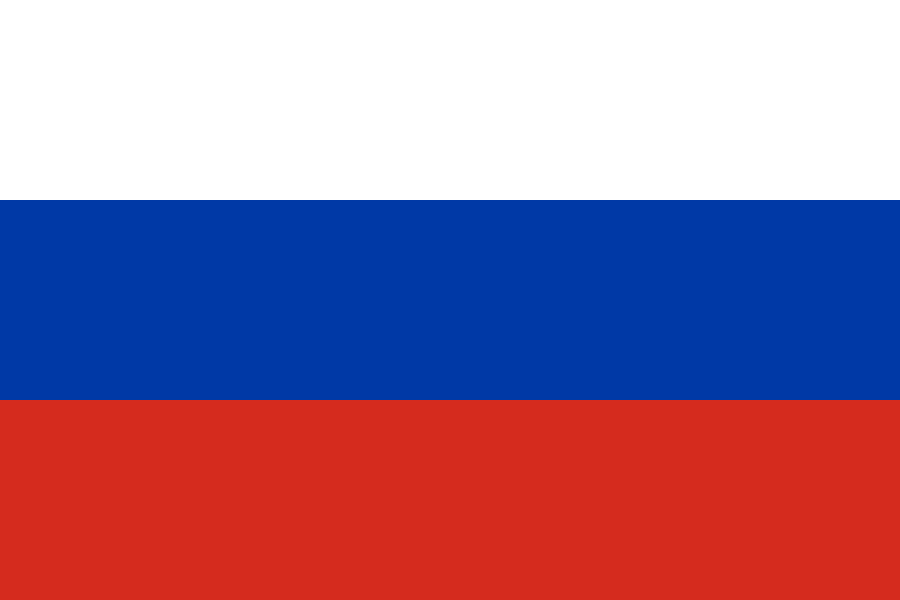
Russia
Location Info
- Continent: Europe, Asia
- Country: Russia
- Coordinates: 61.524 , 105.3188
Trust Info
Verified Geographic Research
References
🌍 Continents
Overview
Russia, officially the Russian Federation, is the largest country in the world by land area, spanning across Eastern Europe and Northern Asia. It shares borders with sixteen sovereign nations and encompasses eleven time zones. The landscape varies significantly, from the icy tundras of the north to the fertile steppes and vast taiga forests that cover much of Siberia. Its geography is defined by major features such as the Ural Mountains, which traditionally mark the boundary between Europe and Asia, and the world's deepest lake, Baikal.
Historically, Russia transitioned from a collection of medieval principalities to the powerful Russian Empire and later the Soviet Union, before becoming the modern federation in 1991. Today, it is a global power with a diverse economy heavily influenced by its vast natural resources, particularly oil and natural gas. With a rich cultural heritage in literature, music, and science, Russia remains a central figure in international geopolitics and global trade.
Truth & Facts
| Total Area | 17,098,246 sq km |
| Coastline | 37,653 km |
| Total Population | 144.5 million |
| Urban Population | 75% |
| Capital | Moscow |
| Federal Subjects | 85 (de jure) |
| Foundation | 862 AD |
| USSR Dissolution | December 25, 1991 |
| Currency | Russian Ruble (RUB) |
| Main Export | Crude Petroleum and Natural Gas |
| Railway Length | Over 85,000 km |
| Literacy Rate | 99.7% |
| Healthcare Model | Obligatory Medical Insurance (OMI) |
| Official Language | Russian |
| Most Visited Site | Moscow Kremlin |
| Forest Coverage | Approx. 49% |
| Major Hub | Sheremetyevo Airport (SVO) |
| Space Agency | Roscosmos |
| Emergency Number | 112 |
| Legislature | Federal Assembly |
| UN Status | Permanent Member of Security Council |
| Electricity Source | Thermal, Nuclear, Hydro |
| GDP (PPP) | $5.0+ Trillion |
| Top Search Engine | Yandex |
| Unemployment Rate | Approx 3.0% |
📑 Table of Contents
Overview
Russia is a transcontinental nation that bridges the gap between Europe and Asia. It is defined by its massive size, spanning 17.1 million square kilometers, making it the largest country on the planet. Its borders touch the Arctic and Pacific Oceans, as well as several regional seas.
- Capital: Moscow
- Official Language: Russian
- Government: Federal semi-presidential republic
- Currency: Russian Ruble
- Time Zones: 11
| Feature | Detail |
|---|---|
| Global Rank by Area | 1st |
| Primary Continent | Europe (approx. 23%) and Asia (approx. 77%) |
History
The history of Russia began with the East Slavs and the emergence of Kievan Rus' in the 9th century. Following the Mongol invasions, the Grand Duchy of Moscow rose to prominence, eventually forming the Tsardom of Russia and then the Russian Empire under Peter the Great.
- 9th Century: Rise of Kievan Rus'
- 1721: Proclamation of the Russian Empire
- 1917: Russian Revolution and end of the Tsardom
- 1922-1991: Era of the Soviet Union (USSR)
- 1991: Establishment of the Russian Federation
Geography
Russia's geography is incredibly diverse, ranging from the vast Arctic tundra to the high mountains of the Caucasus. The Ural Mountains serve as a traditional boundary between European Russia and Siberia.
- Longest River: Lena (or Volga in Europe)
- Largest Lake: Caspian Sea (saltwater) and Baikal (freshwater)
- Highest Peak: Mount Elbrus
- Key Regions: Siberia, Far East, Volga Region, Urals
Climate and Weather
Most of Russia has a humid continental climate, characterized by cold winters and warm summers. Northern coastal areas and islands experience a polar climate, while parts of the south are semi-arid.
- Winter Average: -10°C to -50°C (depending on region)
- Summer Average: 15°C to 30°C
- Extreme Point: Oymyakon (coldest inhabited place)
Population and Demographics
With over 144 million people, Russia is the most populous country in Europe and the ninth most populous in the world. The population is highly urbanized and concentrated in the European part of the country.
- Ethnic Groups: 80% Russian, plus Tatars, Ukrainians, Bashkirs
- Religion: Mostly Orthodox Christian, followed by Islam
- Median Age: Approximately 40 years
Culture and Lifestyle
Russian culture is deeply rooted in its history, literature, and the arts. From the world-famous Russian ballet to the profound works of Dostoyevsky and Tolstoy, the nation has significantly influenced global culture.
- Key Arts: Ballet, Opera, Classical Music
- Philosophy: Strong emphasis on collective history and tradition
- Popular Activities: Chess, Ice Hockey, Dacha (summer house) living
Festivals and Events
Major public holidays in Russia often combine religious traditions with Soviet-era historical celebrations. New Year's Eve is the most significant holiday of the year.
- Victory Day (May 9): Commemorates the end of WWII
- Maslenitsa: A traditional Slavic sun festival
- Christmas: Observed on January 7 (Orthodox)
Food and Cuisine
Russian cuisine is hearty and designed to sustain people through cold winters. It features various grains, root vegetables, and preserved meats.
- Borscht: Beetroot-based soup
- Pelmeni: Meat-filled dumplings
- Shashlik: Grilled skewered meat
- Beverages: Tea (Chay) and Kvass
Economy and Industries
The Russian economy is one of the world's largest, categorized as an upper-middle-income market economy. It is a major global producer of energy and minerals.
- Primary Industry: Oil and Natural Gas
- Secondary Industries: Mining, Metallurgy, Defense
- Agriculture: World's leading exporter of wheat
Cost of Living
The cost of living varies greatly between major cities like Moscow or Saint Petersburg and regional towns. Generally, utilities and transport are relatively affordable compared to Western Europe.
| Item | Average Cost (Approx) |
|---|---|
| Monthly Rent (1BR) | ₽30,000 - ₽70,000 |
| Public Transport Pass | ₽2,500 |
Employment and Business
The labor market is dominated by the energy sector and state-owned enterprises. Moscow serves as the primary business hub for international and domestic firms.
- Key Employers: Gazprom, Rosneft, Sberbank
- Sectors: Energy, IT, Retail, Finance
Real Estate and Housing
Most Russians live in apartment blocks, a legacy of the Soviet era. Recently, there has been a surge in the development of modern residential complexes in metropolitan areas.
- Common Type: Apartment ownership is high
- Trends: Growing interest in suburban cottages
Transportation and Connectivity
Russia maintains one of the most extensive railway networks in the world. Air travel is essential for connecting distant regions in the east.
- Railway: Trans-Siberian (9,289 km)
- Metro Systems: Renowned systems in Moscow and St. Petersburg
- Airports: Sheremetyevo, Domodedovo, Vnukovo
Infrastructure and Utilities
The country has a centralized heating system in most cities, which is vital for the winter months. Electricity is primarily generated through thermal and nuclear power plants.
- Water: Generally available in all urban areas
- Energy: Massive domestic gas distribution network
Education
Education in Russia is provided predominantly by the state and is regulated by the Ministry of Education. Higher education is highly valued, particularly in engineering and science.
- Key Universities: Moscow State University (MSU), SPbSU
- Literacy: Near 100%
Healthcare
The Russian Federation provides free basic healthcare to all citizens through the Obligatory Medical Insurance (OMI) system, though private clinics are popular for specialized care.
- System: State-funded with private options
- Network: Extensive hospital coverage in cities
Tourist Attractions
From the grandeur of the Kremlin to the historic canals of Saint Petersburg, Russia offers diverse sights for international and domestic tourists.
- Moscow Kremlin and Red Square
- Hermitage Museum (St. Petersburg)
- Lake Baikal
- Peterhof Palace
Things to Do
Visitors can experience a wide range of activities, from high-culture performances to extreme outdoor sports in the wilderness of Siberia.
- Watch a ballet at the Bolshoi Theatre
- Take a Trans-Siberian rail journey
- Visit a traditional Banya (sauna)
Best Places to Visit
While Moscow and St. Petersburg are the most famous, other cities and natural areas offer unique cultural and environmental experiences.
- Kazan: Known for the mix of Slavic and Tatar cultures
- Sochi: Subtropical resort city on the Black Sea
- Golden Ring: Ancient cities northeast of Moscow
Travel Guide
Travelers to Russia typically require a visa. Internal travel is best handled via the extensive train network or domestic flights for longer distances.
- Visa: E-visa available for many nationalities
- Connectivity: High-speed Sapsan trains between major cities
Nearby Places
Due to its size, Russia's neighbors vary from European nations in the west to East Asian nations in the far east.
- West: Finland, Estonia, Latvia, Belarus
- South: Kazakhstan, Mongolia, China
- East: Japan and USA (via sea borders)
Environment and Nature
Russia contains the world's largest forest reserves and about one-quarter of the world's fresh unfrozen water. Conservation efforts focus on protecting rare species like the Amur tiger.
- Biomes: Tundra, Taiga, Steppe
- Reserves: Numerous 'Zapovedniks' (strict nature reserves)
Government and Administration
The federal government is divided into executive, legislative, and judicial branches. The President is the head of state and the Prime Minister is the head of government.
- Legislature: State Duma and Federation Council
- Capital: Moscow (Federal City)
Safety and Public Services
Safety levels in Russia are generally comparable to other large nations. Public services like the Metro and police are highly visible in major cities.
- Emergency Services: Dial 112
- Police: Politsiya
Best Time to Visit
The most popular time to visit is during the summer months (June to August) when the weather is mild and the 'White Nights' occur in the north.
- Summer: Sightseeing and festivals
- Winter: Skiing and New Year celebrations
Local Business Directory
Russian commerce is dominated by large-scale retail chains and tech-driven delivery services. Local markets remain popular for fresh produce.
- Tech: Yandex, Ozon, Wildberries
- Retail: Magnit, X5 Group
General Information FAQs
Where is Russia located?
Russia is located in Northern Eurasia, spanning across the northern part of the continents of Europe and Asia.
What is Russia known for?
Russia is known for its vast size, rich history, classical arts (ballet and music), and massive reserves of natural resources like oil and gas.
Why is Russia famous?
It is famous for being the world's largest country, its role as a global superpower, and its contributions to literature, science, and space exploration.
What country or region is Russia part of?
Russia is its own sovereign nation, often referred to as a transcontinental country in Europe and Asia.
What is the population of Russia?
As of 2024, the population is approximately 144.5 million people.
What languages are spoken in Russia?
Russian is the official language. There are over 100 minority languages, including Tatar, Chechen, and Chuvash.
What time zone is Russia in?
Russia spans 11 time zones, from UTC+2 (Kaliningrad) to UTC+12 (Kamchatka).
What are the key facts about Russia?
Key facts include its capital Moscow, its currency the Ruble, and its status as the world's largest country by area.
What makes Russia unique?
Its unique nature lies in its immense geographic diversity, its 11 time zones, and its bridge between Western and Eastern cultures.
How large is Russia in area?
Russia covers approximately 17.1 million square kilometers.
History FAQs
What is the history of Russia?
Russia's history moves from the Kievan Rus' through the Tsardom, the Russian Empire, the Soviet era, and into the modern Russian Federation.
When was Russia established?
The traditional start date is 862 AD, though the modern Russian Federation was established in 1991.
What major historical events happened in Russia?
Major events include the Mongol invasion, the reforms of Peter the Great, the 1917 Revolution, and the Great Patriotic War (WWII).
Who were important historical figures from Russia?
Important figures include Peter the Great, Catherine the Great, Vladimir Lenin, Joseph Stalin, and Mikhail Gorbachev.
How has Russia developed over time?
It evolved from an agrarian empire into a nuclear-armed industrial superpower and now a resource-rich market economy.
Geography & Environment FAQs
What is the geography of Russia?
The geography features massive plains in the west, the Ural mountains in the center, and vast forests and plateaus in Siberia.
What natural features surround Russia?
It is surrounded by the Arctic Ocean to the north, the Pacific to the east, and various seas and mountains to the south and west.
Are there mountains, rivers, or lakes near Russia?
Yes, including the Ural and Caucasus Mountains, the Volga and Yenisei Rivers, and Lake Baikal.
What is the elevation of Russia?
Elevations range from below sea level at the Caspian Sea to 5,642 meters at Mount Elbrus.
What ecosystems exist around Russia?
Ecosystems include arctic tundra, boreal forest (taiga), mixed forests, and steppe grasslands.
Climate & Weather FAQs
What is the climate like in Russia?
Most of the country has a humid continental climate with highly distinct seasons.
What is the average temperature in Russia?
Averages vary widely; Moscow averages -7°C in winter and 19°C in summer.
What is the weather like throughout the year in Russia?
Winters are typically long and snowy, while summers are brief but can be quite warm in the south.
Does Russia experience extreme weather?
Yes, particularly extreme cold in Siberia, where temperatures can drop below -60°C.
What is the best time of year to visit Russia?
Late spring (May) to early autumn (September) is generally considered the best time for weather.
Population & Society FAQs
What is the population density of Russia?
The density is low at about 8.4 people per square km, but much higher in the European part.
What ethnic groups live in Russia?
Ethnic Russians make up 80%, with Tatars (3.9%), Bashkirs (1.2%), and others forming minorities.
What religions are practiced in Russia?
The main religions are Orthodox Christianity, Islam, Buddhism, and Judaism.
What is daily life like in Russia?
Daily life is urban-centric, with a strong focus on education, work, and family social circles.
How diverse is the population of Russia?
It is highly diverse, with over 190 recognized ethnic groups across its territory.
Culture & Traditions FAQs
What cultural traditions are important in Russia?
Hospitality, tea drinking, and the celebration of seasonal holidays are core traditions.
What festivals are celebrated in Russia?
Key festivals include New Year, Maslenitsa, Victory Day, and Orthodox Easter.
What cultural landmarks exist in Russia?
Notable landmarks include the Red Square, Bolshoi Theatre, and the Hermitage Museum.
What traditional clothing or customs are common in Russia?
Traditional dress like the Sarafan and Ushanka are cultural symbols, though modern western clothing is the norm.
What arts and crafts are associated with Russia?
Matryoshka dolls, Khokhloma painting, and Gzhel ceramics are world-famous.
Food & Cuisine FAQs
What foods is Russia known for?
Russia is known for its soups (Borscht), dumplings (Pelmeni), and pancakes (Blini).
What traditional dishes originate from Russia?
Dishes like Beef Stroganoff and Olivier Salad originated in or were popularized in Russia.
What are the best restaurants in Russia?
Major cities have a high density of Michelin-recognized and high-end restaurants specializing in 'New Russian' cuisine.
What local ingredients are commonly used in Russia cuisine?
Common ingredients include beets, cabbage, potatoes, sour cream (smetana), and rye bread.
What food markets or street foods are popular in Russia?
Street foods include Pirozhki (pies) and Blini, while historic markets like Danilovsky are popular in Moscow.
Economy & Business FAQs
What are the main industries in Russia?
Oil, natural gas, mining, metallurgy, and defense manufacturing.
What economic activities drive the economy of Russia?
The extraction and export of energy resources are the primary drivers of the economy.
What businesses operate in Russia?
Major domestic companies like Gazprom, Lukoil, and Sberbank dominate the market.
Is Russia an important economic center?
Yes, it is a member of the G20 and a leading global producer of essential commodities.
What are the major exports or products from Russia?
Petroleum, natural gas, wheat, timber, and military equipment.
Employment & Jobs FAQs
What job opportunities are available in Russia?
Opportunities are highest in IT, energy engineering, retail, and public administration.
What are the major employers in Russia?
State-owned corporations like Russian Railways and Gazprom are among the largest employers.
What skills are in demand in Russia?
Software development, engineering, and digital marketing are currently in high demand.
Is Russia a good place to work?
For skilled professionals in major hubs like Moscow, it offers competitive salaries and low personal income tax rates.
What is the unemployment rate in Russia?
The rate has recently fluctuated around 3% to 4%, historically low for the region.
Cost of Living FAQs
Is Russia expensive to live in?
Moscow and St. Petersburg can be expensive, but the rest of the country is quite affordable.
What is the average cost of living in Russia?
Excluding rent, an individual can live comfortably on approximately $500 - $800 USD per month in most cities.
How much does housing cost in Russia?
Rental costs range from $300 in regional cities to over $1000 for luxury apartments in Moscow.
What are average food and utility costs in Russia?
Utilities are relatively cheap due to domestic energy production, averaging $50-$100 per month.
Is Russia affordable compared to nearby cities?
It is generally more affordable than Western European capitals but more expensive than some Central Asian neighbors.
Housing & Real Estate FAQs
What types of housing are available in Russia?
High-rise apartments are most common, with private houses more prevalent in rural areas and suburbs.
What is the average home price in Russia?
Prices vary wildly; Moscow averages over $4,000 per square meter, while regional prices are much lower.
Is it better to rent or buy property in Russia?
Buying is culturally preferred, though renting is common among young professionals in major cities.
Which neighborhoods are popular in Russia?
In Moscow, Presnensky and Arbat are prestigious; in St. Petersburg, the Central District is highly sought after.
How has the property market changed in Russia?
There has been a shift toward large-scale suburban development and mortgage-backed purchases.
Transportation FAQs
How do you get to Russia?
Most international travelers arrive by air via Moscow or Saint Petersburg hubs.
What is the nearest airport to Russia?
The primary gateways are Sheremetyevo (SVO) and Domodedovo (DME) in Moscow.
Does Russia have railway connections?
Yes, it has extensive international rail links to Europe and Asia, including the Trans-Siberian.
How reliable is public transportation in Russia?
Very reliable, especially the metro systems in major cities and the national rail network.
What major highways or roads connect to Russia?
Major routes include the M10 (Moscow-St. Petersburg) and the M5 (Ural highway).
Education FAQs
What schools are located in Russia?
Russia has a mix of state-funded public schools and specialized lyceums.
Are there universities in Russia?
Yes, there are over 700 universities, including the prestigious Lomonosov Moscow State University.
What is the literacy rate in Russia?
The literacy rate is near universal at 99.7%.
What educational opportunities exist in Russia?
There are strong opportunities in STEM fields, medicine, and the performing arts.
Is Russia a good place for students?
Yes, particularly for those interested in science, ballet, and Slavic studies.
Healthcare FAQs
What hospitals are available in Russia?
Major cities have advanced federal medical centers and numerous municipal hospitals.
Are there emergency medical services in Russia?
Yes, ambulance services are free and accessible by dialing 103 or 112.
What healthcare facilities exist in Russia?
Facilities include policlinics for routine care and specialized hospitals for surgery and oncology.
Is healthcare affordable in Russia?
Basic care is free for citizens; private care is available at various price points.
Are specialized medical services available in Russia?
Yes, particularly in Moscow, which is a regional hub for complex medical procedures.
Tourism & Travel FAQs
What are the top tourist attractions in Russia?
The Kremlin, Red Square, Hermitage Museum, and Lake Baikal.
What are the best things to do in Russia?
Sightseeing in Moscow, visiting the ballet, and taking a river cruise along the Volga.
Is Russia worth visiting?
Yes, for its unique blend of historical depth, cultural richness, and natural beauty.
What landmarks should visitors see in Russia?
Saint Basil’s Cathedral, The Church of the Savior on Spilled Blood, and Peterhof Palace.
How many days should tourists spend in Russia?
A minimum of 10-14 days is recommended to see both Moscow and St. Petersburg.
Nearby Places FAQs
What places are near Russia worth visiting?
Nearby countries like Belarus, Georgia, and the Baltic states offer connected travel experiences.
What cities or towns are close to Russia?
Helsinki, Minsk, and Nur-Sultan are relatively close to major Russian border regions.
What natural attractions are near Russia?
The Altai Mountains (shared with Mongolia/China) and the Caucasus range.
What day trips can be taken from Russia?
From St. Petersburg, a trip to the palace at Gatchina; from Moscow, the 'Golden Ring' towns.
What famous destinations are within reach of Russia?
Destinations like the Great Wall of China or Scandinavian capitals are reachable from border regions.
Safety FAQs
Is Russia safe to live in?
Yes, common sense and adherence to local laws ensure a safe living environment.
Is Russia safe for tourists?
Tourists are generally safe, though it is advised to stay in well-traveled areas and use official transport.
What is the crime rate in Russia?
The crime rate is moderate and has been decreasing in many urban areas over the last decade.
What emergency services operate in Russia?
Police, Fire, and Ambulance services are available nationwide via 112.
What safety tips should visitors follow in Russia?
Keep your passport with you, use official taxi apps, and avoid unauthorized political gatherings.
Lifestyle & Living FAQs
Is Russia a good place to live?
It offers a high level of culture and infrastructure in its major cities.
What recreational activities are available in Russia?
Skiing, hockey, theater, and spending time at the dacha (summer cabin).
Is Russia family-friendly?
Yes, with many parks, children's theaters, and educational museums.
What outdoor activities are popular in Russia?
Hiking in the Caucasus, fishing in Siberia, and ice skating in the winter.
What makes life enjoyable in Russia?
The strong sense of community, rich seasonal traditions, and deep appreciation for the arts.
Practical Information FAQs
What travel tips should visitors know about Russia?
Learn the Cyrillic alphabet and download local maps and translation apps.
What local customs should visitors respect in Russia?
Dress modestly when entering churches and remove shoes when entering a home.
How accessible is Russia for international visitors?
Most major sites are accessible, though English proficiency varies outside big cities.
What services are available for tourists in Russia?
Tourist information centers, multilingual signage in metros, and extensive tour companies.
What important information should travelers know before visiting Russia?
Check the latest visa requirements and ensure you have valid travel insurance.