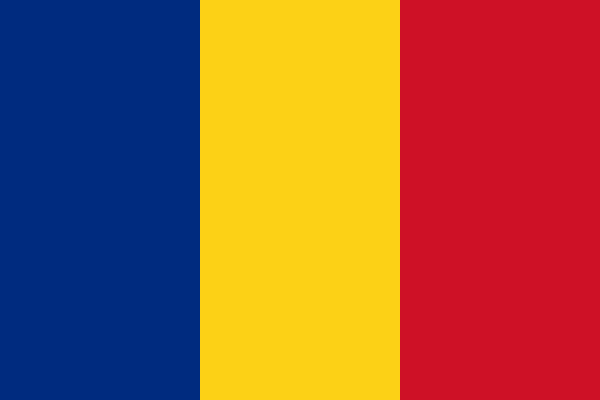
Romania
Location Info
- Continent: Europe
- Country: Romania
- Coordinates: 45.9432 , 24.9668
Trust Info
Verified Geographic Information
🌍 Continents

Overview
Romania is a sovereign state located at the intersection of Central, Eastern, and Southeastern Europe. It borders the Black Sea to the southeast and is defined by the extensive Carpathian Mountain range and the lower reaches of the Danube River. As the twelfth-largest country in Europe by area, it serves as a significant geopolitical bridge between the Balkans and Northern Europe.
The nation's history is characterized by the union of the principalities of Moldavia and Wallachia in 1859, eventually forming the modern state. Following decades under a communist regime, the 1989 Revolution transitioned the country into a democracy. Today, Romania is a member of the European Union and NATO, boasting a diverse economy driven by industry, services, and a rapidly growing information technology sector.
Truth & Facts
| Total Area | 238,397 sq km |
| Highest Point | Moldoveanu Peak (2,544 m) |
| Estimated Population | 19,053,815 |
| Official Language | Romanian |
| Capital | Bucharest |
| Government Type | Semi-presidential Republic |
| Unification of Principalities | 1859 |
| Independence from Ottoman Empire | 1877 |
| Currency | Romanian Leu (RON) |
| GDP Per Capita (PPP) | $41,029 |
| Nuclear Power | Cernavoda NPP |
| Literacy Rate | 98.8% |
| System Type | Social Health Insurance |
| UNESCO Sites | 9 |
| Most Visited Region | Transylvania |
| Forest Coverage | 27% |
| Railway Length | 10,764 km |
| Internet Speed Rank | Top 10 Globally |
| Global Peace Index | High |
| Legal System | Civil Law |
| EU Accession | January 1, 2007 |
| Water Access | 98% (Urban) |
| Birth Rate | 9.2 per 1000 |
| Mobile Penetration | Over 100% |
| Dominant Religion | Eastern Orthodox |
📑 Table of Contents
Overview of Romania
Romania is situated in the southeastern part of Central Europe, bordered by Ukraine, Moldova, Bulgaria, Serbia, and Hungary. It features a diverse landscape ranging from the Black Sea coast to the rugged peaks of the Carpathian Mountains.
As a member of the European Union since 2007, Romania has undergone significant economic transformation. It is known for its well-preserved medieval towns, vast forests, and the unique ecosystem of the Danube Delta.
- Capital City: Bucharest
- Official Currency: Romanian Leu (RON)
- Regional Affiliation: Southeastern Europe
- Political Status: Parliamentary Republic
- Main River: Danube
Historical Timeline
Romanian history dates back to the ancient Dacians, who were conquered by the Roman Empire in the 2nd century AD. This fusion created the Daco-Roman culture that forms the basis of the modern Romanian identity.
During the Middle Ages, the principalities of Wallachia, Moldavia, and Transylvania existed as separate entities, often serving as buffer zones against Ottoman and Austro-Hungarian expansion. The 20th century saw the nation endure two world wars and a long period of communist rule under Nicolae Ceausescu.
| Period | Event |
|---|---|
| 106 AD | Roman Conquest of Dacia |
| 1859 | Union of Moldavia and Wallachia |
| 1918 | Great Union of Romania |
| 1989 | Decembrist Revolution |
| 2004 | NATO Accession |
Geography and Physical Landscape
The geography of Romania is divided almost equally between mountains, hills, and plains. The Carpathian Mountains form a central arc, protecting the Transylvanian Plateau at the heart of the country.
The southern region is dominated by the Wallachian Plain, which is separated from Bulgaria by the Danube River. The Danube Delta, where the river meets the Black Sea, is a world-renowned biosphere reserve hosting thousands of species of birds and fish.
- Mountain Range: Carpathians
- Highest Peak: Moldoveanu
- Major Rivers: Danube, Mures, Olt
- Bordering Sea: Black Sea
- Key Feature: Danube Delta
Climate and Weather Patterns
Romania has a temperate-continental climate with four distinct seasons. Summers are generally warm to hot, while winters can be quite cold with significant snowfall, particularly in the mountainous regions.
Spring and autumn are transitional periods with mild temperatures. Rainfall is distributed throughout the year, but is most frequent during the late spring months. The coastal region near the Black Sea experiences a more moderate maritime influence.
| Season | Avg Temperature | Conditions |
|---|---|---|
| Winter | -3°C to 2°C | Snow, freezing |
| Spring | 10°C to 18°C | Rainy, mild |
| Summer | 25°C to 30°C | Hot, sunny |
| Autumn | 8°C to 15°C | Dry, cool |
Population and Demographics
The population of Romania is predominantly ethnic Romanian, though it includes significant minorities such as Hungarians and Roma. The country has faced a demographic challenge due to high rates of external migration since its EU entry.
Most citizens live in urban areas, with Bucharest being the primary population center. The demographic profile is aging, similar to many other Eastern European nations.
- Main Ethnicity: Romanian (89%)
- Largest Minority: Hungarian (6%)
- Religious Majority: Eastern Orthodox
- Urbanization Rate: ~54%
- Language: Romanian
Culture and Lifestyle
Romanian culture is a unique blend of Latin roots and Balkan influences. It is deeply rooted in folklore, traditional music, and rural customs that have survived for centuries in the mountain villages.
In urban centers, the lifestyle is modern and increasingly integrated with Western European trends. However, traditional holidays and religious festivals remain a central part of family life throughout the country.
- Folklore: Miorita and Manole
- Prominent Artist: Constantin Brancusi
- Music: George Enescu
- Traditional Dress: Ie (embroidered blouse)
- Philosophical outlook: Mioritic Space
Major Festivals and Public Events
Romania hosts a variety of traditional and modern festivals. The National Day, celebrated on December 1st, commemorates the Great Union of 1918 with parades and cultural displays.
Modern music festivals such as UNTOLD and Electric Castle have gained international recognition, attracting hundreds of thousands of visitors to Transylvania. Traditional seasonal festivals often center around agricultural cycles and religious saints.
- National Day: December 1st
- Martisor: March 1st (Spring greeting)
- Untold: Cluj-Napoca (Music)
- Enescu Festival: Classical Music
- Sighisoara Medieval Festival
Romanian Food and Cuisine
Romanian cuisine is hearty and reflects the country's agricultural background. It has been influenced by Turkish, Hungarian, and Balkan traditions, creating a varied culinary landscape.
Staple dishes often include pork, poultry, and corn-based preparations. The use of fermented vegetables and sour soups, known as 'ciorba', is a distinctive feature of the Romanian diet.
- Sarmale: Minced meat in cabbage leaves
- Mamaliga: Cornmeal porridge
- Mici: Grilled meat rolls
- Papanasi: Fried cheese donuts
- Ciorba de Burta: Tripe soup
Economy and Key Industries
Romania is an upper-middle-income economy that has transitioned from a centralized state to a market-based system. It is one of the fastest-growing economies in the European Union, driven by strong industrial production and export growth.
The IT sector has become a major pillar of the economy, particularly in cities like Bucharest, Cluj-Napoca, and Iasi. Automotive manufacturing, through companies like Dacia-Renault and Ford, remains a critical export industry.
| Sector | Contribution | Main Products |
|---|---|---|
| Services | 58% | IT, Finance, Telecom |
| Industry | 28% | Automotive, Machines |
| Agriculture | 4% | Grains, Sunflower seeds |
Cost of Living
The cost of living in Romania remains lower than the EU average, though prices in major cities like Bucharest have risen steadily. Utilities and locally produced food items are generally affordable.
Housing costs vary significantly between regions, with Transylvania and the capital being the most expensive. Public transportation is widely available and remains relatively low-cost for residents and tourists alike.
- Grocery cost: Low-Moderate
- Utilities: Moderate
- Dining out: Affordable
- Public Transport: Cheap
- Internet: Very Cheap/High Speed
Employment and Business Environment
The Romanian labor market has seen a shift towards skilled services, particularly in technology and engineering. Unemployment rates are generally low, although regional disparities exist between urban hubs and rural areas.
The business environment is characterized by a flat tax system on corporate income and a growing startup ecosystem. Foreign direct investment is primarily concentrated in the manufacturing and service sectors.
- Main Employers: IT, Automotive, Retail
- Work Week: 40 hours
- Business Hub: Bucharest
- Regional Hub: Cluj-Napoca
- Tax System: Flat tax
Real Estate and Housing
Romania has one of the highest homeownership rates in the world, with over 90% of the population owning their residences. The housing stock consists largely of apartment blocks built during the communist era and newer residential developments.
The rental market is most active in university cities. Property prices have seen consistent growth over the last decade, driven by increased purchasing power and urbanization.
- Homeownership: 95%
- Urban Housing: Apartment blocks
- Rural Housing: Individual houses
- Growth Area: Suburban Bucharest
- Market Trend: Increasing prices
Transportation and Connectivity
Romania's transport network is undergoing modernization. The railway system, operated by CFR, is extensive, connecting all major towns and cities, although travel times can be longer than Western standards.
Road infrastructure is focused on the development of new motorways (autostrazi) to connect the country with Western Europe. Air travel is served by several international airports, with Henri Coanda in Bucharest being the primary gateway.
- Main Airport: Henri Coanda (OTP)
- Railway: CFR Călători
- Key Motorways: A1, A2, A3
- Major Port: Constanta (Black Sea)
- River Transport: Danube River
Infrastructure and Public Utilities
Public utilities in Romania are managed through a mix of state-owned and private entities. Electricity generation is diverse, utilizing nuclear, hydro, coal, and increasing amounts of renewable wind energy.
Internet infrastructure is exceptionally well-developed, with Romania often ranking in the top tier globally for broadband speeds. Water and sewage coverage is high in urban areas but continues to expand in rural regions.
- Electricity: Nuclearelectrica, Hidroelectrica
- Internet: Fiber-optic dominance
- Water: Regional operators
- Gas: Large domestic reserves
- Waste: Moving toward EU recycling standards
Education System
Education is compulsory in Romania for 11 years. The system is divided into primary, secondary, and tertiary levels. Romanian students often excel in international competitions in mathematics and computer science.
Public universities are the main providers of higher education, with the University of Bucharest and Babes-Bolyai University being the most prestigious institutions. Technical education is highly valued due to the demands of the IT and automotive sectors.
- Compulsory age: 6 to 16
- Graduation exam: Bacalaureat
- Top University: Babes-Bolyai (Cluj)
- Technical Hub: UPB (Bucharest)
- Literacy: 98.8%
Healthcare and Medical Services
Romania provides a universal healthcare system funded by the state through the National Health Insurance House. Public hospitals are available in every county, supplemented by a growing private medical sector in large cities.
Emergency services are provided by SMURD and the National Ambulance Service. While urban facilities are modern, rural areas may have more limited access to specialized care.
- Public Service: CNAS
- Emergency: SMURD (112)
- Private Sector: Growing rapidly
- Main Centers: Bucharest, Cluj, Iasi
- Insurance: Compulsory for employees
Top Tourist Attractions
Romania is famous for its diverse attractions, ranging from medieval castles in Transylvania to the unique painted monasteries of Bucovina. The Palace of the Parliament in Bucharest is the second-largest administrative building in the world.
Nature lovers frequent the Danube Delta and the many national parks in the Carpathian Mountains. The Black Sea resorts provide a popular summer destination for domestic and international travelers.
- Peles Castle: Sinaia
- Bran Castle: Near Brasov
- Corvin Castle: Hunedoara
- Transfagarasan: Mountain road
- Danube Delta: Biosphere reserve
Things to Do
Outdoor activities are abundant in Romania, with the Carpathians providing excellent opportunities for hiking, skiing, and wildlife watching. The country is one of the best places in Europe to see brown bears in their natural habitat.
City exploration offers a mix of architectural styles, from Belle Epoque to Socialist Realism. Wine tasting in regions like Dealu Mare or Murfatlar is also a popular activity for visitors.
- Hiking: Retezat National Park
- Skiing: Poiana Brasov
- Birdwatching: Danube Delta
- City Tours: Bucharest Old Town
- Wildlife: Bear watching tours
Best Places to Visit
Key destinations in Romania include the historic cities of Transylvania, such as Sibiu and Brasov, which feature well-preserved medieval centers. Cluj-Napoca serves as the vibrant cultural capital of the region.
The northern region of Maramures is known for its wooden churches and traditional lifestyle. The Black Sea coast, particularly Mamaia, is the hub for summer entertainment and seaside relaxation.
- Sibiu: 2007 Cultural Capital
- Sighisoara: Birthplace of Vlad Tepes
- Maramures: Wooden architecture
- Iasi: Cultural hub of Moldavia
- Constanta: Ancient port city
Traveler's Guide
International travelers can enter Romania via numerous airports or by rail from neighboring European countries. The national language is Romanian, but English and French are widely spoken among the younger population and in tourist areas.
While Romania is part of the EU, it uses the Leu (RON) rather than the Euro. Credit cards are accepted in most urban establishments, but carrying cash is advisable for rural excursions.
- Visa: EU/Schengen rules apply
- Currency: Romanian Leu
- Language: English widely understood
- Tipping: 10% is customary
- Safety: Generally high for tourists
Nearby Regions and Places
Romania's location makes it a gateway to several other interesting regions. To the south, Bulgaria's Balkan Mountains and Black Sea coast are easily accessible by road.
To the east, the Republic of Moldova shares deep cultural and linguistic ties with Romania. Hungary and Serbia to the west offer convenient rail and road connections to Central Europe.
- Bulgaria: Ruse, Varna
- Moldova: Chisinau
- Hungary: Budapest (via Arad)
- Serbia: Belgrade (via Timisoara)
- Ukraine: Chernivtsi
Environment and Nature
Romania possesses some of the most extensive tracts of virgin forest in Europe. These areas provide a vital habitat for large carnivores, including wolves and lynx, which have disappeared from much of Western Europe.
The government manages numerous national parks and protected areas to balance economic development with conservation. The Danube Delta is a strictly protected UNESCO World Heritage site due to its ecological sensitivity.
- Virgin Forests: Carpathians
- Fauna: Brown bears, Wolves
- Protection: 14 National Parks
- Wetlands: Danube Delta
- Flora: Edelweiss, Peony
Government and Administration
Romania is divided into 41 counties (judete) and the municipality of Bucharest. The government operates under a semi-presidential system where executive power is shared between the President and the Prime Minister.
The legislative branch consists of a bicameral Parliament, comprising the Senate and the Chamber of Deputies. Local administration is handled by mayors and local councils elected every four years.
- Legislature: Parliament of Romania
- Administrative units: 41 Counties
- Highest Court: High Court of Cassation
- Electoral cycle: 4 or 5 years
- EU Representation: 33 MEPs
Safety and Public Services
Romania is considered one of the safer countries in Europe, with low rates of violent crime. Public safety is maintained by the Romanian Police and the Gendarmerie.
Emergency services are integrated under the 112 system, which coordinates fire, medical, and police responses. Public services like mail and utilities are generally reliable in urban centers.
- Emergency Number: 112
- Police: Poliția Română
- Fire Dept: IGSU
- Risk factor: Seismic activity (Vrancea)
- Safety level: High for solo travelers
Best Time to Visit
The ideal time to visit Romania depends on the desired activities. May to September offers the best weather for hiking and exploring the cities, with July and August being the peak for the Black Sea coast.
Ski enthusiasts should visit between December and March. For birdwatching in the Danube Delta, the spring migration in April and May is the most favorable period.
- Hiking: June - September
- Skiing: January - February
- City Tours: May, June, September
- Beaches: July - August
- Cultural: Easter/Christmas periods
Local Business and Economy
The business landscape in Romania is dominated by services, manufacturing, and a strong presence of multinational corporations. Bucharest acts as the primary financial center, hosting the Bucharest Stock Exchange.
Small and medium-sized enterprises (SMEs) are prevalent in the retail and tourism sectors. The country is also a major producer of agricultural goods, being a top exporter of grain within the European Union.
- Stock Exchange: BVB
- Major Bank: Banca Transilvania
- Retail: Mega Image, Carrefour
- Industry: Dacia, OMV Petrom
- Agri-business: Large grain exporters
General Information FAQs
Where is Romania located?
Romania is situated in Southeastern Europe, bordering the Black Sea, between Bulgaria and Ukraine.
What is Romania known for?
It is known for the Carpathian Mountains, Transylvanian castles, the Danube Delta, and its medieval history.
Why is Romania famous?
The country is famous for the legend of Dracula, its unique UNESCO wooden churches, and having one of the world's fastest internet speeds.
What country or region is Romania part of?
Romania is a member of the European Union and NATO, located in the Balkan and Carpathian regions of Europe.
What is the population of Romania?
As of recent census data, the population is approximately 19 million people.
What languages are spoken in Romania?
The official language is Romanian. Hungarian and German are spoken by minorities, and English is widely understood by youth.
What time zone is Romania in?
Romania is in the Eastern European Time zone (EET), which is UTC+2 (UTC+3 during daylight saving time).
What are the key facts about Romania?
Key facts include its capital Bucharest, its currency the Leu, and its status as the 12th largest country in Europe.
What makes Romania unique?
Its unique blend of Latin heritage in an Eastern Orthodox, Slavic-neighboring region sets it apart culturally and linguistically.
How large is Romania in area?
Romania covers an area of 238,397 square kilometers (92,046 square miles).
History FAQs
What is the history of Romania?
Its history includes ancient Dacia, Roman colonization, medieval principalities, and a 20th-century transition from Monarchy to Communism to Democracy.
When was Romania established?
The modern state was established in 1859 through the union of Moldavia and Wallachia.
What major historical events happened in Romania?
Major events include the 1877 Independence War, the 1918 Great Union, and the 1989 Revolution against Nicolae Ceaușescu.
Who were important historical figures from Romania?
Key figures include Vlad the Impaler, King Carol I, Stephen the Great, and diplomat Nicolae Titulescu.
How has Romania developed over time?
It evolved from an agrarian society to a heavily industrialized communist state, and finally into a service-oriented EU market economy.
Geography & Environment FAQs
What is the geography of Romania?
The terrain is distributed roughly equally between mountains (Carpathians), hills, and fertile plains.
What natural features surround Romania?
It is defined by the Black Sea to the southeast, the Danube River to the south, and the Prut River to the east.
Are there mountains, rivers, or lakes near Romania?
The Carpathian Mountains run through the center; major rivers include the Danube, Mureș, and Olt; and it contains over 3,000 lakes.
What is the elevation of Romania?
The average elevation is moderate, but peaks in the Făgăraș Mountains reach over 2,500 meters.
What ecosystems exist around Romania?
Ecosystems range from alpine meadows and temperate forests to the unique wetlands of the Danube Delta.
Climate & Weather FAQs
What is the climate like in Romania?
Romania has a temperate-continental climate with four distinct seasons.
What is the average temperature in Romania?
Annual averages vary from 8°C in the north to 11°C in the south.
What is the weather like throughout the year in Romania?
Expect snowy winters (Dec-Feb), rainy springs (Mar-May), hot summers (Jun-Aug), and dry, cool autumns (Sep-Nov).
Does Romania experience extreme weather?
Occasional blizzards occur in winter and heatwaves or heavy thunderstorms are common in summer.
What is the best time of year to visit Romania?
Late spring (May-June) and early autumn (September) offer the most pleasant weather for sightseeing.
Population & Society FAQs
What is the population density of Romania?
The density is approximately 80 people per square kilometer, with higher concentrations in Bucharest and Iași.
What ethnic groups live in Romania?
89% are ethnic Romanians, with minorities of Hungarians (6%), Roma (3%), Germans, and Ukrainians.
What religions are practiced in Romania?
The majority (over 80%) are Eastern Orthodox Christians, followed by Catholics and Protestants.
What is daily life like in Romania?
Daily life blends modern European consumerism in cities with traditional, agriculture-based rhythms in rural villages.
How diverse is the population of Romania?
While largely homogenous, the country has a significant Hungarian minority in Transylvania and a diverse history of Saxon and Greek influence.
Culture & Traditions FAQs
What cultural traditions are important in Romania?
Traditions include the Martișor spring celebration, caroling (colinde), and elaborate Easter egg painting.
What festivals are celebrated in Romania?
Major festivals include Dragobete (lovers' day), National Day (Dec 1st), and modern events like the Enescu Festival.
What cultural landmarks exist in Romania?
Key landmarks include the Painted Monasteries of Bucovina, the Wooden Churches of Maramureș, and the Romanian Athenaeum.
What traditional clothing or customs are common in Romania?
The 'Ie' (embroidered blouse) is the national garment, often worn during folk festivals and religious holidays.
What arts and crafts are associated with Romania?
Romania is known for Horezu ceramics, wood carving, and intricate weaving traditions.
Food & Cuisine FAQs
What foods is Romania known for?
It is known for hearty dishes like Sarmale, Mici, and various types of sour soups called Ciorbă.
What traditional dishes originate from Romania?
Mămăligă (cornmeal porridge) and Papanăși (cheese donuts) are iconic traditional staples.
What are the best restaurants in Romania?
Traditional venues like Caru' cu Bere in Bucharest are famous, alongside modern fine-dining spots in Cluj and Sibiu.
What local ingredients are commonly used in Romania cuisine?
Pork, potatoes, cabbage, sour cream, and cornmeal are the fundamental building blocks of most recipes.
What food markets or street foods are popular in Romania?
Covrigi (pretzels) and Gogoși (doughnuts) are the most popular street snacks found in every city.
Economy & Business FAQs
What are the main industries in Romania?
Main industries include automotive manufacturing, information technology, agriculture, and energy production.
What economic activities drive the economy of Romania?
Economic growth is driven by consumer spending, IT service exports, and industrial manufacturing for the EU market.
What businesses operate in Romania?
Major companies include Dacia (Renault), OMV Petrom, and numerous multinational tech firms like Oracle and IBM.
Is Romania an important economic center?
It is one of the largest economies in Southeastern Europe and a key logistics hub for the Black Sea region.
What are the major exports or products from Romania?
Major exports include automobiles, machinery, electrical equipment, and agricultural grains.
Employment & Jobs FAQs
What job opportunities are available in Romania?
Opportunities are highest in software development, engineering, shared service centers, and logistics.
What are the major employers in Romania?
The state remains a large employer, alongside private giants like Dacia, Continental, and various retail chains.
What skills are in demand in Romania?
Proficiency in foreign languages (English, German, French) and technical IT skills are in extremely high demand.
Is Romania a good place to work?
It offers a low cost of living relative to salaries in the tech sector, though bureaucratic hurdles remain for some.
What is the unemployment rate in Romania?
The rate typically fluctuates between 5% and 6%, though it is significantly lower in major urban centers.
Cost of Living FAQs
Is Romania expensive to live in?
Compared to Western Europe, Romania is very affordable, though prices in Bucharest are rising.
What is the average cost of living in Romania?
A single person can live comfortably on 700-1000 EUR per month, excluding luxury housing.
How much does housing cost in Romania?
Rent for a one-bedroom apartment in a city center ranges from 300 to 600 EUR.
What are average food and utility costs in Romania?
Monthly utilities for a standard apartment average 100-150 EUR, while groceries are approximately 250 EUR.
Is Romania affordable compared to nearby cities?
It is generally more affordable than Budapest or Warsaw, but more expensive than Sofia or Chișinău.
Housing & Real Estate FAQs
What types of housing are available in Romania?
Options include communist-era apartment blocks, modern residential complexes, and traditional detached houses in rural areas.
What is the average home price in Romania?
Prices average around 1,300 to 2,500 EUR per square meter depending on the city and location.
Is it better to rent or buy property in Romania?
Romanians prefer buying; however, renting is flexible and common for students and young professionals in cities.
Which neighborhoods are popular in Romania?
In Bucharest, Floreasca and Primaverii are upscale; in Cluj, Gheorgheni and Zorilor are highly sought after.
How has the property market changed in Romania?
The market has shifted toward energy-efficient new builds and suburban gated communities over the last decade.
Transportation FAQs
How do you get to Romania?
Most international visitors arrive via Henri Coandă Airport (OTP) or by road/rail from Hungary or Bulgaria.
What is the nearest airport to Romania?
Bucharest (OTP) is the largest hub, with significant regional airports in Cluj (CLJ), Timișoara (TSR), and Iași (IAS).
Does Romania have railway connections?
Yes, the CFR network connects all major cities and offers international routes to Vienna and Budapest.
How reliable is public transportation in Romania?
City transit is frequent and cheap; intercity trains are extensive but can be slow due to aging infrastructure.
What major highways or roads connect to Romania?
The A1 and A2 motorways are the primary arteries, connecting the capital to the Black Sea and the Hungarian border.
Education FAQs
What schools are located in Romania?
Romania has a network of state-run primary and secondary schools, plus increasing private international schools.
Are there universities in Romania?
Major universities include the University of Bucharest, Babeș-Bolyai in Cluj, and Alexandru Ioan Cuza in Iași.
What is the literacy rate in Romania?
The literacy rate is nearly universal at approximately 98.8%.
What educational opportunities exist in Romania?
Erasmus programs, technical vocational training, and world-class medical and polytechnic universities are available.
Is Romania a good place for students?
Yes, it is popular for international medical and dental students due to low tuition and high standards.
Healthcare FAQs
What hospitals are available in Romania?
Large state emergency hospitals (Spital de Urgență) exist in all major cities alongside private networks like Regina Maria.
Are there emergency medical services in Romania?
Yes, the SMURD system provides high-speed emergency response via ambulances and helicopters.
What healthcare facilities exist in Romania?
Facilities range from neighborhood family doctors to specialized oncology and cardiology centers.
Is healthcare affordable in Romania?
Public healthcare is covered by mandatory insurance; private care is affordable compared to Western prices.
Are specialized medical services available in Romania?
Specialized centers for neurosurgery, cardiovascular health, and dentistry are well-regarded in the region.
Tourism & Travel FAQs
What are the top tourist attractions in Romania?
The Palace of Parliament, Bran Castle, the Transfăgărășan road, and the Danube Delta are top sights.
What are the best things to do in Romania?
Recommended activities include hiking the Carpathians, exploring Sibiu's old town, and visiting the Black Sea beaches.
Is Romania worth visiting?
Absolutely; it offers a rare combination of untouched nature, affordable prices, and rich cultural heritage.
What landmarks should visitors see in Romania?
Don't miss the Merry Cemetery in Săpânța, Peleș Castle, and the fortified churches of Transylvania.
How many days should tourists spend in Romania?
A minimum of 7 to 10 days is suggested to cover the capital and the major Transylvanian regions.
Nearby Places FAQs
What places are near Romania worth visiting?
Veliko Tarnovo in Bulgaria and the wine regions of Moldova are popular nearby destinations.
What cities or towns are close to Romania?
Ruse (Bulgaria), Debrecen (Hungary), and Chișinău (Moldova) are the closest foreign cities.
What natural attractions are near Romania?
The Balkan Mountains in Bulgaria and the Carpathian extensions in Ukraine are nearby natural highlights.
What day trips can be taken from Romania?
Day trips from Bucharest to Veliko Tarnovo or from Iași to the monasteries of Moldova are common.
What famous destinations are within reach of Romania?
Istanbul and Vienna are reachable via low-cost flights or long-distance trains from Bucharest.
Safety FAQs
Is Romania safe to live in?
Romania is statistically one of the safest countries in the EU regarding violent crime.
Is Romania safe for tourists?
Yes, though tourists should watch for pickpockets in crowded areas and exercise caution during night travel in remote areas.
What is the crime rate in Romania?
The crime rate is low, with the most common issues being petty theft or minor scams in high-traffic tourist zones.
What emergency services operate in Romania?
Police, Fire, and Ambulance services are all reachable via the universal European emergency number 112.
What safety tips should visitors follow in Romania?
Use official taxi apps, avoid unlicensed money changers, and stick to marked trails when hiking in the mountains.
Lifestyle & Living FAQs
Is Romania a good place to live?
It offers a high quality of life for those in the middle class, balanced by beautiful nature and a relaxed pace.
What recreational activities are available in Romania?
Options include mountain biking, skiing, thermal spas, and a vibrant nightlife scene in major cities.
Is Romania family-friendly?
Yes, children are highly valued in the culture, and there are many parks, malls, and family-oriented events.
What outdoor activities are popular in Romania?
Hiking, camping, birdwatching, and caving are the most popular outdoor pursuits.
What makes life enjoyable in Romania?
The strong sense of community, the proximity to nature, and the rich tradition of hospitality make life here rewarding.
Practical Information FAQs
What travel tips should visitors know about Romania?
Learn a few basic Romanian phrases, validate your bus tickets, and be prepared for cash-only transactions in small villages.
What local customs should visitors respect in Romania?
Dress modestly when entering churches and always bring a small gift when invited to someone's home.
How accessible is Romania for international visitors?
EU citizens enter with an ID; most others require a passport. Infrastructure is improving but varies by region.
What services are available for tourists in Romania?
Tourist info centers are located in main squares, and car rental services are widely available at airports.
What important information should travelers know before visiting Romania?
The local currency is the Leu (RON), the power plugs are Type C/F, and the tap water is safe in major cities.
Is the internet fast in Romania?
Yes, Romania consistently ranks in the top 10 globally for fixed broadband speeds.
Can you use Euro in Romania?
No, the official currency is the Leu. While some hotels list prices in Euro, payment is usually made in RON.
Are credit cards widely accepted?
Yes, in cities and supermarkets. However, smaller guesthouses and rural markets often require cash.
Is Romania in the Schengen Area?
As of March 2024, Romania joined Schengen for air and sea travel, while land border checks remain for now.
What is the main religion in Romania?
The vast majority of the population belongs to the Romanian Orthodox Church.