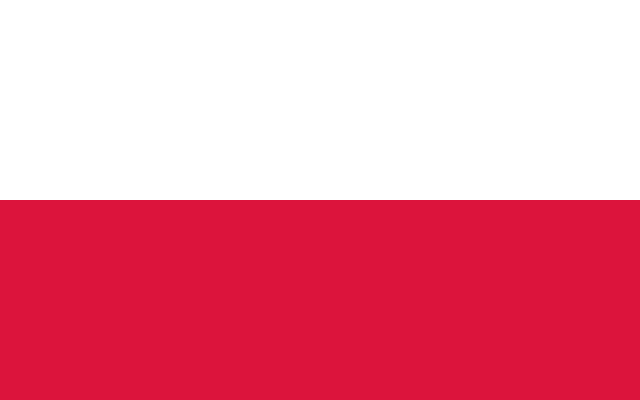
Poland
Location Info
- Continent: Europe
- Country: Poland
- Coordinates: 51.9194 , 19.1451
Trust Info
Verified Geographic and Statistical Data
🌍 Continents
Overview
Poland, officially the Republic of Poland, is a country located in Central Europe. It spans a diverse landscape that transitions from the sandy beaches of the Baltic Sea in the north to the rugged peaks of the Sudetes and Carpathian Mountains in the south. Bordered by seven nations, Poland serves as a vital geographic and political bridge between Western and Eastern Europe.
The nation's history is marked by periods of immense influence, such as the Polish-Lithuanian Commonwealth, as well as struggles for independence during the 19th and 20th centuries. Today, Poland is a developed market economy, a member of the European Union and NATO, and is recognized for its significant industrial output, rich cultural heritage, and influential contributions to science and the arts.
Truth & Facts
| Total Area | 312,696 km² |
| Coastline | 770 km |
| Population | 37.6 million |
| Official Language | Polish |
| Capital | Warsaw |
| Administrative Divisions | 16 Voivodeships |
| Establishment | 966 AD |
| EU Accession | May 1, 2004 |
| Currency | Złoty (PLN) |
| GDP Growth | 3.2% |
| Electricity Access | 100% |
| Literacy Rate | 99.8% |
| Health System | Public/Private Mix |
| UNESCO Sites | 17 |
| Annual Visitors | Approx. 19 million |
| National Parks | 23 |
| Major Airport | Warsaw Chopin (WAW) |
| Internet Penetration | 87% |
| Homicide Rate | 0.7 per 100k |
| Legislature | Bicameral (Sejm and Senat) |
| NATO Join Date | March 12, 1999 |
| Renewable Share | Approx. 25% |
| Population Density | 121 per km² |
| Forest Cover | 30% |
| Constitution of May 3 | 1791 |
📑 Table of Contents
Overview
Poland is a large nation in Central Europe with a total land area of 312,696 square kilometers. It is a parliamentary republic with its capital in Warsaw, a city rebuilt following the devastation of World War II. Poland is known for its cultural resilience and its role as a bridge between the East and West.
- Official Name: Republic of Poland (Rzeczpospolita Polska)
- Capital City: Warsaw
- Official Language: Polish
- Currency: Polish Złoty (PLN)
- International Memberships: EU, NATO, UN, OECD
History
The history of Poland began in 966 AD with the Christianization of the Piast dynasty. The 16th century was the 'Golden Age' of the Polish-Lithuanian Commonwealth, which was one of the largest and most tolerant states in Europe. In the late 18th century, Poland was partitioned by Russia, Prussia, and Austria, disappearing from the map for 123 years.
- 1918: Re-emergence as an independent state.
- 1939: Invasion by Germany and USSR, starting WWII.
- 1945-1989: Communist rule under the Eastern Bloc.
- 1980: Emergence of the Solidarity (Solidarność) movement.
- 1989: Transition to democracy.
Geography
Poland's geography is characterized by lowlands in the north and center, gradually rising toward the mountains in the south. The Baltic Sea forms the northern border, providing major ports like Gdansk and Szczecin. The Vistula and Oder are the primary river systems draining the country.
| Region | Features |
|---|---|
| North | Baltic coastline and lakelands |
| Central | Great Polish Plain |
| South | Tatra and Sudetes Mountains |
Climate and Weather
Poland has a temperate transitional climate, influenced by both oceanic and continental air masses. This results in four distinct seasons with significant temperature variations. Winters are generally cold and snowy, while summers can be warm with occasional thunderstorms.
- Winter: -5°C to 2°C average.
- Summer: 18°C to 25°C average.
- Spring/Autumn: Mild and unpredictable.
Population and Demographics
Poland has a population of approximately 37.6 million people. It is one of the most ethnically homogeneous countries in Europe, with over 95% identifying as Polish. Following the 2022 conflict in Ukraine, Poland became a major host for refugees, temporarily shifting demographic patterns.
- Median Age: 42 years.
- Urban Population: 60%.
- Major Ethnic Minority: Silesian, German, Ukrainian.
Culture and Lifestyle
Polish culture is deeply rooted in Catholicism and European history. It places high value on family life, hospitality, and education. Traditional customs remain strong in rural areas, while urban centers are characterized by a modern, cosmopolitan lifestyle.
- Religion: Predominantly Roman Catholic.
- Hospitality: 'Gość w dom, Bóg w dom' (Guest in the house, God in the house).
- Arts: Long tradition in classical music and literature.
Festivals and Events
Religious and national holidays are the cornerstone of the Polish event calendar. Christmas (Boże Narodzenie) and Easter (Wielkanoc) are celebrated with unique local traditions. National Independence Day on November 11 is the most important secular holiday.
- Wigilia: The traditional Christmas Eve supper.
- Lany Poniedziałek: Wet Monday (Easter tradition).
- Constitution Day: May 3 celebrations.
Food and Cuisine
Polish cuisine is hearty and traditionally utilizes meat, cabbage, and potatoes. It is famous for its savory dumplings, soups, and preserved vegetables. Modern Polish dining also incorporates high-quality organic produce and international influences.
- Pierogi: Filled dumplings (savory or sweet).
- Bigos: Hunter's stew with cabbage and meat.
- Żurek: Sour rye soup with egg and sausage.
Economy and Industries
Poland has the sixth-largest economy in the EU. It is a major producer of machinery, chemicals, and furniture. The country also boasts a rapidly growing tech sector and is a leading destination for business process outsourcing (BPO).
| Sector | Contribution |
|---|---|
| Services | 60% |
| Industry | 34% |
| Agriculture | 6% |
Cost of Living
The cost of living in Poland is generally lower than in Western Europe, though it has increased in recent years due to inflation. Warsaw is the most expensive city, while regional towns remain highly affordable for expatriates and students.
- Housing: Significant portion of monthly expenses.
- Food: Affordable local produce.
- Transport: Low-cost public transit.
Employment and Business
Poland features a low unemployment rate and a strong demand for skilled workers in IT, engineering, and logistics. The business environment is stable, supported by EU structural funds and a well-educated workforce.
- Standard Work Week: 40 hours.
- Business Language: Polish (English in international firms).
- Registration: Central Register and Information on Economic Activity (CEIDG).
Real Estate and Housing
The real estate market in Poland is characterized by a high rate of homeownership. In major cities, modern apartments dominate the market, while detached houses are common in suburban and rural areas.
- Rentals: Usually require a one-month deposit.
- Purchasing: Open to foreigners with some restrictions for agricultural land.
- Utilities: Typically paid separately from rent.
Transportation and Connectivity
Poland is a vital transit corridor with extensive rail and road networks. PKP Intercity connects major cities, while regional bus networks reach smaller towns. The country has several international airports, with Warsaw serving as the primary hub.
- Railways: PKP (Polish State Railways).
- Highways: Developing network of A and S roads.
- Ports: Gdansk, Gdynia, Szczecin.
Infrastructure and Utilities
Modernization of infrastructure has been a priority, funded significantly by EU investments. Most urban areas have access to high-speed fiber-optic internet and centralized heating systems.
- Water: Safe tap water in most cities.
- Waste: Mandatory recycling systems.
- Energy: Primarily coal, moving toward nuclear and wind.
Education
The Polish education system is public and free up to the university level for citizens. It follows a 12-year primary and secondary cycle. Polish universities, such as the Jagiellonian University, are among the oldest and most respected in Europe.
- Compulsory Age: 7 to 18 years.
- Higher Ed: 3-year Bachelor, 2-year Master.
- Literacy: Nearly 100%.
Healthcare
Healthcare is based on a public insurance system funded by the National Health Fund (NFZ). While public facilities provide comprehensive care, many residents also use private medical packages for faster access to specialists.
- Access: Free at point of use for insured persons.
- Emergencies: Dial 112 or 999.
- Pharmacies: Widely available (Apteka).
Tourist Attractions
Poland offers a mix of historical sites, natural wonders, and cultural landmarks. From the medieval squares of Krakow to the solemn grounds of Auschwitz-Birkenau, the country provides diverse experiences for visitors.
- Wawel Castle: Historic seat of Polish kings.
- Old Town Warsaw: UNESCO-listed reconstructed center.
- Wieliczka: Historic underground salt mine.
Things to Do
Outdoor activities are popular due to the varied landscape. Visitors can hike in the Tatra Mountains, sail in the Masurian Lake District, or enjoy the sandy beaches of the Baltic coast.
- Hiking: Zakopane and the High Tatras.
- Sailing: Over 2,000 lakes in Masuria.
- City Breaks: Exploring Wroclaw's dwarfs or Gdansk's shipyards.
Best Places to Visit
While Warsaw and Krakow are the most visited, other cities offer unique charms. Wroclaw is known for its architecture, and Gdansk for its maritime history and amber trade.
| City | Highlight |
|---|---|
| Krakow | Medieval Rynek Główny |
| Warsaw | Modern Skyscrapers & History |
| Wroclaw | Ostrów Tumski |
Travel Guide
Poland is part of the Schengen Area, allowing for easy entry for many nationalities. Public transport is the most efficient way to travel between cities, with frequent train and bus connections.
- Visa: Schengen rules apply.
- Connectivity: Local SIM cards are cheap and widely available.
- Tipping: 10% is standard in restaurants.
Nearby Places
Poland's central location makes it easy to visit neighboring countries. Berlin, Prague, and Vienna are all accessible by train or short flights from major Polish cities.
- West: Germany (Berlin).
- South: Czech Republic (Prague) and Slovakia.
- East: Ukraine, Belarus, and Lithuania.
Environment and Nature
Poland is home to some of Europe's last remaining primeval forests and unique wetlands. The country has 23 national parks dedicated to preserving its biodiversity, including the European bison.
- Bialowieza Forest: UNESCO World Heritage site.
- Biebrza National Park: Vast wetlands and bird habitats.
- Baltic Dunes: Moving dunes in Slowinski National Park.
Government and Administration
Poland is a representative democracy with a President as the head of state and a Prime Minister as the head of government. The legislative branch is the bicameral National Assembly.
- Executive: President and Council of Ministers.
- Legislature: Sejm (Lower) and Senat (Upper).
- Judiciary: Independent court system.
Safety and Public Services
Poland is consistently ranked as one of the safest countries in the world. Crime rates are low, and the police force is visible and helpful. Public services, such as fire brigades and paramedics, are highly efficient.
- Police: Policja.
- Emergency: 112 universal number.
- Safety: Low risk of natural disasters.
Best Time to Visit
The ideal time to visit depends on the planned activity. May to September offers the best weather for sightseeing and outdoor recreation, while December is popular for Christmas markets.
- Sightseeing: May, June, September.
- Skiing: January to March.
- Beach: July and August.
Local Business Directory
Major international corporations and local startups are clustered in Warsaw, Krakow, and Wroclaw. The country is also known for its strong retail sector and traditional craft industries.
- Tech Hubs: Warsaw and Krakow.
- Manufacturing: Upper Silesia.
- Agriculture: Central and Eastern Poland.
General Information FAQs
Where is Poland located?
Poland is located in Central Europe, bordered by the Baltic Sea to the north, Germany to the west, the Czech Republic and Slovakia to the south, and Ukraine, Belarus, Lithuania, and Russia (Kaliningrad) to the east.
What is Poland known for?
Poland is known for its resilient history, its capital Warsaw, the medieval city of Krakow, its delicious pierogi, and historical figures like Marie Curie and Nicolaus Copernicus.
Why is Poland famous?
Poland is famous for being the birthplace of the Solidarity movement, its dramatic history during WWII, and its 17 UNESCO World Heritage sites.
What country or region is Poland part of?
Poland is a sovereign state in Central Europe and is a member of the European Union, NATO, and the Schengen Area.
What is the population of Poland?
As of 2025, the population of Poland is estimated to be approximately 37.6 million people.
What languages are spoken in Poland?
The official and most widely spoken language is Polish. English and German are common foreign languages, especially among the younger generation and in business.
What time zone is Poland in?
Poland is in the Central European Time (CET) zone, which is UTC+1. It observes Daylight Saving Time (CEST, UTC+2) from March to October.
What are the key facts about Poland?
Key facts include its capital Warsaw, its currency the Zloty, its status as a parliamentary republic, and its diverse geography from mountains to the sea.
What makes Poland unique?
Poland is unique for its entirely reconstructed historical centers (like Warsaw's Old Town), its strong Catholic identity, and its survival as a nation despite historical partitions.
How large is Poland in area?
Poland covers a total area of 312,696 square kilometers, making it the ninth-largest country in Europe.
History FAQs
What is the history of Poland?
Poland's history dates back over 1,000 years, beginning with the Christianization of the Piast dynasty in 966, the greatness of the Polish-Lithuanian Commonwealth, a century of partitions, and modern recovery after the Cold War.
When was Poland established?
The traditional date for the establishment of the Polish state is 966 AD, when Duke Mieszko I converted to Christianity.
What major historical events happened in Poland?
Major events include the Battle of Grunwald (1410), the Constitution of May 3 (1791), the Warsaw Uprising (1944), and the Round Table Agreements (1989).
Who were important historical figures from Poland?
Important figures include King Casimir the Great, Nicolaus Copernicus, Frederic Chopin, Marie Curie, Pope John Paul II, and Lech Walesa.
How has Poland developed over time?
Poland has transitioned from a medieval kingdom to a massive commonwealth, then struggled through partitions and world wars, before emerging as a stable, democratic, and high-income EU member.
Geography & Environment FAQs
What is the geography of Poland?
The geography consists mostly of the North European Plain, with the Baltic Sea in the north and the Sudetes and Carpathian mountains in the south.
What natural features surround Poland?
It is surrounded by the Baltic Sea to the north and various mountain ranges to the south, with flat plains extending into its neighbors to the east and west.
Are there mountains, rivers, or lakes near Poland?
Yes, the Tatra mountains are in the south, the Vistula and Oder rivers run through the country, and the Masurian Lake District has over 2,000 lakes.
What is the elevation of Poland?
The average elevation is 173 meters above sea level. The highest point is Mount Rysy at 2,499 meters.
What ecosystems exist around Poland?
Poland has diverse ecosystems including temperate deciduous forests, alpine meadows, coastal dunes, and peat bogs.
Climate & Weather FAQs
What is the climate like in Poland?
The climate is temperate transitional, featuring cold winters and warm, pleasant summers.
What is the average temperature in Poland?
The annual average is around 8-9°C, with summer peaks near 25°C and winter lows below 0°C.
What is the weather like throughout the year in Poland?
Spring and autumn are often mild and windy, while summer is sunny with rain, and winter is characterized by snow and freezing temperatures.
Does Poland experience extreme weather?
Extreme weather is rare, though the country can experience heatwaves in summer and heavy blizzards or flooding in winter and spring.
What is the best time of year to visit Poland?
The best time is usually from May to September, when the weather is warmest and the days are long.
Population & Society FAQs
What is the population density of Poland?
The population density is approximately 121 people per square kilometer.
What ethnic groups live in Poland?
Poland is very homogeneous; over 95% are ethnic Poles. Minority groups include Silesians, Germans, and Ukrainians.
What religions are practiced in Poland?
The vast majority of the population (around 85%) identifies as Roman Catholic.
What is daily life like in Poland?
Daily life is typical of modern Europe, with a strong focus on work during the week and family or social gatherings on weekends.
How diverse is the population of Poland?
Historically diverse, the modern population is quite uniform, though major cities are becoming more international.
Culture & Traditions FAQs
What cultural traditions are important in Poland?
Importance is placed on family meals, religious holidays, and national remembrance days.
What festivals are celebrated in Poland?
Major festivals include Christmas, Easter, All Saints' Day, and the Corpus Christi procession.
What cultural landmarks exist in Poland?
Landmarks include the Wawel Royal Castle, the Jasna Góra Monastery, and the Wieliczka Salt Mine.
What traditional clothing or customs are common in Poland?
Traditional folk costumes (Stroje ludowe) are now mostly seen at festivals. Customs include sharing 'opłatek' (wafer) at Christmas.
What arts and crafts are associated with Poland?
Poland is famous for Bolesławiec pottery, amber jewelry, and paper cutting (Wycinanki).
Food & Cuisine FAQs
What foods is Poland known for?
Poland is known for pierogi, kielbasa (sausage), and bigos (hunter's stew).
What traditional dishes originate from Poland?
Dishes include Gołąbki (cabbage rolls), Żurek (sour rye soup), and Placki ziemniaczane (potato pancakes).
What are the best restaurants in Poland?
Highly rated restaurants are found in Warsaw and Krakow, ranging from traditional 'Milk Bars' to Michelin-starred establishments.
What local ingredients are commonly used in Poland cuisine?
Common ingredients include potatoes, beets, cabbage, mushrooms, and sour cream.
What food markets or street foods are popular in Poland?
Zapiekanka (an open-faced toasted baguette) and Oscypek (smoked cheese) are popular street foods.
Economy & Business FAQs
What are the main industries in Poland?
Main industries include automotive manufacturing, chemicals, food processing, and furniture production.
What economic activities drive the economy of Poland?
The economy is driven by domestic consumption, industrial exports, and a growing services sector.
What businesses operate in Poland?
Many global corporations have hubs in Poland, alongside major local firms like PKN Orlen and Allegro.
Is Poland an important economic center?
Yes, it is the largest economy in Central and Eastern Europe and a significant player in the EU internal market.
What are the major exports or products from Poland?
Major exports include vehicle parts, household appliances, furniture, and agricultural products.
Employment & Jobs FAQs
What job opportunities are available in Poland?
Opportunities are strong in IT, logistics, shared services (BPO), and manufacturing.
What are the major employers in Poland?
Major employers include the state (health, education), as well as companies like Amazon, Google, and Volkswagen.
What skills are in demand in Poland?
Software development, engineering, and multilingual customer service are in high demand.
Is Poland a good place to work?
Yes, with a growing economy and low unemployment, it offers stability and career progression.
What is the unemployment rate in Poland?
The unemployment rate is historically low, usually hovering between 3% and 5%.
Cost of Living FAQs
Is Poland expensive to live in?
Compared to Western Europe or the US, Poland is relatively affordable, though prices in cities like Warsaw are rising.
What is the average cost of living in Poland?
A single person may need between 3,500 and 5,500 PLN per month for a comfortable modest life, depending on the city.
How much does housing cost in Poland?
Rent for a one-bedroom apartment in a major city ranges from 2,500 to 4,500 PLN.
What are average food and utility costs in Poland?
Utilities for an apartment typically cost 600-900 PLN, while food costs are moderate if buying local.
Is Poland affordable compared to nearby cities?
It is generally more affordable than Berlin or Vienna, but comparable to Prague or Budapest.
Housing & Real Estate FAQs
What types of housing are available in Poland?
Housing includes Soviet-era blocks of flats, modern apartment complexes, and detached suburban houses.
What is the average home price in Poland?
In Warsaw, prices exceed 15,000 PLN per square meter; regional cities are lower.
Is it better to rent or buy property in Poland?
Buying is historically popular, though renting is common among young professionals and expats.
Which neighborhoods are popular in Poland?
In Warsaw, Wilanów and Mokotów are popular; in Krakow, Kazimierz and Podgórze are sought after.
How has the property market changed in Poland?
The market has seen significant price increases over the last decade due to high demand and investment.
Transportation FAQs
How do you get to Poland?
Poland is easily reached by plane, train from neighboring EU countries, or by car/bus.
What is the nearest airport to Poland?
Warsaw Chopin Airport (WAW) is the largest. Others include Krakow (KRK) and Gdansk (GDN).
Does Poland have railway connections?
Yes, PKP operates a vast domestic and international network connecting to Berlin, Prague, and beyond.
How reliable is public transportation in Poland?
Public transport in cities is highly reliable, frequent, and affordable.
What major highways or roads connect to Poland?
The A1, A2, and A4 highways are the main arteries connecting Poland to Germany and Ukraine.
Education FAQs
What schools are located in Poland?
Poland has a wide network of public primary and secondary schools, along with international private schools.
Are there universities in Poland?
Yes, major universities include the University of Warsaw, Jagiellonian University, and AGH University of Science and Technology.
What is the literacy rate in Poland?
The literacy rate is near universal at 99.8%.
What educational opportunities exist in Poland?
Opportunities include Erasmus exchanges, technical training, and a growing number of English-taught degree programs.
Is Poland a good place for students?
Yes, because of low tuition fees (free for EU citizens in public schools) and a relatively low cost of living.
Healthcare FAQs
What hospitals are available in Poland?
Major cities have large university teaching hospitals and specialized private clinics.
Are there emergency medical services in Poland?
Yes, 24/7 emergency services are available by dialing 112 or 999.
What healthcare facilities exist in Poland?
Facilities include local health centers (POZ), regional hospitals, and private outpatient clinics.
Is healthcare affordable in Poland?
It is free for those covered by the National Health Fund; private care is affordable compared to Western standards.
Are specialized medical services available in Poland?
Yes, Poland is a destination for medical tourism in dentistry, cardiology, and orthopedics.
Tourism & Travel FAQs
What are the top tourist attractions in Poland?
Top attractions include Krakow's Main Square, the Wieliczka Salt Mine, and the Tatra Mountains.
What are the best things to do in Poland?
Things to do include visiting the museums of Warsaw, hiking in Zakopane, and exploring the Teutonic castles.
Is Poland worth visiting?
Absolutely. It offers a unique combination of historical significance, natural beauty, and modern vitality.
What landmarks should visitors see in Poland?
Visitors should see the Royal Castle in Warsaw, Malbork Castle, and the Cloth Hall in Krakow.
How many days should tourists spend in Poland?
A basic tour takes 7-10 days, while a deep exploration of multiple regions requires at least two weeks.
Nearby Places FAQs
What places are near Poland worth visiting?
Nearby destinations include Berlin, Prague, and the Baltic states.
What cities or towns are close to Poland?
Close cities include Frankfurt (Oder) and Görlitz in Germany, and Ostrava in the Czech Republic.
What natural attractions are near Poland?
The High Tatras are shared with Slovakia, and the Bohemian Switzerland park is near the Czech border.
What day trips can be taken from Poland?
From Wroclaw, one can visit the Giant Mountains; from Krakow, the Eagle’s Nests Trail.
What famous destinations are within reach of Poland?
Vienna and Budapest are reachable within 5-7 hours by train from southern Poland.
Safety FAQs
Is Poland safe to live in?
Yes, Poland is consistently ranked among the safest countries in Europe for both residents and expats.
Is Poland safe for tourists?
Yes, violent crime is very rare. Tourists should mainly be aware of petty theft in crowded areas.
What is the crime rate in Poland?
The crime rate is very low compared to the EU average.
What emergency services operate in Poland?
The main services are the Police (997), Fire Brigade (998), and Ambulance (999), or the general 112.
What safety tips should visitors follow in Poland?
Avoid unlicensed taxis, stay aware of your surroundings at night in quiet areas, and always carry a form of ID.
Lifestyle & Living FAQs
Is Poland a good place to live?
Yes, for those who value safety, history, and a balance between tradition and modernization.
What recreational activities are available in Poland?
Recreation includes cycling, football, attending theater, and enjoying forest walks.
Is Poland family-friendly?
Very family-oriented, with many parks, child-friendly restaurants, and safe public spaces.
What outdoor activities are popular in Poland?
Skiing, mountain climbing, sailing, and mushroom picking are very popular.
What makes life enjoyable in Poland?
The rich cultural life, seasonal traditions, and the rapid improvement in the quality of urban spaces.
Practical Information FAQs
What travel tips should visitors know about Poland?
Validate your transport tickets, learn a few basic Polish phrases, and use cards for payment as they are accepted almost everywhere.
What local customs should visitors respect in Poland?
Be respectful in churches, remove shoes when entering someone's home, and avoid discussing sensitive politics or history unless invited.
How accessible is Poland for international visitors?
Highly accessible via numerous international flight routes and land borders with the EU.
What services are available for tourists in Poland?
Tourist information centers (IT) are found in every major city, offering maps and advice in multiple languages.
What important information should travelers know before visiting Poland?
The currency is the Zloty, not the Euro; Sunday shopping is largely restricted; and drinking in public is prohibited.