Nepal
Location Info
- Continent: Asia
- Country: Nepal
- Coordinates: 28.3949 , 84.124
Trust Info
Verified Geographic and Governmental Data
🌍 Continents
Overview
Nepal, officially the Federal Democratic Republic of Nepal, is a landlocked country located in South Asia, primarily situated in the Himalayas. It is bordered by China to the north and India to the south, east, and west. The country's geography is remarkably diverse, ranging from the fertile, humid Terai plains in the south to the world's highest peaks, including Mount Everest (Sagarmatha), in the north.
Historically, Nepal was a collection of small principalities until its unification in the 18th century. Transitioning from a monarchy to a federal republic in 2008, Nepal is today recognized for its rich cultural heritage, multi-ethnic society, and its strategic importance as a link between the two most populous nations on Earth.
Truth & Facts
| Total Area | 147,516 sq km |
| Highest Point | 8,848.86 m (Everest) |
| Population | 29,164,578 |
| Government Type | Federal Republic |
| Unification | 1768 AD |
| Currency | Nepalese Rupee |
| Electrification | 95% |
| Literacy Rate | 76.2% |
| Life Expectancy | 71.3 Years |
| Official Language | Nepali |
| Major Attraction | Mount Everest |
| Forest Cover | 44.74% |
| Main Airport | TIA (Kathmandu) |
| Internet Penetration | 90% |
| Police Number | 100 |
| No. of Provinces | 7 |
| UN Admission | 1955 |
| Primary Source | Hydropower |
| GDP Share | 24% |
| National Dish | Dal Bhat |
| National Animal | Cow |
📑 Table of Contents
Overview
Nepal is a landlocked sovereign state in South Asia. It is home to eight of the world's ten highest mountains.
- Capital: Kathmandu
- System: Federal Republic
- Language: Nepali
History
The history of Nepal began with the Kirat and Lichhavi eras, followed by unification in 1768.
| Era | Years |
|---|---|
| Malla | 1201–1769 |
| Shah | 1768–2008 |
Geography
Divided into Terai, Hills, and Mountains. Elevation ranges from 60m to 8848m.
- Everest
- Annapurna
- Koshi River
Climate
Varies from subtropical to arctic. Monsoon occurs June-Sept.
Demographics
Home to over 125 ethnic groups and 123 languages.
Culture
Rich in arts, wood carvings, and communal living traditions.
Festivals
Major celebrations include Dashain, Tihar, and Holi.
Cuisine
Staple food is Dal Bhat. Momos are popular urban snacks.
Economy
Driven by agriculture, remittances, and tourism.
Cost of Living
Highly affordable for international standards.
Employment
Agriculture employs 60%; service sector is growing.
Real Estate
Rapid urbanization in Kathmandu valley driving prices.
Transportation
Mainly road-based; air travel vital for mountain regions.
Infrastructure
Massive hydropower expansion is currently underway.
Education
Tribhuvan University is the primary higher education body.
Healthcare
Mix of public hospitals and private specialized clinics.
Attractions
Everest, Lumbini, and Kathmandu Valley temples.
Activities
Trekking, mountaineering, and white-water rafting.
Best Places
Pokhara, Chitwan, and Bhaktapur are top destinations.
Travel Guide
Visas are available on arrival for most visitors.
Nearby Places
Connects to India, China (Tibet), and Bhutan.
Nature
Hosts the rare one-horned rhino and snow leopard.
Government
Federal system with 7 provinces and 753 local units.
Safety
Considered a safe destination for international travelers.
Best Time
Autumn (Oct-Nov) and Spring (Mar-May) are ideal.
Directory
Thamel is the primary hub for tourism businesses.
General Information FAQs
Where is Nepal located?
Nepal is in South Asia, bordered by China and India.
What is Nepal known for?
Known for Mt. Everest and being the birthplace of Buddha.
Why is Nepal famous?
Famous for the Himalayas, temples, and Gurkha soldiers.
What country or region is Nepal part of?
It is an independent country in South Asia.
What is the population of Nepal?
Approximately 29.16 million according to the 2021 census.
What languages are spoken in Nepal?
Nepali is the official language; over 120 others exist.
What time zone is Nepal in?
Nepal Standard Time is UTC +5:45.
What are the key facts about Nepal?
It is landlocked, mountainous, and a federal republic.
What makes Nepal unique?
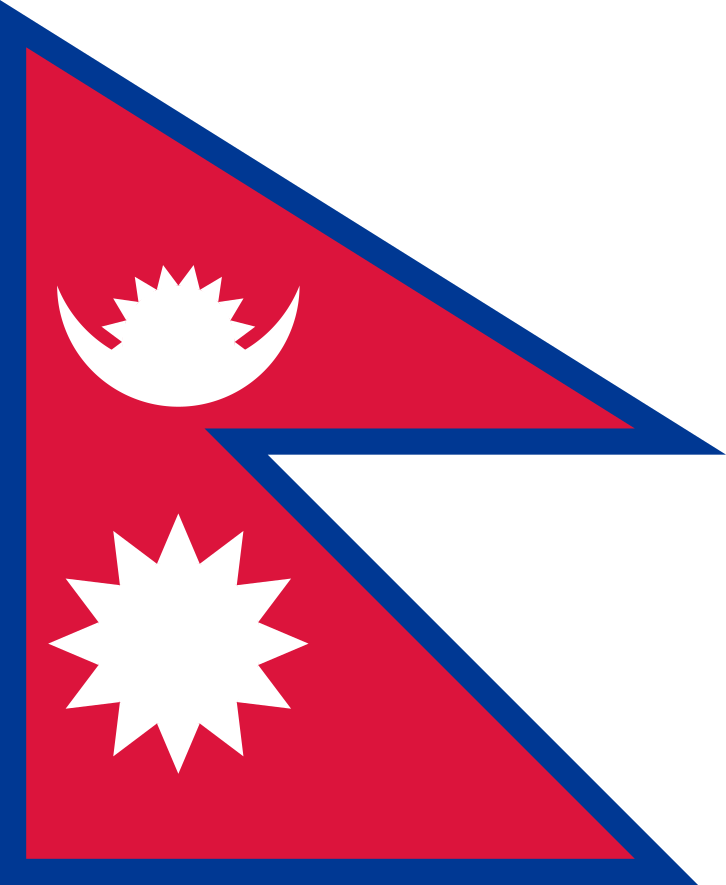
It has the world's only non-quadrilateral flag.
How large is Nepal in area?
It is about 147,516 square kilometers.
History FAQs
What is the history of Nepal?
Ancient kingdoms led to unification in the 18th century.
When was Nepal established?
The unified kingdom was formed in 1768.
What major historical events happened in Nepal?
The unification, the Rana rule, and the 2008 republic declaration.
Who were important historical figures from Nepal?
Buddha, Prithvi Narayan Shah, and Bhanubhakta Acharya.
How has Nepal developed over time?
Evolved from absolute monarchy to a federal democracy.
Geography & Environment FAQs
What is the geography of Nepal?
Consists of Terai plains, Hills, and the Himalayas.
What natural features surround Nepal?
The Great Himalaya Range to the north and plains to the south.
Are there mountains, rivers, or lakes near Nepal?
Yes, home to Everest and rivers like the Koshi and Karnali.
What is the elevation of Nepal?
Ranges from 60m to 8848.86m.
What ecosystems exist around Nepal?
Subtropical, temperate, alpine, and tundra.
Climate & Weather FAQs
What is the climate like in Nepal?
Subtropical in the south, arctic in the high mountains.
What is the average temperature in Nepal?
Varies by altitude; Kathmandu averages 10-25°C.
What is the weather like throughout the year in Nepal?
Distinct spring, summer (monsoon), autumn, and winter seasons.
Does Nepal experience extreme weather?
Yes, heavy monsoon rains and extreme cold in the mountains.
What is the best time of year to visit Nepal?
October and November are the best months.
Population & Society FAQs
What is the population density of Nepal?
About 198 people per sq km.
What ethnic groups live in Nepal?
Chhetri, Brahman, Magar, Tharu, Tamang, Newar, etc.
What religions are practiced in Nepal?
Hinduism (majority), Buddhism, Islam, and Kirat.
What is daily life like in Nepal?
Agri-centric in villages, fast-paced in Kathmandu.
How diverse is the population of Nepal?
Highly diverse with over 100 castes and ethnicities.
Culture & Traditions FAQs
What cultural traditions are important in Nepal?
Family values, religious syncretism, and hospitality.
What festivals are celebrated in Nepal?
Dashain, Tihar, Holi, and Lhosar.
What cultural landmarks exist in Nepal?
Swayambhunath, Pashupatinath, and Lumbini.
What traditional clothing or customs are common in Nepal?
Daura Suruwal and Saree; removing shoes indoors.
What arts and crafts are associated with Nepal?
Thangka painting, wood carving, and metalwork.
Food & Cuisine FAQs
What foods is Nepal known for?
Dal Bhat and Momos.
What traditional dishes originate from Nepal?
Gundruk, Dhido, and Sel Roti.
What are the best restaurants in Nepal?
Found in Thamel and Lakeside, Pokhara.
What local ingredients are commonly used in Nepal cuisine?
Ginger, garlic, turmeric, and mustard oil.
What food markets or street foods are popular in Nepal?
Bara, Chatpate, and Pani Puri are popular street snacks.
Economy & Business FAQs
What are the main industries in Nepal?
Tourism, textiles, and agriculture.
What economic activities drive the economy of Nepal?
Remittances and hydropower development.
What businesses operate in Nepal?
Retail, hospitality, and telecommunications.
Is Nepal an important economic center?
It is a growing market in South Asia.
What are the major exports or products from Nepal?
Tea, carpets, and cardamom.
Employment & Jobs FAQs
What job opportunities are available in Nepal?
IT, tourism, and development sectors.
What are the major employers in Nepal?
Government, banks, and NGOs.
What skills are in demand in Nepal?
Engineering, teaching, and hospitality management.
Is Nepal a good place to work?
Good for those in social development and tourism.
What is the unemployment rate in Nepal?
Officially around 11%.
Cost of Living FAQs
Is Nepal expensive to live in?
No, it is very affordable.
What is the average cost of living in Nepal?
$400-$700 monthly for a modest lifestyle.
How much does housing cost in Nepal?
$150-$400 for standard city apartments.
What are average food and utility costs in Nepal?
Low; locally sourced food is very cheap.
Is Nepal affordable compared to nearby cities?
Cheaper than most Indian metros.
Housing & Real Estate FAQs
What types of housing are available in Nepal?
Apartments, bungalows, and traditional row houses.
What is the average home price in Nepal?
Land prices in Kathmandu are very high.
Is it better to rent or buy property in Nepal?
Renting is common for foreigners.
Which neighborhoods are popular in Nepal?
Jhamsikhel and Maharajgunj.
How has the property market changed in Nepal?
Shifted toward high-rise living in cities.
Transportation FAQs
How do you get to Nepal?
Mainly through Tribhuvan International Airport.
What is the nearest airport to Nepal?
KTM in Kathmandu.
Does Nepal have railway connections?
One link from Jaynagar to Janakpur.
How reliable is public transportation in Nepal?
Frequent but often slow and crowded.
What major highways or roads connect to Nepal?
Prithvi Highway and Mahendra Highway.
Education FAQs
What schools are located in Nepal?
Government and private English-medium schools.
Are there universities in Nepal?
Yes, TU and KU are the leading ones.
What is the literacy rate in Nepal?
76.2% as of 2021.
What educational opportunities exist in Nepal?
Medicine, Engineering, and Buddhist studies.
Is Nepal a good place for students?
Yes, particularly for research and language studies.
Healthcare FAQs
What hospitals are available in Nepal?
Bir, Teaching, and Mediciti.
Are there emergency medical services in Nepal?
Yes, mostly in the capital.
What healthcare facilities exist in Nepal?
Health posts in villages and hospitals in cities.
Is healthcare affordable in Nepal?
Generally very affordable.
Are specialized medical services available in Nepal?
Available for eyes, heart, and kidney in Kathmandu.
Tourism & Travel FAQs
What are the top tourist attractions in Nepal?
Everest Base Camp and Phewa Lake.
What are the best things to do in Nepal?
Trekking and cultural tours.
Is Nepal worth visiting?
Yes, for nature and culture lovers.
What landmarks should visitors see in Nepal?
Boudhanath and Bhaktapur Durbar Square.
How many days should tourists spend in Nepal?
10-14 days for a standard tour.
Nearby Places FAQs
What places are near Nepal worth visiting?
Lhasa and Darjeeling.
What cities or towns are close to Nepal?
Gorakhpur and Siliguri.
What natural attractions are near Nepal?
Sikkim mountains.
What day trips can be taken from Nepal?
Nagarkot for sunrise views.
What famous destinations are within reach of Nepal?
The Taj Mahal (via India).
Safety FAQs
Is Nepal safe to live in?
Yes, very low violent crime rate.
Is Nepal safe for tourists?
One of the safest countries for travelers.
What is the crime rate in Nepal?
Low, though pickpocketing exists in cities.
What emergency services operate in Nepal?
Police (100) and Ambulance (102).
What safety tips should visitors follow in Nepal?
Avoid solo trekking; drink bottled water.
Lifestyle & Living FAQs
Is Nepal a good place to live?
Yes, for a peaceful, scenic environment.
What recreational activities are available in Nepal?
Yoga, football, and cycling.
Is Nepal family-friendly?
Very welcoming culture for families.
What outdoor activities are popular in Nepal?
Hiking and paragliding.
What makes life enjoyable in Nepal?
Social warmth and festivals.
Practical Information FAQs
What travel tips should visitors know about Nepal?
Carry small cash bills; be patient with traffic.
What local customs should visitors respect in Nepal?
Modest dress in temples; use right hand for gifts.
How accessible is Nepal for international visitors?
Visas on arrival make it very accessible.
What services are available for tourists in Nepal?
Guides, trekking shops, and money changers.
What important information should travelers know before visiting Nepal?
Power plugs are Type C/D/M; voltage is 230V.
Additional Facts FAQs
What is the national animal of Nepal?
The Cow.
What is the national flower?
Rhododendron (Lali Gurans).
What is the national bird?
Danphe (Himalayan Monal).
Is Mount Everest entirely in Nepal?
It sits on the border of Nepal and China.
Can you see Everest from Kathmandu?
Rarely, only on very clear winter days.