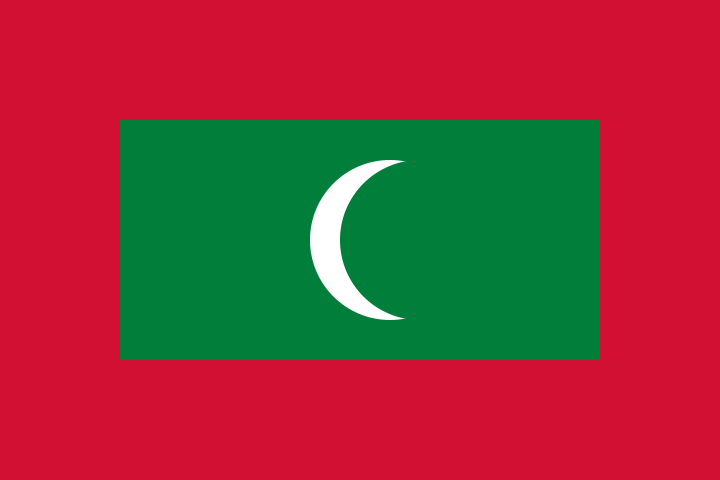
Maldives
Location Info
- Continent: Asia
- Country: Maldives
- Coordinates: 3.2028 , 73.2207
Trust Info
Verified Geographic Information
🌍 Continents
Overview
The Maldives is an archipelagic state situated in the Indian Ocean, southwest of India and Sri Lanka. It consists of a double chain of 26 atolls, stretching from Ihavandhippolhu Atoll in the north to Addu Atoll in the south. It is the smallest country in Asia by land area and population, with a unique geography defined by coral reefs and sandbanks.
Historically, the Maldives occupied a strategic position along major marine trade routes. Having transitioned from a Buddhist kingdom to an Islamic Sultanate in the 12th century, the nation later became a British protectorate before gaining full independence in 1965. Today, it is globally recognized for its tourism-driven economy and its proactive stance on international climate change policy due to its low-lying terrain.
Truth & Facts
| Total Atolls | 26 natural atolls |
| Number of Islands | Approx. 1,192 |
| Total Population | 515,122 |
| Official Language | Dhivehi |
| Capital City | Male |
| Administrative Divisions | 21 Administrative Atolls |
| Independence from UK | July 26, 1965 |
| Islamic Conversion | 1153 AD |
| Currency | Maldivian Rufiyaa (MVR) |
| GDP Per Capita | $11,818 (Nominal) |
| Main International Airport | Velana International Airport (VIA) |
| Literacy Rate | 98% |
| Primary Hospital | Indira Gandhi Memorial Hospital (IGMH) |
| National Anthem | Gaumee Salaam |
| Annual Visitors | 1.8 Million (2023) |
| UNESCO Biosphere | Baa Atoll |
| Seaplane Operator | Trans Maldivian Airways |
| Internet TLD | .mv |
| Emergency Number | 119 (Police), 118 (Fire) |
| Constitution Adopted | August 7, 2008 |
| UN Member Since | September 21, 1965 |
| Electricity Standard | 230V, 50Hz (Type G) |
| Total Land Area | 298 sq km |
| Max Elevation | 2.4 meters (Villingili) |
| Denomination | Sunni Islam |
📑 Table of Contents
Overview
The Maldives is a sovereign island nation located in the Indian Ocean, southwest of the Indian subcontinent. It consists of a chain of atolls made of coral reefs and sandbanks, spread over roughly 90,000 square kilometers of ocean. The country is famous for its unique geography and is considered the world's most dispersed country.
- Capital: Male
- Official Language: Dhivehi
- Religion: Islam
- Total Area: 298 sq km
- Number of atolls: 26
History
Early Maldivian history is characterized by the influence of seafaring people from South Asia and East Africa. The islands were initially Buddhist before the formal conversion to Islam in 1153 AD under Sultan Dhovemi. This conversion established a long line of Sultanates that ruled the archipelago for centuries.
- Early settlement: Dravidian and Indo-Aryan peoples
- Buddhist Period: Approx. 3rd century BC to 1153 AD
- Islamic Sultanate: 1153–1968
- British Protectorate: 1887–1965
- Republic established: 1968
Geography
The Maldives is situated on the Chagos-Laccadive Ridge, a vast submarine mountain range in the Indian Ocean. The country is composed of coral atolls that have formed around submerged volcanic peaks. It is globally recognized as the lowest-lying nation, which presents significant environmental challenges.
| Feature | Details |
|---|---|
| Highest Point | 2.4 m (Addu Atoll) |
| Average Elevation | 1.5 m |
| Coastal Line | 644 km |
Climate & Weather
The country experiences a tropical monsoon climate. There are two distinct seasons: the dry Northeast Monsoon (Iruvai) and the wet Southwest Monsoon (Hulhangu). Humidity remains high throughout the year, and temperatures are consistently warm.
- Dry Season: November to April
- Wet Season: May to October
- Average Temp: 25°C to 31°C
Population & Demographics
The population of the Maldives is predominantly of Indo-Aryan and Dravidian descent, with significant historical influences from Arab and African traders. The majority of the population resides in Male, the capital, which is one of the most densely populated cities in the world.
- Total Population: ~515,000
- Density: ~1,700/km²
- Ethnic Groups: Dhivehi
Culture & Lifestyle
Maldivian culture is deeply rooted in Islamic traditions and maritime heritage. Daily life on local islands often revolves around the fishing industry and community gatherings. Craftsmanship, particularly in lacquer work and mat weaving, remains an important cultural expression.
- Language: Dhivehi (Indo-Aryan family)
- Script: Thaana (written right-to-left)
- Traditional Music: Boduberu
Festivals & Events
Festivals in the Maldives are primarily Islamic religious holidays and national milestones. These events are often marked by community feasts, traditional dances, and parades. Eid celebrations are particularly significant on inhabited islands.
- Eid al-Fitr: End of Ramadan
- National Day: Commemorates victory over the Portuguese
- Independence Day: July 26
- Republic Day: November 11
Food & Cuisine
Maldivian cuisine, known as Dhivehi Keun, relies heavily on fish (especially tuna), coconut, and starches like rice and taro. Flavors are influenced by Indian and Sri Lankan traditions but remain distinct due to the abundance of marine resources.
- Garudhiya: Clear fish broth
- Mas Huni: Shredded smoked tuna with coconut
- Bis Keemiya: Pastry filled with tuna and cabbage
- Huni Roshi: Flatbread with coconut
Economy & Industries
The Maldivian economy has transformed from a subsistence fishing society to a middle-income country driven by tourism. The 'one island, one resort' model has been highly successful in attracting international investment and high-end travelers.
| Sector | Contribution to GDP |
|---|---|
| Tourism | ~28% |
| Fisheries | ~7% |
| Construction | ~6% |
Cost of Living
The cost of living in the Maldives is relatively high due to the necessity of importing nearly all consumer goods. Prices in the capital, Male, are significantly higher than on rural islands, particularly regarding rent and fresh produce.
- Housing: High in Male/Hulhumale
- Imports: Most food and fuel are imported
- Subsidies: Government provides subsidies for electricity and staples
Employment & Business
The tourism sector is the largest employer in the private sector. However, many Maldivians also work in the civil service and the fishing industry. The government has recently focused on diversifying the economy through the 'Blue Economy' initiative.
- Top Employer: Tourism Industry
- Key Resource: Skipjack and Yellowfin Tuna
- Emerging Sector: Digital Services
Real Estate & Housing
Land is a scarce resource in the Maldives. In Male, vertical expansion is the primary solution to housing shortages. Large-scale land reclamation projects, such as Hulhumale, have been developed to provide residential space for the growing population.
- Male: Extreme density, high-rise apartments
- Hulhumale: Planned artificial island
- Local Islands: Traditional single-story homes
Transportation & Connectivity
Transportation is primarily maritime or aerial. Ferries and speedboats connect inhabited islands, while seaplanes and domestic flights serve the resort network. The China-Maldives Friendship Bridge connects Male to the airport island.
- International Hub: Velana International Airport
- Water Transport: Dhoni, Speedboats, Ferries
- Air Transport: Dash-8 and Seaplanes
Infrastructure & Utilities
Utility provision is challenging due to island fragmentation. Desalination plants provide nearly all fresh water on inhabited islands. Electricity is primarily generated through diesel generators, though solar integration is increasing.
- Water: Desalination (RO plants)
- Waste: Thilafushi (waste management island)
- Energy: Transitioning to renewable hybrid systems
Education
The Maldives follows a British-based curriculum for secondary education. Higher education is provided by the Maldives National University and several private colleges. Literacy rates are among the highest in South Asia.
- Main University: Maldives National University (MNU)
- Exams: IGCSE and A-Levels
- Free Education: Provided up to Grade 12
Healthcare
The healthcare system is organized into a hierarchy of health centers, atoll hospitals, and tertiary hospitals in the capital. Specialized care often requires travel to Male or abroad to neighboring countries like India or Sri Lanka.
- Tertiary Hospitals: IGMH, ADK, Tree Top
- Universal Health Insurance: Aasandha
- Medical Evacuation: Sea ambulance service
Tourist Attractions
The Maldives is defined by its natural beauty. Major attractions include vibrant coral reefs, shipwrecks, and sandbanks. Cultural sites in Male offer insight into the country's Islamic history.
- Baa Atoll: UNESCO Biosphere Reserve
- Hukuru Miskiy: 17th-century Coral Stone Mosque
- Banana Reef: Famous diving site
- Maafushi: Popular local tourism island
Things to Do
Activities in the Maldives are primarily water-based. Scuba diving and snorkeling are the main draws due to the clarity of the water and the abundance of marine life like manta rays and whale sharks.
- Diving: Ari Atoll sites
- Water Sports: Surfing, Jet skiing, Parasailing
- Fishing: Night fishing trips
- Spa Treatments: Resort-based wellness
Best Places to Visit
While every atoll offers unique experiences, certain locations are noted for specific features. Ari Atoll is known for whale shark sightings, while Addu Atoll offers a unique historical perspective as a former British base.
- Male: Cultural and commercial heart
- Fuvahmulah: Unique single-island atoll
- Vaavu Atoll: Known for nurse shark diving
Travel Guide
Entry to the Maldives is straightforward for most nationalities, with a 30-day visa on arrival. Visitors should be aware of local customs, particularly regarding the prohibition of alcohol and pork on inhabited islands.
- Visa: On arrival for all tourists
- Dress Code: Modest on local islands
- Alcohol: Only available on resort islands
Nearby Places
The Maldives is relatively isolated in the Indian Ocean. Its nearest neighbors are the Lakshadweep islands of India to the north and the Chagos Archipelago to the south. Sri Lanka is the closest major landmass.
- India: ~600 km to the north
- Sri Lanka: ~700 km to the northeast
- Chagos: ~500 km to the south
Environment & Nature
The Maldives environment is a delicate ecosystem of coral reefs and mangroves. Protecting the reef system is vital for both coastal protection and the economy. The nation is a global leader in advocating for climate action.
- Coral Reefs: Form the foundation of the country
- Fauna: Manta rays, Whale sharks, Sea turtles
- Flora: Coconut palms, Screwpine, Mangroves
Government & Administration
The Maldives is a presidential representative democratic republic. The President serves as both head of state and head of government. The legislative power is vested in the People's Majlis.
- Executive: President and Cabinet
- Legislature: People's Majlis (Unicameral)
- Judiciary: Supreme Court and High Court
Safety & Public Services
The Maldives is generally safe for residents and visitors. Public services are managed by state-owned enterprises and government ministries. Emergency services are well-established in the Male region.
- Crime: Very low rate of violent crime
- Police: Maldives Police Service (MPS)
- Fire: Maldives National Defence Force (MNDF) Fire Service
Best Time to Visit
The peak season for travel corresponds with the dry Northeast Monsoon. This period offers the most sun and the calmest seas, making it ideal for diving and snorkeling.
- Peak: December to March
- Shoulder: April and October
- Off-peak: June to August (Rainy)
Local Business Directory
Business in the Maldives is concentrated in Male and increasingly in Hulhumale. Major industries include logistics, tourism services, and retail. Many businesses are state-linked or family-owned conglomerates.
- STO: State Trading Organization
- Dhiraagu: Major telecommunications provider
- BML: Bank of Maldives
General Information FAQs
Where is Maldives located?
The Maldives is located in the Indian Ocean, situated southwest of India and Sri Lanka. It lies across the equator in the northern and southern hemispheres.
What is Maldives known for?
The Maldives is known for its extensive coral reefs, crystal-clear lagoons, and the 'one island, one resort' concept. It is also recognized as the world's lowest-lying nation.
Why is Maldives famous?
The Maldives is famous for being a premier luxury travel destination and for its significant role in international climate change advocacy due to its vulnerability to rising sea levels.
What country or region is Maldives part of?
The Maldives is a sovereign independent country located in the South Asia region.
What is the population of Maldives?
As of recent estimates, the population of the Maldives is approximately 515,000 people, with a large percentage living in the capital city, Male.
What languages are spoken in Maldives?
The official language is Dhivehi. English is widely used as a second language, especially in government, business, and education.
What time zone is Maldives in?
The standard time zone is Maldives Time (MHT), which is UTC+5. Some resorts use 'Resort Time' (usually UTC+6) to maximize daylight for guests.
What are the key facts about Maldives?
Key facts include: It is the smallest Asian country, it has nearly 1,200 islands, its state religion is Islam, and its economy is based on tourism and fishing.
What makes Maldives unique?
Its unique geography as a vast archipelago of coral atolls with no natural hills or rivers makes it physically distinct from any other country.
How large is Maldives in area?
The total land area is approximately 298 square kilometers, spread across roughly 90,000 square kilometers of ocean.
History FAQs
What is the history of Maldives?
The history of the Maldives involves early settling by South Asian peoples, a long Buddhist period, conversion to Islam in 1153, and colonial influences from the Portuguese, Dutch, and British.
When was Maldives established?
While inhabited for over 2,500 years, the modern Republic of the Maldives was established on November 11, 1968, following independence from British protection in 1965.
What major historical events happened in Maldives?
Major events include the conversion to Islam in 1153, the Portuguese occupation in the 16th century, becoming a British protectorate in 1887, and the 2004 Indian Ocean Tsunami.
Who were important historical figures from Maldives?
Important figures include Muhammad Thakurufaanu Al Auzam, who liberated the country from the Portuguese, and Sultan Muhammad Fareed Didi, the last Sultan of the Maldives.
How has Maldives developed over time?
The Maldives has developed from an isolated fishing nation to a sophisticated middle-income country through the rapid expansion of its tourism industry starting in the 1970s.
Geography & Environment FAQs
What is the geography of Maldives?
The geography is defined by a double chain of 26 atolls. The islands are primarily composed of coral sand and are extremely low-lying.
What natural features surround Maldives?
The islands are surrounded by the Indian Ocean, featuring coral reefs, lagoons, and deep-sea channels between atolls.
Are there mountains, rivers, or lakes near Maldives?
There are no mountains, rivers, or large lakes in the Maldives. A few islands have small freshwater wetlands or brackish ponds.
What is the elevation of Maldives?
The average elevation is 1.5 meters above sea level. The highest natural point is only 2.4 meters high.
What ecosystems exist around Maldives?
The primary ecosystems are coral reefs, seagrass meadows, and mangrove forests, which support a vast array of marine biodiversity.
Climate & Weather FAQs
What is the climate like in Maldives?
The Maldives has a tropical monsoon climate, characterized by warm temperatures year-round and high humidity.
What is the average temperature in Maldives?
The average temperature ranges between 25°C (77°F) and 31°C (88°F) throughout the year.
What is the weather like throughout the year in Maldives?
The weather is divided into the dry Northeast Monsoon (Iruvai) from November to April and the wetter Southwest Monsoon (Hulhangu) from May to October.
Does Maldives experience extreme weather?
While rare, the Maldives can experience heavy rainstorms and occasional tidal surges. It is generally south of the main cyclone belt.
What is the best time of year to visit Maldives?
The best time to visit is during the dry season, specifically from December to March, when sunshine is most consistent.
Population & Society FAQs
What is the population density of Maldives?
The national population density is high, but it is extremely concentrated. Male is one of the most densely populated islands on Earth.
What ethnic groups live in Maldives?
The majority of the population is Dhivehi, an ethnic group resulting from historical mixing of South Asian, Arab, and African peoples.
What religions are practiced in Maldives?
Islam is the state religion, and the population is 100% Sunni Muslim by law.
What is daily life like in Maldives?
Daily life combines modern urban living in the Male region with traditional island life on the outer atolls, where fishing and community remain central.
How diverse is the population of Maldives?
While ethnically homogenous, there is significant diversity in the expatriate workforce, particularly from Bangladesh, India, and Sri Lanka.
Culture & Traditions FAQs
What cultural traditions are important in Maldives?
Important traditions include Islamic rituals, rhythmic drumming (Boduberu), and skilled craftsmanship in coral and wood.
What festivals are celebrated in Maldives?
Key festivals include Eid al-Fitr, Eid al-Adha, Prophet Muhammad's Birthday, and Independence Day.
What cultural landmarks exist in Maldives?
Major landmarks include the Hukuru Miskiy (Friday Mosque), the Medhu Ziyaarai shrine, and the National Museum in Male.
What traditional clothing or customs are common in Maldives?
Traditional clothing includes the 'Libaas' for women and the 'Mundu' (sarong) for men. Respect for Islamic norms is a central social custom.
What arts and crafts are associated with Maldives?
The Maldives is known for lacquer-work (Liyelaa Jehun), finely woven reed mats (Thundu Kunaa), and traditional boat building.
Food & Cuisine FAQs
What foods is Maldives known for?
The Maldives is known for seafood-based dishes, particularly tuna, and the extensive use of coconut in various forms.
What traditional dishes originate from Maldives?
Iconic dishes include Mas Huni (tuna and coconut breakfast), Garudhiya (fish soup), and various 'short eats' known as Hedhikaa.
What are the best restaurants in Maldives?
Fine dining is concentrated in the resorts, featuring underwater restaurants like Ithaa. In Male, local cafes (Hotaa) serve traditional food.
What local ingredients are commonly used in Maldives cuisine?
Common ingredients include skipjack tuna, coconut, chili, lime, curry leaves, and breadfruit.
What food markets or street foods are popular in Maldives?
The Male Fish Market and the Local Market are the primary hubs. Popular street foods include spicy fish cakes and sweet coconut snacks.
Economy & Business FAQs
What are the main industries in Maldives?
The main industries are tourism and fisheries. Construction and shipping also contribute significantly to the economy.
What economic activities drive the economy of Maldives?
The economy is driven by high-end luxury tourism and the export of sustainably caught tuna.
What businesses operate in Maldives?
A mix of international hotel chains, state-owned enterprises (like STO and Dhiraagu), and local trading companies.
Is Maldives an important economic center?
It is a regional leader in the tourism and hospitality sector but is not a global financial center.
What are the major exports or products from Maldives?
The primary export is fish products, especially fresh, frozen, and canned tuna.
Employment & Jobs FAQs
What job opportunities are available in Maldives?
Opportunities are primarily in hospitality, marine biology, construction, and the public sector.
What are the major employers in Maldives?
The Government of Maldives is the largest employer, followed by resort operators like Universal Resorts and Villa Group.
What skills are in demand in Maldives?
Skills in tourism management, diving instruction, engineering, and digital technology are in high demand.
Is Maldives a good place to work?
It offers a unique island lifestyle, though the cost of living in urban areas can be high and space is limited.
What is the unemployment rate in Maldives?
The unemployment rate fluctuates but was recently estimated around 5% to 6%, with efforts to increase youth employment.
Cost of Living FAQs
Is Maldives expensive to live in?
Yes, compared to many South Asian neighbors, it is expensive because most goods are imported.
What is the average cost of living in Maldives?
It varies greatly between Male and local islands, with Male requiring a significantly higher budget for housing and food.
How much does housing cost in Maldives?
In Male, a one-bedroom apartment can cost between $800 and $1,500 per month. On local islands, it is much cheaper.
What are average food and utility costs in Maldives?
Electricity and water are relatively expensive as they are produced via desalination and diesel generators.
Is Maldives affordable compared to nearby cities?
It is generally more expensive than cities in India or Sri Lanka for basic services and housing.
Housing & Real Estate FAQs
What types of housing are available in Maldives?
In Male, multi-story apartments are the norm. In Hulhumale, there are modern housing complexes. Local islands have traditional houses.
What is the average home price in Maldives?
Prices for luxury apartments in Hulhumale can range from $200,000 to over $1 million.
Is it better to rent or buy property in Maldives?
For foreigners, buying is highly restricted. For locals, government-led social housing is a major focus.
Which neighborhoods are popular in Maldives?
Hulhumale is currently the most popular developing residential area, offering more space than Male.
How has the property market changed in Maldives?
There has been a shift toward high-rise residential buildings and reclaimed land to address the extreme land shortage.
Transportation FAQs
How do you get to Maldives?
The primary way to reach the Maldives is by flying into Velana International Airport near Male.
What is the nearest airport to Maldives?
Velana International (MLE) is the main gateway. Other international airports include Gan (GAN) and Hanimaadhoo (HAQ).
Does Maldives have railway connections?
No, there are no railways in the Maldives due to the small size and fragmentation of the islands.
How reliable is public transportation in Maldives?
The public ferry system (MTCC) is reliable but slow. Speedboats and domestic flights are the faster alternatives.
What major highways or roads connect to Maldives?
There are no international highways. The China-Maldives Friendship Bridge connects Male, Hulhule, and Hulhumale.
Education FAQs
What schools are located in Maldives?
A mix of government and private schools follow the British curriculum. Major schools include Majeediyya and Aminiya in Male.
Are there universities in Maldives?
Yes, the Maldives National University (MNU) and the Islamic University of Maldives (IUM) are the main institutions.
What is the literacy rate in Maldives?
The Maldives boasts a literacy rate of approximately 98%, which is exceptionally high for the region.
What educational opportunities exist in Maldives?
Students can pursue degrees in tourism, education, law, and nursing locally; many go abroad for other specialties.
Is Maldives a good place for students?
It is a safe environment, though limited in specialized higher education research facilities compared to larger nations.
Healthcare FAQs
What hospitals are available in Maldives?
Primary hospitals include IGMH (public), ADK (private), and Tree Top Hospital (private).
Are there emergency medical services in Maldives?
Yes, emergency services are available via 102. Sea ambulances are used for inter-island emergencies.
What healthcare facilities exist in Maldives?
Facilities range from specialized tertiary hospitals in Male to smaller health centers on inhabited islands.
Is healthcare affordable in Maldives?
The government-run 'Aasandha' scheme provides universal healthcare coverage for Maldivian citizens.
Are specialized medical services available in Maldives?
Basic specialties are available, but complex surgeries or treatments often require travel to India, Sri Lanka, or Thailand.
Tourism & Travel FAQs
What are the top tourist attractions in Maldives?
Top attractions include Hanifaru Bay (for manta rays), the underwater restaurants, and the historic Friday Mosque in Male.
What are the best things to do in Maldives?
Popular activities include snorkeling, scuba diving, sandbank picnics, and sunset dolphin cruises.
Is Maldives worth visiting?
Yes, it is world-renowned for its pristine natural beauty and unique overwater accommodation experiences.
What landmarks should visitors see in Maldives?
Visitors should see the Victory Monument, the Tsunami Monument, and the Old Friday Mosque.
How many days should tourists spend in Maldives?
Most tourists spend between 4 to 7 days to fully enjoy a resort or local island experience.
Nearby Places FAQs
What places are near Maldives worth visiting?
Sri Lanka and the southern cities of India (like Kochi) are common stopover destinations near the Maldives.
What cities or towns are close to Maldives?
Colombo (Sri Lanka) and Trivandrum (India) are the closest major international cities.
What natural attractions are near Maldives?
The Lakshadweep islands to the north share a similar coral geography with the Maldives.
What day trips can be taken from [Location]?
From Male, day trips to Maafushi, Gulhi, or various resort islands are popular options.
What famous destinations are within reach of Maldives?
Destinations within a 1-2 hour flight include the historic sites of Sri Lanka and the beaches of Kerala, India.
Safety FAQs
Is Maldives safe to live in?
Yes, it is considered a very safe country with low violent crime rates.
Is Maldives safe for tourists?
The Maldives is exceptionally safe for tourists, particularly within the secluded resort island environments.
What is the crime rate in Maldives?
The crime rate is low, though petty theft can occur in the more crowded areas of Male.
What emergency services operate in Maldives?
The Maldives Police Service, MNDF Fire Service, and various coast guard units for maritime rescue.
What safety tips should visitors follow in Maldives?
Visitors should follow water safety guidelines, use sunscreen, and respect local Islamic customs on inhabited islands.
Lifestyle & Living FAQs
Is Maldives a good place to live?
It offers a tranquil, slow-paced lifestyle on the islands, though the capital can feel crowded.
What recreational activities are available in Maldives?
Recreation is heavily focused on the sea—swimming, fishing, and boating—along with football, the national sport.
Is Maldives family-friendly?
Yes, many resorts cater specifically to families, and local island communities are very welcoming to children.
What outdoor activities are popular in Maldives?
Snorkeling, evening football matches on the beach, and night fishing are very popular.
What makes life enjoyable in Maldives?
The proximity to the ocean, the warm climate, and the strong sense of community on the islands.
Practical Information FAQs
What travel tips should visitors know about Maldives?
Always carry some local currency (Rufiyaa) for local islands, though USD is widely accepted in resorts.
What local customs should visitors respect in Maldives?
Avoid bringing alcohol or pork into the country, and dress modestly when visiting inhabited local islands.
How accessible is Maldives for international visitors?
Highly accessible with many direct flights from Europe, the Middle East, and Asia.
What services are available for tourists in Maldives?
Extensive services including airport transfers, guided diving tours, and high-speed internet in most areas.
What important information should travelers know before visiting?
The Maldives is a 100% Muslim country; public observance of other religions is prohibited, and Friday is a day of rest.