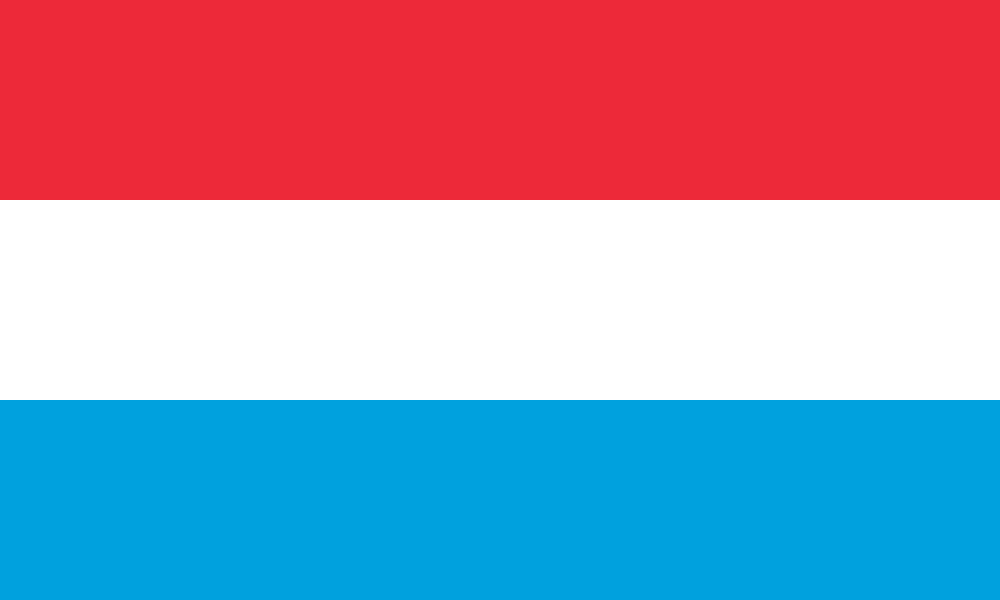
Luxembourg
Location Info
- Continent: Europe
- Country: Luxembourg
- Coordinates: 49.8153 , 6.1296
Trust Info
Verified Geographic Information
🌍 Continents

Overview
Luxembourg is a small, landlocked country in Western Europe, bordered by Belgium, France, and Germany. As the world's only remaining sovereign Grand Duchy, it maintains a unique political status and a rich historical legacy dating back to the 10th century. The nation is divided into two primary geographic regions: the rugged Oesling plateau in the north and the fertile Gutland plains in the south.
Economically, Luxembourg is one of the world's wealthiest nations, boasting the highest GDP per capita globally. It serves as a major international financial hub and a core administrative center for the European Union. Despite its small size, Luxembourg is characterized by a diverse, multilingual population and a high standard of living, further distinguished by its pioneering initiative to provide free nationwide public transportation.
Truth & Facts
| Total Area | 2,586 square kilometers |
| Land Boundaries | 356 km total (Belgium 148 km, France 73 km, Germany 135 km) |
| Total Population | 690,947 (2026 estimate) |
| Foreign Resident Share | Approximately 47% |
| Government Type | Unitary parliamentary constitutional monarchy |
| Capital City | Luxembourg City |
| Founded | 963 AD |
| Independence | 1867 (Treaty of London) |
| Currency | Euro (EUR) |
| GDP Per Capita (PPP) | Highest in the world (approx. $143,000) |
| Public Transport Cost | Free |
| Road Network | Approx. 2,900 km |
| National University | University of Luxembourg |
| Instructional Languages | Luxembourgish, German, French |
| Healthcare Coverage | Universal (National Health Fund - CNS) |
| Life Expectancy | 83.4 years |
| Official Languages | Luxembourgish, French, German |
| National Motto | Mir wëlle bleiwe wat mir sinn |
| UNESCO Sites | Luxembourg City: Old Quarters and Fortifications |
| Top Attraction | Vianden Castle |
| Forest Cover | 34% of land area |
| Climate Type | Temperate Continental |
| Main Airport | Luxembourg Airport (LUX/Findel) |
| Railway Operator | CFL (Société Nationale des Chemins de Fer Luxembourgeois) |
| Global Innovation Index | 23rd (2025) |
| Space Sector | Leading center for satellite operations (SES) |
| Safety Index | High |
| Police Force | Police Grand-Ducale |
| Legislature | Chamber of Deputies (60 members) |
| Council of State | 21-member advisory body |
| EU Founding Member | Yes (1951/1957) |
| NATO Headquarters | NSPA based in Capellen |
| Energy Import Dependency | Approx. 95% |
| Renewable Energy Target | 25% by 2030 |
| Minimum Wage | Highest in the EU |
| Unemployment Rate | Approx. 5.5% |
| Religious Affiliation | Predominantly Roman Catholic (approx. 70%) |
| Urban Population | 95% |
| Legal System | Civil law system based on French and German codes |
| Highest Court | Superior Court of Justice |
📑 Table of Contents
Overview of Luxembourg
Luxembourg, officially the Grand Duchy of Luxembourg, is a landlocked nation situated at the crossroads of Western Europe. It is the only sovereign Grand Duchy in existence today, characterized by its stable constitutional monarchy and high economic prosperity. The country serves as a vital bridge between Germanic and Romance linguistic cultures, with a society that is both deeply rooted in tradition and forward-thinking in its international outlook.
- Official Name: Grand Duchy of Luxembourg
- Continental Location: Western Europe
- Political Status: Sovereign Grand Duchy
- Primary Hub: Luxembourg City
- Membership: EU, UN, NATO, Benelux
Historical Development
The history of Luxembourg began in 963 AD when Count Siegfried acquired a small fort on the Bock promontory. Over the centuries, the territory evolved into a strategically vital fortress city, often referred to as the 'Gibraltar of the North.' It was controlled by various European powers including Spain, France, Austria, and Prussia before gaining significant autonomy at the 1815 Congress of Vienna.
- 963 AD: Foundation of Luxembourg City
- 1815: Recognition as a Grand Duchy
- 1839: Loss of territory to Belgium (Treaty of London)
- 1867: Formal independence and neutrality
- 1945: Post-WWII abandoned neutrality for international cooperation
Geographic Features
Luxembourg's geography is defined by two distinct regions: the Oesling in the north and the Gutland in the south. The Oesling occupies the northern third of the territory and is characterized by the rugged Ardennes plateau, dense forests, and deep river valleys. In contrast, the Gutland region in the south features rolling hills, fertile agricultural land, and the country's main urban centers.
| Region | Characteristics | Main Towns |
|---|---|---|
| Oesling | Ardennes Highlands, Forested | Clervaux, Wiltz |
| Gutland | Rolling Plains, Agriculture | Luxembourg City, Esch |
Climate and Weather Conditions
Luxembourg experiences a temperate continental climate, influenced by Atlantic weather systems. This results in mild summers and relatively cold winters, with precipitation distributed fairly evenly throughout the year. The Oesling region in the north tends to be slightly cooler and more humid than the southern plains of the Gutland.
- Average Summer Temp: 17°C to 24°C
- Average Winter Temp: -1°C to 3°C
- Annual Precipitation: ~800 mm
- Sunniest Months: May and June
- Hottest Months: July and August
Population and Demographics
With a population of nearly 700,000, Luxembourg has a unique demographic profile where almost half of the residents are foreign nationals. This diversity is a cornerstone of Luxembourgish society, with large communities of Portuguese, French, Italian, and Belgian citizens living and working alongside the native population. The majority of the population is concentrated in the southern urban areas.
- Total Residents: ~690,000
- Foreign Nationals: ~47%
- Median Age: 39 years
- Urbanization Rate: 95%
- Major Minority Group: Portuguese (~15%)
Culture and Lifestyle
Culture in Luxembourg is a blend of French and German influences, uniquely combined with a strong local identity. The trilingual nature of the population allows for a diverse media landscape and cultural expression. Daily life is characterized by a focus on work-life balance, high standards of living, and a strong commitment to European integration and multiculturalism.
- National Language: Luxembourgish
- Working Languages: French, German
- Religious Heritage: Roman Catholic
- Architecture: Blend of medieval and ultra-modern EU buildings
- Values: Pragmatism, hospitality, and multilingualism
Festivals and Events
Luxembourg celebrates a variety of traditional and modern festivals. The most significant is National Day on June 23rd, which honors the Grand Duke's official birthday. Other notable events include Schueberfouer, one of the oldest funfairs in Europe, and the Echternach Hopping Procession, which is recognized by UNESCO as an Intangible Cultural Heritage.
- National Day: June 23 (National festivities and fireworks)
- Schueberfouer: Late August funfair in the capital
- Echternach Procession: Whit Tuesday religious tradition
- Buergbrennen: Traditional bonfire festival in spring
- Fête de la Musique: Nationwide music celebration in June
Food and Cuisine
Luxembourgish cuisine combines the hearty portions of German traditions with the finesse and refinement of French culinary arts. Traditional dishes often utilize local ingredients such as smoked pork, river fish, and potatoes. The country is also famous for its Moselle Valley wines, particularly white varieties like Riesling and Crémant de Luxembourg.
| Dish Name | Description |
|---|---|
| Judd mat Gaardebounen | Smoked pork collar with broad beans |
| Gromperekichelcher | Crispy fried potato pancakes |
| Bouneschlupp | Thick bean soup with potatoes and bacon |
| Quetschentaart | Plum tart, a popular seasonal dessert |
Economy and Industries
Luxembourg possesses an advanced economy that was historically built on the steel industry but has since diversified into a global financial powerhouse. It is a leading center for investment funds and private banking. Additionally, the country has invested heavily in the technology, logistics, and space sectors to ensure long-term sustainability.
- Key Sector: Finance and Banking
- Major Industry: Steel (ArcelorMittal headquarters)
- Growing Sector: Satellite and Space Resources
- Media Hub: Home to RTL Group
- Logistics: Major European air freight terminal
Cost of Living
While Luxembourg offers some of the highest salaries in the world, the cost of living is correspondingly high, particularly in the housing sector. Basic expenses such as food and utilities are generally higher than the EU average. However, the government offsets some of these costs through free public transport and generous social benefits and family allowances.
- Housing: Very high rental and purchase prices
- Public Transport: 0€ (Free nationwide)
- Food: Higher than neighboring countries
- Purchasing Power: Exceptionally high due to high wages
- Fuel: Historically cheaper than neighboring states
Employment and Business
Luxembourg is a major employment hub, attracting over 200,000 cross-border workers daily from France, Germany, and Belgium. The labor market is highly international, with English often used as a professional lingua franca alongside French and German. The business environment is stable, characterized by favorable legal frameworks and political consistency.
- Total Labor Force: ~500,000
- Cross-border workers: ~45% of workforce
- Main Employers: State, Amazon, ArcelorMittal, Banks
- Work Culture: Professional, multicultural, punctual
- Job Growth: Strong in tech and financial services
Real Estate and Housing
The real estate market in Luxembourg is highly competitive and has seen significant price increases over the last decade. High demand and limited land supply in the capital have pushed residents toward suburban and rural areas or into neighboring countries. Modern apartment buildings and traditional stone houses are the primary housing types.
- Market Trend: High demand and low supply
- Popular Areas: Kirchberg, Limpertsberg, Gasperich
- Home Ownership: High priority for residents
- Rentals: Highly regulated but expensive
- Construction: Ongoing large-scale urban development projects
Transportation and Connectivity
Luxembourg is exceptionally well-connected within Europe. It was the first country to introduce free public transportation for all users. The network includes a comprehensive bus system, a modern tram in the capital, and a national railway. The country also serves as a major road transit point for European freight.
- Free Transport: Buses, Trains, and Trams (Free nationwide)
- Railway: Managed by CFL
- Air: Luxembourg-Findel Airport
- Tram: Luxembourg City Tram (Stater Tram)
- Roads: Extensive motorway network to neighbors
Infrastructure and Utilities
Luxembourg maintains state-of-the-art infrastructure, including high-speed fiber internet and reliable utility services. While the country produces some energy through wind and solar, it remains heavily dependent on imports. The infrastructure is designed to handle the massive daily influx of commuters and international transit traffic.
- Internet: 100% fiber optic coverage goal
- Electricity: Mix of imports and growing renewables
- Water: Managed by local syndicates (SEBES)
- Waste Management: High recycling rates and modern facilities
- Sustainability: Focus on smart city and green energy projects
Education System
The education system in Luxembourg is unique for its trilingual curriculum. Children begin in Luxembourgish, transition to German for literacy, and introduce French as a major subject shortly after. This prepares students for a diverse workforce. Higher education is anchored by the University of Luxembourg, which attracts students from around the world.
- Compulsory Education: Ages 4 to 16
- Instruction Languages: Luxembourgish, German, French
- University: University of Luxembourg (uni.lu)
- International Schools: Multiple English and European schools
- Public Schools: Free and high quality
Healthcare Services
Healthcare in Luxembourg is based on a system of compulsory social insurance. All residents have access to high-quality medical care through the Caisse Nationale de Santé (CNS). The country boasts a high density of doctors and modern hospital facilities, with patient satisfaction rates among the highest in Europe.
- System: Universal Social Security
- Health Fund: CNS (National Health Fund)
- Standard: High-quality facilities and technology
- Wait Times: Generally low for primary care
- Pharmacy: Widely available with standardized pricing
Tourist Attractions
Luxembourg offers a variety of attractions ranging from medieval fortresses to scenic natural parks. The capital's old quarters are a UNESCO World Heritage site, featuring the famous Casemates du Bock. Outside the city, the Ardennes and the Moselle Valley provide stunning landscapes and historical castles.
- Casemates du Bock: Underground military tunnels
- Grand Ducal Palace: Official city residence of the monarch
- Vianden Castle: Restored medieval fortress
- Müllerthal: Known as 'Little Switzerland'
- Notre-Dame Cathedral: Historic Jesuit cathedral
Things to Do
Recreation in Luxembourg often revolves around the outdoors and cultural exploration. The country's extensive network of hiking and cycling trails is meticulously maintained. Visitors and residents also enjoy wine tasting in the Moselle region and visiting the numerous museums dedicated to history, art, and the steel industry.
- Hiking: Explore the Mullerthal Trail
- Wine Tasting: Visit vineyards along the Moselle River
- Cycling: Over 600 km of dedicated cycle paths
- Museums: Visit MUDAM or the National History Museum
- Shopping: Explore the pedestrian zones in the capital
Best Places to Visit
Beyond the capital city, several towns and regions are essential for understanding Luxembourg's heritage. Echternach is famous for its ancient abbey and festival, while Esch-sur-Alzette showcases the country's industrial past and modern cultural venues. The northern towns of Clervaux and Wiltz are gateways to the Ardennes.
| Place | Highlight |
|---|---|
| Luxembourg City | UNESCO Old Town and Fortifications |
| Vianden | Iconic Castle and Chairlift |
| Echternach | Ancient Abbey and Roman Villa |
| Esch-sur-Alzette | Steel heritage and Belval district |
| Schengen | Birthplace of borderless Europe |
Travel Guide Essentials
Traveling to and within Luxembourg is straightforward due to its compact size and modern facilities. The main point of entry is Luxembourg Airport or the central railway station. Visitors should note that public transport is free, and the country is exceptionally walkable. Most residents speak multiple languages, facilitating easy communication.
- Language: French is dominant in hospitality
- Currency: Euro only
- Connectivity: Free public transport nationwide
- Walking: Capital is best explored on foot
- Electricity: Type C / F plugs (230V)
Nearby Places
Due to its central location, Luxembourg is an ideal base for exploring the Greater Region. Cities in neighboring countries are within a short driving or train distance, offering various day-trip opportunities. This interconnectedness is a key feature of life in the Grand Duchy.
- Trier, Germany: Oldest city in Germany (30 mins)
- Metz, France: Historic city and Pompidou Center (50 mins)
- Arlon, Belgium: Roman heritage and local shopping (20 mins)
- Paris, France: 2 hours via TGV high-speed train
- Brussels, Belgium: 3 hours via train or car
Environment and Nature
Luxembourg places a high priority on environmental protection. Over one-third of the country is covered by forests, and there are several nature parks dedicated to biodiversity. The government is actively working toward carbon neutrality, with initiatives focused on renewable energy and sustainable agriculture.
- Nature Parks: Our, Upper-Sûre, and Mëllerdall
- Forestry: 34% of the country is wooded
- Wildlife: Red deer, wild boar, and various bird species
- Water: Upper Sûre Lake provides most drinking water
- Policy: Strong commitment to the Paris Agreement
Government and Administration
Luxembourg is a representative democracy with a constitutional monarch. The Grand Duke's role is largely ceremonial, while the Prime Minister leads the government. Administratively, the country is divided into 12 cantons and 100 communes, which manage local services and planning.
- Head of State: Grand Duke Henri
- Head of Government: Prime Minister
- Legislative Branch: Chamber of Deputies
- Local Gov: 100 Communes
- Capital Status: One of three EU capitals
Safety and Public Services
Luxembourg is consistently ranked as one of the safest countries in the world. Public services are efficient and well-funded, providing a high level of security for both residents and visitors. The Grand Ducal Police operate nationally, and emergency services are accessible via the standard 112 European emergency number.
- Crime Rate: Exceptionally low
- Police: Police Grand-Ducale (High presence)
- Emergency: 112 (Universal emergency number)
- Public Services: Reliable and digitalized
- Safety Tip: Standard precautions apply in crowded areas
Best Time to Visit
The ideal time to visit Luxembourg is from late spring to early autumn. May and June offer the most sunshine, while July and August are the warmest months for outdoor activities. The winter months can be cold and gray, but the Christmas markets in Luxembourg City provide a festive atmosphere.
- May - June: Best for hiking and nature
- July - August: Peak tourism and outdoor festivals
- September: Grape harvest in the Moselle Valley
- December: Christmas markets and winter lights
- January - February: Quietest and coldest months
Business and Industry Directory
Luxembourg hosts a high concentration of international corporations and financial institutions. The economy is structured around sectors like banking, steel, and technology. Many of these businesses are clustered in the Kirchberg district or the Belval innovation hub, reflecting the country's economic strategy.
- Banking: Over 120 international banks
- Investment: Leading global hub for fund administration
- Tech: HQ for Amazon and Skype in Europe
- Steel: ArcelorMittal Global HQ
- Media: SES and RTL Group
General Information FAQs
Where is Luxembourg located?
Luxembourg is located in Western Europe. It is a landlocked country bordered by Belgium to the west and north, Germany to the east, and France to the south.
What is Luxembourg known for?
Luxembourg is known for being the world's only Grand Duchy, its powerful financial sector, high GDP per capita, medieval old town, and its role as a founding member of the EU.
Why is Luxembourg famous?
It is famous for its extreme wealth, beautiful castles, the Casemates du Bock, and for offering free public transportation nationwide.
What country or region is Luxembourg part of?
Luxembourg is a sovereign nation in Western Europe. It is part of the Benelux union and the European Union.
What is the population of Luxembourg?
As of early 2026, the population is estimated to be approximately 690,000 residents.
What languages are spoken in Luxembourg?
The three official languages are Luxembourgish, French, and German. English is also widely spoken, especially in business.
What time zone is Luxembourg in?
Luxembourg is in the Central European Time (CET) zone, which is GMT+1 in winter and GMT+2 during daylight savings in summer.
What are the key facts about Luxembourg?
Key facts include its status as a Grand Duchy, its area of 2,586 sq km, its trilingual education system, and its status as a leading global financial center.
What makes Luxembourg unique?
Its unique status as a Grand Duchy and the fact that nearly half its population are foreign nationals make it exceptionally diverse and politically distinct.
How large is Luxembourg in area?
The country covers an area of approximately 2,586 square kilometers (998 square miles).
History FAQs
What is the history of Luxembourg?
Luxembourg began as a small fort in 963 AD. It grew into a strategic European fortress, changed hands between major powers for centuries, and eventually gained independence in 1867.
When was Luxembourg established?
The foundation of Luxembourg City dates to 963 AD, while the modern state was established as a Grand Duchy in 1815 at the Congress of Vienna.
What major historical events happened in Luxembourg?
Major events include the acquisition of the Bock by Count Siegfried (963), the Treaty of London (1867), and the foundation of the European Coal and Steel Community in 1951.
Who were important historical figures from Luxembourg?
Count Siegfried (founder), John the Blind (King of Bohemia and Count of Luxembourg), and Robert Schuman (architect of European unity who was born in Luxembourg).
How has Luxembourg developed over time?
It transitioned from a medieval county to a major fortress, then an industrial steel producer, and finally a global financial and digital services hub.
Geography & Environment FAQs
What is the geography of Luxembourg?
Luxembourg is divided into the northern Oesling (Ardennes plateau) and the southern Gutland (rolling hills and plains).
What natural features surround Luxembourg?
It is surrounded by the Ardennes forest to the north and the Moselle River valley to the east.
Are there mountains, rivers, or lakes near Luxembourg?
The Ardennes in the north offer mountainous terrain. Major rivers include the Alzette, Sûre, and Moselle. The Upper Sûre Lake is the largest body of water.
What is the elevation of Luxembourg?
The average elevation is 325 meters. The highest point is Kneiff at 560 meters above sea level.
What ecosystems exist around Luxembourg?
Ecosystems include temperate broadleaf forests, wetlands in river valleys, and managed agricultural landscapes.
Climate & Weather FAQs
What is the climate like in Luxembourg?
Luxembourg has a temperate continental climate with moderate rainfall and mild temperatures.
What is the average temperature in Luxembourg?
Average temperatures range from 0°C in winter to 23°C in summer.
What is the weather like throughout the year in Luxembourg?
Spring and autumn are mild; summer is warm and occasionally humid; winter is cold, often gray, and sometimes snowy.
Does Luxembourg experience extreme weather?
Extreme weather is rare, though occasional heavy rainfall can cause localized flooding in river valleys.
What is the best time of year to visit Luxembourg?
The best time to visit is between May and September when the weather is most pleasant for outdoor exploration.
Population & Society FAQs
What is the population density of Luxembourg?
The population density is approximately 264 people per square kilometer.
What ethnic groups live in Luxembourg?
The population is composed of native Luxembourgers and large groups of Portuguese, French, Italian, Belgian, and German nationals.
What religions are practiced in Luxembourg?
The majority of the population is Roman Catholic, though there are growing Protestant, Muslim, and non-religious communities.
What is daily life like in Luxembourg?
Daily life is characterized by multiculturalism, a high degree of organization, and a strong focus on family and career balance.
How diverse is the population of Luxembourg?
Luxembourg is exceptionally diverse, with residents representing over 170 different nationalities.
Culture & Traditions FAQs
What cultural traditions are important in Luxembourg?
Important traditions include Buergbrennen (bonfires), Bretzelsonndeg (Pretzel Sunday), and Liichtmëssdag (candle procession).
What festivals are celebrated in Luxembourg?
Key festivals include National Day, Schueberfouer, the Echternach Procession, and various wine festivals along the Moselle.
What cultural landmarks exist in Luxembourg?
Landmarks include the Grand Ducal Palace, the Bock Casemates, Vianden Castle, and the National Museum of History and Art.
What traditional clothing or customs are common in Luxembourg?
Traditional clothing is rarely worn daily but appears during festivals. Customs emphasize multilingualism and respect for European values.
What arts and crafts are associated with Luxembourg?
Luxembourg is associated with Villeroy & Boch ceramics (historically), ironworking, and contemporary art through the MUDAM museum.
Food & Cuisine FAQs
What foods is Luxembourg known for?
It is known for smoked pork with broad beans (Judd mat Gaardebounen), potato pancakes (Gromperekichelcher), and plum tarts.
What traditional dishes originate from Luxembourg?
Bouneschlupp (bean soup) and Kachkéis (cooked cheese) are traditional staples of the local diet.
What are the best restaurants in Luxembourg?
Luxembourg has a high density of Michelin-starred restaurants, particularly in the capital and the Moselle region.
What local ingredients are commonly used in Luxembourg cuisine?
Potatoes, smoked meats, cream, broad beans, and freshwater fish are fundamental local ingredients.
What food markets or street foods are popular in Luxembourg?
Weekly markets in Place Guillaume II are popular, along with Gromperekichelcher sold at local fairs like Schueberfouer.
Economy & Business FAQs
What are the main industries in Luxembourg?
The main industries are financial services (banking and funds), steel production, logistics, and information technology.
What economic activities drive the economy of Luxembourg?
Financial services account for about a third of GDP. Other drivers include international trade, digital economy, and public sector employment.
What businesses operate in Luxembourg?
Major companies include ArcelorMittal, Amazon, SES, RTL Group, and numerous international banks like BNP Paribas and State Street.
Is Luxembourg an important economic center?
Yes, it is the world's second-largest investment fund center after the United States and a major hub for private banking.
What are the major exports or products from Luxembourg?
Major exports include finished steel products, machinery, financial services, and chemicals.
Employment & Jobs FAQs
What job opportunities are available in Luxembourg?
Opportunities are strong in finance, auditing, tech, logistics, and European institutional administration.
What are the major employers in Luxembourg?
The Luxembourg State is the largest employer, followed by companies like Post Luxembourg, ArcelorMittal, and Amazon.
What skills are in demand in Luxembourg?
Multilingualism (especially French, German, and English), financial expertise, digital skills, and legal knowledge are highly valued.
Is Luxembourg a good place to work?
Yes, it offers high salaries, excellent social security, and a multicultural work environment.
What is the unemployment rate in Luxembourg?
The unemployment rate typically fluctuates around 5% to 6%, which is lower than the EU average.
Cost of Living FAQs
Is Luxembourg expensive to live in?
Yes, Luxembourg is one of the most expensive countries in Europe, particularly regarding housing and services.
What is the average cost of living in Luxembourg?
A single person may need between 1,500€ and 2,500€ per month (excluding rent) to maintain a good standard of living.
How much does housing cost in Luxembourg?
Average rent for a one-bedroom apartment in the city starts at 1,500€–1,800€, while property prices often exceed 10,000€ per square meter.
What are average food and utility costs in Luxembourg?
Monthly utility costs for a standard apartment average 250€–350€, and food prices are roughly 10-20% higher than in neighboring countries.
Is Luxembourg affordable compared to nearby cities?
It is generally more expensive than Trier or Metz, which is why many people commute from Germany or France.
Housing & Real Estate FAQs
What types of housing are available in Luxembourg?
Options include modern city apartments, semi-detached suburban houses, and traditional large farmhouses in rural areas.
What is the average home price in Luxembourg?
Average prices for houses often exceed 1 million euros, with apartments in the city being significantly more expensive.
Is it better to rent or buy property in Luxembourg?
Renting is common for expats, but buying is seen as a stable long-term investment despite high initial costs.
Which neighborhoods are popular in Luxembourg?
Popular districts include Limpertsberg, Belair, Kirchberg (for work), and Gasperich (for modern living).
How has the property market changed in Luxembourg?
The market has seen a sustained period of rapid growth, although rising interest rates have recently stabilized prices.
Transportation FAQs
How do you get to Luxembourg?
Luxembourg is accessible by air via Luxembourg-Findel Airport, by TGV train from Paris, or by an extensive motorway network.
What is the nearest airport to Luxembourg?
Luxembourg Airport (LUX), located 6 km from the capital, is the primary international gateway.
Does Luxembourg have railway connections?
Yes, the national railway (CFL) connects to France, Belgium, and Germany with frequent regional and high-speed services.
How reliable is public transportation in Luxembourg?
Public transportation is very reliable and modern. Since 2020, it has been free of charge for all users nationwide.
What major highways or roads connect to Luxembourg?
The A1, A3, A4, A6, and A7 motorways provide direct links to the German, French, and Belgian borders.
Education FAQs
What schools are located in Luxembourg?
Luxembourg has a range of public trilingual schools, private international schools, and vocational training centers.
Are there universities in Luxembourg?
The University of Luxembourg is the primary institution, offering bachelor's, master's, and doctoral programs.
What is the literacy rate in Luxembourg?
The literacy rate is near 100% due to a high-quality compulsory education system.
What educational opportunities exist in Luxembourg?
Opportunities include academic research, specialized finance certifications, and lifelong learning programs through the State.
Is Luxembourg a good place for students?
Yes, particularly for students interested in international relations, finance, and multilingual environments.
Healthcare FAQs
What hospitals are available in Luxembourg?
Major facilities include the Centre Hospitalier de Luxembourg (CHL) and the Hôpitaux Robert Schuman.
Are there emergency medical services in Luxembourg?
Yes, full emergency services are available 24/7, accessible via the 112 emergency number.
What healthcare facilities exist in Luxembourg?
The country has numerous clinics, specialized centers, and a wide network of private general practitioners.
Is healthcare affordable in Luxembourg?
Yes, healthcare costs are largely reimbursed by the state health fund (CNS) for residents.
Are specialized medical services available in Luxembourg?
Yes, Luxembourg offers high-level specialized care in fields like cardiology and rehabilitation.
Tourism & Travel FAQs
What are the top tourist attractions in Luxembourg?
Top attractions include the Casemates du Bock, Vianden Castle, the Müllerthal region, and the Moselle wine valley.
What are the best things to do in Luxembourg?
Activities include hiking the Mullerthal trail, exploring the capital's old town, and taking wine tours along the Moselle.
Is Luxembourg worth visiting?
Yes, for its unique blend of history, natural beauty, and modern European culture within a compact area.
What landmarks should visitors see in Luxembourg?
Visitors should see the Adolphe Bridge, the Grand Ducal Palace, and the Kirchberg European quarter.
How many days should tourists spend in Luxembourg?
Two to three days are usually sufficient to see the capital and a few regional highlights.
Nearby Places FAQs
What places are near Luxembourg worth visiting?
Nearby highlights include the Roman city of Trier in Germany and the historic city of Metz in France.
What cities or towns are close to Luxembourg?
Close towns include Arlon (Belgium), Thionville (France), and Merzig (Germany).
What natural attractions are near Luxembourg?
The Eifel region in Germany and the Belgian Ardennes are immediately adjacent to Luxembourg's borders.
What day trips can be taken from [Location]?
Popular day trips include visiting the Saar Loop in Germany or the Belgian city of Bastogne.
What famous destinations are within reach of Luxembourg?
Paris and Brussels are within a 2-to-3-hour radius by train or car.
Safety FAQs
Is Luxembourg safe to live in?
Yes, it is consistently ranked as one of the world's safest countries with very low violent crime rates.
Is Luxembourg safe for tourists?
Yes, tourists face very few risks, although standard precautions against petty theft in crowded areas should be taken.
What is the crime rate in Luxembourg?
The crime rate is very low, primarily consisting of minor property crimes and traffic violations.
What emergency services operate in Luxembourg?
The Grand Ducal Police and national fire and rescue services (CGDIS) operate nationwide.
What safety tips should visitors follow in Luxembourg?
Keep an eye on belongings in public transport hubs and follow standard pedestrian safety rules.
Lifestyle & Living FAQs
Is Luxembourg a good place to live?
Yes, it offers political stability, high safety, excellent public services, and a multicultural community.
What recreational activities are available in Luxembourg?
Recreation includes hiking, cycling, organized sports clubs, and a vibrant cultural and festival calendar.
Is Luxembourg family-friendly?
Very family-friendly, offering high-quality childcare, numerous parks, and generous family allowances.
What outdoor activities are popular in Luxembourg?
Cycling, mountain biking in the Red Rock region, and hiking the Ardennes are very popular.
What makes life enjoyable in Luxembourg?
The combination of economic security, natural proximity, and high-quality international dining and culture makes life enjoyable.
Practical Information FAQs
What travel tips should visitors know about Luxembourg?
Public transport is free—there's no need to buy tickets for buses or trains within the country.
What local customs should visitors respect in Luxembourg?
Respect for multilingualism and punctuality in business and social meetings is highly valued.
How accessible is Luxembourg for international visitors?
It is highly accessible, with most staff in the travel and service industry speaking English, French, and German.
What services are available for tourists in Luxembourg?
Extensive tourist information offices, free city Wi-Fi, and the 'LuxembourgCard' for museum discounts are available.
What important information should travelers know before visiting?
Banks and many shops close early on Saturdays and are often closed on Sundays, except for specific tourist areas.