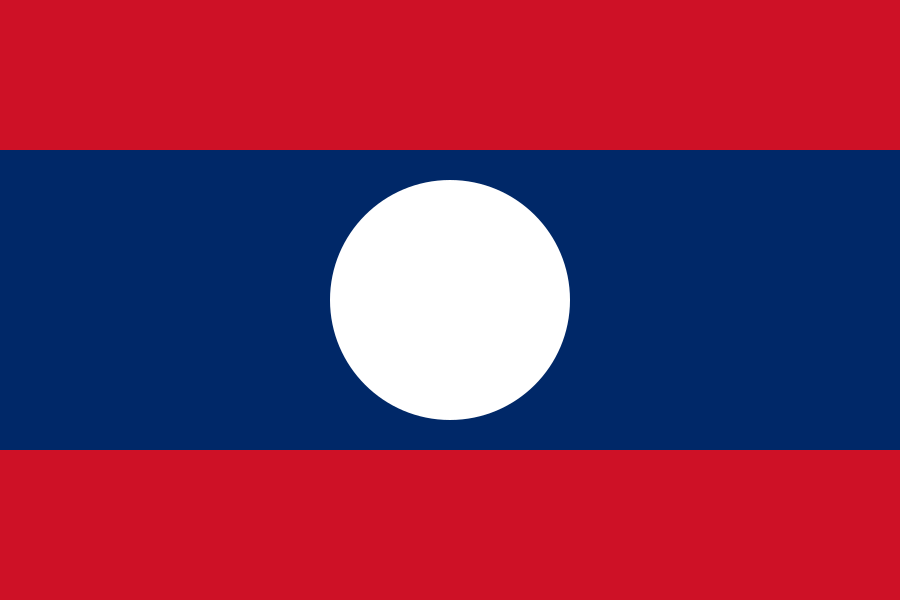
Laos
Location Info
- Continent: Asia
- Country: Laos
- Coordinates: 18 , 105
Trust Info
Verified Geographic Information
🌍 Continents







Overview
Laos, officially the Lao People's Democratic Republic, is a landlocked nation located in the heart of the Southeast Asian peninsula. It shares borders with China, Vietnam, Cambodia, Thailand, and Myanmar. The country is defined by its rugged mountainous terrain and the powerful Mekong River, which serves as a vital artery for transport, agriculture, and energy production. Historically known as the Kingdom of Lan Xang, or the 'Land of a Million Elephants,' the nation has evolved from a powerful regional empire to a modern socialist state following decades of colonial influence and internal conflict.
With a population of approximately 7.5 million, Laos is known for its ethnic diversity and deep-rooted Theravada Buddhist traditions. The economy is currently transitioning from a subsistence-based agricultural system to one driven by natural resource extraction and hydropower exports. As a member of ASEAN, Laos plays a significant role in regional connectivity projects, including major new railway links that connect the capital, Vientiane, with international markets. The nation remains a focal point for cultural heritage conservation and environmental protection within the Mekong basin.
Truth & Facts
| Total Area | 236,800 sq km |
| Highest Point | Phou Bia (2,817 m) |
| Population | 7,750,000 (Estimated) |
| Official Language | Lao |
| Government Type | Unitary Marxist-Leninist one-party socialist republic |
| Capital | Vientiane |
| Lan Xang Kingdom Established | 1353 |
| Independence from France | October 22, 1953 |
| Currency | Lao Kip (LAK) |
| Major Export | Electricity (Hydropower) |
| Major Rail Link | Boten-Vientiane Railway |
| Literacy Rate | 84.7% |
| Life Expectancy | 68.5 years |
| Dominant Religion | Theravada Buddhism (66%) |
| UNESCO Sites | 3 (Luang Prabang, Wat Phou, Plain of Jars) |
| Forest Cover | Approx. 40% |
| Road Network | 39,568 km |
| Internet Penetration | 62% |
| UXO Status | Significant unexploded ordnance remain from 1964-1973 |
| Legislature | National Assembly |
| ASEAN Entry | July 23, 1997 |
| Electricity Access | 95% of households |
| Time Zone | ICT (UTC+7) |
| Main Crop | Rice |
| Hydropower Dams | Over 80 operational |
📑 Table of Contents
Overview of Laos
Laos is a landlocked sovereign state in Southeast Asia, officially known as the Lao People's Democratic Republic. It is characterized by its geography of forested mountains and the Mekong River valley. The nation serves as a strategic crossroads between the major economies of Thailand, Vietnam, and China.
- Official Name: Lao People's Democratic Republic
- Capital City: Vientiane
- Region: Southeast Asia
- Bordering Countries: 5
- Political System: Socialist Republic
Historical Background
The history of Laos traces back to the 14th-century Kingdom of Lan Xang. In the late 19th century, it became a French protectorate as part of French Indochina. Following World War II and a period of constitutional monarchy, the country underwent a revolution that established the current socialist republic in 1975.
| Era | Event |
|---|---|
| 1353 | Foundation of Lan Xang |
| 1893 | French Protectorate begins |
| 1953 | Full independence granted |
| 1975 | Abolition of Monarchy, LPDR formed |
Geography and Physical Features
Laos is the only landlocked country in its region. Over 70% of the land consists of mountains and plateaus. The Mekong River defines the western border for long stretches and provides fertile plains for agriculture.
- Key River: Mekong (nearly 1,900 km within Laos)
- Major Mountain Range: Annamite Range (east)
- High Plateau: Bolaven Plateau (south)
- Major Peak: Phou Bia
Climate and Weather
The country experiences a tropical monsoon climate with distinct wet and dry seasons. Temperatures vary based on elevation, with the northern highlands being significantly cooler than the Mekong valley plains.
- Rainy Season: May to October
- Dry Season: November to April
- Hottest Months: March and April
- Average Temperature: 25°C to 30°C in lowlands
Population and Demographics
Laos has a relatively low population density compared to its neighbors. The government officially recognizes 49 ethnic groups, which are broadly categorized into three groups based on habitat elevation: Lao Loum, Lao Theung, and Lao Soung.
- Total Population: ~7.7 million
- Ethnic Majority: Lao (53.2%)
- Religion: Buddhism (predominant)
- Median Age: ~24 years
Culture and Lifestyle
Lao culture is deeply influenced by Theravada Buddhism. This influence is visible in the architecture of temples (wats), traditional arts, and the daily conduct of the people, which emphasizes modesty and community respect.
- Core Philosophy: Buddhist principles
- Art Forms: Temple architecture, silk weaving
- Social Norms: Respect for elders and monks
- Instruments: The Khaen (bamboo mouth organ)
Major Festivals and Events
Festivals in Laos, known as 'Boun,' are typically tied to the Buddhist calendar and agricultural cycles. These events are communal and often involve temple visits and boat racing.
- Boun Pi Mai: Lao New Year (April)
- Boun Bang Fai: Rocket Festival
- That Luang Festival: National religious celebration
- Boun Nam: Boat Racing Festival
Food and Culinary Traditions
Lao cuisine is distinct for its use of sticky rice (khao niao), which is eaten by hand. Dishes are often flavored with fermented fish sauce (padaek), fresh herbs, and chilies.
| Dish | Description |
|---|---|
| Larb | Minced meat salad with herbs |
| Tam Muk Hoong | Spicy green papaya salad |
| Khao Piak Sen | Rice noodle soup |
Economy and Major Industries
The economy of Laos relies heavily on its natural resources. The government has focused on hydropower generation and mining as primary drivers of growth, while agriculture remains the main employer for the rural population.
- Primary Industry: Hydropower production
- Mining: Copper and Gold
- Agriculture: Rice, Coffee, Rubber
- Membership: WTO and ASEAN
Cost of Living
While generally affordable compared to Western nations, the cost of living in Laos has seen inflation in recent years. Imports of consumer goods from Thailand and China significantly influence local prices.
- Local Currency: Lao Kip
- Daily Budget: Moderate for regional standards
- Import Factor: High reliance on Thai imports
Employment and Business
Agriculture employs the majority of the workforce. However, urbanization in Vientiane is shifting some labor toward services, manufacturing, and international trade projects linked to regional infrastructure.
- Labor Force: ~3.6 million
- Key Sector: Subsistence and commercial farming
- Emerging Sector: Logistics and construction
Real Estate and Housing
Housing in Laos varies from traditional wooden stilt houses in rural areas to modern villas and apartments in Vientiane. Foreign land ownership is generally restricted, though long-term lease options exist.
- Rural Housing: Traditional wooden structures
- Urban Housing: Concrete houses and apartments
- Legal Status: State-owned land, private usage rights
Transportation and Connectivity
Transportation is undergoing a major transformation with the completion of the high-speed railway connecting Vientiane to China. Road networks remain the primary mode of travel for most of the country.
- Railway: Laos-China Railway (Boten-Vientiane)
- Main Roads: Route 13 (North-South)
- River Transport: Mekong River ferries and boats
Infrastructure and Utilities
Access to electricity has expanded rapidly, now reaching most villages. Water utility infrastructure is more concentrated in urban centers, while rural areas often rely on wells or natural sources.
- Power: National grid coverage >90%
- Water: Urban piped systems available
- Telephony: Widespread mobile network coverage
Education System
The education system consists of primary, secondary, and tertiary levels. The National University of Laos in Vientiane is the leading institution. Improving literacy and vocational training is a government priority.
- Compulsory Level: Primary education
- Higher Education: National University of Laos
- Language: Lao (French as a second language historically)
Healthcare and Medical Services
Healthcare infrastructure is developing, with major hospitals located in the capital. Many residents in border provinces travel to Thailand for specialized medical treatments.
- Main Facilities: Mahosot Hospital (Vientiane)
- Rural Health: Community health centers
- Cross-border: Heavy reliance on Thai medical services
Major Tourist Attractions
Laos is known for its serene landscape and UNESCO World Heritage sites. Luang Prabang remains the most popular destination for its mixture of colonial and traditional architecture.
- Luang Prabang: Ancient royal capital
- Wat Phou: Khmer temple ruins
- Plain of Jars: Megalithic archaeological site
- Vang Vieng: Limestone karst scenery
Things to Do
Outdoor activities and cultural immersion are the primary draws for visitors. Ecotourism is a growing sector, focusing on the country's natural biodiversity.
- Trekking: Northern highlands
- River Cruises: Mekong multi-day trips
- Temple Visits: Vientiane and Luang Prabang
- Cave Exploration: Kong Lor and Vieng Xai
Best Places to Visit
Beyond the capital, several regions offer unique experiences ranging from waterfall-rich plateaus to island clusters in the far south.
- 4,000 Islands (Si Phan Don): Southern Mekong archipelago
- Bolaven Plateau: Waterfalls and coffee plantations
- Vientiane: National monuments and markets
Travel Guide Information
International visitors typically enter through Wattay International Airport or across land borders with Thailand. E-visas and visas on arrival are available for many nationalities.
- Entry Points: Vientiane, Luang Prabang, Pakse
- Visa: E-visa system operational
- Connectivity: High-speed rail is now a major travel option
Nearby Regions and Countries
Being landlocked, Laos shares close cultural and economic ties with its five neighbors, making it a hub for multi-country Southeast Asian itineraries.
- Thailand: Major trade partner to the west
- Vietnam: Key political ally to the east
- China: Growing influence to the north
Environment and Nature
Laos contains some of the most intact forest cover in Southeast Asia. It is home to endangered species such as the Asian elephant and various rare birds.
- Protected Areas: National Biodiversity Conservation Areas (NBCAs)
- Flora: Teak and Rosewood
- Fauna: Wild tigers, elephants, and saola
Government and Administration
The country is divided into 17 provinces and one prefecture (Vientiane). Administration is centralized through the Lao People's Revolutionary Party.
- Ruling Party: LPRP
- Head of State: President
- Head of Government: Prime Minister
Safety and Public Services
Laos is generally safe with low crime rates. The most significant safety concern is unexploded ordnance (UXO) in rural areas affected by previous conflict.
- Crime: Very low violent crime
- Rural Hazard: UXO (unexploded bombs)
- Emergency: Limited local ambulance services
Best Time to Visit
The most favorable time for travel is during the cool, dry season when roads are accessible and the heat is manageable.
- Peak Season: November to February
- Festive Period: April (Lao New Year)
- Green Season: May to September (rainy but lush)
Local Business and Industry
The business landscape is dominated by state-owned enterprises in utility and resource sectors, alongside a large informal market sector and increasing foreign direct investment in infrastructure.
- Investment: High Chinese and Thai capital
- Local Trade: Morning markets and night markets
- Key Hub: Vientiane and Special Economic Zones
General Information FAQs
Where is Laos located?
Laos is located in Southeast Asia. It is a landlocked country bordered by China, Vietnam, Cambodia, Thailand, and Myanmar.
What is Laos known for?
Laos is known for its rugged mountains, Mekong River, Buddhist monasteries, and French colonial architecture.
Why is Laos famous?
It is famous for being the most heavily bombed country per capita in history and for its three UNESCO World Heritage sites.
What country or region is Laos part of?
Laos is a sovereign nation in the Southeast Asian region and is a member of ASEAN.
What is the population of Laos?
As of 2026, the population of Laos is approximately 7.75 million people.
What languages are spoken in Laos?
The official language is Lao. Various ethnic languages such as Hmong and Khmu are also spoken, and French and English are used in tourism and diplomacy.
What time zone is Laos in?
Laos is in the Indochina Time zone, which is UTC+7.
What are the key facts about Laos?
Key facts include its status as a landlocked socialist republic, its reliance on hydropower, and its diverse ethnic makeup of 49 recognized groups.
What makes Laos unique?
Laos is unique as the only landlocked country in Southeast Asia and for its exceptionally laid-back lifestyle compared to its neighbors.
How large is Laos in area?
Laos has a total land area of approximately 236,800 square kilometers.
History FAQs
What is the history of Laos?
Laos history includes the 14th-century Lan Xang Kingdom, a period of French colonial rule starting in 1893, and the establishment of a socialist state in 1975.
When was Laos established?
The modern Lao People's Democratic Republic was established on December 2, 1975.
What major historical events happened in Laos?
Significant events include the unification under Lan Xang, the 1893 Franco-Siamese War, the Secret War (1964-1973), and the 1975 revolution.
Who were important historical figures from Laos?
King Fa Ngum, the founder of Lan Xang, and Kaysone Phomvihane, the first leader of the LPDR, are highly significant figures.
How has Laos developed over time?
Laos has transitioned from a feudal kingdom to a French colony, then a war-torn battleground, and finally a developing nation focused on regional integration.
Geography & Environment FAQs
What is the geography of Laos?
The geography is mostly mountainous with high plateaus and some plains in the Mekong River valley.
What natural features surround Laos?
It is surrounded by the Annamite Mountains to the east and the Mekong River which forms most of its western border.
Are there mountains, rivers, or lakes near Laos?
Yes, the Mekong is the primary river, and the Annamite Range is the major mountain chain. Nam Ngum is a large man-made lake/reservoir.
What is the elevation of Laos?
Elevation varies from around 70 meters at the Mekong River to 2,817 meters at Phou Bia.
What ecosystems exist around Laos?
Ecosystems include tropical rainforests, monsoon forests, and freshwater river systems.
Climate & Weather FAQs
What is the climate like in Laos?
It has a tropical monsoon climate with a rainy season (May-Oct) and a dry season (Nov-April).
What is the average temperature in Laos?
Average temperatures range from 24°C (75°F) in January up to 30°C (86°F) in April.
What is the weather like throughout the year in Laos?
The cool dry season (Nov-Feb) is pleasant, the hot dry season (March-April) is very warm, and the wet season (May-Oct) is humid with frequent rain.
Does Laos experience extreme weather?
Laos can experience seasonal flooding during the monsoon and occasional droughts.
What is the best time of year to visit Laos?
The best time to visit is between November and February when it is dry and relatively cool.
Population & Society FAQs
What is the population density of Laos?
It is relatively low, at approximately 32 people per square kilometer.
What ethnic groups live in Laos?
The government recognizes 49 groups, with the Lao ethnic group being the largest, followed by the Khmu and Hmong.
What religions are practiced in Laos?
Theravada Buddhism is practiced by the majority. Animism is common among hill tribes, and there are small Christian and Muslim minorities.
What is daily life like in Laos?
Daily life often revolves around agriculture in rural areas and small-scale trade and civil service in urban areas, with a heavy emphasis on religious observances.
How diverse is the population of Laos?
It is highly diverse, containing dozens of different languages and ethnic cultures across its mountainous terrain.
Culture & Traditions FAQs
What cultural traditions are important in Laos?
Important traditions include Alms Giving (Tak Bat), Baci ceremonies, and respecting Buddhist lunar holidays.
What festivals are celebrated in Laos?
Major festivals include Pi Mai (New Year), Boun That Luang, and the Rocket Festival (Boun Bang Fai).
What cultural landmarks exist in Laos?
Pha That Luang, Wat Xieng Thong, and Wat Phou are among the most significant landmarks.
What traditional clothing or customs are common in Laos?
Women frequently wear the 'sinh' (a traditional wraparound skirt), and the 'phaa biang' shawl is used for formal occasions.
What arts and crafts are associated with Laos?
Laos is famous for intricate silk and cotton weaving, wood carving, and silverwork.
Food & Cuisine FAQs
What foods is Laos known for?
Laos is known for sticky rice, Larb (meat salad), and Tam Mak Hoong (papaya salad).
What traditional dishes originate from Laos?
Larb, Mok Pa (steamed fish in banana leaf), and Khao Poon (rice vermicelli soup) are traditional staples.
What are the best restaurants in Laos?
Popular dining spots are located in Vientiane and Luang Prabang, ranging from street food markets to French-Lao fusion bistros.
What local ingredients are commonly used in Laos cuisine?
Ingredients include padaek (fermented fish sauce), lemongrass, galangal, kaffir lime leaves, and plenty of fresh chilies.
What food markets or street foods are popular in Laos?
The Vientiane Night Market and the Luang Prabang Morning Market are famous for grilled meats, noodle soups, and fresh fruit.
Economy & Business FAQs
What are the main industries in Laos?
Hydropower, mining (gold, copper), agriculture, and tourism are the primary industries.
What economic activities drive the economy of Laos?
Natural resource exports, particularly electricity sold to neighboring countries, and infrastructure development projects drive the economy.
What businesses operate in Laos?
Business ranges from state enterprises in power and telecommunications to foreign-owned mining companies and small-scale agriculture.
Is Laos an important economic center?
While not a global center, it is a key regional player in the Southeast Asian energy market.
What are the major exports or products from Laos?
Electricity, copper ore, gold, coffee, and rubber are the major exports.
Employment & Jobs FAQs
What job opportunities are available in Laos?
Most opportunities are in agriculture, mining, construction, and tourism-related services.
What are the major employers in Laos?
The government is a major employer, alongside companies like Electricite du Laos and international mining firms.
What skills are in demand in Laos?
Skills in engineering, project management, hospitality, and foreign languages (English, Chinese) are increasingly in demand.
Is Laos a good place to work?
For expats, it offers a peaceful lifestyle, though wages in the local sector are generally low compared to regional neighbors.
What is the unemployment rate in Laos?
The official unemployment rate is generally low, around 1-3%, though underemployment in agriculture is common.
Cost of Living FAQs
Is Laos expensive to live in?
It is affordable for Westerners, but more expensive than some neighbors like Vietnam due to the high volume of imported goods.
What is the average cost of living in Laos?
A single person can live comfortably on $800-$1,200 per month in the capital, while rural living is significantly cheaper.
How much does housing cost in Laos?
Rent for a modern apartment in Vientiane ranges from $300 to $1,000 per month depending on location and amenities.
What are average food and utility costs in Laos?
Local meals cost $2-$5, while monthly utilities (power, water, internet) average $50-$100.
Is Laos affordable compared to nearby cities?
It is comparable to Thailand but generally more expensive than Cambodia or rural Vietnam for imported items.
Housing & Real Estate FAQs
What types of housing are available in Laos?
Options include traditional wooden houses, colonial-style villas, and modern concrete apartment blocks.
What is the average home price in Laos?
Prices vary wildly; a modern house in a Vientiane suburb might cost between $100,000 and $250,000.
Is it better to rent or buy property in Laos?
Most foreigners rent due to land ownership restrictions, while locals typically prefer to own land and build their own homes.
Which neighborhoods are popular in Laos?
In Vientiane, Sisattanak and Chanthabuly are popular due to their central location and proximity to services.
How has the property market changed in Laos?
Urbanization and new infrastructure, like the railway, have driven up land prices in Vientiane and Luang Prabang.
Transportation FAQs
How do you get to Laos?
Most visitors arrive by air at Vientiane or Luang Prabang, or by land via the Friendship Bridges from Thailand.
What is the nearest airport to Laos?
Wattay International Airport (VTE) in Vientiane and Luang Prabang International Airport (LPQ) are the main gateways.
Does Laos have railway connections?
Yes, a high-speed rail line connects Vientiane with China, and a shorter link connects Vientiane with Thailand.
How reliable is public transportation in Laos?
Inter-city buses and vans are reliable but often slow. Within cities, tuk-tuks and taxis are the main options.
What major highways or roads connect to Laos?
Route 13 is the main north-south artery. The East-West Economic Corridor connects Laos with Vietnam and Thailand.
Education FAQs
What schools are located in Laos?
There are state schools, private Lao schools, and international schools like Vientiane International School.
Are there universities in Laos?
Yes, the National University of Laos (NUOL) is the primary institution for higher education.
What is the literacy rate in Laos?
The literacy rate is approximately 85% for the total population.
What educational opportunities exist in Laos?
There is a focus on vocational training and increasing access to primary education in remote mountain areas.
Is Laos a good place for students?
It offers a unique cultural environment for research and language study, though academic resources are more limited than in neighboring Thailand.
Healthcare FAQs
What hospitals are available in Laos?
Major hospitals include Mahosot and Mittaphab in Vientiane. Private clinics like French Medical Centre are also available.
Are there emergency medical services in Laos?
Yes, but they are limited. Volunteer organizations like Vientiane Rescue provide vital ambulance services.
What healthcare facilities exist in Laos?
There are provincial hospitals and village health centers, though equipment and staffing vary widely.
Is healthcare affordable in Laos?
Public healthcare is inexpensive, but specialized care and private clinics can be costly for local residents.
Are specialized medical services available in Laos?
Complex surgeries and specialized treatments are often sought across the border in Thailand.
Tourism & Travel FAQs
What are the top tourist attractions in Laos?
Top sites include Luang Prabang city, the Plain of Jars, Wat Phou, and Kuang Si Falls.
What are the best things to do in Laos?
Popular activities include trekking, visiting Buddhist temples, river tubing in Vang Vieng, and Mekong cruises.
Is Laos worth visiting?
Yes, it is highly regarded for its natural beauty, slow pace of life, and well-preserved cultural heritage.
What landmarks should visitors see in Laos?
Pha That Luang (the national symbol), Patuxai (Victory Gate), and the Buddha Park near Vientiane.
How many days should tourists spend in Laos?
A typical itinerary lasts 7 to 14 days to see the major highlights of the north and south.
Nearby Places FAQs
What places are near Laos worth visiting?
Udon Thani in Thailand, Dien Bien Phu in Vietnam, and the temples of Angkor in Cambodia are nearby.
What cities or towns are close to Laos?
Nong Khai (Thailand) is just across the river from Vientiane. Kunming (China) is accessible via the new railway.
What natural attractions are near Laos?
The mountains of northern Vietnam and the Khorat Plateau in Thailand are adjacent natural regions.
What day trips can be taken from [Location]?
From Vientiane, one can visit the Buddha Park or the Nam Ngum reservoir.
What famous destinations are within reach of Laos?
Bangkok, Hanoi, and Chiang Mai are all within a short flight or day's journey.
Safety FAQs
Is Laos safe to live in?
Yes, Laos is generally very safe with low rates of violent crime against residents.
Is Laos safe for tourists?
Yes, though petty theft like bag snatching can occur in tourist areas. Travelers should also avoid off-trail hiking due to UXOs.
What is the crime rate in Laos?
The crime rate is low by international standards, though statistics are not always publicly detailed.
What emergency services operate in Laos?
The police (1191), fire department (1190), and ambulance (1195) are the primary numbers.
What safety tips should visitors follow in Laos?
Stay on marked paths in rural areas, secure valuables in urban centers, and respect local customs to avoid social friction.
Lifestyle & Living FAQs
Is Laos a good place to live?
It appeals to those seeking a quiet, traditional lifestyle with a low cost of living, though infrastructure is still developing.
What recreational activities are available in Laos?
Football, Sepak Takraw (kick volleyball), hiking, and swimming in natural pools are popular.
Is Laos family-friendly?
Lao culture is very family-oriented, and children are generally welcomed everywhere.
What outdoor activities are popular in Laos?
Caving, kayaking, mountain biking, and jungle trekking are common in places like Vang Vieng and Luang Namtha.
What makes life enjoyable in Laos?
The 'Sabai Sabai' (relaxed) attitude and the presence of vibrant community festivals make life pleasant.
Practical Information FAQs
What travel tips should visitors know about Laos?
Carry cash (Kip or Thai Baht), dress modestly in temples, and remove shoes before entering homes.
What local customs should visitors respect in Laos?
Avoid touching people's heads, don't point with your feet, and always ask before taking photos of monks.
How accessible is Laos for international visitors?
While flights are fewer than to Thailand, the e-visa system has made entry much simpler for many nations.
What services are available for tourists in Laos?
Travel agencies, motorbike rentals, and guided tours are widely available in Luang Prabang and Vientiane.
What important information should travelers know before visiting Laos?
Internet can be spotty in remote areas, and it is essential to have travel insurance that covers medical evacuation.