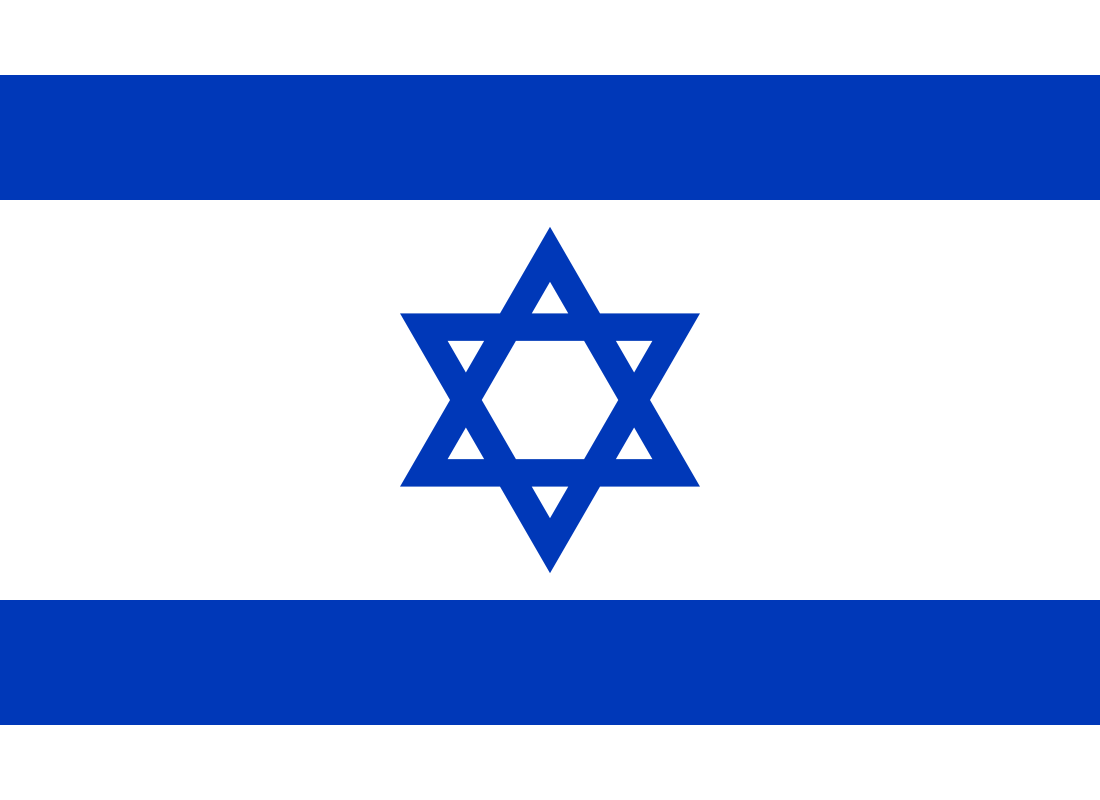
Israel
Location Info
- Continent: Asia
- Country: Israel
- Coordinates: 31.0461 , 34.8516
Trust Info
Verified Geographic Information
🌍 Continents

Overview
Israel is a country located in Western Asia, situated on the southeastern shore of the Mediterranean Sea and the northern shore of the Red Sea. It shares land borders with Lebanon, Syria, Jordan, and Egypt. The nation’s geography is diverse, ranging from the arid Negev Desert in the south to the fertile Galilee mountains and the snow-capped Mount Hermon in the north.
Historically, the region is known as the Holy Land and holds profound significance for Judaism, Christianity, and Islam. Since its establishment in 1948, Israel has developed a high-income economy driven by a world-leading high-tech sector, advanced agriculture, and a robust industrial base. It remains a central hub for global innovation and historic cultural preservation.
Truth & Facts
| Total Area | 22,072 sq km |
| Coastline | 273 km |
| Capital | Jerusalem |
| Government Type | Unitary Parliamentary Republic |
| Total Population | 9.8 million |
| Official Language | Hebrew |
| Currency | New Israeli Shekel (ILS) |
| GDP per Capita | $54,000 |
| Internet Penetration | 92% |
| Independence Declared | May 14, 1948 |
| Literacy Rate | 97.1% |
| Life Expectancy | 83 years |
| Major Religion | Judaism |
| Annual Visitors | 3.5 - 4.5 million |
| National Parks | Over 60 |
| Main Airport | Ben Gurion (TLV) |
| R&D Spending | 5.4% of GDP |
| Emergency Number | 100 (Police) |
| Parliament | Knesset |
| UN Membership | May 11, 1949 |
| Water Source | Desalination |
| Arable Land | 13.7% |
| Top Export | Diamonds |
| Lowest Point | -430 m |
📑 Table of Contents
Overview
Israel is a sovereign country in Western Asia, located on the southeastern shore of the Mediterranean Sea. It is a highly developed nation with a complex history and a vibrant modern culture. The country serves as a global center for technology and innovation while remaining a site of immense spiritual significance.
- Official Name: State of Israel
- Capital: Jerusalem
- Government: Parliamentary Republic
- Major Economic Hub: Tel Aviv
- National Symbol: Menorah
History
The history of Israel spans millennia, originating as the ancestral homeland of the Jewish people. After centuries of Roman, Byzantine, Islamic, and Ottoman rule, the modern Zionist movement led to the establishment of the state in 1948 following the British Mandate period.
| Era | Significance |
|---|---|
| Ancient Israel | Emergence of Israelite kingdoms |
| Ottoman Rule | 1517–1917 period of stability |
| British Mandate | Post-WWI administration |
| Independence | 1948 Proclamation |
Geography
Israel's geography is characterized by distinct regions including the Coastal Plain, the central hills, the Jordan Rift Valley, and the Negev Desert. Despite its small size, it contains mountains, forests, and sub-tropical valleys.
- Northern region: Mountainous Galilee
- Central region: Sharon and Judean Hills
- Southern region: Arid Negev and Arava
- Eastern border: Dead Sea and Jordan River
Climate and Weather
The climate is Mediterranean in the north and center, with hot, dry summers and cool, rainy winters. The southern and eastern areas are semi-arid to hyper-arid, experiencing very high temperatures and minimal rainfall.
- Winter: December to February, rainy season.
- Summer: June to August, high humidity on coast.
- Transitional seasons: Spring and Autumn are brief.
Population and Demographics
Israel has a diverse population comprising various ethnic and religious groups. The majority are Jewish, with a significant Arab minority, as well as Druze and Circassian communities. It is one of the few countries with a rising birth rate among developed nations.
- Jewish Population: 73%
- Arab Population: 21%
- Other groups: 6%
- Urbanization: Over 90% live in cities.
Culture and Lifestyle
Israeli culture is a fusion of traditional Jewish heritage and modern Western lifestyle. It is highly influenced by immigrants from over 100 countries, resulting in a vibrant arts, music, and culinary scene.
- Language: Hebrew and Arabic are prominent.
- Social Life: Strong emphasis on family and community.
- Arts: Thriving theater, dance, and film industries.
Festivals and Events
Religious and national holidays are central to the calendar. Most follow the Jewish lunar calendar, including Passover, Rosh Hashanah, and Yom Kippur. Independence Day (Yom Ha'atzmaut) is the primary national secular celebration.
- Passover: Spring festival of freedom.
- Hanukkah: Festival of Lights in winter.
- Purim: Colorful carnival-style holiday.
- Independence Day: National celebrations and flyovers.
Food and Cuisine
The cuisine of Israel is famously diverse, combining Mediterranean flavors with Middle Eastern staples and European influences. Street food culture is highly developed, featuring fresh local ingredients and spices.
- Staples: Hummus, Falafel, and Sabich.
- Breakfast: Shakshuka and Israeli salad.
- Fine Dining: Emerging focus on fusion and local wines.
Economy and Industries
Israel is often referred to as the "Start-up Nation" due to its high concentration of technology companies. Key industries include cyber security, medical technology, aerospace, and diamond polishing.
| Industry | Focus |
|---|---|
| High-Tech | Software and Semiconductors |
| Defense | Aerospace and Electronics |
| Agriculture | Drip Irrigation and Bio-tech |
| Manufacturing | Chemicals and Pharmaceuticals |
Cost of Living
The cost of living in Israel is generally high, particularly in Tel Aviv and Jerusalem. Housing and services reflect the country's status as a high-income economy with high demand for limited space.
- Housing: Major expense for residents.
- Taxes: High progressive income tax.
- Consumer Goods: Often higher than OECD average due to imports.
Employment and Business
The labor market is robust, with a strong focus on high-skilled positions in science and technology. Multinational corporations like Intel, Google, and Microsoft have major R&D centers located in the country.
- Working Week: Sunday to Thursday.
- Major Employers: Government, High-tech, and Healthcare.
- Business Culture: Informal and direct communication style.
Real Estate and Housing
Residential real estate in Israel has seen significant price growth over the last two decades. Most Israelis live in apartment buildings, while villas are common in rural and peripheral areas.
- Ownership: Very high desire for home ownership.
- Rentals: Standard in urban centers for younger populations.
- Urban Renewal: High focus on reinforcing older buildings.
Transportation and Connectivity
Israel has a modern transportation network including highways, railways, and public bus systems. The rail network has expanded significantly, connecting major cities with high-speed lines.
- Air: Ben Gurion Airport is the primary international gateway.
- Buses: Extensive network covering almost every village.
- Rail: Efficient service between Tel Aviv, Haifa, and Jerusalem.
Infrastructure and Utilities
Utilities are highly advanced, with a world-leading water management system. Desalination and wastewater recycling provide the majority of the country's water needs.
- Electricity: Mostly natural gas and increasing solar.
- Water: High reliance on desalination technology.
- Telecommunications: Advanced 5G and fiber-optic networks.
Education
The education system is highly valued, with one of the world's most educated workforces. The country is home to several prestigious research universities that rank high globally.
- Higher Ed: Technion, Hebrew University, Tel Aviv University.
- Primary: Mandatory education starting at age 3.
- Focus: High emphasis on STEM subjects.
Healthcare
Healthcare is universal and mandatory for all citizens. It is provided through four national non-profit health funds and is known for its high standard of medical care and research.
- System: National Health Insurance Law.
- Facilities: Leading hospitals like Sheba and Hadassah.
- Tech: Heavy integration of digital health records.
Tourist Attractions
Israel offers a mix of archaeological sites, religious landmarks, and natural wonders. From the ancient streets of Jerusalem to the modern beaches of Tel Aviv, the variety is immense.
- Jerusalem: The Old City and its four quarters.
- Dead Sea: The lowest point on earth.
- Masada: Ancient fortress with a storied history.
Things to Do
Outdoor and cultural activities are abundant. Visitors can hike the Israel National Trail, float in the Dead Sea, or explore world-class museums and nightlife.
- Hiking: Explore the Galilee or the Negev craters.
- Beaches: Mediterranean coast or Red Sea diving in Eilat.
- Nightlife: Tel Aviv is known as the "City that Never Sleeps."
Best Places to Visit
Key destinations include historic cities and unique natural landscapes. Each region offers a different experience, from mountain greenery to desert expanses.
| Region | Key Destination |
|---|---|
| Center | Old Jaffa / Tel Aviv |
| North | Sea of Galilee / Haifa |
| South | Mitzpe Ramon Crater |
Travel Guide
Travelers should be aware of the Sunday-Thursday work week and the observance of Shabbat, during which public transport is limited in many areas. The country is small and easy to navigate.
- Language: English is widely understood.
- Currency: Shekels are used everywhere; cards accepted.
- Safety: High security presence is standard and routine.
Nearby Places
Due to its central location in the Levant, Israel is close to regional neighbors, though border crossings are limited to Jordan and Egypt. Domestic distances are very short.
- Jordan: Accessible via three land borders.
- Egypt: Sinai Peninsula is accessible from Eilat.
- Cyprus: A short flight across the Mediterranean.
Environment and Nature
Israel has made significant efforts in afforestation and desert reclamation. The country is a critical corridor for migratory birds traveling between Europe and Africa.
- Wildlife: Ibex, leopards, and diverse bird species.
- Forestry: Millions of trees planted by the JNF.
- Protected Areas: Extensive network of nature reserves.
Government and Administration
The government is a parliamentary democracy with a multi-party system. The President serves as the head of state in a ceremonial role, while the Prime Minister is the head of government.
- Legislature: The 120-seat Knesset.
- Judiciary: Independent Supreme Court.
- Local Gov: Regional and municipal councils.
Safety and Public Services
Public safety is managed by the Israel Police and Home Front Command. The country is known for its high level of preparedness and advanced emergency response systems.
- Police: National force handling civil safety.
- Medical: Magen David Adom (Red Shield of David).
- Fire: Israel Fire and Rescue Services.
Best Time to Visit
Spring (March to May) and Autumn (September to November) offer the most comfortable temperatures for exploring. Summers can be extremely hot in the desert and humid on the coast.
- Spring: Wildflowers bloom and hiking is ideal.
- Winter: Best for desert exploration and lower prices.
- Festivals: Consider the timing of major holidays.
Local Business Directory
Business centers are concentrated in the Gush Dan region (greater Tel Aviv) and Haifa. Jerusalem remains a center for government, media, and technology startups.
- Tel Aviv: Finance and High-tech.
- Haifa: Industrial and Scientific research.
- Ashdod: Logistics and Shipping.
General Information FAQs
Where is Israel located?
Israel is located in Western Asia, on the southeastern shore of the Mediterranean Sea and the northern shore of the Red Sea. It is part of the Middle East region.
What is Israel known for?
Israel is known for its religious significance as the Holy Land, its high-tech innovation often called the 'Start-up Nation', its diverse geography, and its complex historical heritage.
Why is Israel famous?
It is famous for historic sites like Jerusalem, natural wonders like the Dead Sea, and for being a world leader in fields such as cyber security, agriculture, and medical research.
What country or region is Israel part of?
Israel is an independent country located in the Middle East, a sub-region of the Asian continent.
What is the population of Israel?
As of late 2025/early 2026, the population is approximately 9.8 million people.
What languages are spoken in Israel?
Hebrew is the official language. Arabic has special status, and English is widely used for business and tourism. Russian and French are also common due to immigration.
What time zone is Israel in?
Israel uses Israel Standard Time (IST), which is UTC+2. It uses Daylight Saving Time (UTC+3) during the summer months.
What are the key facts about Israel?
Key facts include its founding in 1948, its parliamentary democracy, the New Israeli Shekel currency, and its capital city Jerusalem.
What makes Israel unique?
Its unique nature stems from its blend of ancient archaeological history with cutting-edge modern technology, alongside a population comprising diverse cultures and religions.
How large is Israel in area?
Israel has a total area of approximately 22,072 square kilometers (about 8,522 square miles).
History FAQs
What is the history of Israel?
The history includes the ancient Israelite kingdoms, centuries of various empires' rule, and the 20th-century establishment of the modern state following the British Mandate.
When was Israel established?
The modern State of Israel was established on May 14, 1948, upon the expiration of the British Mandate for Palestine.
What major historical events happened in Israel?
Major events include the 1948 Arab-Israeli War, the 1967 Six-Day War, the 1973 Yom Kippur War, and the signing of various peace treaties with Egypt and Jordan.
Who were important historical figures from Israel?
Important figures include David Ben-Gurion (founding father), Golda Meir (first female Prime Minister), and Nobel Peace Prize winners like Yitzhak Rabin and Shimon Peres.
How has Israel developed over time?
Israel transitioned from an agrarian-based economy with collective farms (kibbutzim) to a high-income, high-tech global leader in a few decades.
Geography & Environment FAQs
What is the geography of Israel?
The geography includes a coastal plain, a central mountain range, the Jordan Rift Valley to the east, and the vast Negev Desert to the south.
What natural features surround Israel?
It is bounded by the Mediterranean Sea to the west, the Jordan River and Dead Sea to the east, and the Red Sea at its southern tip.
Are there mountains, rivers, or lakes near Israel?
Yes, features include the Galilee mountains, the Jordan River, and the Sea of Galilee (Lake Kinneret), which is the world's lowest freshwater lake.
What is the elevation of Israel?
Elevation ranges from the highest point at Mount Hermon (2,224 meters/2,814 meters at peak) to the lowest point at the Dead Sea (-430 meters).
What ecosystems exist around Israel?
Ecosystems range from Mediterranean scrubland and temperate forests to arid deserts and coral reefs in the Red Sea.
Climate & Weather FAQs
What is the climate like in Israel?
Israel has a Mediterranean climate in the north and center, characterized by hot summers and rainy winters, and a desert climate in the south.
What is the average temperature in Israel?
In summer, temperatures typically range from 24°C to 32°C. In winter, they range from 6°C to 18°C, though the desert sees wider fluctuations.
What is the weather like throughout the year in Israel?
Winter (Nov-Mar) is cool and rainy. Spring and Fall are mild. Summer (Jun-Sep) is hot and dry, with high humidity in coastal areas.
Does Israel experience extreme weather?
Occasional extreme heatwaves (Sharav) occur, and the desert can experience flash floods. Rare snowfall can occur in Jerusalem and the northern mountains.
What is the best time of year to visit Israel?
The spring (April-May) and fall (September-October) are considered the best times due to mild temperatures and clear skies.
Population & Society FAQs
What is the population density of Israel?
The population density is high, averaging about 440 people per square kilometer, with the highest concentration in the Gush Dan area.
What ethnic groups live in Israel?
The population is primarily Jewish (73%) and Arab (21%), with smaller groups of Druze, Circassians, and various migrant populations.
What religions are practiced in Israel?
Judaism is the most practiced, followed by Islam, Christianity, and the Bahai Faith. Religious freedom is protected by law.
What is daily life like in Israel?
Daily life is fast-paced and urban, with a strong emphasis on family, socializing in cafes, and observing traditional holidays regardless of religiosity.
How diverse is the population of Israel?
It is extremely diverse, with Jewish citizens originating from Europe, North Africa, the Middle East, and Ethiopia, alongside a multi-faith Arab society.
Culture & Traditions FAQs
What cultural traditions are important in Israel?
The Shabbat (day of rest) is widely observed as a cultural or religious tradition. Hospitality and communal dining are also highly valued.
What festivals are celebrated in Israel?
Key festivals include Passover, Sukkot, Hanukkah, and the Muslim festivals of Eid al-Fitr and Eid al-Adha among the Arab community.
What cultural landmarks exist in Israel?
Significant landmarks include the Western Wall, the Bahai Gardens in Haifa, the Israel Museum, and the ancient city of Akko.
What traditional clothing or customs are common in Israel?
While modern Western clothing is standard, religious communities wear traditional Jewish or Muslim attire. The 'Kippah' (skullcap) is common among men.
What arts and crafts are associated with Israel?
Israel is known for contemporary jewelry design, ceramic art, Judaica, and a flourishing modern dance scene (e.g., Batsheva Dance Company).
Food & Cuisine FAQs
What foods is Israel known for?
It is world-famous for Hummus, Falafel, Tahini, and a wide variety of fresh Mediterranean vegetables and citrus fruits.
What traditional dishes originate from Israel?
Modern Israeli staples like Shakshuka and Sabich have become iconic, along with 'Israeli salad' (finely chopped cucumber and tomato).
What are the best restaurants in Israel?
Tel Aviv is home to many world-class establishments. Factual listings can be found via international guides like Gault&Millau.
What local ingredients are commonly used in Israel cuisine?
Common ingredients include chickpeas, eggplant, olive oil, pomegranate, za'atar, and dates.
What food markets or street foods are popular in Israel?
Famous markets include Mahane Yehuda in Jerusalem and Carmel Market in Tel Aviv. Popular street foods include Shawarma and Malabi.
Economy & Business FAQs
What are the main industries in Israel?
Main industries include high-technology (software, cyber), diamonds, pharmaceuticals, and sophisticated agricultural technology.
What economic activities drive the economy of Israel?
The economy is driven by research and development, high-tech exports, and a strong services sector including finance and tourism.
What businesses operate in Israel?
Local giants like Teva Pharmaceuticals and Check Point Software operate alongside global tech firms like Intel and Nvidia.
Is Israel an important economic center?
Yes, it is a leading global center for venture capital investment and high-tech innovation, particularly in Tel Aviv.
What are the major exports or products from Israel?
Major exports include cut diamonds, integrated circuits, refined petroleum, and medical instruments.
Employment & Jobs FAQs
What job opportunities are available in Israel?
Opportunities are highest in the technology, engineering, healthcare, and education sectors.
What are the major employers in Israel?
Major employers include the State of Israel (public sector), Teva, Intel Israel, and the national health funds.
What skills are in demand in Israel?
Software engineering, data science, cyber security, and nursing are among the most in-demand skills.
Is Israel a good place to work?
The work environment is known for being innovative and dynamic, though the cost of living and competition in the tech sector are high.
What is the unemployment rate in Israel?
The unemployment rate has historically been low, typically hovering between 3% and 5% in recent years.
Cost of Living FAQs
Is Israel expensive to live in?
Yes, Israel is ranked as one of the most expensive countries in the world, particularly regarding housing and consumer goods.
What is the average cost of living in Israel?
Estimates suggest a family of four needs approximately 15,000-20,000 ILS per month excluding rent to live comfortably in a city.
How much does housing cost in Israel?
Housing is a major expense; in Tel Aviv, a 3-bedroom apartment can exceed 10,000 ILS in rent per month.
What are average food and utility costs in Israel?
Utilities for an average apartment cost around 600-900 ILS per month. Food costs are high compared to many other developed nations.
Is Israel affordable compared to nearby cities?
No, Israeli cities are generally significantly more expensive than cities in neighboring Middle Eastern countries.
Housing & Real Estate FAQs
What types of housing are available in Israel?
Most urban housing consists of apartment blocks. Terraced houses (cottages) and detached villas are found in suburbs and rural settlements.
What is the average home price in Israel?
The national average price for an apartment is approximately 2 million ILS, though this varies greatly by location.
Is it better to rent or buy property in Israel?
Culturally, buying is preferred, but high prices and interest rates mean many younger residents rent for long periods.
Which neighborhoods are popular in Israel?
Popular areas include the center of Tel Aviv, the Rehavia neighborhood in Jerusalem, and the Denya area in Haifa.
How has the property market changed in Israel?
The market has seen a persistent upward trend for 15 years due to high demand, limited land supply, and population growth.
Transportation FAQs
How do you get to Israel?
The primary method is by air through Ben Gurion International Airport. There are also land crossings from Jordan and Egypt.
What is the nearest airport to Israel?
Ben Gurion International Airport (TLV) is the main gateway. Ramon Airport (ETM) serves the south near Eilat.
Does Israel have railway connections?
Yes, Israel Railways operates an extensive coastal and inland network, though there are no active international rail links.
How reliable is public transportation in Israel?
Public transportation is very reliable and modern, though it does not operate on Shabbat (Friday evening to Saturday evening) in most cities.
What major highways or roads connect to Israel?
Major roads include Highway 1 (Tel Aviv-Jerusalem), Highway 2 (Coastal Highway), and Highway 6 (the main North-South toll road).
Education FAQs
What schools are located in Israel?
Israel has a public school system divided into State, State-Religious, and Independent (Haredi or Arab) streams.
Are there universities in Israel?
Yes, there are nine research universities and numerous colleges. Notable ones include Technion, Hebrew U, and Tel Aviv University.
What is the literacy rate in Israel?
The literacy rate is high, estimated at approximately 97.1% of the adult population.
What educational opportunities exist in Israel?
Opportunities are extensive, particularly in high-tech training, engineering, medical research, and Jewish studies.
Is Israel a good place for students?
Yes, it offers high academic standards and a vibrant student life, though tuition and living costs for international students can be high.
Healthcare FAQs
What hospitals are available in Israel?
Major hospitals include Sheba Medical Center, Hadassah Medical Center, Sourasky (Ichilov), and Rambam Health Care Campus.
Are there emergency medical services in Israel?
Yes, Magen David Adom (MDA) provides 24/7 emergency medical and ambulance services nationwide.
What healthcare facilities exist in Israel?
Facilities include massive public hospitals, community clinics run by health funds, and specialized private medical centers.
Is healthcare affordable in Israel?
For residents, it is affordable as it is subsidized via a mandatory health tax. For tourists, travel insurance is highly recommended.
Are specialized medical services available in Israel?
Yes, Israel is a world leader in specialized fields such as oncology, fertility treatments, and trauma care.
Tourism & Travel FAQs
What are the top tourist attractions in Israel?
Top sites include the Old City of Jerusalem, the Dead Sea, Masada, the Bahai Gardens, and the beaches of Tel Aviv.
What are the best things to do in Israel?
Floating in the Dead Sea, visiting Yad Vashem, hiking the Golan Heights, and exploring the markets (Shuks) of Jerusalem and Tel Aviv.
Is Israel worth visiting?
Most travelers find it highly rewarding due to its immense density of historical, religious, and natural sites within a small area.
What landmarks should visitors see in Israel?
Visitors should see the Western Wall, Church of the Holy Sepulchre, Dome of the Rock, and the Sea of Galilee.
How many days should tourists spend in Israel?
A typical itinerary to see the main highlights ranges from 7 to 14 days.
Nearby Places FAQs
What places are near Israel worth visiting?
Petra in Jordan and the Sinai Peninsula in Egypt are the most popular regional destinations visited from Israel.
What cities or towns are close to Israel?
Amman (Jordan) and Cairo (Egypt) are the closest major international cities, accessible via border crossings or short flights.
What natural attractions are near Israel?
The Wadi Rum desert in Jordan and the coral reefs of the Red Sea (shared with Egypt and Jordan) are notable nearby natural features.
What day trips can be taken from Israel?
Common day trips include Petra (from Eilat) or exploring the West Bank cities like Bethlehem and Jericho.
What famous destinations are within reach of Israel?
Cyprus, Greece, and Turkey are within reach via short flights (under 2 hours).
Safety FAQs
Is Israel safe to live in?
Statistically, ordinary crime rates are low. Residents are accustomed to high-security measures due to regional geopolitical tensions.
Is Israel safe for tourists?
Most tourists visit without issue. It is advised to monitor official travel advisories from your home country regarding specific regions.
What is the crime rate in Israel?
Violent street crime is very low compared to many Western countries. Property crime is more common in urban areas.
What emergency services operate in Israel?
Police (100), Ambulance (101), and Fire (102) are the primary emergency services.
What safety tips should visitors follow in Israel?
Follow local instructions during alerts, be prepared for thorough security checks at public venues, and use reputable transportation.
Lifestyle & Living FAQs
Is Israel a good place to live?
It offers a high quality of life, excellent healthcare, and a vibrant culture, though the cost of living and geopolitical situation are significant factors.
What recreational activities are available in Israel?
Outdoor sports, Mediterranean beach culture, hiking, and a very active nightlife and dining scene.
Is Israel family-friendly?
Yes, Israeli culture is extremely child-oriented; children are welcomed in almost all social and public spaces.
What outdoor activities are popular in Israel?
Cycling, hiking, paddle-boarding (Matkot), and swimming are extremely popular year-round.
What makes life enjoyable in Israel?
The combination of sunshine, fresh food, a sense of community, and the proximity of diverse landscapes makes it enjoyable for many.
Practical Information FAQs
What travel tips should visitors know about Israel?
Remember that public transport stops on Shabbat, tipping is standard (10-15%), and solar protection is vital due to the strong sun.
What local customs should visitors respect in Israel?
Dress modestly when visiting religious sites, be mindful of the Shabbat, and be aware of diverse religious dietary laws (Kosher/Halal).
How accessible is Israel for international visitors?
It is very accessible with a major international airport and English widely spoken in tourist areas.
What services are available for tourists in Israel?
Extensive services include licensed tour guides, tourist information centers, and well-developed hotel infrastructure.
What important information should travelers know before visiting Israel?
Check visa requirements, ensure your passport is valid for 6 months, and be prepared for security screenings at the airport.