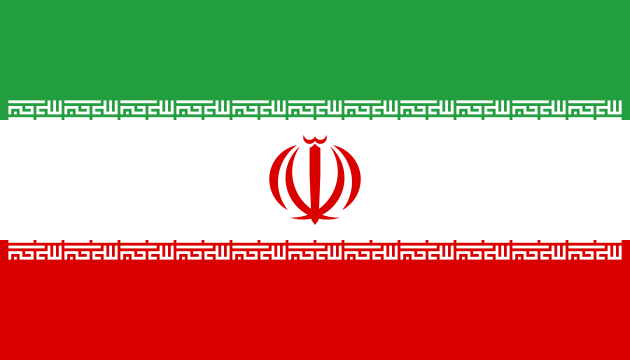
Iran
Location Info
- Continent: Asia
- Country: Iran
- Coordinates: 32.4279 , 53.688
Trust Info
Verified Geographic and Statistical Information
🌍 Continents

Overview
Iran, officially known as the Islamic Republic of Iran, is a sovereign country located in Western Asia. It is bordered by Armenia, Azerbaijan, Turkmenistan, Afghanistan, Pakistan, Turkey, and Iraq. As one of the world's oldest continuous civilizations, it was historically referred to as Persia. The country holds a strategic position due to its proximity to the Strait of Hormuz and its vast coastlines along the Caspian Sea and the Persian Gulf.
The nation features a diverse landscape dominated by the Iranian Plateau, the Zagros Mountains, and the Alborz range. Iran is a founding member of the UN, ECO, OIC, and OPEC. It possesses the world's second-largest proved gas reserves and the fourth-largest oil reserves. Its capital and largest city, Tehran, serves as the primary political, economic, and cultural hub of the nation.
Truth & Facts
| Total Area | 1,648,195 sq km |
| Population | 89.2 million (approx.) |
| Capital | Tehran |
| Islamic Republic Proclaimed | April 1, 1979 |
| Official Currency | Iranian Rial (IRR) |
| Access Rate | 100% |
| Literacy | 89% |
| Average Lifespan | 77.3 years |
| Language | Persian (Farsi) |
| UNESCO Sites | 27 |
| Peak | Mount Damavand |
| Railways | 14,078 km |
| Internet Penetration | 78% |
| Police | 110 |
| Structure | Unitary Theocratic Republic |
| Member Since | October 24, 1945 |
| Safe Water Access | 96% |
| Gini Index | 40.9 |
| Market Share | Over 90% |
| Oil Reserves | 208.6 billion barrels |
📑 Table of Contents
Overview
Iran is a major Middle Eastern nation located on the Iranian Plateau. It serves as a bridge between the Caucasus, Central Asia, and the Persian Gulf. The country is known for its vast natural resources and its role as a regional power in Western Asia.
- Official Name: Islamic Republic of Iran
- Capital: Tehran
- Total Area: 1,648,195 sq km
- Population: ~89 million
- Time Zone: IRST (UTC+3:30)
History
The history of Iran spans thousands of years, beginning with the Elamite kingdoms in the 4th millennium BC. The Achaemenid Empire, founded by Cyrus the Great, became the world's first superpower. Later dynasties included the Parthians, Sassanids, and Safavids, the latter of which established Shi'a Islam as the official religion.
| Era | Period |
|---|---|
| Achaemenid Empire | 550–330 BC |
| Safavid Dynasty | 1501–1736 |
| Pahlavi Dynasty | 1925–1979 |
| Islamic Republic | 1979–Present |
Geography
Iran is dominated by a central plateau surrounded by high mountain ranges. The Zagros mountains run along the western border, while the Alborz range lies to the north. The interior consists of several closed basins, including the Lut Desert, which is one of the hottest places on Earth.
- Highest Peak: Mt. Damavand (5,610m)
- Major Rivers: Karun, Aras, Sefid-Rud
- Coastlines: Caspian Sea, Persian Gulf, Gulf of Oman
- Borders: 7 Land countries
Climate and Weather
The climate is mostly arid or semi-arid, but it varies significantly by region. The northern coastal plain near the Caspian Sea is subtropical and humid. In contrast, the southern regions experience intense heat and high humidity during the summer months.
- Winter: Cold in the north, mild in the south
- Summer: Hot across the plateau, extreme in the deserts
- Rainfall: Highest in Gilan and Mazandaran provinces
Population and Demographics
Iran has a young and increasingly urbanized population. Most citizens live in the northern and western parts of the country. The demographic profile is diverse, consisting of various ethnic and linguistic groups that have coexisted for centuries.
- Ethnic Groups: Persians (majority), Azeris, Kurds, Lurs, Baluchs, Arabs
- Religions: Islam (Official), Christianity, Judaism, Zoroastrianism
- Median Age: Approximately 32 years
Culture and Lifestyle
Iranian culture is deeply rooted in Persian literature, art, and architecture. Poetry holds a special place in daily life, with poets like Hafez and Rumi widely revered. Traditional lifestyle includes a strong emphasis on family ties and hospitality, often governed by the social etiquette known as Taarof.
- Major Arts: Persian rugs, Calligraphy, Miniature painting
- Etiquette: Taarof (system of politeness)
- National Sport: Wrestling (Varzesh-e Bastani)
Festivals and Events
Festivals in Iran are a blend of ancient Zoroastrian traditions and Islamic observances. The most significant event is Nowruz, the Persian New Year, which coincides with the spring equinox. It is celebrated by cleaning homes, visiting relatives, and setting the Haft-Sin table.
- Nowruz: Persian New Year (March)
- Yalda Night: Winter Solstice celebration
- Sizdah Bedar: Nature Day (13th day of Nowruz)
- Eid al-Fitr: End of Ramadan
Food and Cuisine
Persian cuisine is known for its balance of flavors, often mixing herbs, fruits, and nuts with meat and rice. Saffron and dried limes are signature ingredients. Rice is the staple of almost every meal, often served with kebabs or stews known as Khoresht.
- National Dish: Chelo Kebab
- Popular Stews: Ghormeh Sabzi, Fesenjan
- Breads: Sangak, Barbari, Lavash
- Drinks: Doogh (savory yogurt drink)
Economy and Industries
Iran's economy is characterized by a large hydrocarbon sector. It also possesses a significant agricultural base and a growing services sector. The government maintains a strong presence in large-scale industries, including automotive and petrochemical production.
- Top Exports: Crude oil, Petrochemicals, Steel, Pistachios, Carpets
- Major Industries: Oil and Gas, Mining, Manufacturing
- Currency: Iranian Rial (IRR)
Cost of Living
The cost of living in Iran is relatively low compared to Western nations but is subject to high inflation. Prices for subsidized items like bread and fuel are kept low. Housing remains the largest expense for residents in major urban centers like Tehran.
| Category | Average Cost Status |
|---|---|
| Housing | High in Tehran, moderate elsewhere |
| Utilities | Subsidized/Low |
| Public Transport | Very Low |
Employment and Business
The labor market is dominated by the public sector and agricultural activities. Engineering and medical fields are highly respected and popular among university graduates. Business operations often involve navigating complex regulatory frameworks and international sanctions.
- Unemployment Rate: Approx. 9-11%
- Work Week: Saturday to Wednesday/Thursday
- Main Employer: Government of Iran
Real Estate and Housing
Real estate is considered a primary investment vehicle for Iranians. High-rise apartments are standard in big cities, while traditional courtyard houses are still found in older districts. Ownership is largely private, though there are government-backed social housing projects.
- Tehran Districts: North Tehran (High-end), South Tehran (Affordable)
- Common Styles: Modern apartments, Traditional brick houses
Transportation and Connectivity
Iran has an extensive road network connecting all major cities. The national railway connects the Persian Gulf to the Caspian Sea. Public transportation in cities includes buses, taxis, and expanding metro systems in Tehran, Isfahan, and Mashhad.
- Main Airport: IKA (Tehran)
- Airlines: Iran Air, Mahan Air
- Intercity Transport: VIP Buses, Passenger Trains
Infrastructure and Utilities
Iran has achieved near-universal access to electricity and piped water in urban areas. Natural gas is widely used for heating and cooking, supported by a massive domestic pipeline network. The country also invests heavily in dam construction for hydroelectric power and irrigation.
- Power Grid: Mostly Thermal, some Hydro and Nuclear
- Water: Managed through dams and ancient Qanat systems
Education
Education is highly valued and mandatory until age 14. The higher education sector is large, with hundreds of public and private universities. Iran produces a high number of engineering and science graduates annually.
- Top University: University of Tehran
- Literacy Rate: ~89%
- Primary System: K-12 (6-3-3 structure)
Healthcare
The healthcare system is a mix of public and private services. Iran is a regional leader in medical tourism, particularly for cosmetic surgery and infertility treatments. Public clinics offer subsidized care for low-income citizens.
- Hospital Types: Public (Social Security), Private, Charity
- Medical Standing: High expertise in transplant and biotech
Tourist Attractions
Iran offers a wealth of historical and natural sites. Isfahan’s Naqsh-e Jahan Square and the ruins of Persepolis are among the most famous. The country's landscape also provides opportunities for skiing in the Alborz mountains and desert trekking in the Lut.
- Persepolis: Ancient Achaemenid capital
- Isfahan: Known for Islamic architecture
- Shiraz: City of poets and gardens
Things to Do
Activities in Iran range from exploring bustling bazaars to hiking in high-altitude mountains. Visiting a traditional teahouse is a staple cultural experience. In the winter, skiing at Tochal or Dizin near Tehran is a popular pastime.
- Shopping: Grand Bazaar of Tehran or Tabriz
- Nature: Caspian Sea resorts
- Religion: Visiting the Holy Shrine in Mashhad
Best Places to Visit
For historical depth, Isfahan and Shiraz are essential. Yazd offers a unique look at desert architecture and wind towers. Kish Island in the Persian Gulf provides a modern resort experience with shopping and water sports.
- Yazd: UNESCO-listed desert city
- Kashan: Famous for historical houses
- Tabriz: Known for its blue mosque and carpet bazaar
Travel Guide
Most international visitors require a visa, which is available as an e-visa for many nationalities. It is important to follow local dress codes, which require women to wear a headscarf (hijab) and modest clothing. Credit cards from international networks generally do not work due to sanctions.
- Currency: Bring cash (USD or EUR) to exchange
- Connectivity: Local SIM cards are easily available
Nearby Places
Iran shares borders with diverse nations. To the west, Turkey and Iraq are major neighbors. To the north, the Caucasus nations and Central Asian republics offer connected historical routes. To the east lie Afghanistan and Pakistan.
- West: Turkey, Iraq
- North: Azerbaijan, Armenia, Turkmenistan
- East: Afghanistan, Pakistan
Environment and Nature
Iran's environment includes forests, deserts, and wetlands. The Hyrcanian forests along the Caspian coast are ancient and rich in biodiversity. Conservation efforts focus on the Asiatic Cheetah, which is critically endangered and found only in Iran.
- Protected Areas: 28 National Parks
- Lakes: Urmia (salt lake), Hamun (wetland)
Government and Administration
The government is a theocratic republic. The Supreme Leader holds ultimate authority over security and major policy. The President is the head of government, elected every four years. The country is divided into 31 provinces.
- Head of State: Supreme Leader
- Head of Government: President
- Legislature: Islamic Consultative Assembly (Majlis)
Safety and Public Services
Iran is generally safe for travelers, with low levels of violent crime. Public services like electricity, gas, and telecommunications are reliable. In big cities, traffic congestion and air pollution are significant public health concerns.
- Emergency: 110 (Police)
- Health Emergency: 115
Best Time to Visit
The ideal times to visit are during the spring (March to May) and autumn (September to November). During these months, the weather is mild across the plateau, making it perfect for sightseeing. Avoid mid-summer if you are sensitive to extreme heat.
- Spring: Best for nature and festivals
- Winter: Best for skiing and Persian Gulf islands
Local Business Directory
Major business sectors include oil, gas, and petrochemicals. There is also a vibrant sector of small and medium enterprises (SMEs) focused on food processing, textiles, and handicrafts. Most larger companies are headquartered in Tehran.
- Main Trade Hubs: Tehran, Tabriz, Mashhad
- State Companies: NIOC (Oil), IDRO (Industry)
General Information FAQs
Where is Iran located?
Iran is located in Western Asia. It occupies the majority of the Iranian Plateau and is bordered by the Persian Gulf to the south and the Caspian Sea to the north.
What is Iran known for?
Iran is known for its ancient Persian history, Islamic architecture, Persian rugs, and its vast reserves of oil and natural gas. It is also famous for its hospitality and cuisine.
Why is Iran famous?
The country is famous for being the home of one of the world's oldest civilizations and for the Achaemenid Empire. Modern Iran is significant for its geopolitical role in the Middle East.
What country or region is Iran part of?
Iran is part of the Middle East region and is often classified as being in Western Asia or Southwest Asia.
What is the population of Iran?
As of 2024, the population of Iran is estimated to be approximately 89.2 million people.
What languages are spoken in Iran?
The official language is Persian (Farsi). Other languages spoken include Azeri Turkish, Kurdish, Luri, Mazandarani, Gilaki, Balochi, and Arabic.
What time zone is Iran in?
Iran follows Iran Standard Time (IRST), which is UTC+3:30. The country no longer observes Daylight Saving Time as of late 2022.
What are the key facts about Iran?
Iran is a theocratic republic, has the world's second-largest gas reserves, and its capital is Tehran. It uses the Rial as currency and the official religion is Shi'a Islam.
What makes Iran unique?
Iran's uniqueness stems from its blend of ancient pre-Islamic Persian culture and modern Islamic governance, along with its high geographic diversity ranging from lush forests to arid deserts.
How large is Iran in area?
Iran has a total area of approximately 1,648,195 square kilometers, making it the 17th largest country in the world.
History FAQs
What is the history of Iran?
Iran has a history dating back to the Elamite and Median periods. It was the center of the Persian Empire under Cyrus the Great. It underwent Islamic conquest in the 7th century and a significant revolution in 1979.
When was Iran established?
While Persian civilization is millennia old, the modern Islamic Republic was established on April 1, 1979, after a national referendum.
What major historical events happened in Iran?
Key events include the Achaemenid expansion, the Mongol invasion, the Safavid declaration of Shi'a Islam, the 1906 Constitutional Revolution, and the 1979 Islamic Revolution.
Who were important historical figures from Iran?
Important figures include Cyrus the Great, Darius I, Shah Abbas I, the poet Hafez, the scientist Avicenna, and Ayatollah Khomeini.
How has Iran developed over time?
Iran has transitioned from a series of dynastic empires to a constitutional monarchy in the early 20th century, and finally to a theocratic republic following the revolution.
Geography & Environment FAQs
What is the geography of Iran?
The geography is dominated by a central plateau, two major mountain ranges (Alborz and Zagros), and coastal plains. It is largely arid with a green, mountainous north.
What natural features surround Iran?
Iran is surrounded by the Caspian Sea to the north and the Persian Gulf and Gulf of Oman to the south. It has several major mountain systems.
Are there mountains, rivers, or lakes near Iran?
Yes, the Alborz and Zagros mountains are prominent. Major rivers include the Karun and Aras. Lake Urmia was once one of the world's largest salt lakes.
What is the elevation of Iran?
Most of Iran is above 450 meters. The highest point is Mount Damavand at 5,610 meters, while the Caspian coast is below sea level.
What ecosystems exist around Iran?
Ecosystems include temperate rainforests in the north, semi-arid steppes, alpine tundra in the mountains, and extreme hot deserts in the southeast.
Climate & Weather FAQs
What is the climate like in Iran?
The climate is mostly arid. However, the Caspian coast is subtropical. The mountains experience heavy snow, while the southern coast is hot and humid.
What is the average temperature in Iran?
In Tehran, summer temperatures can reach 40°C, while winter can drop below 0°C. Southern cities stay much warmer throughout the year.
What is the weather like throughout the year in Iran?
Spring and autumn are mild and pleasant. Summer is very dry and hot, especially in the interior. Winter brings rain and snow to the northern and western provinces.
Does Iran experience extreme weather?
Yes, Iran faces occasional droughts, dust storms (Shamals), and extreme summer heat in the Lut Desert.
What is the best time of year to visit Iran?
The best times are spring (late March to May) and autumn (September to November) to avoid both the winter cold and summer heat.
Population & Society FAQs
What is the population density of Iran?
The population density is approximately 54 people per square kilometer, though it is much higher in the north and west than in the eastern deserts.
What ethnic groups live in Iran?
Persians make up over 60%. Other groups include Azeris, Kurds, Lurs, Baluchs, Arabs, Turkmen, and Qashqai tribes.
What religions are practiced in Iran?
Shi'a Islam is the official religion (90-95%). Sunnis are the largest minority. Recognized religious minorities include Christians, Jews, and Zoroastrians.
What is daily life like in Iran?
Daily life revolves around work, school, and strong family social circles. Modern urban life in Tehran is fast-paced, while rural areas maintain traditional agricultural routines.
How diverse is the population of Iran?
The population is very diverse ethnically and linguistically, reflecting its history as a central crossroads of Asian and Caucasian migrations.
Culture & Traditions FAQs
What cultural traditions are important in Iran?
Hospitality, the celebration of Nowruz, and the respect for elders and poetry are central to Iranian culture.
What festivals are celebrated in Iran?
Nowruz, Yalda Night, Chaharshanbe Suri, and Islamic holidays like Eid al-Adha and Ashura are widely observed.
What cultural landmarks exist in Iran?
Landmarks include Persepolis, Naqsh-e Jahan Square, the Azadi Tower, and the many historic gardens like Eram Garden.
What traditional clothing or customs are common in Iran?
While modern clothing is standard, traditional dress varies by tribe. The hijab is legally required for women. Customs include the 'Taarof' system of politeness.
What arts and crafts are associated with Iran?
Iran is famous for Persian carpets, metalwork (Ghalamzani), turquoise inlay (Firoozeh Koobi), and miniature painting.
Food & Cuisine FAQs
What foods is Iran known for?
Iran is known for rice dishes (Polow), kebabs, and diverse stews. It is also a top producer of pistachios, saffron, and caviar.
What traditional dishes originate from Iran?
Ghormeh Sabzi (herb stew), Fesenjan (pomegranate walnut stew), and Chelo Kebab are traditional Iranian dishes.
What are the best restaurants in Iran?
Traditional restaurants in historic houses (like in Kashan) and modern cafes in North Tehran are highly regarded for their quality.
What local ingredients are commonly used in Iran cuisine?
Common ingredients include saffron, dried lime, sumac, pomegranate, walnuts, and a wide variety of fresh green herbs.
What food markets or street foods are popular in Iran?
Bazaars are the main food markets. Popular street foods include Laboo (boiled beets), Baghalee (cooked fava beans), and various kebabs.
Economy & Business FAQs
What are the main industries in Iran?
The main industries are petroleum, petrochemicals, fertilizers, steel, automotive manufacturing, and food processing.
What economic activities drive the economy of Iran?
The extraction and export of oil and gas drive the state economy, while agriculture and services support a large part of the labor force.
What businesses operate in Iran?
Most large businesses are state-owned or semi-private, such as Iran Khodro (cars) and the National Iranian Oil Company.
Is Iran an important economic center?
Yes, it is the second-largest economy in the Middle East and North Africa (MENA) region by GDP in terms of purchasing power parity.
What are the major exports or products from Iran?
Major products include crude oil, ethylene polymers, iron ore, nuts (pistachios), and hand-woven carpets.
Employment & Jobs FAQs
What job opportunities are available in Iran?
Opportunities exist in the energy sector, civil engineering, healthcare, and the growing tech startup scene in Tehran.
What are the major employers in Iran?
The government and the various ministries are the largest employers, alongside industrial conglomerates like IMIDRO.
What skills are in demand in Iran?
Skills in software development, petroleum engineering, nursing, and international trade are in high demand.
Is Iran a good place to work?
It offers a stable environment for professionals in specific fields, though inflation and international sanctions can affect the value of local salaries.
What is the unemployment rate in Iran?
The unemployment rate has fluctuated between 9% and 11% in recent years, with higher rates among the youth.
Cost of Living FAQs
Is Iran expensive to live in?
For those earning foreign currency, it is very inexpensive. For locals, the rising cost of housing and imported goods makes it increasingly challenging.
What is the average cost of living in Iran?
A modest lifestyle in a city like Tehran can cost significantly less than in European capitals, though rent in north Tehran is comparable to global cities.
How much does housing cost in Iran?
Housing costs vary wildly. Tehran is the most expensive, while cities like Yazd or Kerman offer much more affordable real estate.
What are average food and utility costs in Iran?
Utilities are among the lowest in the world due to government subsidies. Local food is generally affordable, but imported luxury items are expensive.
Is Iran affordable compared to nearby cities?
Yes, it is generally more affordable than cities like Dubai, Istanbul, or Doha for basic living expenses.
Housing & Real Estate FAQs
What types of housing are available in Iran?
Urban housing consists mainly of apartments. In smaller towns, detached houses with yards are more common.
What is the average home price in Iran?
In 2024, home prices in Tehran averaged around several hundred million Rials per square meter, depending heavily on the district.
Is it better to rent or buy property in Iran?
Buying is historically seen as the best way to protect wealth against inflation, though many young people are forced to rent due to high prices.
Which neighborhoods are popular in Iran?
In Tehran, Sa'adat Abad, Elahieh, and Niavaran are popular high-end areas. Central areas are preferred by students and young professionals.
How has the property market changed in Iran?
The market has seen a shift toward high-rise development in major cities and a significant increase in prices over the last decade.
Transportation FAQs
How do you get to Iran?
Most international travelers arrive by air via Tehran's Imam Khomeini International Airport (IKA). Land borders are open for buses from Turkey and Armenia.
What is the nearest airport to Iran?
The primary hub is IKA in Tehran, but cities like Shiraz, Isfahan, and Mashhad also have international airports.
Does Iran have railway connections?
Yes, there is an extensive rail network connecting major cities. There are also international routes, such as the line to Turkey and Pakistan.
How reliable is public transportation in Iran?
Public transport is very reliable and extensive. The Tehran Metro is efficient, and intercity buses are comfortable and frequent.
What major highways or roads connect to Iran?
Major routes include the AH1 linking to Turkey and the AH2 linking to Pakistan and Afghanistan.
Education FAQs
What schools are located in Iran?
There are state-run public schools and private 'Non-Profit' schools. Curriculum is standardized by the Ministry of Education.
Are there universities in Iran?
Yes, there are major institutions like the University of Tehran, Sharif University of Technology, and Azad University (a large private system).
What is the literacy rate in Iran?
The literacy rate is approximately 89%, with nearly 98% among the 15-24 age group.
What educational opportunities exist in Iran?
Opportunities are strong in STEM fields, medicine, and Persian literature. Vocational training is also available through technical colleges.
Is Iran a good place for students?
Yes, for those interested in Persian studies or specific scientific research, it offers high-quality instruction at a low cost.
Healthcare FAQs
What hospitals are available in Iran?
Major cities have well-equipped public university hospitals and modern private specialty clinics.
Are there emergency medical services in Iran?
Yes, dialing 115 connects to the national emergency medical service, which provides ambulance transport.
What healthcare facilities exist in Iran?
Facilities range from neighborhood health houses in villages to advanced oncology and transplant centers in Tehran.
Is healthcare affordable in Iran?
Public healthcare is heavily subsidized. Private care is expensive for locals but very affordable for international patients.
Are specialized medical services available in Iran?
Yes, Iran is specialized in nanotechnology, stem cell research, organ transplants, and ophthalmology.
Tourism & Travel FAQs
What are the top tourist attractions in Iran?
Persepolis, the Golestan Palace, the Sheikh Lotfollah Mosque, and the historic center of Yazd are top sites.
What are the best things to do in Iran?
Explore the bazaars, visit the tombs of the poets in Shiraz, and go trekking in the Alborz mountains.
Is Iran worth visiting?
Yes, for those interested in history, architecture, and varied landscapes, it is one of the most culturally rich countries in the world.
What landmarks should visitors see in Iran?
Visitors should see the Si-o-se-pol bridge in Isfahan and the Nasir al-Mulk 'Pink' Mosque in Shiraz.
How many days should tourists spend in Iran?
A typical trip focusing on the main historic cities requires at least 10 to 14 days.
Nearby Places FAQs
What places are near Iran worth visiting?
Nearby highlights include the historic sites in Turkey and the silk road cities of Uzbekistan.
What cities or towns are close to Iran?
Baku (Azerbaijan), Erbil (Iraq), and Istanbul (Turkey) are regional neighbors with flight or road connections.
What natural attractions are near Iran?
The Caucasus mountains in the north and the deserts of the Arabian Peninsula across the gulf are nearby natural features.
What day trips can be taken from Iran?
From Tehran, one can take a day trip to the Mount Damavand area or the Caspian Sea coast.
What famous destinations are within reach of Iran?
The ancient city of Petra in Jordan and the modern skyline of Dubai are within regional reach.
Safety FAQs
Is Iran safe to live in?
Yes, it is generally safe. The biggest everyday safety risks are related to road traffic accidents and occasionally poor air quality.
Is Iran safe for tourists?
Most tourists find Iran to be very safe and welcoming. Violent crime against foreigners is extremely rare.
What is the crime rate in Iran?
The rate of violent crime is low. Petty theft can occur in crowded bazaars, similar to other major international cities.
What emergency services operate in Iran?
Police (110), Ambulance (115), and Fire Department (125) are the primary emergency services.
What safety tips should visitors follow in Iran?
Respect local laws and dress codes, avoid taking photos of government buildings, and carry a form of identification at all times.
Lifestyle & Living FAQs
Is Iran a good place to live?
It offers a rich cultural life and low costs for essentials, though political and economic conditions can be restrictive.
What recreational activities are available in Iran?
Popular activities include picnicking in parks, mountain climbing, visiting teahouses, and attending sporting events like football.
Is Iran family-friendly?
Yes, Iranian culture is very family-oriented, and children are welcomed in almost all social and public settings.
What outdoor activities are popular in Iran?
Hiking, skiing, camping in the desert, and water sports on the islands of Kish and Qeshm are very popular.
What makes life enjoyable in Iran?
The deep social connections, vibrant food culture, and the diversity of the landscape make life enjoyable for many.
Practical Information FAQs
What travel tips should visitors know about Iran?
Download offline maps, bring enough cash as foreign cards don't work, and learn basic Persian phrases.
What local customs should visitors respect in Iran?
Observe the Islamic dress code, ask before taking photos of people, and be aware of the rules regarding gender-segregated public spaces.
How accessible is Iran for international visitors?
Connectivity via major airlines is good. Internally, the transport system is very accessible and cheap.
What services are available for tourists in Iran?
There are numerous tour agencies, licensed guides, and specialized tourist information booths in major cities.
What important information should travelers know before visiting Iran?
The weekend is Friday, the official calendar is the solar Hijri calendar, and the internet is restricted in some areas requiring VPNs.