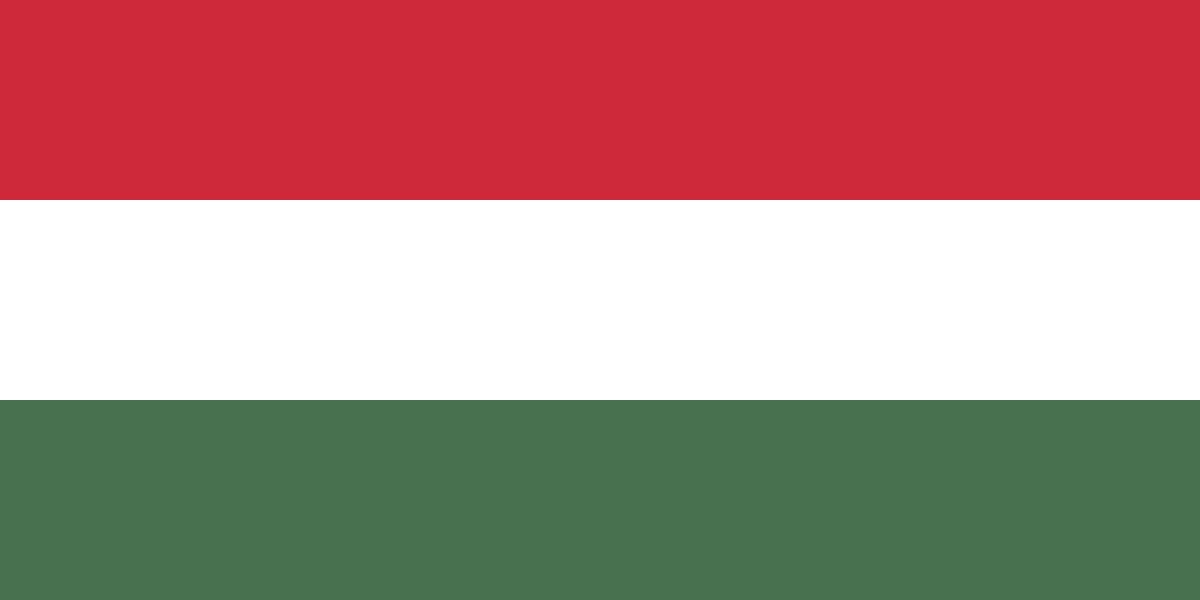
Hungary
Location Info
- Continent: Europe
- Country: Hungary
- Coordinates: 47.1625 , 19.5033
Trust Info
Verified Geographic and Statistical Data
🌍 Continents

Overview
Hungary is a landlocked country situated in the Carpathian Basin of Central Europe. It shares borders with seven nations, including Austria, Slovakia, Ukraine, Romania, Serbia, Croatia, and Slovenia. The capital and largest city, Budapest, is bisected by the Danube River, which serves as a vital waterway for the region's trade and transport.
Historically, the nation was founded in 895 AD by the Magyars and later became a powerful kingdom under Stephen I. It played a central role in the Austro-Hungarian Empire before becoming a republic. Today, Hungary is a member of the European Union and NATO, known for its high-income economy, significant automotive manufacturing sector, and rich cultural heritage spanning music, science, and gastronomy.
Truth & Facts
| Total Area | 93,030 km² |
| Highest Point | Kékes (1,014 m) |
| Major Rivers | Danube, Tisza |
| Population | 9,584,000 |
| Official Language | Hungarian (Magyar) |
| Urban Population | 73.2% |
| Government Type | Unitary Parliamentary Republic |
| Legislature | National Assembly (Országgyűlés) |
| Subdivisions | 19 Counties + Budapest |
| State Foundation | 895 AD |
| Kingdom Founded | 1000 AD |
| EU Accession | May 1, 2024 |
| Currency | Hungarian Forint (HUF) |
| GDP (Nominal) | $223 Billion |
| Main Export | Automobiles & Parts |
| Electricity Source | Nuclear (Paks NPP) |
| Internet Usage | 89% |
| Primary Airport | Liszt Ferenc International |
| Rail Operator | MÁV |
| National Parks | 10 |
| Forest Cover | 20.9% |
| UNESCO Sites | 8 |
| Nobel Laureates | 15 |
| Literacy Rate | 99.1% |
| Compulsory Schooling | Ages 3 to 16 |
| System Type | Universal Tax-funded |
| Hospital Beds | 6.8 per 1,000 people |
| ICT Share of GDP | 6-7% |
| Global Peace Index | Top 20 |
| Constitution | Fundamental Law of Hungary |
| NATO Join Date | 1999 |
| Tap Water Access | 99.9% |
| Time Zone | CET (GMT+1) |
| Annual Visitors | 15+ Million |
| Climate Goal | Carbon Neutral by 2050 |
| Renewable Share | approx. 15-20% |
📑 Table of Contents
Overview
Hungary is a sovereign state in Central Europe, located within the Carpathian Basin. It serves as a bridge between Eastern and Western Europe, characterized by its unique language and distinct cultural identity. The nation is landlocked and shares borders with seven other countries.
- Capital: Budapest
- Official Language: Hungarian
- Currency: Forint
- Political System: Parliamentary Republic
- Regional Status: EU and NATO member
History
The history of Hungary begins with the arrival of the Magyar tribes in the late 9th century. Under King Stephen I, Hungary transitioned into a Christian kingdom by the year 1000. For centuries, it served as a major power in Central Europe, later forming the dual monarchy of Austria-Hungary.
- 895: Conquest of the Carpathian Basin
- 1000: Coronation of St. Stephen
- 1526: Battle of Mohács and Ottoman partition
- 1867: Austro-Hungarian Compromise
- 1920: Treaty of Trianon
- 1956: Anti-Soviet Revolution
- 1989: Proclamation of the Republic
Geography
Hungary's landscape is predominantly flat, featuring the vast Great Hungarian Plain (Alföld) in the east and south. To the west lies the Transdanubian region, characterized by rolling hills and small mountains. The country is part of the Pannonian Basin, surrounded by the Alps and Carpathians.
| Feature | Description |
|---|---|
| Major Rivers | Danube, Tisza, Dráva |
| Largest Lake | Lake Balaton |
| Highest Point | Kékes (1,014m) |
Climate & Weather
The country experiences a continental climate with four distinct seasons. Summers are typically warm to hot, while winters are cold and often see snowfall. Precipitation is distributed throughout the year, with early summer being the wettest period.
- Average July Temp: 21°C - 26°C
- Average January Temp: -1°C - 3°C
- Annual Precipitation: 500–700 mm
- Sunny Hours: approx. 2,000 per year
Population & Demographics
Hungary has a population of approximately 9.6 million. The population has been in a natural decline since the 1980s, common to many Central European nations. The majority of residents are ethnically Hungarian, with significant Romani and German minorities.
- Median Age: 43 years
- Ethnic Composition: 84% Hungarian
- Urbanization: 73% urban dwellers
- Birth Rate: ~9 per 1,000 population
Culture & Lifestyle
Hungarian culture is defined by its isolation as a non-Indo-European linguistic island. It has a rich tradition in classical music, folk art, and literature. Daily life often revolves around thermal bath culture and family gatherings.
- Music: Composers like Liszt and Bartók
- Art: Renowned for Herend porcelain
- Innovations: Rubik's Cube, ballpoint pen
- Baths: Over 1,000 thermal springs
Festivals & Events
Hungary hosts numerous cultural and religious festivals. National holidays often commemorate historical events, such as the 1848 Revolution and the foundation of the state by St. Stephen.
- August 20: St. Stephen's Day (National Day)
- February: Busójárás (Spring Carnival)
- August: Sziget Festival (Budapest)
- March 15: 1848 Revolution Memorial Day
Food & Cuisine
Hungarian cuisine is hearty and heavily influenced by the use of paprika. It combines nomadic meat traditions with central European influences. Goulash and stews are foundational dishes.
- Goulash: Traditional meat and vegetable soup
- Paprikás Csirke: Chicken with paprika and cream
- Tokaji Aszú: World-famous dessert wine
- Lángos: Fried dough topped with garlic and sour cream
Economy & Industries
Hungary has a high-income, export-oriented economy. The industrial sector is driven primarily by automotive manufacturing and electronics. It is a major recipient of foreign direct investment in Central Europe.
| Sector | Key Players/Products |
|---|---|
| Automotive | Audi, Suzuki, Mercedes-Benz |
| Pharma | Richter Gedeon |
| Energy | MOL Group |
Cost of Living
The cost of living in Hungary is generally lower than in Western Europe, though prices in Budapest have risen significantly. Utilities and basic food items remain relatively affordable compared to regional averages.
- Rent: Highest in Budapest District V and VI
- Local Forint (HUF) usage is mandatory
- VAT: 27% (one of the highest in the EU)
Employment & Business
The labor market is tight, with low unemployment rates. Business culture is formal, and the country offers a low corporate tax rate of 9% to attract international corporations.
- Unemployment Rate: ~4.5%
- Key Hub: Budapest and Győr
- Language: Professional English common in MNCs
Real Estate & Housing
Hungary's housing market features a mix of historic urban apartments and suburban detached houses. Ownership rates are very high, exceeding 90% in many regions.
- Capital Appreciation: Significant in Budapest 2014-2024
- Foreign Ownership: Permitted with administrative approval
Transportation & Connectivity
Hungary has a radial transportation network with Budapest as the central hub. Motorways connect the capital to all neighboring borders. The railway system is extensive, though some rural lines are currently being modernized.
- M-Roads: Connect to Vienna, Belgrade, and Kiev
- Metro: Budapest has four lines, including the historic Line 1
- River Transport: Seasonal Danube cruises
Infrastructure & Utilities
Hungary has well-developed public utilities. Electricity is largely generated by the Paks Nuclear Power Plant. Water services are publicly managed and generally of high quality.
- Power: 50% Nuclear, 20% Solar
- Waste: Moving toward EU circular economy standards
Education
Education is compulsory until age 16. Hungary has a long history of excellence in mathematics and science, producing numerous Nobel Prize winners and world-renowned inventors.
- ELTE: Top-ranked general university
- Semmelweis: Leading medical university
- Literacy: Over 99%
Healthcare
The healthcare system is based on mandatory insurance. While urban centers have advanced facilities, rural areas may face resource constraints. Private healthcare is a growing sector in the capital.
- System: National Health Insurance (NEAK)
- Thermal Therapy: Integrated into medical treatments
Tourist Attractions
Major attractions include the architectural landmarks of Budapest and the natural beauty of Lake Balaton. Thermal baths and historic castle districts are primary draws for international visitors.
- Parliament: One of the world's largest legislative buildings
- Fisherman's Bastion: Neo-Romanesque terrace in Buda
- Tokaj: Famous wine-growing region
Things to Do
Visitors and residents engage in activities ranging from thermal bathing to hiking in the northern hills. Lake Balaton is the center for sailing and summer recreation.
- Bathing: Visit Széchenyi or Gellért baths
- Wine Tasting: Explore Eger or Villány
- Hiking: Follow the National Blue Trail
Best Places to Visit
Beyond Budapest, several cities and regions offer unique cultural and historical value. The Great Plain and the western lakes are essential for understanding the country's geography.
- Debrecen: The 'Calvinist Rome'
- Szentendre: Artistic riverside town
- Hévíz: World's second-largest thermal lake
Travel Guide
Travelers to Hungary should be aware of the currency and basic customs. Public transport is efficient, and walking is the best way to see the historic centers of major cities.
- Currency: Exchange at banks or official booths
- Tipping: Generally 10% in restaurants
Nearby Places
Hungary's location makes it a gateway to neighboring capitals. Vienna and Bratislava are within short driving or train distance from Budapest.
- Vienna, Austria (approx. 2.5 hours)
- Bratislava, Slovakia (approx. 2 hours)
- Zagreb, Croatia (approx. 3.5 hours)
Environment & Nature
Hungary maintains a diverse range of ecosystems, from the saline grasslands of the Puszta to the limestone caves of Aggtelek. Conservation efforts focus on wetland restoration.
- Biodiversity: High number of migratory bird species
- National Parks: 10 state-protected areas
Government & Administration
The government operates under a parliamentary system. The Prime Minister holds the executive power, while the President's role is largely ceremonial. Administration is decentralized into counties.
- Executive: Cabinet led by the PM
- Electoral: 4-year cycles
Safety & Public Services
Hungary is statistically one of the safest countries in the world. Emergency services are integrated into the 112 system. Public safety in urban areas is maintained by the national police force.
- Emergency Number: 112
- Police: Rendőrség
Best Time to Visit
Late spring and early autumn offer the most comfortable weather for exploring. Winter is ideal for spa visits and Christmas markets, while summer is peak season for Lake Balaton.
- Peak: June-August
- Shoulder: May, September
Local Business Directory
The Hungarian business landscape is a mix of state-owned enterprises, large multinationals, and a vibrant SME sector. Most companies are registered in the National Tax and Customs Administration records.
- Chamber: Hungarian Chamber of Commerce and Industry
- Registration: Ministry of Justice Company Service
General Information FAQs
Where is Hungary located?
Hungary is located in Central Europe, situated within the landlocked Carpathian Basin. It shares borders with Austria, Slovakia, Ukraine, Romania, Serbia, Croatia, and Slovenia.
What is Hungary known for?
Hungary is known for its capital Budapest, its unique Uralic language, its thermal bath culture, classical music heritage, and cuisine featuring paprika.
Why is Hungary famous?
The country is famous for its historical role in the Austro-Hungarian Empire, its stunning architecture like the Parliament building, and scientific inventions like the Rubik's Cube.
What country or region is Hungary part of?
Hungary is an independent nation in Central Europe. It has been a member of the European Union since 2004 and NATO since 1999.
What is the population of Hungary?
As of recent estimates in 2025, the population of Hungary is approximately 9.6 million people.
What languages are spoken in Hungary?
The official language is Hungarian (Magyar). English and German are the most common second languages spoken, especially among younger generations and in business.
What time zone is Hungary in?
Hungary is in the Central European Time zone (CET), which is GMT+1. It observes Daylight Saving Time (CEST, GMT+2) from March to October.
What are the key facts about Hungary?
Key facts include its capital Budapest, its currency the Forint, its 1,000-year-old statehood, and its geography dominated by the Danube and Tisza rivers.
What makes Hungary unique?
Hungary is unique due to its language, which is unrelated to neighboring Slavic or Germanic tongues, and its abundance of thermal water springs.
How large is Hungary in area?
Hungary covers a total area of 93,030 square kilometers (approximately 35,919 square miles).
History FAQs
What is the history of Hungary?
Hungary was founded by the Magyars in 895 AD. It became a Christian kingdom in 1000 AD, survived Ottoman occupation, was part of the Habsburg Empire, and became a republic in 1989.
When was Hungary established?
The traditional date for the foundation of the Hungarian state is 895 AD (The Conquest), with the kingdom formally established in 1000 AD.
What major historical events happened in Hungary?
Major events include the Mongol invasion (1241), the Battle of Mohács (1526), the 1848 Revolution, the Treaty of Trianon (1920), and the 1956 Revolution.
Who were important historical figures from Hungary?
Important figures include King Stephen I (St. Stephen), King Matthias Corvinus, Lajos Kossuth, and Count István Széchenyi.
How has Hungary developed over time?
Hungary developed from a medieval regional power into a partner in the Austro-Hungarian Empire, underwent industrialization in the late 19th century, and transitioned from communism to a market economy after 1989.
Geography & Environment FAQs
What is the geography of Hungary?
Hungary is mostly flat, featuring the Great Hungarian Plain. The western part, Transdanubia, has hills and low mountains. The Danube River bisects the country.
What natural features surround Hungary?
While landlocked, Hungary is sheltered by the Carpathian Mountains to the north and east and the Alps to the west.
Are there mountains, rivers, or lakes near Hungary?
Yes, major features include the Danube and Tisza rivers, Lake Balaton (the largest in Central Europe), and the Mátra and Bükk mountain ranges.
What is the elevation of Hungary?
Most of the country lies below 200 meters. The highest point is Kékes at 1,014 meters above sea level.
What ecosystems exist around Hungary?
Hungary features temperate grasslands (Puszta), deciduous forests, and extensive wetland systems along its major rivers.
Climate & Weather FAQs
What is the climate like in Hungary?
Hungary has a continental climate with cold winters and warm, sunny summers.
What is the average temperature in Hungary?
Average temperatures range from -1°C in January to around 26°C in July, though summer peaks can exceed 30°C.
What is the weather like throughout the year in Hungary?
Spring and autumn are mild; summer is hot with occasional thunderstorms; winter is cold with frequent frost and some snow.
Does Hungary experience extreme weather?
Extreme weather is rare, but the country can experience heatwaves in summer and occasional flooding of the Danube and Tisza rivers.
What is the best time of year to visit Hungary?
The best times are May-June and September-October for mild weather, or December for the Christmas markets and thermal baths.
Population & Society FAQs
What is the population density of Hungary?
The population density is approximately 103 people per square kilometer.
What ethnic groups live in Hungary?
The vast majority are Hungarians (Magyars). Recognized minorities include Romani, Germans, Slovaks, Croats, and Serbs.
What religions are practiced in Hungary?
The majority are Christians, primarily Roman Catholic (approx. 37%) and Protestant (Calvinist and Lutheran).
What is daily life like in Hungary?
Daily life is characterized by a strong emphasis on family, a love for coffee house culture, and frequent use of public transportation and local markets.
How diverse is the population of Hungary?
Hungary is relatively homogeneous, with about 85-90% identifying as ethnically Hungarian, though urban areas are increasingly international.
Culture & Traditions FAQs
What cultural traditions are important in Hungary?
Key traditions include folk dancing (Táncház), intricate embroidery, and the celebration of name days alongside birthdays.
What festivals are celebrated in Hungary?
Major festivals include St. Stephen's Day, the Busójárás carnival in Mohács, and various wine and harvest festivals.
What cultural landmarks exist in Hungary?
Landmarks include Buda Castle, the Hungarian Parliament, the Early Christian Necropolis of Pécs, and the Tokaj wine region.
What traditional clothing or customs are common in Hungary?
Traditional clothing often features colorful embroidery (Kalocsa or Matyó styles). Customs include 'sprinkling' (locsolkodás) during Easter.
What arts and crafts are associated with Hungary?
Hungary is famous for its porcelain (Herend and Zsolnay), hand-painted eggs, and lace-making.
Food & Cuisine FAQs
What foods is Hungary known for?
Hungary is known for Goulash, Chicken Paprikash, chimney cake (Kürtőskalács), and Dobos torte.
What traditional dishes originate from Hungary?
Traditional dishes include Halászlé (Fisherman’s soup), Töltött Káposzta (stuffed cabbage), and Pörkölt (meat stew).
What are the best restaurants in Hungary?
Notable high-end restaurants include Onyx and Stand in Budapest, though traditional 'csárdas' (inns) offer the most authentic local experience.
What local ingredients are commonly used in Hungary cuisine?
Common ingredients include paprika, sour cream (tejföl), onions, lard, and various meats like pork and beef.
What food markets or street foods are popular in Hungary?
The Great Market Hall in Budapest is famous for local produce. Popular street foods include Lángos and sausages.
Economy & Business FAQs
What are the main industries in Hungary?
Main industries include automotive manufacturing, pharmaceuticals, electronics, and food processing.
What economic activities drive the economy of Hungary?
The economy is driven by export-oriented manufacturing and a growing services sector, particularly in ICT and tourism.
What businesses operate in Hungary?
Major businesses include MOL Group (energy), OTP Bank (finance), Richter Gedeon (pharma), and various global auto plants (Audi, Mercedes).
Is Hungary an important economic center?
Yes, it is a key manufacturing hub in Central Europe and serves as a logistics gateway between the EU and the Balkans.
What are the major exports or products from Hungary?
Major exports include automobiles, engine parts, packaged medicaments, and electrical machinery.
Employment & Jobs FAQs
What job opportunities are available in Hungary?
Opportunities are strongest in engineering, IT, finance, and shared service centers (SSCs).
What are the major employers in Hungary?
Major employers include the state (public sector), Audi Hungaria, Magyar Telekom, and OTP Bank.
What skills are in demand in Hungary?
Technical skills, multilingualism (German/English), and specialized engineering knowledge are in high demand.
Is Hungary a good place to work?
Hungary offers a high quality of life and a growing job market, though salaries are generally lower than in Western Europe.
What is the unemployment rate in Hungary?
The unemployment rate has remained relatively low, typically fluctuating between 4% and 5%.
Cost of Living FAQs
Is Hungary expensive to live in?
Hungary is generally more affordable than Western Europe, but costs have risen in Budapest and for imported goods.
What is the average cost of living in Hungary?
A single person might spend around 250,000–350,000 HUF per month excluding rent, depending on lifestyle.
How much does housing cost in Hungary?
Rent for a one-bedroom apartment in Budapest ranges from 180,000 to 300,000 HUF, while rural prices are significantly lower.
What are average food and utility costs in Hungary?
Utilities for a standard apartment average 40,000–60,000 HUF. Food costs are comparable to regional peers like Poland or Czechia.
Is Hungary affordable compared to nearby cities?
Budapest is generally more affordable than Vienna but more expensive than Bucharest or Sofia.
Housing & Real Estate FAQs
What types of housing are available in Hungary?
Options include classic 19th-century apartments, socialist-era block flats (panel), and modern suburban houses.
What is the average home price in Hungary?
In Budapest, prices average 1 million HUF per square meter, while rural prices can be as low as 200,000 HUF per square meter.
Is it better to rent or buy property in Hungary?
Most Hungarians prefer buying, as ownership rates are high, but renting is common for students and young professionals in cities.
Which neighborhoods are popular in Hungary?
In Budapest, Districts V, VI, and VII are popular for urban life, while Districts II and XII are preferred for families.
How has the property market changed in Hungary?
The market saw a major boom between 2014 and 2022, followed by a cooling period due to higher interest rates.
Transportation FAQs
How do you get to Hungary?
Most visitors arrive via Liszt Ferenc International Airport or by train/bus from neighboring European capitals.
What is the nearest airport to Hungary?
The primary gateway is Budapest Liszt Ferenc International Airport (BUD).
Does Hungary have railway connections?
Yes, Hungary has an extensive rail network operated by MÁV, with international connections to Vienna, Munich, Prague, and beyond.
How reliable is public transportation in Hungary?
Public transport in Budapest is world-class and very reliable. Inter-city buses and trains are also generally punctual.
What major highways or roads connect to Hungary?
Key motorways include the M1 (Vienna), M3 (Ukraine), M5 (Serbia), and M7 (Croatia/Lake Balaton).
Education FAQs
What schools are located in Hungary?
Hungary has a mix of state-run and private primary and secondary schools, including several international schools in Budapest.
Are there universities in Hungary?
Yes, major universities include Eötvös Loránd University (ELTE), Corvinus University, and the University of Szeged.
What is the literacy rate in Hungary?
The literacy rate is exceptionally high, estimated at over 99%.
What educational opportunities exist in Hungary?
Opportunities include state-funded tertiary education for citizens and various international programs for foreign students.
Is Hungary a good place for students?
Yes, especially Budapest, which is known for its vibrant student life and relatively low tuition fees for international students.
Healthcare FAQs
What hospitals are available in Hungary?
Major public hospitals include the Honvéd Hospital and various university clinics. Private clinics like Duna Medical Center are also available.
Are there emergency medical services in Hungary?
Yes, the National Ambulance Service (OMSZ) provides emergency care across the country reachable via 112.
What healthcare facilities exist in Hungary?
Facilities range from local GP clinics (rendelő) to specialized research hospitals and world-renowned thermal rehabilitation centers.
Is healthcare affordable in Hungary?
Public healthcare is funded by insurance contributions. Out-of-pocket costs for private services are moderate by international standards.
Are specialized medical services available in Hungary?
Yes, Hungary is particularly well-regarded for dentistry, ophthalmology, and medical spa treatments.
Tourism & Travel FAQs
What are the top tourist attractions in Hungary?
Top sites include the Parliament Building, Buda Castle district, Lake Balaton, and the thermal baths of Budapest.
What are the best things to do in Hungary?
Things to do include taking a Danube river cruise, visiting a 'ruin bar', bathing in thermal waters, and exploring wine cellars.
Is Hungary worth visiting?
Absolutely. It offers a unique blend of history, stunning architecture, and world-class culinary and spa experiences.
What landmarks should visitors see in Hungary?
Visitors should see the Chain Bridge, Hero's Square, St. Stephen's Basilica, and the historic town of Eger.
How many days should tourists spend in Hungary?
A typical trip for Budapest is 3–4 days, while 7–10 days allows for exploring the countryside and Lake Balaton.
Nearby Places FAQs
What places are near Hungary worth visiting?
Nearby attractions include the Austrian Alps, the Slovakian Tatras, and the historic cities of Vienna and Bratislava.
What cities or towns are close to Hungary?
Vienna, Bratislava, and Zagreb are all within a 2-4 hour drive or train ride from Budapest.
What natural attractions are near Hungary?
The Danube Bend, the Hortobágy National Park, and the caves of Aggtelek are significant natural sites.
What day trips can be taken from Hungary?
Common day trips from Budapest include Szentendre, the Royal Palace of Gödöllő, and the vineyards of Etyek.
What famous destinations are within reach of Hungary?
Destinations like Prague and Munich are reachable by overnight train or short flights.
Safety FAQs
Is Hungary safe to live in?
Hungary is considered a very safe country with low rates of violent crime.
Is Hungary safe for tourists?
Yes, it is safe for tourists, though standard precautions against pickpocketing in crowded areas of Budapest are advised.
What is the crime rate in Hungary?
The crime rate is low and has been generally decreasing over the past decade.
What emergency services operate in Hungary?
Police, Fire, and Ambulance services are all active and reachable through the 112 emergency number.
What safety tips should visitors follow in Hungary?
Avoid unmetered taxis, keep an eye on belongings in tourist hotspots, and be aware of exchange rate scams.
Lifestyle & Living FAQs
Is Hungary a good place to live?
Hungary offers a balanced lifestyle with excellent culture, safe cities, and a relatively affordable cost of living.
What recreational activities are available in Hungary?
Popular activities include cycling around Lake Balaton, hiking in the hills, and participating in the vibrant music and theater scene.
Is Hungary family-friendly?
Yes, Hungarian society is generally very family-oriented, with many parks and child-friendly activities in cities.
What outdoor activities are popular in Hungary?
Hiking, rowing on the Danube, and cycling are among the most popular outdoor pursuits.
What makes life enjoyable in Hungary?
Life is made enjoyable by the rich culinary scene, the relaxation of thermal baths, and the variety of cultural events year-round.
Practical Information FAQs
What travel tips should visitors know about Hungary?
Buy a transport pass for Budapest, always validate your ticket, and remember that shops are usually closed on Sundays.
What local customs should visitors respect in Hungary?
Greeting people when entering shops (Jó napot!), and avoid clinking beer glasses (a historical tradition related to 1849).
How accessible is Hungary for international visitors?
Hungary is highly accessible with many budget flights, international rail links, and a good highway network.
What services are available for tourists in Hungary?
Extensive services include tourist information centers (Tourinform), English-speaking guides, and digital city passes.
What important information should travelers know before visiting?
The currency is the Forint, credit cards are widely accepted, and the tap water is safe to drink everywhere.