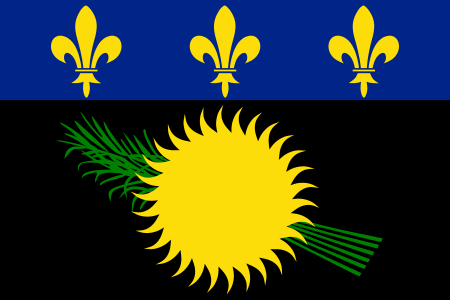
Guadeloupe
Location Info
- Continent: North America
- Country: Guadeloupe
- Coordinates: 16.265 , -61.551
Trust Info
Verified Geographic Information
🌍 Continents

Overview
Guadeloupe is an archipelago located in the Lesser Antilles of the eastern Caribbean Sea. It is an overseas department and region of France, consisting of two main islands—Basse-Terre and Grande-Terre—separated by a narrow channel called the Salée River, along with several smaller islands including Marie-Galante, Les Saintes, and La Désirade.
Geographically diverse, the territory features the active volcano La Grande Soufrière on the mountainous Basse-Terre, while Grande-Terre is characterized by rolling limestone plains. As an integral part of France and the European Union, Guadeloupe functions under French law and uses the Euro, serving as a significant economic and administrative hub in the Caribbean region.
Truth & Facts
| Total Area | 1,628 square kilometers |
| Highest Point | La Grande Soufrière (1,467m) |
| Status | Overseas Department and Region of France |
| Capital | Basse-Terre |
| Population | 384,315 |
| Official Language | French |
| Currency | Euro (EUR) |
| Main Exports | Bananas, Sugar, Rum |
| European Discovery | 1493 |
| Abolition of Slavery | 1848 |
| Electricity Source | Thermal and Geothermal |
| Main Airport | Pointe-à-Pitre Le Raizet Airport (PTP) |
| Traditional Music | Gwo Ka |
| National Park | Parc National de la Guadeloupe |
| Main University | Université des Antilles |
| Major Hospital | CHUG (Centre Hospitalier Universitaire de Guadeloupe) |
| Primary Force | Gendarmerie Nationale and Police Nationale |
| Mobile Standard | 4G/5G |
| Deputies | 4 in the National Assembly |
| EU Status | Outermost Region (OR) |
| Provider | SMGEAG |
| GDP Per Capita | Approx. €22,000 |
| Annual Visitors | Over 700,000 |
| Main Distilleries | 9 active rum distilleries |
| Iconic Species | Guadeloupe Woodpecker |
📑 Table of Contents
Overview of Guadeloupe
Guadeloupe is a French overseas department located in the Lesser Antilles. It consists of an archipelago where the two largest islands form the shape of a butterfly. This territory is an integral part of France and functions as an outermost region of the European Union.
The region is known for its blend of French and Caribbean influences, manifesting in its administration, language, and social structure. It serves as a vital link between Europe and the Americas in terms of trade and political presence.
- Official Status: Overseas Department and Region of France
- Main Islands: Basse-Terre, Grande-Terre, Marie-Galante, Les Saintes, La Désirade
- Administrative Capital: Basse-Terre
- Economic Capital: Pointe-à-Pitre
- Currency: Euro (€)
History
The history of Guadeloupe began with the settlement of Arawak and later Carib peoples. In 1493, Christopher Columbus arrived during his second voyage, naming the island Santa María de Guadalupe de Extremadura. French colonization began in 1635, leading to the establishment of a plantation economy based on slave labor.
Throughout the 18th century, the island was a site of conflict between France and Britain. Slavery was permanently abolished in 1848 through the efforts of Victor Schœlcher. In 1946, Guadeloupe transitioned from a colony to an overseas department of France, integrating fully into the French political system.
| Period | Event |
|---|---|
| 1493 | Arrival of Christopher Columbus |
| 1635 | French colonization begins |
| 1848 | Final abolition of slavery |
| 1946 | Departmentalization of Guadeloupe |
Geography
The geography of Guadeloupe is defined by its volcanic and limestone origins. Basse-Terre, the western wing, is mountainous and dominated by the La Grande Soufrière volcano. Grande-Terre, the eastern wing, is a flat limestone plateau with white sand beaches and coral reefs.
The smaller islands contribute to the archipelago's geographic variety. Marie-Galante is known for its circular shape and agriculture, while the Les Saintes archipelago is volcanic with deep-water bays. La Désirade is a high limestone tableland situated to the east.
- Highest Peak: La Grande Soufrière (1,467m)
- Principal Waterway: Rivière Salée
- Total Coastline: 306 km
- Natural Hazards: Tropical cyclones and volcanic activity
- Forest Cover: Tropical rainforest in Basse-Terre
Climate and Weather
Guadeloupe experiences a tropical maritime climate characterized by two distinct seasons. The 'Carême' (dry season) lasts from December to May, while the 'Hivernage' (wet season) occurs from June to November. Average temperatures remain consistent, typically ranging between 23°C and 30°C.
Humidity is high throughout the year, especially during the wet season. The archipelago is located within the Atlantic hurricane belt, making it susceptible to tropical storms and hurricanes during the summer and autumn months.
| Month | Avg High (°C) | Avg Low (°C) |
|---|---|---|
| January | 28 | 22 |
| July | 31 | 25 |
| October | 31 | 24 |
Population and Demographics
The population of Guadeloupe is approximately 384,000 residents. The demographic makeup is a result of centuries of migration and history, with a majority of the population being of African or mixed European-African descent. There are also significant minorities of Indian, Lebanese, and Chinese origin.
Population density is highest in the urban area surrounding Pointe-à-Pitre and Les Abymes. Migration patterns often involve young adults moving to mainland France for education and employment, while retirees frequently return to the islands.
- Official Language: French
- Regional Language: Antillean Creole
- Life Expectancy: Approx. 81 years
- Literacy Rate: Over 95%
- Urbanization: 98% of population lives in urban areas
Culture and Lifestyle
Culture in Guadeloupe is a synthesis of French and Caribbean traditions. This is most evident in the local music, literature, and art. Gwo Ka, a musical genre based on drumming, is central to the island's identity and is performed at many community gatherings.
Daily life reflects a blend of European standards and Caribbean pacing. Literature has a strong tradition here, with authors such as Saint-John Perse and Maryse Condé gaining international recognition for their explorations of identity and history.
- Music Genres: Gwo Ka, Zouk, Biguine
- Religious Affiliation: Predominantly Roman Catholic
- Philosophy: Strong emphasis on community and oral tradition
Festivals and Events
The most significant cultural event in Guadeloupe is Carnival, which takes place between Epiphany and Ash Wednesday. It features elaborate parades, traditional masks, and musical competitions across the archipelago. The event is a major display of local craftsmanship and community organization.
Other events include the Fête des Cuisinières, where female chefs celebrate local gastronomy, and the Route du Rhum, a prestigious transatlantic sailing race that finishes in Pointe-à-Pitre every four years.
- Carnival: January to February
- Fête des Cuisinières: August
- All Saints' Day: November 1st
- Route du Rhum: Every 4 years (November)
Food and Cuisine
Guadeloupean cuisine is characterized by its use of local spices, seafood, and tropical produce. Key ingredients include scotch bonnet peppers, coconut milk, and limes. Seafood is a staple, often served grilled or in stews like 'Blaff de poisson'.
Agricultural products like sugar cane and bananas also influence the diet. Rum is the primary alcoholic beverage, often consumed as 'Ti' Punch', a simple mixture of rum, lime, and sugar cane syrup.
- Bokit: A popular deep-fried local sandwich
- Accras de morue: Saltfish fritters
- Colombo: A curry dish typically made with chicken or goat
- Tourment d'amour: A traditional tart from Les Saintes
Economy and Industries
The economy of Guadeloupe is heavily dependent on services and public administration. Agriculture, once the dominant sector, now focuses on the export of bananas and sugar cane. Tourism is a key driver of foreign exchange, with the majority of visitors arriving from mainland France.
Industrial activity is largely concentrated in the Jarry industrial zone, one of the largest in the Caribbean. The territory faces challenges such as high unemployment rates and a dependence on subsidies from the French central government and EU funds.
| Sector | Contribution to Economy |
|---|---|
| Services/Admin | High |
| Tourism | Medium-High |
| Agriculture | Low-Medium |
Cost of Living
The cost of living in Guadeloupe is generally higher than in mainland France. This is primarily due to the fact that a large percentage of consumer goods and food items must be imported from Europe, leading to increased transportation costs and taxes.
Utility costs, such as electricity and water, can also be higher. However, local fresh produce from markets can be more affordable than imported alternatives. Real estate prices vary significantly between urban centers and rural areas.
- Imported Goods: 10-20% higher than France
- Currency: Euro
- Sales Tax: Octroi de Mer (local tax on imports)
Employment and Business
Employment in Guadeloupe is largely provided by the public sector, which includes education, healthcare, and local administration. The private sector is dominated by retail, construction, and tourism-related services. Unemployment, particularly among youth, remains a significant socio-economic challenge.
The business environment follows French law, offering legal security for investors. The Jarry industrial park in Baie-Mahault serves as the commercial heart of the archipelago, hosting numerous international and local companies.
- Major Employer: French State (National Education, Health)
- Unemployment Rate: Historically above 20%
- Business Hub: Jarry, Baie-Mahault
Real Estate and Housing
Housing in Guadeloupe ranges from traditional Creole wooden houses to modern apartment complexes and villas. Demand is highest in the urban zones of Grande-Terre and the residential areas of Basse-Terre. Social housing projects are a priority for the local government to address demographic needs.
Property ownership follows French legal standards. There has been a trend towards the development of eco-friendly housing to mitigate the impact of the tropical climate and reduce energy consumption.
- Urban Centers: Pointe-à-Pitre, Les Abymes
- Tourist Areas: Saint-François, Sainte-Anne
- Administrative Center: Basse-Terre
Transportation and Connectivity
Guadeloupe is connected to the rest of the world via the Pôle Caraïbes International Airport. Domestic travel between islands is primarily handled by high-speed ferries and small aircraft. Road networks are well-developed on the main islands of Basse-Terre and Grande-Terre.
Public transportation consists of a network of buses and 'taxis-collectifs'. However, private vehicle ownership is high, leading to significant traffic congestion during peak hours in the urban areas around Pointe-à-Pitre.
- Main Port: Grand Port Maritime de la Guadeloupe
- Airport Code: PTP
- Inter-island Ferries: To Marie-Galante, Les Saintes, and Dominica
Infrastructure and Utilities
Utility services in Guadeloupe are modernized to French national standards. Electricity is provided by EDF, with an increasing share coming from renewable sources such as geothermal and wind energy. Water distribution is managed by local syndicates, though some areas face periodic supply issues.
Telecommunications infrastructure includes widespread 4G and 5G mobile coverage and an expanding fiber-optic network. The territory is linked to international subsea cables, ensuring stable internet connectivity.
- Internet: ADSL and Fiber Optic
- Energy: Mix of fossil fuels and renewables
- Waste Management: Organized by municipal communities
Education
The education system in Guadeloupe follows the French national curriculum. Schooling is compulsory from ages 3 to 16. The territory is organized as the 'Académie de la Guadeloupe', managed by a Rector appointed by the French Ministry of Education.
Higher education is provided by the Université des Antilles, which has campuses in Fouillole and Saint-Claude. Many students also opt to attend universities in mainland France for specialized degrees.
- Primary and Secondary Schools: Widespread in all communes
- University: Université des Antilles
- Vocational Training: Provided by RSMA and local centers
Healthcare
Healthcare in Guadeloupe is of a high standard, aligned with the French national system. Residents have access to the 'Sécurité Sociale'. The University Hospital (CHU) in Pointe-à-Pitre is the largest medical facility in the archipelago.
Specialized clinics and private practices are available throughout the islands. Emergency medical services are coordinated by the SAMU, and the territory has established protocols for managing tropical diseases and volcanic monitoring.
- Primary Facility: CHU de Guadeloupe
- Health Coverage: PUMa (Universal Health Protection)
- Emergency Services: Dial 15 for SAMU
Tourist Attractions
Guadeloupe offers a range of natural and cultural attractions. The Guadeloupe National Park on Basse-Terre is a major draw for its hiking trails and waterfalls like the Carbet Falls. The Pointe des Châteaux on Grande-Terre offers dramatic coastal views.
Cultural sites include the Mémorial ACTe, a world-class museum dedicated to the history of the slave trade. The historical distilleries across the islands provide insight into the sugar and rum industry.
- Carbet Falls: Three majestic waterfalls
- Pointe des Châteaux: Scenic peninsula
- Mémorial ACTe: Contemporary museum
- Deshaies Botanical Garden: Flora and fauna park
Things to Do
Outdoor activities are central to the experience in Guadeloupe. Hiking is popular in the rainforests of Basse-Terre, while diving and snorkeling are common in the Jacques Cousteau Underwater Reserve. Sailing and windsurfing are popular in the lagoons of Grande-Terre.
For those interested in culture, visiting local markets in Pointe-à-Pitre or Basse-Terre provides a look at local life and commerce. Sampling rum at various island distilleries is also a frequent activity for visitors.
- Diving: Reserve Cousteau
- Hiking: La Soufrière volcano climb
- Water Sports: Surfing and Kiteboarding
Best Places to Visit
The archipelago's diverse islands offer distinct experiences. Basse-Terre is preferred for its natural landscapes and volcano. Grande-Terre is known for its beach resorts and bustling commercial centers. The smaller islands offer a more secluded environment.
Marie-Galante is prized for its traditional atmosphere and windmills, while the Les Saintes islands are known for their picturesque bay and colonial architecture. La Désirade remains the most tranquil and least developed of the islands.
- Terre-de-Haut: One of the Les Saintes islands
- Sainte-Anne: Known for its beaches
- Marie-Galante: The 'island of a hundred windmills'
Travel Guide Information
Travel to Guadeloupe is straightforward for citizens of the European Union, who only need a national ID. For others, French visa rules apply. The main entry point is the airport near Pointe-à-Pitre. Renting a car is the most efficient way to explore the main islands.
French is the language of communication, and while some English is spoken in tourist areas, a basic knowledge of French is beneficial. The local time zone is Atlantic Standard Time (UTC-4).
- Entry Requirements: Valid passport or ID for EU citizens
- Electricity: 230V, Type C and E plugs
- Time Zone: UTC-4
Nearby Places
Guadeloupe is part of the Lesser Antilles chain and is located near several other Caribbean nations. To the south lies the island of Dominica, which can be reached by ferry. To the north is the island of Montserrat and the dual-nation island of Saint Martin.
The location makes it a strategic point for exploring the wider Caribbean region. Regular air and sea connections link Guadeloupe to Martinique, another French overseas department located further south.
- Dominica: Accessible via express ferry
- Martinique: Neighboring French department
- Antigua: Located to the north
Environment and Nature
The natural environment of Guadeloupe is highly biodiverse. The territory contains tropical rainforests, mangroves, and coral reefs. Basse-Terre's rainforest is protected as a UNESCO Biosphere Reserve, housing species like the Guadeloupe Woodpecker.
Marine life is equally rich, with sea turtles, humpback whales (during migration), and numerous tropical fish species. Conservation efforts are active to protect these habitats from climate change and pollution.
- Protected Area: Guadeloupe National Park
- Biosphere Reserve: UNESCO designated
- Marine Life: Sea turtles and coral reefs
Government and Administration
As an overseas department, Guadeloupe has the same administrative structure as departments in mainland France. It has a Prefecture, led by a Prefect appointed by the President of France. Local government consists of the Regional Council and the Departmental Council.
Residents are French citizens with full voting rights in national elections. The territory is divided into two arrondissements (Basse-Terre and Pointe-à-Pitre) and 32 communes.
- Prefecture: Basse-Terre
- Local Councils: Regional and Departmental
- Representation: Deputies and Senators in Paris
Safety and Public Services
Safety in Guadeloupe is comparable to many regions in mainland France. Law enforcement is provided by the Gendarmerie and the National Police. Public services including fire departments (Sapeurs-Pompiers) and postal services (La Poste) operate effectively.
Visitors are advised to follow standard safety precautions in urban areas and when engaging in outdoor activities. The territory has robust emergency plans for natural disasters like hurricanes or volcanic unrest.
- Emergency Number: 112 (General), 17 (Police)
- Police Force: Gendarmerie and Police Nationale
- Health Services: SAMU (15)
Best Time to Visit
The optimal time to visit Guadeloupe is during the dry season, from December to May. During this period, the weather is sunny and the risk of hurricanes is negligible. The months of February and March are particularly popular due to Carnival festivities.
The wet season from June to November sees more frequent rainfall and the potential for tropical storms. However, this period often features lower prices and fewer crowds for those willing to accommodate the weather.
- Peak Season: December to April
- Off-Peak: June to November
- Event Highlight: January/February (Carnival)
Local Business Directory
The business directory of Guadeloupe is centered around the major urban hubs. Baie-Mahault hosts the majority of large-scale retail and logistics businesses. Tourism-related businesses such as hotels and car rentals are concentrated in coastal towns like Saint-François and Deshaies.
Local craftsmanship remains important, with numerous small businesses focusing on agro-products like coffee, cocoa, and rum. These are often organized into cooperatives to facilitate export and marketing.
- Commercial Hub: Jarry, Baie-Mahault
- Primary Market: Pointe-à-Pitre
- Crafts Center: Village Artisanal, Sainte-Anne
General Information FAQs
Where is Guadeloupe located?
Guadeloupe is located in the Lesser Antilles in the eastern Caribbean Sea, north of Dominica and south of Antigua and Barbuda.
What is Guadeloupe known for?
It is known for its butterfly shape, diverse landscapes ranging from volcanic mountains to flat limestone plains, and its status as a French overseas territory.
Why is Guadeloupe famous?
Guadeloupe is famous for its high-quality agricultural rum, the active Soufrière volcano, and its unique Creole culture and cuisine.
What country or region is Guadeloupe part of?
Guadeloupe is an overseas department and region of France and is part of the European Union.
What is the population of Guadeloupe?
The population is approximately 384,000 residents as of 2023 estimates.
What languages are spoken in Guadeloupe?
French is the official language. Antillean Creole (Guadeloupean Creole) is also widely spoken in daily life.
What time zone is Guadeloupe in?
Guadeloupe is in the Atlantic Standard Time zone (UTC-4).
What are the key facts about Guadeloupe?
Key facts include its capital Basse-Terre, its currency being the Euro, and its geography consisting of two main islands and several smaller ones.
What makes Guadeloupe unique?
Its unique nature lies in being a piece of Europe in the Caribbean, combining French administrative standards with West Indian cultural identity.
How large is Guadeloupe in area?
The total land area of the archipelago is approximately 1,628 square kilometers.
History FAQs
What is the history of Guadeloupe?
The history spans from Pre-Columbian indigenous settlements to French colonization in 1635, a long period of sugar plantation economy, and final integration as a French department in 1946.
When was Guadeloupe established?
As a French colony, it was established in 1635 by the Compagnie des Îles de l'Amérique.
What major historical events happened in Guadeloupe?
Major events include the 1848 abolition of slavery and the 1946 law that turned it into a French department.
Who were important historical figures from Guadeloupe?
Important figures include Louis Delgrès, who fought against the reinstatement of slavery, and Nobel laureate poet Saint-John Perse.
How has Guadeloupe developed over time?
It has moved from a colonial plantation economy to a modernized service-based economy heavily integrated with mainland France.
Geography & Environment FAQs
What is the geography of Guadeloupe?
The territory is an archipelago. The two main islands are the mountainous, volcanic Basse-Terre and the flat, limestone Grande-Terre.
What natural features surround Guadeloupe?
It is surrounded by the Caribbean Sea to the west and the Atlantic Ocean to the east, with coral reefs and mangroves along its coasts.
Are there mountains, rivers, or lakes near Guadeloupe?
Yes, Basse-Terre has a high mountain range including the Soufrière volcano and numerous rivers and waterfalls like the Carbet Falls.
What is the elevation of Guadeloupe?
The elevation ranges from sea level to 1,467 meters at the summit of La Grande Soufrière.
What ecosystems exist around Guadeloupe?
Ecosystems include tropical rainforests, dry forests, mangroves, and extensive coral reef systems.
Climate & Weather FAQs
What is the climate like in Guadeloupe?
It has a tropical maritime climate with warm temperatures year-round and distinct wet and dry seasons.
What is the average temperature in Guadeloupe?
Average temperatures range from 23°C (73°F) in winter to 31°C (88°F) in summer.
What is the weather like throughout the year in Guadeloupe?
The weather is generally sunny with trade winds. Rainfall is more frequent on Basse-Terre than Grande-Terre.
Does Guadeloupe experience extreme weather?
Yes, it is located in a hurricane zone and can experience tropical cyclones between June and November.
What is the best time of year to visit Guadeloupe?
The best time is usually from December to May during the dry season.
Population & Society FAQs
What is the population density of Guadeloupe?
The population density is approximately 236 people per square kilometer.
What ethnic groups live in Guadeloupe?
Most residents are of mixed African-European descent, with significant Indo-Guadeloupean and European-descended communities.
What religions are practiced in Guadeloupe?
The majority of the population is Roman Catholic, with Protestant, Hindu, and Jewish minorities.
What is daily life like in Guadeloupe?
Daily life is influenced by French administrative rhythms blended with Caribbean social customs and outdoor living.
How diverse is the population of Guadeloupe?
The population is quite diverse due to a history of migration from Africa, Europe, and Asia.
Culture & Traditions FAQs
What cultural traditions are important in Guadeloupe?
Gwo Ka music, the celebration of Carnival, and traditional Creole storytelling are key pillars of local tradition.
What festivals are celebrated in Guadeloupe?
Major festivals include Carnival, the Fête des Cuisinières, and various local patron saint festivals (fêtes communales).
What cultural landmarks exist in Guadeloupe?
Landmarks include the Mémorial ACTe in Pointe-à-Pitre and the Fort Delgrès in Basse-Terre.
What traditional clothing or customs are common in Guadeloupe?
The 'Madras' fabric is traditionally used in formal Creole dress, particularly for headwraps and skirts.
What arts and crafts are associated with Guadeloupe?
Traditional crafts include basketry, pottery, and the making of Gwo Ka drums.
Food & Cuisine FAQs
What foods is Guadeloupe known for?
It is known for spicy Creole dishes, fresh seafood, and tropical fruits like mangoes and guavas.
What traditional dishes originate from Guadeloupe?
Common dishes include Colombo (curry), Accras (fritters), and Bokit (fried bread sandwich).
What are the best restaurants in Guadeloupe?
Popular dining spots are found in Sainte-Anne and Deshaies, ranging from beachside 'lolos' to high-end French-Creole restaurants.
What local ingredients are commonly used in Guadeloupe cuisine?
Ingredients include scotch bonnet peppers, lime, coconut, yam, and local fish like snapper.
What food markets or street foods are popular in Guadeloupe?
The spice markets in Pointe-à-Pitre and street-side Bokit stands are very popular.
Economy & Business FAQs
What are the main industries in Guadeloupe?
The main industries are tourism, public administration, and agriculture (specifically sugar and bananas).
What economic activities drive the economy of Guadeloupe?
The service sector, retail, and construction are the primary economic drivers.
What businesses operate in Guadeloupe?
A mix of French national companies (like Carrefour and EDF) and local agricultural cooperatives operate there.
Is Guadeloupe an important economic center?
It serves as a major logistical and administrative hub for the French West Indies.
What are the major exports or products from Guadeloupe?
Major exports include bananas, sugar cane, and agricultural rum.
Employment & Jobs FAQs
What job opportunities are available in Guadeloupe?
Jobs are primarily found in healthcare, education, tourism, and the civil service.
What are the major employers in Guadeloupe?
The French State, the Regional Council, and large retail groups are the largest employers.
What skills are in demand in Guadeloupe?
Skills in healthcare, renewable energy, and digital services are increasingly in demand.
Is Guadeloupe a good place to work?
It offers a high quality of life, though the labor market can be competitive with high youth unemployment.
What is the unemployment rate in Guadeloupe?
The unemployment rate typically fluctuates between 15% and 20%, significantly higher than the French national average.
Cost of Living FAQs
Is Guadeloupe expensive to live in?
Yes, many consumer goods are more expensive than in France due to import costs.
What is the average cost of living in Guadeloupe?
It is generally 10% to 15% higher than in mainland France for standard household budgets.
How much does housing cost in Guadeloupe?
Housing costs vary; a two-bedroom apartment in an urban area may rent for €800 to €1,200 per month.
What are average food and utility costs in Guadeloupe?
Electricity and imported food items are relatively high, while local produce is reasonably priced.
Is Guadeloupe affordable compared to nearby cities?
It is comparable to Martinique but generally more expensive than non-French Caribbean islands like Dominica.
Housing & Real Estate FAQs
What types of housing are available in Guadeloupe?
Options include modern apartments, colonial-style villas, and traditional Creole houses.
What is the average home price in Guadeloupe?
Prices range from €200,000 for modest homes to over €1 million for coastal villas.
Is it better to rent or buy property in Guadeloupe?
Renting is common for newcomers, while long-term residents often prefer to buy as an investment.
Which neighborhoods are popular in Guadeloupe?
Popular areas include Gosier for its central location and Saint-François for its seaside lifestyle.
How has the property market changed in Guadeloupe?
There has been a steady increase in property values driven by tourism and demand for secondary homes.
Transportation FAQs
How do you get to Guadeloupe?
Most visitors arrive by air at Pôle Caraïbes International Airport, primarily from Paris or North America.
What is the nearest airport to Guadeloupe?
The main airport is Pointe-à-Pitre Le Raizet (PTP).
Does Guadeloupe have railway connections?
No, there are no public railway systems in Guadeloupe.
How reliable is public transportation in Guadeloupe?
Buses are available but schedules can be inconsistent; many residents rely on private cars.
What major highways or roads connect to Guadeloupe?
Main roads like the N1 and N2 encircle the islands and connect major towns.
Education FAQs
What schools are located in Guadeloupe?
There is a full range of French public and private schools from nursery through high school (Lycée).
Are there universities in Guadeloupe?
Yes, the Université des Antilles has a significant presence in the territory.
What is the literacy rate in Guadeloupe?
The literacy rate is high, estimated at over 96%.
What educational opportunities exist in Guadeloupe?
Students can pursue degrees in law, medicine, science, and humanities locally.
Is Guadeloupe a good place for students?
It is a vibrant place for study, though many students move to France for specific graduate programs.
Healthcare FAQs
What hospitals are available in Guadeloupe?
The main public facility is the Centre Hospitalier Universitaire (CHU) de Guadeloupe.
Are there emergency medical services in Guadeloupe?
Yes, the SAMU (emergency medical assistance) and fire services provide 24/7 coverage.
What healthcare facilities exist in Guadeloupe?
There are numerous public hospitals, private clinics, and pharmacies throughout the islands.
Is healthcare affordable in Guadeloupe?
Healthcare is affordable for those covered by the French social security system.
Are specialized medical services available in Guadeloupe?
Most major specialties are available, though extremely rare cases may be transferred to Paris.
Tourism & Travel FAQs
What are the top tourist attractions in Guadeloupe?
Top sites include the Carbet Falls, the Soufrière volcano, and the beach at Grande Anse.
What are the best things to do in Guadeloupe?
Activities include hiking in the National Park, diving in the Cousteau Reserve, and visiting rum distilleries.
Is Guadeloupe worth visiting?
Yes, it offers a unique blend of French European infrastructure and Caribbean natural beauty.
What landmarks should visitors see in Guadeloupe?
Must-see landmarks include the Mémorial ACTe and the Fort Napoléon in Les Saintes.
How many days should tourists spend in Guadeloupe?
A stay of 7 to 10 days is recommended to see both Basse-Terre and Grande-Terre.
Nearby Places FAQs
What places are near Guadeloupe worth visiting?
The islands of Les Saintes and Marie-Galante are excellent for day trips or short stays.
What cities or towns are close to Guadeloupe?
Roseau in Dominica and St. John's in Antigua are the nearest international island capitals.
What natural attractions are near Guadeloupe?
Nearby attractions include the underwater reserves of the Lesser Antilles.
What day trips can be taken from Guadeloupe?
Ferries allow for easy day trips to Marie-Galante or the Les Saintes archipelago.
What famous destinations are within reach of Guadeloupe?
Martinique and Saint-Barthélemy are within a short flight from the main airport.
Safety FAQs
Is Guadeloupe safe to live in?
Yes, it is generally safe, following similar safety standards as mainland French regions.
Is Guadeloupe safe for tourists?
Yes, though tourists should take standard precautions against petty theft in crowded areas.
What is the crime rate in Guadeloupe?
The crime rate is moderate and mostly involves non-violent property crimes.
What emergency services operate in Guadeloupe?
Services include the National Police, Gendarmerie, and municipal fire departments.
What safety tips should visitors follow in Guadeloupe?
Do not leave valuables in rental cars and be cautious when hiking on volcanic trails.
Lifestyle & Living FAQs
Is Guadeloupe a good place to live?
It offers a tropical lifestyle with modern European amenities, making it popular for expats and retirees.
What recreational activities are available in Guadeloupe?
Sailing, surfing, hiking, and traditional music festivals are widely available.
Is Guadeloupe family-friendly?
Yes, with many beaches, parks, and family-oriented cultural activities.
What outdoor activities are popular in Guadeloupe?
Canyoning, trail running, and snorkeling are highly popular.
What makes life enjoyable in Guadeloupe?
The combination of a warm climate, rich culinary traditions, and a laid-back island atmosphere.
Practical Information FAQs
What travel tips should visitors know about Guadeloupe?
Rent a car in advance and learn basic French phrases to navigate outside of tourist zones.
What local customs should visitors respect in Guadeloupe?
Modesty in attire when away from the beach and polite greetings (Bonjour) are important.
How accessible is Guadeloupe for international visitors?
It is very accessible for Europeans, while North Americans usually connect via Miami or Montreal.
What services are available for tourists in Guadeloupe?
Tourist offices are available in most major towns to provide maps and tour information.
What important information should travelers know before visiting Guadeloupe?
The currency is the Euro, and electrical outlets are European (230V).
Additional Facts FAQs
Are there any active volcanoes in Guadeloupe?
Yes, La Grande Soufrière on Basse-Terre is an active volcano under constant monitoring.
What is the primary religion in Guadeloupe?
The primary religion is Roman Catholicism.
Is the water safe to drink in Guadeloupe?
Tap water is generally safe to drink in urban areas, though bottled water is often used in rural parts.
What is the political status of Guadeloupe?
It is a Department and Region of France (DROM), with the same status as departments in Europe.
What is the driving side in Guadeloupe?
Vehicles drive on the right side of the road, as in mainland France.