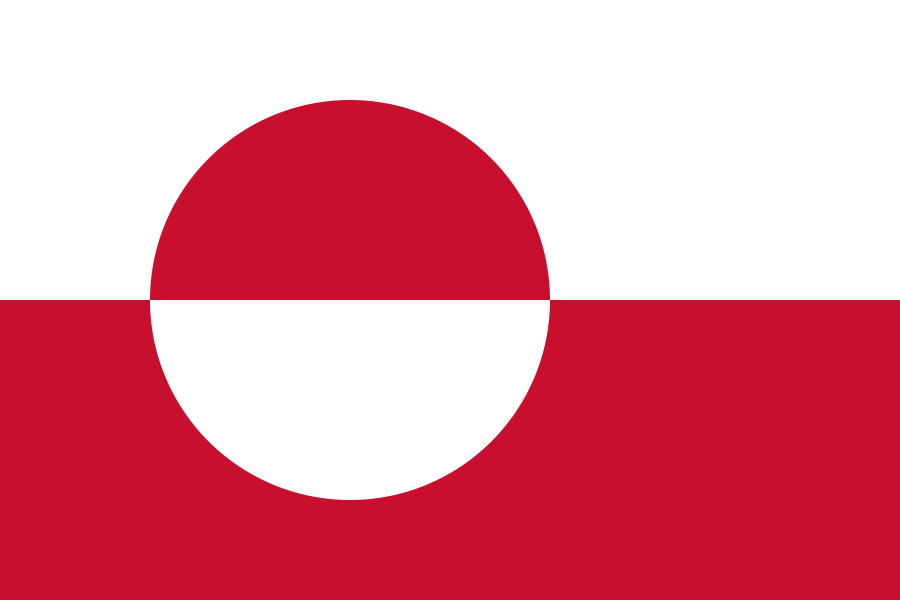
Greenland
Location Info
- Continent: North America
- Country: Greenland
- Coordinates: 71.7069 , -42.6043
Trust Info
Verified Geographic and Government Data
🌍 Continents

Overview
Greenland, known in Greenlandic as Kalaallit Nunaat, is the world's largest island, located between the Arctic and Atlantic Oceans. While geographically part of North America, it is politically an autonomous territory within the Kingdom of Denmark. About 80% of its landmass is covered by the Greenland Ice Sheet, the only permanent ice sheet outside Antarctica. The population is primarily Inuit and is concentrated along the ice-free coastal fringes, particularly in the southwest.
The history of Greenland is marked by successive waves of Paleo-Inuit migrations and the medieval Norse settlement led by Erik the Red. Today, the economy relies heavily on fishing, which accounts for the vast majority of exports, and a significant annual block grant from Denmark. As the Arctic gains global strategic importance, Greenland's potential in mineral resources and its role in climate change research have become focal points for international interest.
Truth & Facts
| Total Area | 2,166,086 sq km |
| Ice Cover | 81% |
| Capital | Nuuk (Godthåb) |
| Political System | Parliamentary Democracy |
| Population | 56,699 (2025 est.) |
| Ethnic Groups | 89% Greenlandic (Inuit), 11% Danish/Other |
| Inuit Arrival | approx. 2500 BCE |
| Norse Settlement | 982 CE |
| Major Export | Shrimp and Fish |
| Currency | Danish Krone (DKK) |
| Energy Source | Hydroelectric (approx. 70%) |
| University | Ilisimatusarfik (University of Greenland) |
| Main Hospital | Queen Ingrid's Hospital |
| Official Language | Kalaallisut (Greenlandic) |
| UNESCO Site | Ilulissat Icefjord |
| National Park | Northeast Greenland National Park |
| Primary Air Hub | Kangerlussuaq Airport |
| Internet TLD | .gl |
| Police Authority | Polititi |
| Monarch | King Frederik X |
| EU Status | OCT (Overseas Country/Territory) |
| Water Source | Surface water / Glacial melt |
| GDP per Capita | approx. $54,000 |
| Native Land Mammals | 9 species |
| UNESCO Settlement | Kujataa |
📑 Table of Contents
Overview
Greenland is a massive Arctic territory located between the North Atlantic and Arctic Oceans. It is the largest island in the world that is not a continent. Approximately 80% of its land area is covered by a permanent ice sheet, leaving only the rugged coastline inhabitable.
Politically, Greenland is an autonomous territory within the Kingdom of Denmark. It has its own parliament and domestic government but maintains a shared foreign policy and currency with Denmark. The majority of the population lives in small towns and settlements along the southwest coast.
- Official Name: Kalaallit Nunaat
- Total Area: 2.16 million km²
- Capital City: Nuuk
- Government: Parliamentary Democracy
- Currency: Danish Krone
History
The history of Greenland began with successive waves of Paleo-Inuit migrations from North America, starting around 2500 BCE. These early cultures, such as the Saqqaq and Dorset, lived as nomadic hunters in the harsh Arctic environment. In the 10th century, Norse explorers led by Erik the Red established settlements in the south and west, which lasted for several centuries before disappearing in the 15th century.
In 1721, the missionary Hans Egede re-established contact between Scandinavia and Greenland, leading to Danish colonization. Greenland transitioned from a colony to a province of Denmark in 1953, and eventually gained Home Rule in 1979. Full self-government was achieved in 2009, giving the territory control over its judicial system and natural resources.
| Period | Event |
|---|---|
| 2500 BCE | Saqqaq Culture arrivals |
| 982 CE | Erik the Red lands in Greenland |
| 1721 CE | Hans Egede founds Nuuk |
| 1953 CE | Greenland becomes a Danish Province |
| 2009 CE | Self-Government Act implemented |
Geography
Greenland's geography is defined by its massive central ice sheet, which reaches heights of over 3,000 meters. The ice-free coastal areas are characterized by deep fjords, high mountains, and thousands of small islands. Gunnbjørn Fjeld is the highest point on the island, standing at 3,694 meters.
The island is surrounded by the Greenland Sea, the Denmark Strait, the Labrador Sea, and Baffin Bay. The northernmost point, Cape Morris Jesup, was long thought to be the northernmost land on Earth. Permafrost is present across nearly all of Greenland, affecting both construction and vegetation.
Climate and Weather
Greenland has an Arctic climate, with significant variations between the coastal regions and the interior ice sheet. Summers are short and cool, while winters are long and extremely cold. In the south, temperatures can rise above 10°C in July, whereas the northern interior stays well below freezing year-round.
- Mean Annual Temp: -18°C (Interior)
- Record Low: -69.6°C
- Coastal Summer Highs: 5°C to 15°C
- Extreme Weather: Pitoraq (katabatic winds)
- Precipitation: Mostly snow, varies by region
Population and Demographics
The population of Greenland is approximately 56,000 people. Around 90% of the inhabitants are Greenlandic Inuit, with the remainder being primarily of Danish descent. Population density is the lowest in the world, at approximately 0.03 people per square kilometer.
Most people live in the 17 towns and roughly 50 settlements located along the coast. Nuuk, the capital, is home to nearly a third of the total population. Urbanization is a continuing trend as people move from smaller settlements to larger administrative centers for work and education.
Culture and Lifestyle
Modern Greenlandic culture is a synthesis of traditional Inuit practices and modern Western lifestyle. Hunting and fishing remain central to the identity of many Greenlanders, particularly in remote areas. The kayak and dog sled are iconic cultural symbols that are still used in various parts of the territory.
Contemporary culture is also expressed through a vibrant arts scene, including rock music, literature, and film. The national costume, known as the kalaallisuut, is worn during festive occasions. Drum dancing, once suppressed by missionaries, has seen a cultural revival in recent decades.
Festivals and Events
National Day is celebrated on June 21, the summer solstice, with ceremonies and music across the country. Many festivals focus on traditional sports, such as the Arctic Winter Games or the Greenlandic Kayak Championships.
- Ullortuneq (National Day): June 21
- Return of the Sun: January/February (varies by latitude)
- Arctic Circle Race: International cross-country skiing
- Nuuk Snow Festival: Annual sculpture competition
- Qivittoq Film Festival: Showcasing local cinema
Food and Cuisine
Greenlandic cuisine is based on local marine and land mammals, birds, and fish. Traditional dishes often feature seal, whale, reindeer, and muskox. Suaasat, a hearty soup made from seal or reindeer meat with onions and rice, is the national dish.
Due to the climate, very few vegetables are grown locally, though some sheep farming and small-scale gardening exist in the south. Most modern food items are imported from Denmark, making the cost of groceries significantly higher than in mainland Europe.
Economy and Industries
The Greenlandic economy is heavily dependent on the fishing industry, particularly cold-water shrimp and Greenland halibut. Fishing accounts for over 90% of the country's exports. The public sector also plays a massive role, employing a large portion of the workforce.
Tourism is a growing sector, though limited by infrastructure and high costs. Significant interest exists in the mining industry, as Greenland possesses large deposits of rare earth elements, gold, and iron ore. However, high operational costs and environmental concerns have slowed large-scale mining developments.
Cost of Living
Living in Greenland is expensive due to the need to import nearly all consumer goods and fuel. Transport costs between towns are high because there are no roads. Housing in Nuuk is particularly costly and in short supply.
| Item | Relative Cost |
|---|---|
| Groceries | Very High (Imported) |
| Utilities | High (Subsidized in some areas) |
| Internet | High (Satellite/Cable dependent) |
| Domestic Travel | Very High (Flight or Boat only) |
Employment and Business
The Government of Greenland is the largest employer. Private business is dominated by fishing companies like Royal Greenland and the retail monopoly KNI. There is a high demand for skilled labor in construction, healthcare, and education.
Small and medium enterprises (SMEs) are primarily found in the services and tourism sectors. The unemployment rate varies by season and region, with higher rates often found in smaller, remote settlements compared to the capital city.
Real Estate and Housing
Housing in Greenland consists of a mix of modern apartments in Nuuk and traditional colorful wooden houses in smaller towns. Land cannot be privately owned in Greenland; instead, residents and businesses are granted a right of use for the land their building occupies.
There is a chronic housing shortage in Nuuk, leading to long waiting lists for public housing. In recent years, private construction has increased to meet the demand from a growing urban population and international workers.
Transportation and Connectivity
Greenland has no inter-town road system. All travel between settlements is conducted via aircraft, coastal ferries, or, in winter, dog sleds and snowmobiles. Air Greenland is the primary carrier, operating a fleet of STOL (Short Take-Off and Landing) aircraft and helicopters.
Major international gateways include Kangerlussuaq and Narsarsuaq, though Nuuk is currently upgrading its airport to handle larger international jets. The Arctic Umiaq Line provides a vital passenger ferry service along the western coast during the ice-free months.
Infrastructure and Utilities
Utility services are provided by state-owned companies. Nukissiorfiit manages electricity, water, and heating. Due to the extreme cold, water pipes are often insulated and heated to prevent freezing. Many towns now utilize hydroelectric power to reduce dependence on imported oil.
- Power: Hydroelectric and Diesel
- Water: Desalination and Lake sources
- Waste: Incineration plants in major towns
- Telecoms: 4G/5G available in most towns
Education
Education is free and compulsory for children between the ages of 6 and 16. The primary language of instruction is Greenlandic, with Danish taught as a second language. Higher education is centered at Ilisimatusarfik (The University of Greenland) in Nuuk.
Many Greenlandic students travel to Denmark for specialized vocational training or advanced university degrees. The government provides grants for students studying abroad to ensure the territory develops a highly skilled workforce for the future.
Healthcare
The Greenlandic health system is public and free for all residents. Queen Ingrid's Hospital in Nuuk serves as the national referral center for specialized care. Smaller towns have local hospitals, while settlements are served by nursing stations.
Patients requiring highly specialized surgery or treatment not available in Nuuk are often evacuated to Rigshospitalet in Copenhagen, Denmark. The system faces challenges related to the vast distances between towns and recruitment of medical staff.
Tourist Attractions
Greenland's attractions are primarily natural. The Ilulissat Icefjord, a UNESCO World Heritage site, is famous for its massive icebergs. Disko Bay is a popular spot for whale watching, while South Greenland offers historical Norse ruins.
- Ilulissat Icefjord: Massive calving glaciers
- Disko Bay: Whale watching and icebergs
- Qaqortoq: Stone carvings and hot springs
- Nuuk: National Museum and Art Museum
- East Greenland: Untouched wilderness and fjords
Things to Do
Activities in Greenland center on the outdoors. Popular pursuits include hiking, dog sledding, and fishing. During the winter, the Northern Lights (Aurora Borealis) are visible across most of the country.
In the summer, the Midnight Sun allows for 24-hour exploration. Kayaking is a traditional activity that remains popular for both locals and visitors. Mountaineering and glacier hiking are available for those seeking more extreme adventure.
Best Places to Visit
The 'Big Three' destinations for visitors are Nuuk, Ilulissat, and the Kangerlussuaq area. Kangerlussuaq is the best place to access the Greenland Ice Sheet by land.
| Destination | Main Feature |
|---|---|
| Ilulissat | Icebergs and Glaciers |
| Nuuk | Culture and Dining |
| Kangerlussuaq | Wildlife and Ice Sheet |
| Tasiilaq | East Greenland scenery |
Travel Guide
Travel to Greenland requires careful planning. Most visitors arrive via flights from Denmark (Copenhagen) or Iceland (Reykjavik). Within the country, all travel is by air or sea; there are no roads between towns.
Pack for Arctic conditions, even in summer. Layering is essential. Visas are generally the same as for Denmark, but a separate entry permit may be required for certain nationalities as Greenland is not part of the Schengen Area for visa-free travel purposes.
Nearby Places
Greenland's closest neighbors are Canada to the west and Iceland to the east. Nunavut, Canada, is separated from Greenland by the Nares Strait, Baffin Bay, and the Davis Strait.
Regular flight connections link Nuuk and Ilulissat to Reykjavik, Iceland. Despite the proximity to North America, there are currently few direct commercial transport links between Greenland and Canada, with most travel routing through Europe or Iceland.
Environment and Nature
The environment is characterized by Arctic tundra and a massive ice sheet. Vegetation is limited to mosses, lichens, and small shrubs. Wildlife includes polar bears, muskoxen, reindeer, and various species of seals and whales.
Climate change is significantly impacting Greenland, with the ice sheet melting at an accelerating rate. This has global implications for sea-level rise and local impacts on traditional hunting patterns and infrastructure built on permafrost.
Government and Administration
Greenland's parliament, the Inatsisartut, has 31 members elected every four years. The government, or Naalakkersuisut, is led by a Prime Minister. Greenland is divided into five municipalities: Avannaata, Kujalleq, Qeqertalik, Qeqqata, and Sermersooq.
Foreign affairs, defense, and currency remain the responsibility of the Kingdom of Denmark. Greenland is represented in the Danish Parliament (Folketing) by two elected members.
Safety and Public Services
Greenland is generally safe with low crime rates. The biggest safety risks involve the natural environment, such as extreme cold, crevasses on glaciers, and polar bears in certain regions. Emergency services are professional but may be limited by weather and distance.
Search and Rescue (SAR) operations are coordinated by the Arctic Command of the Danish Defence in cooperation with local police. Travelers are advised to register their itineraries when heading into the remote backcountry.
Best Time to Visit
The best time to visit depends on the desired activities. Summer (June to August) is ideal for hiking, boat trips, and seeing the Midnight Sun. Winter (February to April) is best for dog sledding and Northern Lights.
- Summer: Mild weather, 24-hour daylight
- Winter: Dog sledding, snowmobiling
- Autumn: First Northern Lights appear
- Spring: Ideal for cross-country skiing
Local Business Directory
Major businesses in Greenland are often state-owned or cooperatives. The directory includes logistics providers, fishing exporters, and local retailers concentrated in the primary towns.
| Company | Sector |
|---|---|
| Air Greenland | Aviation |
| Royal Greenland | Seafood |
| KNI (Pilersuisoq) | Retail |
| Tele Greenland (Tusass) | Telecoms |
| Arctic Umiaq Line | Shipping |
General Information FAQs
Where is Greenland located?
Greenland is located between the Arctic and Atlantic Oceans, east of the Canadian Arctic Archipelago. It is geographically part of North America but politically associated with Europe through Denmark.
What is Greenland known for?
Greenland is best known for its massive ice sheet, spectacular fjords, icebergs, and its unique Inuit culture. It is also famous for being the world's largest island.
Why is Greenland famous?
It is famous for the Ilulissat Icefjord (a UNESCO site), its status as the largest island, the presence of the Northern Lights, and its pivotal role in climate change research due to the melting ice sheet.
What country or region is Greenland part of?
Greenland is an autonomous territory within the Kingdom of Denmark. It is one of the three constituent parts of the Danish Realm, along with Denmark and the Faroe Islands.
What is the population of Greenland?
As of recent estimates, the population is approximately 56,600 people.
What languages are spoken in Greenland?
The official language is Greenlandic (Kalaallisut). Danish is also widely spoken and used in administration and education.
What time zone is Greenland in?
Most of Greenland uses UTC-2. However, there are exceptions: Pituffik Space Base uses UTC-4, and the weather station Danmarkshavn uses UTC+0.
What are the key facts about Greenland?
Key facts include: Capital is Nuuk, currency is the Danish Krone, 80% of the land is ice-covered, and the population is mostly Inuit.
What makes Greenland unique?
Its lack of an inter-town road system, its massive ice sheet, the fact that it has the world's lowest population density, and its unique blend of Inuit and Nordic cultures make it unique.
How large is Greenland in area?
Greenland covers approximately 2,166,086 square kilometers (836,330 square miles).
History FAQs
What is the history of Greenland?
Greenland has been inhabited for millennia by Paleo-Inuit groups. It was later settled by Norsemen in the 10th century and colonized by Denmark in the 18th century before becoming autonomous in the 20th and 21st centuries.
When was Greenland established?
Modern Greenlandic self-government was established with Home Rule in 1979 and expanded to Self-Rule in 2009. The colony was originally established by Hans Egede in 1721.
What major historical events happened in Greenland?
Key events include the arrival of the Thule people, the disappearance of the Norse settlements, the 1953 change from colony to province, and the 2009 Self-Government Act.
Who were important historical figures from Greenland?
Erik the Red (Norse explorer), Hans Egede (missionary), and modern political leaders like Jonathan Motzfeldt (first Prime Minister) are significant figures.
How has Greenland developed over time?
It has moved from a nomadic hunting society to a colonized territory, and now to a modern autonomous nation with a globalized economy focused on fishing and potential mining.
Geography & Environment FAQs
What is the geography of Greenland?
It is an island dominated by a central ice sheet and a mountainous coastal strip indented by deep fjords.
What natural features surround Greenland?
It is surrounded by the Atlantic and Arctic Oceans, including the Greenland Sea, Baffin Bay, and the Labrador Sea.
Are there mountains, rivers, or lakes near Greenland?
Yes, Greenland is very mountainous, with the highest peak being Gunnbjørn Fjeld. Rivers are mostly seasonal glacial melt streams, and there are many freshwater lakes along the coast.
What is the elevation of Greenland?
Coastal elevations vary from sea level to 3,694 meters at its highest peak. The ice sheet itself averages 1,500 meters in elevation.
What ecosystems exist around Greenland?
Ecosystems include Arctic tundra, polar deserts, and marine Arctic ecosystems rich in fish and marine mammals.
Climate & Weather FAQs
What is the climate like in Greenland?
It has an Arctic climate, characterized by cold winters and cool summers. The humidity is generally low, making the cold feel less biting but the sun more intense.
What is the average temperature in Greenland?
In Nuuk, average temperatures range from -8°C in winter to 7°C in summer. Interior temperatures are much lower, often below -30°C.
What is the weather like throughout the year in Greenland?
Winter is long with snow and polar nights. Spring is clear and sunny. Summer features the midnight sun. Autumn is short with increasing storms and the return of darkness.
Does Greenland experience extreme weather?
Yes, Greenland can experience severe blizzards and the Pitoraq—a violent katabatic wind that can reach hurricane speeds.
What is the best time of year to visit Greenland?
July and August are best for hiking and boat trips. March and April are best for dog sledding and seeing the Northern Lights.
Population & Society FAQs
What is the population density of Greenland?
It is approximately 0.03 people per square kilometer, the lowest in the world.
What ethnic groups live in Greenland?
About 89% are Greenlandic (Inuit or mixed Inuit-Danish), and roughly 11% are Danes or other Europeans.
What religions are practiced in Greenland?
The majority are members of the Evangelical Lutheran Church of Denmark (Church of Greenland), though traditional Inuit spiritual beliefs still influence culture.
What is daily life like in Greenland?
Life is a mix of modern urban routines in Nuuk and traditional hunting/fishing cycles in smaller settlements. Connectivity via sea and air is a constant part of planning daily life.
How diverse is the population of Greenland?
While ethnically fairly homogenous (Inuit-majority), there is growing diversity in the capital with international workers and students.
Culture & Traditions FAQs
What cultural traditions are important in Greenland?
Hunting, fishing, drum dancing, kayak building, and the celebration of the first sun after the polar night are vital traditions.
What festivals are celebrated in Greenland?
National Day (June 21), Christmas, and the return of the sun are major celebrations.
What cultural landmarks exist in Greenland?
The ruins of Norse settlements (Hvalsey Church), the National Museum in Nuuk, and the Sermermiut settlement area are important landmarks.
What traditional clothing or customs are common in Greenland?
The kalaallisuut (beaded national costume) is worn for special events. Kaffemik (a social gathering with coffee and cake) is a common custom.
What arts and crafts are associated with Greenland?
Soapstone carving, tupilak (spirit figures) carving, and intricate beadwork are famous Greenlandic crafts.
Food & Cuisine FAQs
What foods is Greenland known for?
Greenland is known for seafood (shrimp, halibut, cod) and wild game (seal, whale, muskox, reindeer).
What traditional dishes originate from Greenland?
Suaasat (meat soup) is the national dish. Other traditions include mattak (whale skin and blubber) and dried fish.
What are the best restaurants in Greenland?
Nuuk has several high-quality restaurants like Sarfalik and Katuaq that specialize in modern Greenlandic cuisine.
What local ingredients are commonly used in Greenland cuisine?
Wild berries (crowberries, blueberries), angelica, seaweed, and locally caught meat/fish are primary ingredients.
What food markets or street foods are popular in Greenland?
Local 'Kalaaliaraq' markets where hunters sell fresh catch are the most popular places for local food.
Economy & Business FAQs
What are the main industries in Greenland?
Fishing (shrimp and halibut), the public sector, and tourism are the primary industries.
What economic activities drive the economy of Greenland?
The economy is driven by seafood exports and a significant annual financial grant from the Danish government.
What businesses operate in Greenland?
Major businesses include Royal Greenland, Air Greenland, KNI (retail), and Tusass (telecoms).
Is Greenland an important economic center?
It is becoming strategically important due to its rare earth mineral deposits and its position in Arctic shipping lanes.
What are the major exports or products from Greenland?
Shrimp, halibut, cod, and various fish products make up over 90% of exports.
Employment & Jobs FAQs
What job opportunities are available in Greenland?
Opportunities exist in healthcare, education, construction, fishing, and administration.
What are the major employers in Greenland?
The Government of Greenland (Naalakkersuisut) and the municipal governments are the largest employers.
What skills are in demand in Greenland?
Skilled trades, medical professions, and bilingual (Greenlandic/Danish) administrative skills are in high demand.
Is Greenland a good place to work?
It offers a unique lifestyle and high wages in certain sectors, but the cost of living and isolation can be challenging.
What is the unemployment rate in Greenland?
It fluctuates between 4% and 9% depending on the region and the fishing season.
Cost of Living FAQs
Is Greenland expensive to live in?
Yes, it is one of the more expensive places in the world because nearly everything must be imported by sea or air.
What is the average cost of living in Greenland?
The cost is similar to or higher than in major Scandinavian cities, particularly for food, internet, and travel.
How much does housing cost in Greenland?
In Nuuk, rent for a one-bedroom apartment can exceed 8,000 DKK, and there is a significant shortage of available units.
What are average food and utility costs in Greenland?
Fresh vegetables and dairy are expensive. Utilities are also high, though energy in many towns is hydroelectric.
Is Greenland affordable compared to nearby cities?
It is generally more expensive than Denmark or Iceland for basic goods and domestic services.
Housing & Real Estate FAQs
What types of housing are available in Greenland?
Types include modern apartment blocks, single-family detached wooden houses, and dormitory-style housing for workers.
What is the average home price in Greenland?
Prices vary wildly; a modern house in Nuuk can cost several million DKK, while prices in smaller settlements are much lower.
Is it better to rent or buy property in Greenland?
Most locals live in public rental housing, but there is a growing market for private ownership in larger towns.
Which neighborhoods are popular in Greenland?
In Nuuk, neighborhoods like Qinngorput are popular for new developments, while the Old Harbor area is sought for its history.
How has the property market changed in Greenland?
There has been a shift toward private construction and investment, particularly in Nuuk, to alleviate the public housing shortage.
Transportation FAQs
How do you get to Greenland?
The only way to reach Greenland is by flight from Copenhagen (Denmark) or Reykjavik (Iceland). There are no passenger ships from Canada or Europe.
What is the nearest airport to Greenland?
Kangerlussuaq and Narsarsuaq are the primary international hubs. Nuuk and Ilulissat also receive international flights from Iceland.
Does Greenland have railway connections?
No, there are no railways in Greenland.
How reliable is public transportation in Greenland?
Domestic flights and ferries are reliable but highly dependent on the weather, which often causes delays.
What major highways or roads connect to Greenland?
There are no highways connecting towns. Roads only exist within town limits.
Education FAQs
What schools are located in Greenland?
Every town has a 'Folkeskole' (primary/lower secondary). There are also high schools (Gymnasiums) in the four largest towns.
Are there universities in Greenland?
Yes, Ilisimatusarfik (University of Greenland) is located in Nuuk.
What is the literacy rate in Greenland?
The literacy rate is 100%.
What educational opportunities exist in Greenland?
Opportunities include university degrees in humanities and social sciences, as well as vocational training in fishing and maritime skills.
Is Greenland a good place for students?
It is excellent for those studying Arctic biology, geology, or social sciences, though options for other majors are limited.
Healthcare FAQs
What hospitals are available in Greenland?
The main hospital is Queen Ingrid's Hospital in Nuuk. Each of the other 15 towns has a local hospital.
Are there emergency medical services in Greenland?
Yes, emergency services are provided via helicopter evacuation for remote areas.
What healthcare facilities exist in Greenland?
Facilities include general practitioners, dental clinics, and specialized units in the capital.
Is healthcare affordable in Greenland?
Healthcare is free and taxpayer-funded for all residents.
Are specialized medical services available in Greenland?
Basic specialties are available in Nuuk. For highly complex treatments, patients are sent to Denmark.
Tourism & Travel FAQs
What are the top tourist attractions in Greenland?
The top attractions are the Ilulissat Icefjord, the Eqi Glacier, and the Greenland Ice Sheet at Kangerlussuaq.
What are the best things to do in Greenland?
Whale watching, hiking, visiting the Norse ruins, and taking boat tours through the fjords are highly recommended.
Is Greenland worth visiting?
Yes, for travelers who appreciate raw nature, silence, and unique Arctic culture, it is a world-class destination.
What landmarks should visitors see in Greenland?
The Mother of the Sea statue in Nuuk and the Church of Hvalsey are key historical landmarks.
How many days should tourists spend in Greenland?
Most tourists spend between 5 and 10 days to allow for weather-related travel flexibility and to see at least two different regions.
Nearby Places FAQs
What places are near Greenland worth visiting?
Iceland is the most common nearby destination combined with a Greenland trip. Nunavut in Canada is also geographically close.
What cities or towns are close to Greenland?
Reykjavik, Iceland, is the closest major international city.
What natural attractions are near Greenland?
The Canadian Arctic islands and the mid-Atlantic ridge in Iceland are the nearest major natural features.
What day trips can be taken from [Location]?
From Nuuk, boat trips to the abandoned settlement of Kangeq are popular day excursions.
What famous destinations are within reach of Greenland?
Copenhagen and Reykjavik are the two primary destinations reachable by direct flight.
Safety FAQs
Is Greenland safe to live in?
Yes, it has very low rates of violent crime and is a peaceful society.
Is Greenland safe for tourists?
It is very safe for tourists, though the environment requires respect and preparation.
What is the crime rate in Greenland?
The crime rate is low, though social issues like alcoholism affect some segments of the population.
What emergency services operate in Greenland?
Police, fire services, and medical helicopter transport are the primary emergency services.
What safety tips should visitors follow in Greenland?
Always check weather forecasts, tell someone your route before hiking, and never wander onto a glacier without a guide.
Lifestyle & Living FAQs
Is Greenland a good place to live?
It is ideal for those who love nature and a slower pace of life, but it can be isolated for those used to large urban centers.
What recreational activities are available in Greenland?
Skiing, football (soccer), hiking, fishing, and boating are the most popular activities.
Is Greenland family-friendly?
Yes, towns are small and safe, and children often have a high degree of freedom.
What outdoor activities are popular in Greenland?
Hunting and fishing are not just hobbies but a core part of the lifestyle for many.
What makes life enjoyable in Greenland?
The clean air, the stunning views, the sense of community in small towns, and the proximity to the wilderness make life enjoyable.
Practical Information FAQs
What travel tips should visitors know about Greenland?
Always have travel insurance that covers medical evacuation, and carry some cash as not all small settlements accept cards.
What local customs should visitors respect in Greenland?
Respect the privacy of hunters and always ask before taking photos of people or their homes.
How accessible is Greenland for international visitors?
It is moderately accessible via Denmark or Iceland, but domestic travel is complicated and expensive.
What services are available for tourists in Greenland?
Most towns have a visitor center, hotels, and guided tour operators.
What important information should travelers know before visiting Greenland?
The weather dictates everything; schedules are often flexible, and delays are common. Pack for 'all seasons in one day'.