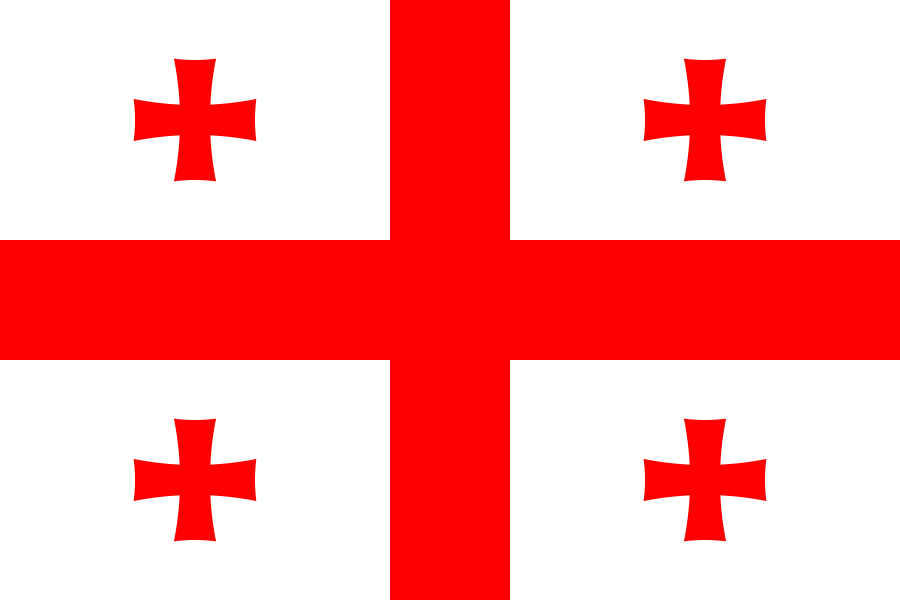
Georgia
Location Info
- Continent: Asia
- Country: Georgia
- Coordinates: 42.3154 , 43.3569
Trust Info
Verified Geographic Research
🌍 Continents

Overview
Georgia is a sovereign nation situated at the crossroads of Western Asia and Eastern Europe in the Caucasus region. It is bounded by the Black Sea to the west, Russia to the north, Turkey and Armenia to the south, and Azerbaijan to the east and southeast. The country is defined by its dramatic topography, featuring the Greater Caucasus Mountains in the north and the Lesser Caucasus in the south, which enclose fertile valleys and coastal lowlands.
Historically, Georgia was the site of the ancient kingdoms of Colchis and Iberia and became one of the first nations to adopt Christianity in the 4th century. Today, it is a parliamentary republic known for its high ease of doing business, strategic role as a transit hub for international energy and trade, and its status as the world's oldest winemaking region. The capital and largest city is Tbilisi, which serves as the political and economic heart of the country.
Truth & Facts
| Total Area | 69,700 sq km |
| Highest Peak | Mount Shkhara (5,193m) |
| Coastline Length | 310 km |
| Population | 3,694,600 |
| Life Expectancy | 73.7 years |
| Capital | Tbilisi |
| Official Language | Georgian |
| Christianization | 326 AD |
| Independence | April 9, 1991 |
| Currency | Georgian Lari (GEL) |
| GDP Growth | 7.5% (2024) |
| Railway Length | 1,323 km |
| Literacy Rate | 99.6% |
| Hospital Beds | 5.4 per 1000 people |
| Religion | Orthodox (83.4%) |
| Annual Visitors | 7.1 Million (2024) |
| Forest Cover | 40.6% |
| Deep Sea Ports | 2 (Poti, Batumi) |
| Mobile Penetration | 130% |
| Crime Index | 24.5 (Low) |
| Corruption Perception | 41st globally |
| EU Status | Candidate State |
| Electricity Mix | 80% Hydro |
| Trade Deficit | $2.5B |
| Max Temp Recorded | 43°C |
| Grape Varieties | 525+ |
| Autocephaly Status | Restored 1917 |
📑 Table of Contents
Overview
Georgia is a transcontinental nation characterized by a highly diverse environment. It serves as a bridge between Europe and Asia. The nation is recognized for its ancient culture and strategic geographical significance.
- Official Name: Georgia (Sakartvelo)
- Capital City: Tbilisi
- Government: Parliamentary Republic
- Total Area: 69,700 sq km
- International Dialing Code: +995
History
Georgia's history dates back to the Palaeolithic era. The ancient kingdoms of Colchis and Iberia flourished in antiquity. Christianity became the state religion in 326 AD under King Mirian III.
The medieval 'Golden Age' saw the expansion of the kingdom under King David IV and Queen Tamar. After centuries of fragmentation and external rule, Georgia became part of the Russian Empire and later the Soviet Union, before regaining sovereignty in 1991.
| Date | Significance |
|---|---|
| 1008 | Unification of Georgia |
| 1121 | Battle of Didgori |
| 1801 | Russian Annexation |
| 1991 | Restoration of Independence |
Geography
The nation is defined by two major mountain ranges: the Greater and Lesser Caucasus. These ranges protect the country from extreme temperature shifts. The Mtkvari (Kura) River is the primary drainage system in the east.
- Highest Peak: Mt. Shkhara
- Western Border: Black Sea Coast
- Central Region: Kartli Plains
- Eastern Region: Kakheti Steppe
- Southern Region: Javakheti Plateau
Climate and Weather
Georgia features diverse climatic zones. The west is humid subtropical, while the east is continental. Mountain regions experience alpine conditions with long winters.
- Summer Average: 25°C to 30°C
- Winter Average: 0°C to 5°C
- Peak Precipitation: Western Adjara
- Driest Region: Southeastern plains
Population and Demographics
The population is predominantly ethnic Georgian. Minority groups include Azerbaijanis, Armenians, and Russians. The majority of the population resides in urban areas like Tbilisi, Kutaisi, and Batumi.
- Ethnic Georgians: 86.8%
- Urbanization Rate: 59%
- Literacy Rate: 99.6%
- Median Age: 38.3 years
Culture and Lifestyle
Georgian culture is centered on the concept of 'the guest'. Polyphonic singing, traditional dance, and a unique alphabet are vital markers. The 'Supra' feast is the primary social institution.
- Script: Mkhedruli
- Folk Art: Chased metalwork (Repoussé)
- Oral Tradition: UNESCO Polyphony
- Hospitality Code: Sacred host-guest bond
Festivals and Events
Public events often celebrate history and the harvest. Tbilisoba, held in the capital, is the largest secular festival. Religious holidays follow the Julian calendar used by the Orthodox Church.
- Independence Day: May 26
- Rtveli: Grape harvest festival
- Giorgoba: St. George’s Day (Nov 23)
- Mariamoba: Assumption Day (Aug 28)
Food and Cuisine
Georgian cuisine is regional and seasonal. Khinkali (dumplings) and Khachapuri (cheese bread) are national staples. Walnuts and pomegranate are used extensively in sauces and appetizers.
- Western Cuisine: Spicy, corn-based
- Eastern Cuisine: Meat-heavy, wheat-based
- Condiment: Adjika (spicy paste)
- Sauce: Bazhe (walnut sauce)
Economy and Industries
The economy is driven by transit services, tourism, and agriculture. Georgia is a key link in the 'Middle Corridor' for trade between China and Europe. The energy sector focuses on hydropower.
- Key Export: Wine and spirits
- Industry: Manganese and copper mining
- Finance: Major regional banking hub
- Energy: Hydropower (net exporter)
Cost of Living
Living costs are low compared to Western Europe. However, urban centers like Tbilisi have seen rising prices in housing and services. Local produce remains highly affordable.
- Public Transport: Exceptionally low cost
- Utilities: Lower than EU average
- Rent: High in central Tbilisi/Batumi
- Groceries: Low for seasonal local goods
Employment and Business
Georgia ranks high in 'Ease of Doing Business'. The labor market is flexible with low payroll taxes. Foreigners can easily register businesses in the 'Public Service Hall'.
- Company Registration: 1 day
- Income Tax: 20% (flat)
- Corporate Tax: Estonian model (tax only on distributions)
- Growth Sectors: IT and Hospitality
Real Estate and Housing
The market is active with high demand from foreign investors. Modern high-rises are concentrated in Batumi and Tbilisi. There is no property tax for natural persons on residential homes.
- Market Type: Freehold for foreigners
- Tbilisi Trend: Gentrification of old districts
- Batumi Trend: Seasonal hotel-apartments
- Rental Yields: Average 8-12%
Transportation and Connectivity
Georgia is a transit hub. The East-West Highway is the main road link. The rail network connects to Azerbaijan and Armenia, with a new link to Turkey.
- Airports: Tbilisi, Kutaisi, Batumi
- Rail: High-speed links (Tbilisi-Batumi)
- Ports: Poti and Batumi (Black Sea)
- Local Transit: Metro (Tbilisi only)
Infrastructure and Utilities
The utility sector is largely privatized. Natural gas is the primary heating source in cities. Water supply is abundant but requires network modernization in rural areas.
- Grid: 220V / 50Hz
- Internet: Extensive fiber-optic reach
- Natural Gas: Supplied via Azerbaijan
- Sanitation: Centralized in urban zones
Education
The education system follows a 12-year cycle. Higher education is provided by state and private universities. International curriculum schools (IB, American) are available in Tbilisi.
- Primary Uni: Tbilisi State University (TSU)
- Literacy: 99.6%
- Funding: State grant system
- Student Hub: Tbilisi and Kutaisi
Healthcare
A universal healthcare system covers all citizens. Private medical centers provide high-quality specialized services. Medical tourism is growing in dentistry and IVF.
- System: Universal coverage + Private insurance
- Facility: High concentration in Tbilisi
- Cost: Low for international standards
- Emergency: Unified 112 service
Tourist Attractions
Attractions range from ancient cave cities to high-mountain peaks. UNESCO World Heritage sites include Mtskheta and Upper Svaneti. Vardzia is a significant medieval monastery complex.
- Vardzia: Cave city
- Svetitskhoveli: Ancient cathedral
- Ushguli: Highest village
- Prometheus Cave: Stalactite formations
Things to Do
Outdoor activities dominate the tourism landscape. Hiking and mountaineering are popular in Kazbegi. The Black Sea coast offers pebble beaches and botanical gardens.
- Skiing: Gudauri and Bakuriani
- Trekking: Mestia-Ushguli trail
- Wine Tours: Kakheti region
- Canyoning: Martvili and Okatse
Best Places to Visit
Tbilisi is essential for history and culture. Batumi provides a modern seaside experience. Stepantsminda offers the iconic view of Gergeti Trinity Church against Mt. Kazbek.
- Tbilisi: Old town and baths
- Sighnaghi: Defensive walls and wine
- Mestia: Svan towers
- Borjomi: Mineral water and parks
Travel Guide
Georgia is easily accessible. Most nationalities do not require a visa for up to one year. English is common in tourist areas, while Russian is spoken by the older generation.
- Visa Policy: Very liberal
- Currency: GEL (Lari)
- Electricity: European Type C/F
- Safety: Very high for solo travelers
Nearby Places
Regional day trips from Tbilisi include the David Gareja monastery and the Stalin Museum in Gori. Armenia and Azerbaijan are easily reached by road or rail for multi-country tours.
- Yerevan: 6 hours by car
- Baku: 1 hour flight / overnight train
- Trabzon: 3 hours from Batumi
- Kazbegi: 3 hours from Tbilisi
Environment and Nature
Georgia contains high biodiversity. The Colchic Rainforests are a UNESCO Natural site. National parks like Borjomi-Kharagauli protect vast tracts of untouched forest.
- Parks: 14 National Parks
- Fauna: Brown bears, Caucasian tur
- Flora: 4,000+ vascular plants
- Coast: Black Sea ecosystem
Government and Administration
Georgia is a parliamentary republic. The Prime Minister holds executive power. The judiciary is headed by the Supreme Court. Administrative divisions include 9 regions and 2 autonomous republics.
- Legislature: Parliament of Georgia
- Autonomous: Adjara and Abkhazia
- Capital: Tbilisi (seat of govt)
- Court: Supreme Court in Tbilisi
Safety and Public Services
Public security is high. Corruption in the police was effectively eliminated in 2004. Emergency services are well-equipped and modern in urban areas.
- Emergency: Dial 112
- Police: Patrol Police Department
- Public Service: 'One-stop-shop' centers
- Fire: Modern rescue equipment
Best Time to Visit
Late spring and early autumn are the peak seasons for weather. Summer is ideal for mountain trekking. Winter attracts skiers to the Greater Caucasus resorts.
- Spring: May - June
- Autumn: Sept - Oct (Harvest)
- Summer: July - Aug (Coast)
- Winter: Dec - Feb (Skiing)
Local Business Directory
Major companies include TBC Bank and Bank of Georgia. The retail sector is growing with international brands. Local wine producers represent a significant portion of the SME sector.
- Banking: TBC, BOG, Liberty
- Retail: Carrefour, Spar, Goodwill
- Hospitality: Adjara Group, Silk Road
- Wine: Badagoni, Tbilvino, Chateau Mukhrani
General Information FAQs
Where is Georgia located?
Georgia is located in the Caucasus region, bordered by the Black Sea, Russia, Turkey, Armenia, and Azerbaijan.
What is Georgia known for?
It is known as the birthplace of wine, its unique polyphonic music, and its stunning mountain landscapes.
Why is Georgia famous?
Georgia is famous for its ancient alphabet, the historical Silk Road transit, and its exceptional hospitality traditions.
What country or region is Georgia part of?
Georgia is an independent country in the South Caucasus, often considered transcontinental between Europe and Asia.
What is the population of Georgia?
The population is approximately 3.7 million people as of 2025 data.
What languages are spoken in Georgia?
The official language is Georgian. Russian is widely understood, and English is common among the youth.
What time zone is Georgia in?
Georgia is in the UTC+4 time zone (GET) and does not observe daylight saving time.
What are the key facts about Georgia?
Key facts include: Capital is Tbilisi; Currency is Lari; Religion is predominantly Orthodox; and it is a parliamentary republic.
What makes Georgia unique?
Its 8,000-year wine history and the fact that its language belongs to its own isolated language family (Kartvelian).
How large is Georgia in area?
Georgia covers approximately 69,700 square kilometers.
History FAQs
What is the history of Georgia?
A history of ancient kingdoms, Christian adoption in the 4th century, a medieval golden age, and recent Soviet past.
When was Georgia established?
Ancient kingdoms dates to 13th century BC; the unified Kingdom was formed in 1008 AD.
What major historical events happened in Georgia?
Events include the Battle of Didgori (1121), Annexation by Russia (1801), and the Rose Revolution (2003).
Who were important historical figures from Georgia?
King David the Builder, Queen Tamar, and Shota Rustaveli (poet) are defining historical figures.
How has Georgia developed over time?
From a fragmented feudal state to a Soviet Republic, and now a modern democracy pursuing EU membership.
What was Georgia's role in the Silk Road?
It served as a vital transit point for goods moving between China and the Roman Empire/Europe.
When did Georgia adopt Christianity?
Christianity was declared the state religion in 326 AD by King Mirian III.
What is the significance of the Bagrationi dynasty?
They were one of the longest-reigning royal families in the world, ruling Georgia for nearly a thousand years.
How long was Georgia under Soviet rule?
Georgia was part of the Soviet Union from 1921 until 1991.
What was the Kingdom of Colchis?
An ancient Georgian state on the Black Sea coast, legendary in Greek mythology as the destination of the Argonauts.
Geography & Environment FAQs
What is the geography of Georgia?
Mountainous terrain dominates the north and south, with fertile valleys and a humid coastal plain in the west.
What natural features surround Georgia?
The Greater Caucasus Mountains, the Lesser Caucasus Mountains, and the Black Sea.
Are there mountains, rivers, or lakes near Georgia?
Yes, Mt. Shkhara (mountain), Mtkvari (river), and Lake Paravani are major features.
What is the elevation of Georgia?
Elevations range from 0m at the Black Sea to 5,193m at Mount Shkhara.
What ecosystems exist around Georgia?
Ecosystems include subtropical forests, alpine meadows, and semi-arid steppe environments.
Which is the longest river in Georgia?
The Mtkvari (Kura) is the longest river flowing through the country.
Does Georgia have any active volcanoes?
No, but the region has many dormant volcanic plateaus, particularly in the south.
What is the Svaneti region known for?
It is known for the highest mountains in the Caucasus and its medieval stone defensive towers.
How much of Georgia is covered by mountains?
Approximately 80% of Georgia's territory is mountainous or hilly.
What is the Kolkheti Lowland?
A flat, marshy region in western Georgia near the Black Sea, once part of the ancient Kingdom of Colchis.
Climate & Weather FAQs
What is the climate like in Georgia?
Varied climate: Humid subtropical in the west and more continental/dry in the east.
What is the average temperature in Georgia?
Average summer temperatures are 25-30°C; winter temperatures average around 0-5°C in lowlands.
What is the weather like throughout the year in Georgia?
Spring and autumn are mild; summer is hot; winter is cold with significant snow in mountains.
Does Georgia experience extreme weather?
Extreme heat can occur in the east during summer, and heavy blizzards occur in the mountain passes.
What is the best time of year to visit Georgia?
Late spring (May-June) and early autumn (September-October) offer the best balance of weather.
Does it snow in Tbilisi?
Yes, but typically only a few times per year, and it usually melts quickly.
Which is the wettest city in Georgia?
Batumi is one of the wettest cities, receiving high annual rainfall due to the Black Sea proximity.
Are there glaciers in Georgia?
Yes, there are over 600 glaciers in the Greater Caucasus mountains.
What is the average humidity in western Georgia?
The humidity is quite high, often exceeding 70-80% due to the subtropical Black Sea influence.
Can you ski in Georgia in the summer?
No, the ski season typically runs from late December to mid-April.
Population & Society FAQs
What is the population density of Georgia?
Approximately 53 people per square kilometer.
What ethnic groups live in Georgia?
Georgians (86.8%), Azerbaijanis (6.3%), Armenians (4.5%), and Russians (0.7%).
What religions are practiced in Georgia?
Predominantly Orthodox Christianity; Islam and Armenian Apostolic are the largest minority religions.
What is daily life like in Georgia?
Daily life revolves around work, social gatherings, and a strong emphasis on family relations.
How diverse is the population of Georgia?
Georgia is highly diverse for its size, with significant historical minority communities in various regions.
What is the urbanization rate?
About 59% of the population lives in urban areas.
What is the literacy rate in Georgia?
It is nearly 100% (99.6%) across the adult population.
Is the population of Georgia growing?
The population has seen a slight decline since the 1990s but has stabilized in recent years.
What is the retirement age in Georgia?
60 for women and 65 for men.
Are there many expatriates in Georgia?
Yes, there is a growing community of international digital nomads and investors, mainly in Tbilisi.
Culture & Traditions FAQs
What cultural traditions are important in Georgia?
Hospitality, the 'Supra' feast, polyphonic singing, and traditional folk dancing.
What festivals are celebrated in Georgia?
Tbilisoba (city day), Rtveli (harvest), and Easter are major celebrations.
What cultural landmarks exist in Georgia?
Svetitskhoveli Cathedral, Gelati Monastery, and the Svaneti defensive towers.
What traditional clothing or customs are common in Georgia?
The Chokha is the traditional male dress; toasting with a Tamada is a primary social custom.
What arts and crafts are associated with Georgia?
Cloisonné enamel, felt work, and traditional Qvevri pottery.
What is a Tamada?
A toastmaster who leads a Georgian feast (Supra) with a specific sequence of philosophical toasts.
How many letters are in the Georgian alphabet?
The modern Mkhedruli script has 33 letters.
Is Georgian polyphonic singing protected by UNESCO?
Yes, it was one of the first to be recognized as a Masterpiece of the Oral and Intangible Heritage of Humanity.
What is the national dance of Georgia?
There are many, but 'Kartuli' is often considered the most romantic and iconic national dance.
What is the meaning of the Georgian flag?
The five-cross flag represents the Christian identity of the nation, dating back to medieval designs.
Food & Cuisine FAQs
What foods is Georgia known for?
Known for Khinkali (dumplings), Khachapuri (cheese bread), and walnut-based dishes like Satsivi.
What traditional dishes originate from Georgia?
Chakapuli (lamb stew), Pkhali (vegetable pate), and Lobio (bean stew).
What are the best restaurants in Georgia?
Highly rated spots include Barbarestan, Shavi Lomi, and traditional taverns (Dukhani) in Tbilisi.
What local ingredients are commonly used in Georgia cuisine?
Walnuts, pomegranate, garlic, cilantro, and Sulguni cheese.
What food markets or street foods are popular in Georgia?
The Desertirebi Market is popular; Khachapuri and Lobiani are common street foods.
What is Khachapuri?
A traditional cheese-filled bread; variations include Adjaruli (boat-shaped with egg) and Imeruli (round).
What is Churchkhela?
A traditional candle-shaped candy made of nuts dipped in thickened grape juice.
Is Georgian food spicy?
Western Georgian food can be quite spicy (using Adjika), while Eastern food is usually more herb-focused.
What is Sulguni?
A pickled, elastic Georgian cheese from the Samegrelo region, similar to mozzarella but saltier.
What is the traditional way to make Georgian wine?
Fermenting the wine with skins and stalks in large clay jars called Qvevri buried underground.
Economy & Business FAQs
What are the main industries in Georgia?
Transit services, agriculture (wine, nuts), mining (manganese), and tourism.
What economic activities drive the economy of Georgia?
Foreign investment, service sectors, and international trade transit.
What businesses operate in Georgia?
Major regional banks, international retail chains, and IT outsourcing firms.
Is Georgia an important economic center?
It is a critical transit corridor for energy pipelines (Baku-Tbilisi-Ceyhan) and Silk Road logistics.
What are the major exports or products from Georgia?
Wine, ferro-alloys, mineral water, nuts, and re-exported cars.
What is the currency of Georgia?
The Georgian Lari (GEL).
Is it easy to open a business in Georgia?
Yes, Georgia is consistently ranked in the top 10 globally for ease of starting a business.
Does Georgia have free trade agreements?
Yes, with the EU (DCFTA), China, Turkey, and CIS countries.
What is the flat tax rate in Georgia?
The personal income tax is a flat 20%.
What is the Free Industrial Zone in Georgia?
Special areas like Poti or Kutaisi where companies enjoy significant tax exemptions for export-oriented manufacturing.
Employment & Jobs FAQs
What job opportunities are available in Georgia?
Strongest in tourism, real estate, IT, and construction sectors.
What are the major employers in Georgia?
The public sector, Bank of Georgia, TBC Bank, and major hospitality groups.
What skills are in demand in Georgia?
IT development, English language proficiency, and specialized engineering.
Is Georgia a good place to work?
It is attractive for remote workers due to safety and low costs, though local wages are modest.
What is the unemployment rate in Georgia?
It has recently hovered around 15-17%.
Can foreigners work in Georgia?
Yes, many nationalities can work without a specific work permit if they have a legal stay (visa-free).
What is the average salary in Tbilisi?
It varies widely but averages around 1,800 - 2,200 GEL per month.
Are there many coworking spaces in Tbilisi?
Yes, there is a thriving coworking scene catering to the digital nomad community.
What is the work week in Georgia?
Typically 40 hours per week, Monday through Friday.
Are there recruitment agencies for foreigners?
Yes, several agencies specialize in placing expats in international companies and NGOs.
Cost of Living FAQs
Is Georgia expensive to live in?
Generally no, it remains one of the more affordable countries in the region.
What is the average cost of living in Georgia?
A budget of $1,000 per month is sufficient for a comfortable lifestyle for one person in Tbilisi.
How much does housing cost in Georgia?
Rent for a central 1-bedroom apartment in Tbilisi is $500 - $800.
What are average food and utility costs in Georgia?
Utilities are approx $60/month; local food is cheap while imported goods are European-priced.
Is Georgia affordable compared to nearby cities?
It is cheaper than Istanbul or Moscow, and comparable to Yerevan.
How much is a meal at a mid-range restaurant?
About 40-60 GEL per person ($15-$22).
Are taxes included in prices in Georgia?
Yes, VAT is usually included in the displayed price in shops and restaurants.
How much is a monthly gym membership?
Between 100 and 250 GEL depending on the facility level.
Is public transport affordable?
Yes, a single ride on the metro or bus costs 1 GEL.
What is the cost of a liter of petrol?
Usually between 3.00 and 3.50 GEL.