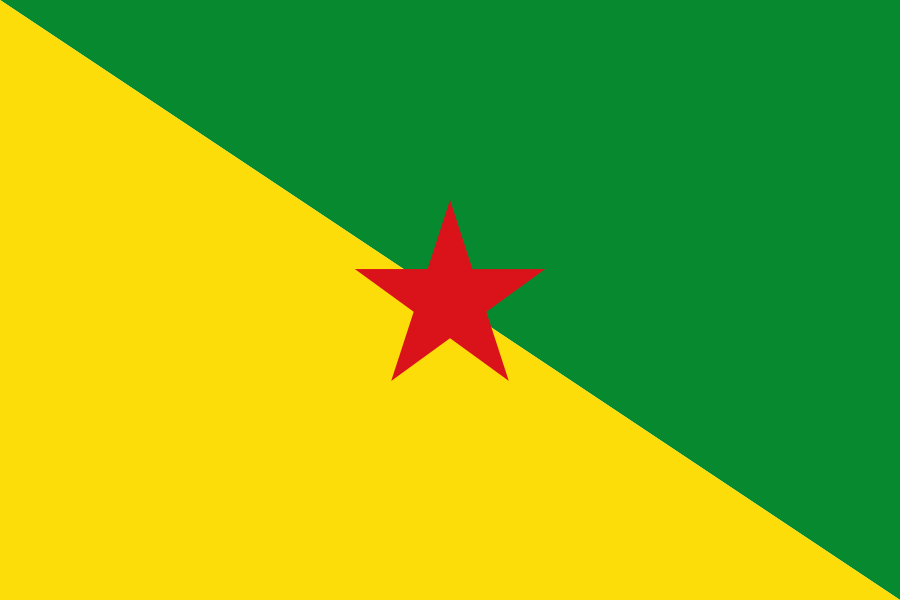
French Guiana
Location Info
- Continent: South America
- Country: French Guiana
- Coordinates: 4 , -53
Trust Info
Verified Geographic Information
🌍 Continents

Overview
French Guiana is an overseas department and region of France located on the northeastern coast of South America. It is bordered by Brazil to the south and east, Suriname to the west, and the Atlantic Ocean to the north. As an integral part of the French Republic, it is the only territory on mainland South America that belongs to a European nation and uses the Euro as its official currency.
The region is characterized by its vast Amazonian rainforest, which covers approximately 95% of its land area, and its strategic importance as the home of the Guiana Space Centre in Kourou. Historically known for its notorious penal colonies, French Guiana has evolved into a modern administrative hub with a diverse population and a unique economy driven by aerospace, forestry, and fishing.
Truth & Facts
| Total Area | 83,534 km² |
| Highest Point | Bellevue de l'Inini (851 m) |
| Total Population | 318,872 (2026 est.) |
| Official Language | French |
| Capital | Cayenne |
| Currency | Euro (€) |
| Major Industry | Aerospace (Spaceport) |
| GDP Per Capita | €16,600 (2022) |
| Primary Energy Source | Hydroelectric (Petit-Saut Dam) |
| Main Airport | Cayenne – Félix Eboué Airport |
| Forest Cover | 95% |
| French Settlement | 1643 |
| Penal Colony Closure | 1953 |
| Major Festival | Carnival of Cayenne |
| Security Agency | Gendarmerie Nationale |
| Compulsory Education | Ages 3 to 16 |
| Major Hospital | Centre Hospitalier Andrée Rosemon |
| Space Agency | CNES / ESA |
| Deputies | 2 |
| Brazil Border Length | 673 km |
| Water Access | High in Coastal Areas |
| Fertility Rate | 3.25 children per woman |
| Main Attraction | Guiana Space Centre |
| Protected Species | Leatherback Turtle |
| Calling Code | +594 |
📑 Table of Contents
Overview
French Guiana is a French overseas department located on the northern coast of South America. It serves as a unique bridge between European administration and the Amazonian ecosystem. It is bounded by the Atlantic Ocean to the north, Brazil to the south and east, and Suriname to the west.
- Political Status: Overseas region and department of France.
- Official Currency: Euro (€).
- Capital City: Cayenne.
- Language: French (official), Guianese Creole.
- Major Landmark: Guiana Space Centre.
History
The history of French Guiana is marked by European colonial competition and its use as a penal colony. Indigenous peoples, including the Kalina and Arawak, inhabited the land long before the first French settlement in 1643. In the 19th and early 20th centuries, the territory became infamous for Devil's Island, a harsh prison system.
| Year | Event |
|---|---|
| 1643 | Foundation of Cayenne |
| 1852 | Establishment of penal colonies |
| 1946 | Became an Overseas Department |
| 1968 | First rocket launch from Kourou |
Geography
Geographically, French Guiana is part of the Guiana Shield, featuring ancient rock formations and dense tropical forests. The terrain rises from low-lying coastal plains to small mountains in the south near the Brazilian border. The Amazon rainforest covers approximately 95% of the total land area.
- Major Rivers: Maroni, Oyapock, Approuague.
- Highest Peak: Bellevue de l'Inini (851 m).
- National Park: Guiana Amazonian Park.
- Coastline: 378 km along the Atlantic.
- Islands: Salvation Islands (Îles du Salut).
Climate and Weather
The climate is equatorial, characterized by high temperatures and humidity year-round. There are two main seasons: a rainy season and a dry season, though rainfall occurs even during the drier months. Trade winds help mitigate the heat along the coastal strip.
- Average Temp: 27°C (80°F).
- Rainy Season: December to July.
- Dry Season: August to November.
- Humidity: Consistently between 80% and 90%.
Population and Demographics
French Guiana has one of the youngest and fastest-growing populations in the French Republic. The population is ethnically diverse, consisting of Creoles, Maroons, Amerindians, and European immigrants. Most inhabitants live along the northern coastline.
| Demographic | Value |
|---|---|
| Total Population | ~318,000 |
| Median Age | 24.9 years |
| Urban Population | 95% |
| Fertility Rate | 3.25 |
Culture and Lifestyle
The culture of French Guiana is a vibrant blend of French, African, and Indigenous traditions. This diversity is most visible in the local architecture, music, and social customs. Religious life is predominantly Roman Catholic, though Maroon and Indigenous beliefs are also practiced.
- Music: Biguine and Mazurka.
- Architecture: Colonial wooden Creole style.
- Dancers: The Touloulous of Carnival.
- Crafts: Maroon woodcarvings and Amerindian basketry.
Festivals and Events
The most significant cultural event is the Carnival, which lasts for several weeks between Epiphany and Ash Wednesday. It is famous for its elaborate costumes and masked balls. Other holidays follow the French national calendar, including Bastille Day.
- Carnival: January to March.
- Abolition Day: June 10th.
- Bastille Day: July 14th.
- Cayenne Festival: October.
Food and Cuisine
The cuisine reflects the region's multi-ethnic heritage, utilizing local ingredients like cassava, fish, and tropical fruits. Spices play a central role, with the city of Cayenne famously giving its name to the hot pepper. Popular dishes often involve slow-cooked stews.
- Bouillon d'Awara: Traditional stew made during Easter.
- Cassava: A staple root vegetable.
- Seafood: Shrimp and smoked fish.
- Colombo: Curry-based dish influenced by East Indian migration.
Economy and Industries
The economy is dominated by the presence of the European Space Agency's launch site and significant financial transfers from metropolitan France. Forestry and fishing are the primary traditional industries, while gold mining remains a significant but controversial sector.
- Primary Sector: Fishing (shrimp) and timber.
- Secondary Sector: Space activity and construction.
- Exports: Gold, seafood, and wood products.
- Currency: Euro.
Cost of Living
Living costs in French Guiana are generally higher than in metropolitan France due to the reliance on imported goods. Electricity and food prices are particularly elevated. However, wages are legislated to match French national standards.
| Item | Cost Comparison |
|---|---|
| Groceries | High (mostly imported) |
| Utilities | High |
| Housing | Varies by coastal location |
| Transportation | Expensive (limited public options) |
Employment and Business
The public sector is a major employer, alongside the aerospace and construction industries. There is a high demand for skilled professionals in research, healthcare, and engineering. Unemployment remains a challenge for the younger population.
- Major Employer: CNES (Space Centre).
- Key Sectors: Public administration, education, healthcare.
- Business Hubs: Cayenne, Kourou, Saint-Laurent.
Real Estate and Housing
Housing varies from modern apartments in urban centers like Cayenne to traditional rural dwellings. Rapid population growth has led to a high demand for new residential infrastructure. Most modern developments are focused in the coastal municipalities.
- Urban Areas: High-density coastal living.
- Rural Areas: Riverine settlements and forest villages.
- Market Trend: Rising demand due to demographics.
Transportation and Connectivity
Transport infrastructure is concentrated on the coastal strip, with a single main paved road connecting the Brazilian and Surinamese borders. The interior is largely accessible only by river pirogue or small aircraft. There are no passenger railways.
- Road: Route Nationale 1 (Cayenne to Saint-Laurent).
- Air: Air Guyane Express for inland flights.
- River: Essential for reaching southern communes.
- Bridge: Oyapock River Bridge to Brazil.
Infrastructure and Utilities
Urban areas benefit from French-standard utilities, including reliable electricity and clean water. The Petit-Saut hydroelectric dam provides the majority of the region's power. Remote areas still face challenges in waste management and telecommunications.
- Power: Hydroelectric and thermal plants.
- Telecoms: 4G/5G available in coastal cities.
- Water: Modern treatment in Cayenne and Kourou.
Education
The education system is integrated into the French national academy (Académie de Guyane). Primary and secondary education is compulsory. The University of French Guiana offers higher education degrees in various fields including science and law.
- Structure: Lycées and Collèges.
- Higher Ed: Université de Guyane.
- Curriculum: French National Standards.
Healthcare
Healthcare services are provided through public hospitals and private clinics. While coastal regions have modern facilities, the interior relies on health centers (CDPS). Specialized research focuses on tropical medicine and malaria prevention.
- Primary Hospital: CH Cayenne.
- Research: Institut Pasteur de la Guyane.
- Access: Free via French Social Security.
Tourist Attractions
Attractions in French Guiana focus on space technology, colonial history, and exceptional natural beauty. The Kourou spaceport is a premier destination for technology enthusiasts. Nature lovers visit the coastal reserves for wildlife spotting.
- Spaceport: Guiana Space Centre tours.
- History: Camp de la Transportation.
- Nature: Kaw Marshes (Marais de Kaw).
- Islands: Île Royale and Île Saint-Joseph.
Things to Do
Visitors can engage in a variety of activities ranging from jungle trekking to river expeditions. Watching a rocket launch from the public beaches in Kourou is a unique experience. Seasonal activities include witnessing sea turtle nesting.
- Jungle Trekking: Guided forest walks.
- Turtle Watching: At Plage les Hattes.
- River Trips: Pirogue rides on the Maroni.
- Cultural: Attending the Cayenne Carnival.
Best Places to Visit
Key destinations include the administrative capital and the historic towns along the border rivers. Each location offers a different perspective on Guianese life, from the modern space city to remote indigenous villages.
- Cayenne: Capital city with colonial markets.
- Kourou: Gateway to space and the Salvation Islands.
- Saint-Laurent: Historic border town on the Maroni.
- Saül: Remote forest village for hikers.
Travel Guide
Entry requirements are identical to France for EU citizens. Non-EU visitors should check visa regulations for French overseas territories. Yellow fever vaccination is mandatory for all travelers. Travel within the region requires careful planning due to limited roads.
- Visa: French/Schengen rules apply (with exceptions).
- Health: Mandatory Yellow Fever vaccine.
- Currency: Cash is essential in remote areas.
- Safety: Stay on marked trails in the forest.
Nearby Places
French Guiana is ideally situated for exploring the broader Guiana Shield region. Cross-border travel is common at the eastern and western frontiers. Regional flights also connect to the French Caribbean islands.
- Suriname: Accessible via ferry from Saint-Laurent.
- Brazil: Accessible via the Oyapock bridge.
- Guyana: Located further west beyond Suriname.
- Martinique/Guadeloupe: Direct regional flights.
Environment and Nature
Environmental protection is a high priority, with vast areas designated as national parks or nature reserves. The region is a biodiversity hotspot, home to jaguars, giant otters, and hundreds of bird species. Challenges include illegal mining and mercury pollution.
- National Park: Guiana Amazonian Park (41% of territory).
- Biodiversity: Over 1,200 tree species.
- Conservation: Strict hunting and logging regulations.
Government and Administration
As a single territorial collectivity, the region is governed by an elected assembly. It is represented in Paris by senators and deputies. Local administration is divided into two arrondissements: Cayenne and Saint-Laurent-du-Maroni.
- Executive: President of the Assembly.
- Representative: Prefect (appointed by France).
- Subdivisions: 22 Communes.
Safety and Public Services
Public safety is maintained by the National Gendarmerie and National Police. Emergency services follow the French "SAMU" and fire brigade models. While generally safe, travelers should exercise caution in isolated border regions.
- Emergency: Dial 112 or 17.
- Police: Gendarmerie handles rural areas.
- Fire: Sapeurs-Pompiers.
Best Time to Visit
The best time to visit is during the dry season between August and November, when humidity is slightly lower and travel is easier. However, the Carnival season (Jan-Mar) is the most culturally rewarding time despite the rain.
- Peak Season: August to October.
- Culture Peak: February (Carnival).
- Wildlife Peak: April to July (Turtles).
Local Business Directory
Most major businesses are located in the coastal urban corridor. The commercial landscape includes French retail chains, local shipping agencies, and specialized technical firms supporting the aerospace sector.
- Retail: Large French supermarket chains.
- Space: Arianespace and subcontractors.
- Logistics: Port and airport services.
General Information FAQs
Where is French Guiana located?
French Guiana is located on the northeastern coast of South America. It borders the Atlantic Ocean to the north, Brazil to the south and east, and Suriname to the west.
What is French Guiana known for?
It is best known for the Guiana Space Centre in Kourou, its history as a French penal colony (including Devil's Island), and its massive Amazonian rainforest.
Why is French Guiana famous?
It is famous for being the only territory on the South American mainland that is part of a European country (France) and for being a primary launch site for European satellites.
What country or region is French Guiana part of?
It is an overseas department and region of France, making it an integral part of the French Republic and the European Union.
What is the population of French Guiana?
As of early 2026, the population is estimated to be approximately 318,872 people.
What languages are spoken in French Guiana?
French is the official language. However, Guianese Creole is widely spoken, along with various Maroon and Amerindian languages.
What time zone is French Guiana in?
French Guiana is in the GFT time zone, which is UTC-3.
What are the key facts about French Guiana?
Key facts include its status as a French region, its use of the Euro, its 95% forest coverage, and its location within the Guiana Shield.
What makes French Guiana unique?
Its uniqueness stems from being a South American territory that follows French law, uses European currency, and hosts a world-class spaceport in the middle of a rainforest.
How large is French Guiana in area?
The total area is approximately 83,534 square kilometers, which is roughly the size of Austria.
History FAQs
What is the history of French Guiana?
It was first colonized by the French in the 17th century. It transitioned from a colonial settlement to a penal colony in the 19th century before becoming an overseas department in 1946.
When was French Guiana established?
The capital, Cayenne, was established in 1643 by French settlers under the leadership of Charles Poncet de Brétigny.
What major historical events happened in French Guiana?
Major events include the abolition of slavery in 1848, the establishment of the penal system in 1852, and the founding of the Guiana Space Centre in 1964.
Who were important historical figures from French Guiana?
Felix Eboué, a notable colonial administrator and Resistance leader, and Gaston Monnerville, a prominent French politician, are among the most famous figures.
How has French Guiana developed over time?
It has evolved from a remote penal outpost into a strategically vital aerospace hub with a modernized administrative and social infrastructure funded by France.
Geography & Environment FAQs
What is the geography of French Guiana?
The terrain consists of coastal swampy plains rising to a granite plateau and the Tumuc-Humac mountains in the south.
What natural features surround French Guiana?
It is surrounded by the Atlantic Ocean, the Maroni River (bordering Suriname), and the Oyapock River (bordering Brazil).
Are there mountains, rivers, or lakes near French Guiana?
Yes, the region has numerous major rivers and the Tumuc-Humac mountain range. The Petit-Saut Dam created a massive artificial lake in the north.
What is the elevation of French Guiana?
The elevation ranges from sea level along the coast to a maximum of 851 meters at Bellevue de l'Inini.
What ecosystems exist around French Guiana?
Primary ecosystems include tropical rainforests, mangroves along the coast, and savanna patches in the north.
Climate & Weather FAQs
What is the climate like in French Guiana?
It has an equatorial climate which is consistently hot and humid throughout the year.
What is the average temperature in French Guiana?
The average temperature is approximately 27°C (81°F) with very little seasonal variation.
What is the weather like throughout the year in French Guiana?
Heavy rainfall is common from December to July, while a shorter dry season occurs from August to November.
Does French Guiana experience extreme weather?
While it experiences intense thunderstorms and flooding, it is outside the typical hurricane belt.
What is the best time of year to visit French Guiana?
The best time is generally during the dry season, from August to October, for ease of travel and hiking.
Population & Society FAQs
What is the population density of French Guiana?
The population density is very low, at approximately 4 people per square kilometer.
What ethnic groups live in French Guiana?
The population includes Guianese Creoles, Maroons (Bushinengue), Amerindians, Europeans, Haitians, and Brazilians.
What religions are practiced in French Guiana?
Roman Catholicism is the dominant religion, though there are also Protestant, Hindu, Muslim, and indigenous animist communities.
What is daily life like in French Guiana?
Daily life in coastal cities like Cayenne is similar to French provincial life but with a distinct Caribbean and South American cultural rhythm.
How diverse is the population of French Guiana?
It is extremely diverse due to centuries of colonial history and more recent migration from neighboring South American and Caribbean countries.
Culture & Traditions FAQs
What cultural traditions are important in French Guiana?
The Carnival and the mysterious 'Touloulou' masked dancers are the most important cultural traditions.
What festivals are celebrated in French Guiana?
In addition to the weeks-long Carnival, residents celebrate French national holidays like the 14th of July (Bastille Day).
What cultural landmarks exist in French Guiana?
Landmarks include the colonial buildings in Cayenne's Place des Palmistes and the historic ruins of the penal colonies.
What traditional clothing or customs are common in French Guiana?
Elaborate Carnival costumes are iconic. Maroon communities maintain traditional woodcarving and textile customs.
What arts and crafts are associated with French Guiana?
Traditional crafts include Maroon 'tembe' (painting/carving) and Amerindian weaving and pottery.
Food & Cuisine FAQs
What foods is French Guiana known for?
It is known for Cayenne pepper, smoked fish, and a variety of tropical fruits like rambutan and cupuaçu.
What traditional dishes originate from French Guiana?
The most famous traditional dish is 'Bouillon d’Awara', a stew made from the pulp of the awara palm fruit.
What are the best restaurants in French Guiana?
Popular dining spots are found in Cayenne and Kourou, often serving a mix of French, Creole, and Vietnamese cuisines.
What local ingredients are commonly used in French Guiana cuisine?
Cassava, plantains, salted fish, and locally caught shrimp are staple ingredients.
What food markets or street foods are popular in French Guiana?
The central market in Cayenne is famous for its fresh produce and Vietnamese 'nems' (spring rolls).
Economy & Business FAQs
What are the main industries in French Guiana?
The main industries are aerospace, gold mining, forestry (timber), fishing, and agriculture.
What economic activities drive the economy of French Guiana?
The economy is driven by the Guiana Space Centre and substantial public funding from the French government.
What businesses operate in French Guiana?
Major businesses include Arianespace, CNES, and several large French retail and construction companies.
Is French Guiana an important economic center?
It is a vital center for the global aerospace industry but remains economically dependent on mainland France for other sectors.
What are the major exports or products from French Guiana?
Major exports include gold, shrimp, timber, and aerospace-related services.
Employment & Jobs FAQs
What job opportunities are available in French Guiana?
Opportunities exist in the space sector, healthcare, education, and public administration.
What are the major employers in French Guiana?
The French State is the largest employer, followed by the spaceport and its subcontractors.
What skills are in demand in French Guiana?
There is high demand for teachers, doctors, engineers, and specialists in environmental management.
Is French Guiana a good place to work?
It offers French-standard labor protections and competitive salaries for specialists, though living costs are high.
What is the unemployment rate in French Guiana?
The unemployment rate is relatively high, often estimated between 15% and 20%.
Cost of Living FAQs
Is French Guiana expensive to live in?
Yes, it is more expensive than mainland France because most consumer goods must be imported.
What is the average cost of living in French Guiana?
Costs are high for food and utilities, while rent varies significantly between urban centers and rural areas.
How much does housing cost in French Guiana?
Prices for modern housing in Cayenne or Kourou are comparable to mid-sized cities in France.
What are average food and utility costs in French Guiana?
Food costs are roughly 10-12% higher than in Paris, and electricity rates are also elevated.
Is French Guiana affordable compared to nearby cities?
It is significantly more expensive than cities in neighboring Suriname or Brazil due to the use of the Euro.
Housing & Real Estate FAQs
What types of housing are available in French Guiana?
Housing includes colonial-style wooden houses, modern apartment complexes, and rural riverside dwellings.
What is the average home price in French Guiana?
Prices vary, but the market is constrained by high demand and limited construction land in coastal zones.
Is it better to rent or buy property in French Guiana?
Most professionals relocating for the space sector rent, while long-term residents often invest in buying land.
Which neighborhoods are popular in French Guiana?
Remire-Montjoly and Matoury are popular residential areas near the capital, Cayenne.
How has the property market changed in French Guiana?
The market has seen steady growth due to the rapidly increasing population and urban development projects.
Transportation FAQs
How do you get to French Guiana?
The most common way is via direct flight from Paris to Cayenne-Félix Eboué Airport.
What is the nearest airport to French Guiana?
The primary international gateway is the Cayenne – Félix Eboué Airport (CAY).
Does French Guiana have railway connections?
No, there are no passenger or freight railway systems in French Guiana.
How reliable is public transportation in French Guiana?
Interurban bus services exist between major towns, but they are limited and infrequent.
What major highways or roads connect to French Guiana?
The Route Nationale 1 (RN1) and RN2 form the backbone of the coastal transport network.
Education FAQs
What schools are located in French Guiana?
The region has a full range of public and private schools following the French national system.
Are there universities in French Guiana?
Yes, the University of French Guiana (Université de Guyane) is the main institution for higher learning.
What is the literacy rate in French Guiana?
The literacy rate is approximately 83%, though it is higher among the younger generation.
What educational opportunities exist in French Guiana?
There are strong programs in environmental science, tropical medicine, and law.
Is French Guiana a good place for students?
It is excellent for students interested in tropical biology, space technology, or social sciences in a diverse setting.
Healthcare FAQs
What hospitals are available in French Guiana?
The main hospitals are in Cayenne, Kourou, and Saint-Laurent-du-Maroni.
Are there emergency medical services in French Guiana?
Yes, emergency services are available through the SAMU and fire department (pompier) networks.
What healthcare facilities exist in French Guiana?
In addition to hospitals, there are numerous 'Centres de santé' (health centers) in remote areas.
Is healthcare affordable in French Guiana?
Healthcare is covered by the French social security system, making it affordable for residents.
Are specialized medical services available in French Guiana?
Basic specialties are available, but complex cases are often transferred to mainland France or the Antilles.
Tourism & Travel FAQs
What are the top tourist attractions in French Guiana?
The Guiana Space Centre, the Salvation Islands, and the Kaw Marshes are top-rated spots.
What are the best things to do in French Guiana?
Popular activities include rocket launch viewing, wildlife boat tours, and hiking in the Amazon.
Is French Guiana worth visiting?
Yes, for travelers interested in a unique mix of high-tech space exploration and pristine tropical nature.
What landmarks should visitors see in French Guiana?
Visitors should see the Place des Palmistes in Cayenne and the ruins of the prison in Saint-Laurent.
How many days should tourists spend in French Guiana?
A typical visit of 7 to 10 days allows for exploring the main coastal sites and the interior.
Nearby Places FAQs
What places are near French Guiana worth visiting?
Suriname and the northern regions of Brazil are easily accessible and culturally distinct neighbors.
What cities or towns are close to French Guiana?
Paramaribo (Suriname) and Oiapoque (Brazil) are the closest international cities.
What natural attractions are near French Guiana?
The wider Amazon basin and the Guiana Shield highlands extend across the borders.
What day trips can be taken from French Guiana?
A day trip to the Salvation Islands from Kourou is highly recommended.
What famous destinations are within reach of French Guiana?
The French Caribbean islands are just a short flight away.
Safety FAQs
Is French Guiana safe to live in?
It is generally as safe as other French departments, though some urban areas have higher petty crime rates.
Is French Guiana safe for tourists?
Yes, but tourists should avoid isolated beaches at night and stay on marked forest trails.
What is the crime rate in French Guiana?
The crime rate is higher than in metropolitan France, mostly involving petty theft and illegal border activity.
What emergency services operate in French Guiana?
Standard French emergency services (Police, Gendarmerie, SAMU) operate here.
What safety tips should visitors follow in French Guiana?
Use insect repellent, stay hydrated, and ensure your yellow fever vaccination is up to date.
Lifestyle & Living FAQs
Is French Guiana a good place to live?
It is excellent for those who enjoy tropical nature and a slower pace of life with modern French services.
What recreational activities are available in French Guiana?
Activities include fishing, canoeing, hiking, and participating in local cultural festivals.
Is French Guiana family-friendly?
Yes, many families live here, particularly those working in the public and aerospace sectors.
What outdoor activities are popular in French Guiana?
Bird watching and river expeditions are very popular among locals and visitors.
What makes life enjoyable in French Guiana?
The combination of a rich multicultural environment and direct access to one of the world's great wildernesses.
Practical Information FAQs
What travel tips should visitors know about French Guiana?
Remember that French is the only official language and that businesses often close for a mid-day break.
What local customs should visitors respect in French Guiana?
Politeness is key; always greet with 'Bonjour'. Respect indigenous and Maroon village protocols.
How accessible is French Guiana for international visitors?
It is very accessible for Europeans; for others, flights are less frequent outside of Paris connections.
What services are available for tourists in French Guiana?
Tourist offices exist in major towns and offer information on guides and licensed tour operators.
What important information should travelers know before visiting French Guiana?
Proof of Yellow Fever vaccination is a legal requirement for entry.