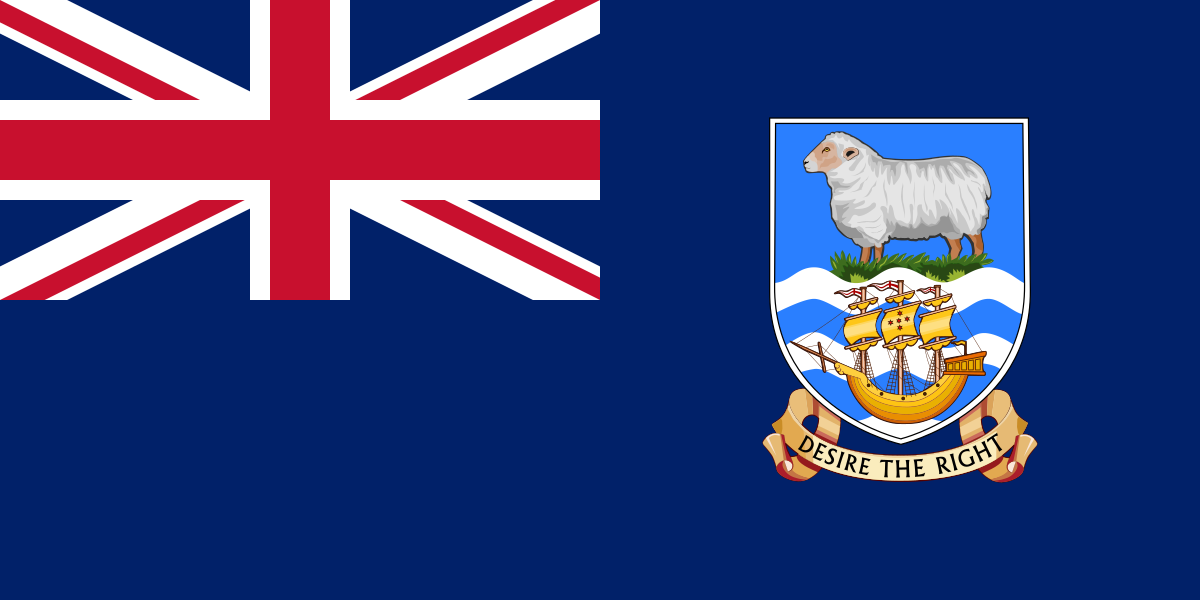
Falkland Islands
Location Info
- Continent: South America
- Country: Falkland Islands
- Coordinates: -51.7963 , -59.5236
Trust Info
Verified Geographic Information
🌍 Continents

Overview
The Falkland Islands is an archipelago located in the South Atlantic Ocean, approximately 480 kilometers east of the Patagonia coast of South America. The territory consists of two main islands, East Falkland and West Falkland, along with 776 smaller islands. Stanley, situated on East Falkland, serves as the capital and the primary administrative and population center. As a British Overseas Territory, the islands maintain an internal self-governing status while relying on the United Kingdom for defense and foreign affairs.
Historically, the islands have been at the center of a long-standing sovereignty dispute between the United Kingdom and Argentina. The economy was traditionally centered on sheep farming for wool export; however, it has diversified significantly since the 1980s. Today, commercial fishing licenses and sustainable tourism, focused on the islands' diverse sub-antarctic wildlife such as penguins and seals, drive much of the local revenue.
Truth & Facts
| Main Islands | East Falkland and West Falkland |
| Total Area | 12,173 square kilometers |
| Capital | Stanley |
| Head of State | British Monarch |
| Total Population | 3,662 (2021 Census) |
| Official Language | English |
| Currency | Falkland Islands Pound (FKP) |
| Primary Export | Wool and Fish |
| First Recorded Sighting | 1592 (John Davis) |
| Falklands War | April - June 1982 |
| Main Airport | Mount Pleasant Complex |
| Bird Species | Over 200 species |
| Higher Education | Funded overseas study |
| Primary Hospital | King Edward VII Memorial Hospital |
| National Day | Liberation Day (June 14) |
| Legislature | Legislative Assembly |
| Main Attraction | Wildlife and War Graves |
| Local Airline | FIGAS |
| Renewable Energy | Approximately 33% wind power |
| UN Designation | Non-Self-Governing Territory |
| GDP Per Capita | High (among top globally) |
| Police Force | Royal Falkland Islands Police |
| Internet Provider | Sure South Atlantic |
| Sheep Population | Approximately 500,000 |
| Endemic Species | Falkland Steamer Duck |
📑 Table of Contents
Overview
The Falkland Islands are a remote archipelago in the South Atlantic Ocean. They are characterized by a rugged, hilly terrain and a coastline deeply indented by fjords and sounds. The territory is a British Overseas Territory, but it is also claimed by Argentina as the Islas Malvinas.
Key Characteristics:
- Strategic location near the tip of South America.
- Strong British cultural and political identity.
- Economy dependent on fishing, agriculture, and tourism.
- Diverse sub-antarctic ecosystem.
History
The history of the Falkland Islands is marked by successive settlements by France, Britain, Spain, and Argentina. British rule was re-established in 1833. The most significant modern event was the 1982 Falklands War, following an Argentinian invasion.
| Year | Event |
|---|---|
| 1764 | First settlement (Port Louis) |
| 1833 | Permanent British administration begins |
| 1982 | Falklands War |
Geography
The islands consist of two main landmasses: East Falkland and West Falkland. The terrain is largely rocky and hilly, with the highest point being Mount Usborne at 705 meters. The soil is mostly peat-based, which has influenced the islands' lack of natural tree growth.
- Coastline length: 1,288 km
- Major water body: Falkland Sound
- Highest Point: Mount Usborne (705m)
- Predominant vegetation: Tussac grass and heath
Climate and Weather
The climate is classified as a cold marine climate. It is characterized by narrow temperature ranges and frequent strong westerly winds. Snow is common in winter but rarely persists for long periods at sea level.
- Summer Average: 9°C to 13°C
- Winter Average: 2°C to 5°C
- Annual Rainfall: Approx 573mm
Population and Demographics
The population is predominantly of British descent, known as 'Falkland Islanders'. Recent years have seen an increase in residents from Saint Helena, Chile, and the United Kingdom. Most people live in the capital, Stanley.
| Demographic | Percentage |
|---|---|
| Falkland Islander | Approx 70% |
| British | Approx 13% |
| Saint Helenian | Approx 6% |
Culture and Lifestyle
Life in the Falklands reflects a traditional British island lifestyle with a distinct 'Camp' (rural) influence. Community events often revolve around agricultural shows and social gatherings in local halls. The culture is resilient and highly community-oriented.
- Popular sports: Football, golf, and horse racing.
- Local media: Penguin News and FIRS radio.
- Religion: Mostly Anglican and Catholic.
Festivals and Events
Events in the Falklands are often patriotic or agricultural in nature. The annual sports week is a major highlight for the rural community, featuring horse racing and dog trials. Public holidays are strictly observed.
- Liberation Day (June 14)
- Peat Cutting Monday
- Queen's Birthday Parade
- Stanley Sports Race Meeting
Food and Cuisine
Falklands cuisine is heavily influenced by British traditions, with a focus on local ingredients. Mutton and beef are staples, supplemented by fresh seafood like squid and toothfish. Home baking is a significant cultural tradition known as 'smoko'.
- Standard dishes: Roast mutton, fish and chips.
- Unique ingredients: Diddle-dee berries, upland goose.
- The 'Smoko': Traditional tea and cake break.
Economy and Industries
The economy is one of the most prosperous in the region relative to its size. Commercial fishing is the primary source of income, specifically through the sale of fishing licenses to foreign fleets. Agriculture remains a secondary but culturally vital industry.
- Major sector: Commercial Fisheries (squid)
- Export product: High-quality wool
- Emerging sector: Tourism and hydrocarbon exploration
Cost of Living
The cost of living is comparable to the United Kingdom, though many goods must be imported by sea or air, increasing prices for fresh produce and electronics. Housing and utilities are managed through both private and government sectors.
- Currency: Falkland Islands Pound (FKP)
- Import reliance: High for fuel and food
Employment and Business
The Falkland Islands Government (FIG) is the largest employer. Unemployment is historically very low, often under 1%. Private business is concentrated in fishing, retail, and tourism services.
- Main employer: Government (FIG)
- Unemployment rate: <1%
- Business focus: Logistics and Fisheries
Real Estate and Housing
Housing in Stanley consists mostly of detached, timber-framed houses. Due to the small population, the housing market is limited, and the government often provides housing for contract workers. Land ownership in 'Camp' is dominated by large sheep stations.
- Style: Scandinavian-style timber builds
- Development: Expanding suburbs in West Stanley
Transportation and Connectivity
The islands are connected internationally via the Mount Pleasant Complex. Domestically, the Falkland Islands Government Air Service (FIGAS) provides essential links to remote islands and farms. A road network connects Stanley to the interior of East Falkland.
- International Hub: Mount Pleasant (MPN)
- Local Air: FIGAS (Britten-Norman Islanders)
- Sea link: Concordia Bay Ferry
Infrastructure and Utilities
Stanley has a centralized power and water system. Recent investments have focused on wind energy to reduce reliance on diesel imports. Telecommunications are delivered via satellite, providing mobile and broadband services across the islands.
- Energy: Diesel and Wind turbines
- Communication: Satellite-based internet
Education
Education is compulsory and free for children up to 16. There are two main schools in Stanley: Infant Junior School and the Falkland Islands Community School. Students pursuing higher education or vocational training are funded to study in the UK.
- Primary: Infant Junior School (IJS)
- Secondary: Falkland Islands Community School (FICS)
- Higher Ed: Overseas scholarships
Healthcare
Medical services are provided at the King Edward VII Memorial Hospital (KEMH) in Stanley. The facility provides primary, dental, and emergency care. Serious cases are medically evacuated to Chile or the United Kingdom.
- Hospital: KEMH Stanley
- Services: General practice and surgery
- Emergency: Medevac capability
Tourist Attractions
The islands are famous for their unique wildlife and historical sites. Battlefield tours are popular for those interested in the 1982 conflict. Nature enthusiasts visit for the vast colonies of penguins and albatrosses.
- Volunteer Point: King Penguin colony
- Sea Lion Island: Elephant seals
- Gypsy Cove: Magellanic penguins
- Stanley: Historical landmarks
Things to Do
Activities are primarily outdoor-focused. Fishing for brown trout, birdwatching, and hiking are the most common activities for visitors and locals alike. Photography is also a major draw due to the clear air and wildlife accessibility.
- Wildlife watching: 5 species of penguins
- Hiking: Mount Tumbledown and Mount Kent
- History: Guided battlefield tours
Best Places to Visit
Beyond Stanley, the 'outer islands' offer the best wildlife experiences. Carcass Island and West Point Island are renowned for their birdlife and lack of predators. Pebble Island is noted for its war history and varied geography.
| Location | Primary Attraction |
|---|---|
| Volunteer Point | King Penguins |
| Saunders Island | Rockhopper Penguins |
| Stanley | Museum and Cathedral |
Travel Guide
Access to the Falklands is primarily through the UK or Chile. Visitors must have proof of return travel and medical insurance that covers aeromedical evacuation. Accommodations range from small hotels in Stanley to farm stays in 'Camp'.
- Entry: Passport and insurance required
- Transport: FIGAS for internal travel
Nearby Places
The Falklands serve as a gateway to Antarctica and South Georgia. While isolated, the islands are part of a wider network of South Atlantic territories. The nearest continental point is Argentina, though direct travel is often restricted by political factors.
- South Georgia Island
- South Sandwich Islands
- Punta Arenas, Chile
Environment and Nature
The environment is pristine and strictly protected. There are no native trees, and much of the land is covered in dwarf shrub heath. The marine environment is highly productive, supporting massive populations of sea birds and marine mammals.
- Native birds: 63 breeding species
- Flora: 171 native species
- Conservation: Falklands Conservation
Government and Administration
The Governor, appointed by the UK, represents the British Monarch. However, the eight elected members of the Legislative Assembly exercise power over all internal matters. The islands are financially self-sufficient except for the cost of defense.
- Head of Government: Chief Executive
- Legislative: Unicameral Assembly
Safety and Public Services
The Falklands are exceptionally safe with virtually no violent crime. The Royal Falkland Islands Police provide law enforcement. Fire and rescue services are well-equipped, particularly near the airports.
- Crime Rate: Very Low
- Police: RFIP
- Safety Tip: Be aware of marked minefields (mostly cleared)
Best Time to Visit
The tourism season runs from October to March, coinciding with the southern hemisphere's spring and summer. This is the best time for wildlife viewing as penguins and seals are breeding.
- October-November: Seal breeding
- December-February: Peak penguin activity
Local Business Directory
Most businesses are located in Stanley. These include retail shops, tour operators, and shipping agencies. Agricultural businesses are spread throughout the islands, focused on wool production.
- Retail: West Store, Falkland Islands Company
- Tourism: Falkland Islands Tours & Travel
General Information FAQs
Where is Falkland Islands located?
The Falkland Islands are located in the South Atlantic Ocean, roughly 300 miles (480 km) east of the southern tip of Argentina.
What is Falkland Islands known for?
It is known for its diverse wildlife (especially penguins), its British heritage, sheep farming, and the 1982 conflict between the UK and Argentina.
What country or region is Falkland Islands part of?
It is a British Overseas Territory. While it is self-governing internally, the UK is responsible for its defense and foreign relations.
What is the population of Falkland Islands?
The population is approximately 3,662 people based on the 2021 census results.
What languages are spoken in Falkland Islands?
English is the official and primary language spoken by the residents.
What time zone is Falkland Islands in?
The islands use Falkland Islands Time (FKST), which is UTC-3 year-round.
What makes Falkland Islands unique?
Its combination of South Atlantic wildlife, extreme remote geography, and a resilient culture that maintains British traditions in a sub-antarctic environment.
How large is Falkland Islands in area?
The total land area is approximately 4,700 square miles (12,173 square kilometers).
History FAQs
What is the history of Falkland Islands?
The islands have been inhabited since the 1760s, with various periods of French, British, Spanish, and Argentinian presence. Britain has maintained a continuous administration since 1833.
When was Falkland Islands established?
The first settlement, Port Louis, was established by the French in 1764. The British established Port Egmont in 1765.
What major historical events happened in Falkland Islands?
Significant events include the 1914 Battle of the Falkland Islands during WWI and the 1982 Falklands War.
Geography & Environment FAQs
What is the geography of Falkland Islands?
The geography features mountainous terrain, boggy plains (peatlands), and a heavily indented coastline with many natural harbors.
What natural features surround Falkland Islands?
They are surrounded by the South Atlantic Ocean, with the Falkland Sound separating the two main islands.
Are there mountains, rivers, or lakes near Falkland Islands?
Yes, the islands have several mountain ranges, such as the Wickham Heights, and numerous small streams and ponds.
Climate & Weather FAQs
What is the climate like in Falkland Islands?
The climate is cold, windy, and humid. Temperatures are moderate with no extreme heat and rare extreme cold at sea level.
What is the best time of year to visit Falkland Islands?
The best time is during the summer months from October to March when the weather is milder and wildlife is most active.
Economy & Business FAQs
What are the main industries in Falkland Islands?
The primary industries are commercial fishing (squid), agriculture (wool), and tourism.
Is Falkland Islands an important economic center?
It is a significant regional center for South Atlantic fishing and a gateway for Antarctic research and tourism.
Transportation FAQs
How do you get to Falkland Islands?
Access is usually via the RAF airbridge from Brize Norton in the UK or commercial flights from Punta Arenas, Chile.
What is the nearest airport to Falkland Islands?
The main international airport is at the Mount Pleasant Complex (MPN), about 35 miles from Stanley.
Safety FAQs
Is Falkland Islands safe for tourists?
Yes, it is extremely safe. The crime rate is very low. The primary safety concern is the weather and staying within marked paths in areas formerly containing mines.