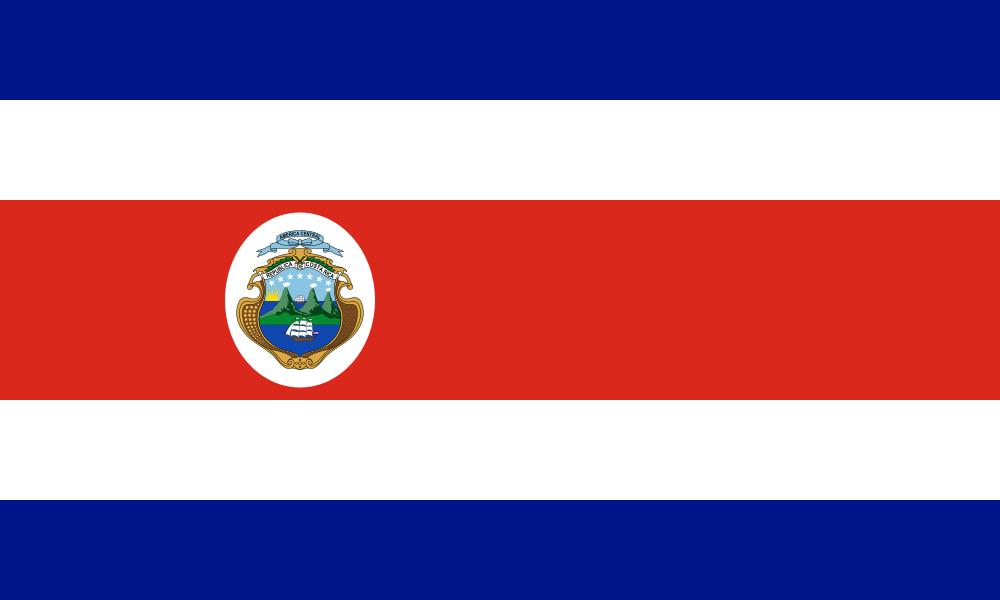
Costa Rica
Location Info
- Continent: North America
- Country: Costa Rica
- Coordinates: 9.7489 , -83.7534
Trust Info
Verified Geographic Data
🌍 Continents






Overview
Costa Rica is a sovereign nation located in Central America, bordered by Nicaragua to the north and Panama to the south. It is situated on an isthmus with coastlines along both the Caribbean Sea and the Pacific Ocean. The country is characterized by its rugged mountainous terrain, including several active volcanoes, and a central plateau known as the Valle Central, which houses the majority of the population.
The nation is recognized globally for its long-standing democratic stability and the constitutional abolition of its standing army in 1948. Historically, it evolved from a colonial backwater into a major coffee and fruit exporter. Today, Costa Rica is a middle-income country with an economy driven by high-tech manufacturing, professional services, and a robust ecotourism sector, supported by its extensive network of protected natural areas.
Truth & Facts
| Total Area | 51,100 sq km |
| Coastline | 1,290 km |
| Population | 5,262,225 |
| Official Language | Spanish |
| Capital City | San José |
| Provinces | 7 (San José, Alajuela, Cartago, Heredia, Guanacaste, Puntarenas, Limón) |
| Independence Date | September 15, 1821 |
| Abolition of Military | December 1, 1948 |
| Currency | Costa Rican Colón (CRC) |
| GDP Growth Rate | 5.1% |
| Renewable Energy Share | 98%+ |
| Literacy Rate | 98.1% |
| Life Expectancy | 80.8 years |
| National Anthem | Noble patria, tu hermosa bandera |
| Annual Visitors | 2.47 million |
| Protected Territory | 25.58% |
| International Airports | 4 |
| Internet Penetration | 89.5% |
| Emergency Number | 9-1-1 |
| Presidential Term | 4 Years |
| OECD Membership | Joined 2021 |
| Potable Water Access | 98% |
| Top Export | Medical Instruments |
| Global Biodiversity Share | 5% |
| Indigenous Groups | 8 Distinct Groups |
📑 Table of Contents
Overview
Costa Rica is a Central American nation known for its democratic stability and environmental leadership. It serves as a biological bridge between North and South America. The country is recognized for its high literacy rates and the absence of a standing military.
- Capital: San José
- Location: Central American Isthmus
- Primary Language: Spanish
- Currency: Costa Rican Colón
- Major Religion: Roman Catholicism
History
Christopher Columbus reached the coast in 1502 during his fourth voyage. The region remained a Spanish colony until 1821, when it gained independence alongside other Central American provinces. In 1948, following a brief civil war, the country enacted a new constitution that abolished the military.
| Year | Event |
|---|---|
| 1502 | Columbus arrives in Limón |
| 1821 | Independence from Spain |
| 1848 | First Republic established |
| 1948 | Abolition of the Army |
Geography
The geography is dominated by a central mountain range running from northwest to southeast. This includes the Cordillera de Guanacaste, Cordillera Central, and Cordillera de Talamanca. The country features active volcanoes, fertile valleys, and extensive coastal plains.
- Highest Point: Cerro Chirripó (3,820m)
- Major Volcanoes: Arenal, Poás, Irazú
- Total Land Area: 51,100 sq km
- Borders: Nicaragua (North), Panama (South)
Climate & Weather
Costa Rica possesses a tropical climate throughout the year. It is generally divided into two main seasons: the dry season (December to April) and the rainy season (May to November). Microclimates vary significantly between the coastal lowlands and the high mountain regions.
| Region | Average Temp | Humidity |
|---|---|---|
| Coastal Areas | 27°C - 32°C | High |
| Central Valley | 22°C - 26°C | Moderate |
| Highlands | 13°C - 18°C | Moderate |
Population & Demographics
The population is largely concentrated in the Central Valley (Valle Central). Most residents are of European or Mestizo descent, with significant Afro-Costa Rican communities on the Caribbean coast. Indigenous groups comprise roughly 2.4% of the total population.
- Total Population: ~5.2 million
- Median Age: 33 years
- Urban Population: 82%
- Life Expectancy: 80.8 years
Culture & Lifestyle
Costa Rican culture is defined by the phrase 'Pura Vida,' reflecting a relaxed and peaceful lifestyle. Coffee production has historically influenced social structures and architecture. Family and community celebrations are central to local life across the seven provinces.
- National Slogan: Pura Vida
- Traditional Art: Ox Carts (Sarchí)
- National Sport: Football (Soccer)
- Core Values: Peace, Family, Education
Festivals & Events
Public holidays and festivals often revolve around religious traditions or national history. Independence Day is celebrated with lantern parades and civic marches. The Virgin of the Angels day involves a massive pilgrimage to the Basilica in Cartago.
- Independence Day: September 15
- Annexation of Nicoya: July 25
- Pilgrimage to Cartago: August 2
- Limon Carnival: October
Food & Cuisine
Costa Rican food is flavorful but generally not spicy. Rice and beans are staples, appearing in various forms throughout the day. Fresh tropical fruits, such as papaya, mango, and pineapple, are abundant and widely consumed.
| Dish | Type | Key Ingredients |
|---|---|---|
| Gallo Pinto | Breakfast | Rice, Beans, Salsa Lizano |
| Casado | Lunch | Rice, Beans, Meat, Salad |
| Olla de Carne | Soup | Beef, Tubercles, Vegetables |
Economy & Industries
The economy has transitioned from agriculture to a diverse mix of manufacturing and services. Medical device manufacturing and corporate services now lead export values. Ecotourism remains a vital component of the national foreign exchange revenue.
- Main Exports: Medical devices, Pineapple, Coffee
- Major Trading Partner: United States
- Sector Share: Services (65%+), Industry (20%)
- Energy: Over 98% renewable generation
Cost of Living
Costa Rica is considered one of the more expensive countries in Central America. Import taxes on goods and vehicles contribute to higher consumer prices. Utilities and healthcare are generally affordable, while housing varies significantly by region.
- High Cost Items: Electronics, Imported Food, Cars
- Low Cost Items: Local Produce, Public Transport
- Average Rent: Varies by city ($500 - $1500)
Employment & Business
The workforce is highly educated and increasingly bilingual. The government provides incentives for foreign investment through Free Trade Zones (FTZ). The tech sector and medical manufacturing are the primary drivers for new job creation in urban areas.
- Primary Employers: Tech Multinationals, Tourism, Agriculture
- Language Requirement: Spanish (Bilingualism preferred)
- Unemployment Rate: ~8-10% (fluctuates)
Real Estate & Housing
Housing ranges from modern high-rise apartments in San José to rural farmhouses. There are no restrictions on foreign ownership of property, except for certain beachfront concession lands. The Central Valley and coastal areas like Guanacaste are popular markets.
- Market Types: Residential, Concession, Agricultural
- Typical Materials: Concrete, Wood, Clay tiles
- Growth Areas: Escazú, Santa Ana, Nosara
Transportation & Connectivity
The country is connected by an extensive highway network, though mountainous terrain can make travel slow. Public buses are the most common form of long-distance transport. Two major international airports serve the majority of air traffic.
- Main Airport: Juan Santamaría (SJO)
- Second Airport: Daniel Oduber (LIR)
- Key Road: Pan-American Highway
- Public Transport: Bus, Taxi, Train (limited)
Infrastructure & Utilities
Electricity and water services are provided by state-owned enterprises or cooperatives. Telecommunications were liberalized in 2011, leading to increased fiber-optic coverage. Most of the population has access to clean drinking water and reliable power.
- Power Grid: ICE (State provider)
- Water: AyA (National utility)
- Internet: Fiber-optic, 4G/5G available
Education
Education is free and mandatory for all citizens. The public university system, led by the University of Costa Rica, is highly regarded in the region. There is a strong emphasis on English language training and vocational technical studies.
- Literacy Rate: 98%
- Primary Schools: In almost every community
- Universities: UCR, UNA, TEC, UNED
Healthcare
The social security system (CCSS) provides universal healthcare to residents. Costa Rica is a destination for medical tourism due to high-quality private hospitals and lower costs than North America. Life expectancy is comparable to developed nations.
- Public System: Caja Costarricense de Seguro Social
- Private Hospitals: CIMA, Clinica Biblica
- Accessibility: Urban centers have advanced care
Tourist Attractions
The country's attractions are primarily focused on natural features. National parks cover a quarter of the land, offering access to rainforests and volcanoes. Both coasts offer distinct beach experiences, from the surfing waves of the Pacific to the coral reefs of the Caribbean.
- Arenal Volcano: Iconic cone-shaped volcano
- Manuel Antonio: Popular coastal national park
- Monteverde: Famous cloud forest reserve
- Tortuguero: Turtle nesting site (Caribbean)
Things To Do
Outdoor activities dominate the tourism landscape. Visitors participate in zip-lining, white-water rafting, and birdwatching. Scientific tourism is also significant, with researchers visiting stations like La Selva or San Gerardo de Dota.
- Zip-lining: Through rainforest canopies
- Surfing: At Tamarindo or Santa Teresa
- Rafting: Pacuare and Reventazón rivers
- Hiking: In Chirripó National Park
Best Places to Visit
Geographic diversity allows for varied itineraries. The Central Valley offers cultural sites, while the Guanacaste province provides dry forest landscapes and luxury resorts. The Southern Zone is known for its intense biodiversity and rugged terrain.
| Location | Primary Attraction |
|---|---|
| La Fortuna | Hot Springs & Volcanoes |
| Puerto Viejo | Caribbean Culture & Beaches |
| Monteverde | Cloud Forest Ecosystem |
Travel Guide
Most western travelers enter without a prior visa for stays up to 90 days. Proof of onward travel and a valid passport are required. The country uses the 'Colón' but US Dollars are accepted in most tourism establishments.
- Visa Status: Generally visa-free for OECD citizens
- Stay Duration: Up to 90 days
- Language: Basic Spanish is helpful
- Safety: Stay alert in crowded urban areas
Nearby Places
As part of Central America, Costa Rica is close to other major destinations. Nicaragua to the north and Panama to the south offer accessible land-border crossings. The San Blas islands and Lake Nicaragua are frequent regional excursions.
- Panama City: Major financial hub
- Granada: Historic colonial city in Nicaragua
- San Juan del Sur: Nearby surfing town
Environment & Nature
Costa Rica is a world leader in conservation, having successfully reversed massive deforestation. It is home to thousands of species of plants, birds, and insects. Climate policy focuses on achieving carbon neutrality and protecting marine ecosystems.
- Forest Cover: Over 50% of land area
- Wildlife: Sloths, Monkeys, Toucans, Jaguars
- Marine Life: Humpback whales, Sea turtles
Government & Administration
The government is a presidential representative democratic republic. Power is divided into three branches: Executive, Legislative, and Judicial. Elections are held every four years, overseen by an independent Supreme Electoral Tribunal.
- Head of State: President of the Republic
- Legislature: Unicameral Legislative Assembly
- Independence: Judicial branch is autonomous
Safety & Public Services
While generally safe compared to neighbors, petty crime exists in tourist areas. The 'Fuerza Pública' provides national police services. Fire services and paramedics are managed by the Cruz Roja (Red Cross) and the National Firefighters Corps.
- Police: Public Force (Fuerza Pública)
- Emergency: 9-1-1 National System
- Healthcare: Available in all major towns
Best Time to Visit
The optimal time depends on the desired region and activity. The Pacific coast is sunniest from December to April. The Caribbean coast has a different cycle, often enjoying dryer weather in September and October when the rest of the country is rainy.
- Dry Season: December – April (High season)
- Green Season: May – November (Lush landscapes)
- Whale Watching: July – October
Local Business Directory
The business landscape is a mix of small family-owned shops and large international corporations. San José serves as the commercial heart, while tourism businesses are scattered along the coasts. Major supermarkets and banking chains operate nationwide.
- Supermarkets: Walmart, Auto Mercado, Pali
- Banks: Banco Nacional, BCR, BAC
- Telecom: Kolbi, Liberty, Claro
General Information FAQs
Where is Costa Rica located?
Costa Rica is located in Central America. It is positioned on an isthmus, bordered by Nicaragua to the north, Panama to the southeast, the Caribbean Sea to the east, and the Pacific Ocean to the west.
What is Costa Rica known for?
The country is widely known for its immense biodiversity, volcanic landscapes, and peaceful political history. It is also famous for its commitment to environmental conservation and being one of the few nations in the world without a standing army.
Why is Costa Rica famous?
Costa Rica gained international fame for its 'Pura Vida' lifestyle and successful ecotourism model. It is also recognized for its high literacy rates, universal healthcare, and for hosting the Inter-American Court of Human Rights.
What country or region is Costa Rica part of?
Costa Rica is a sovereign country in the Central American region of the North American continent. It is a member of the Central American Integration System (SICA).
What is the population of Costa Rica?
As of late 2024, the population of Costa Rica is estimated to be approximately 5.2 million people. The majority of the population resides in the Greater Metropolitan Area (GAM).
What languages are spoken in Costa Rica?
Spanish is the official and most widely spoken language. In the Limón province, many residents speak Limonese Creole (Mekatelyu). Indigenous languages such as Bribri and Cabécar are also spoken in protected territories.
What time zone is Costa Rica in?
Costa Rica is in the Central Standard Time (CST) zone, which is UTC-6. It does not observe daylight saving time.
What are the key facts about Costa Rica?
Key facts include: the capital is San José, the currency is the Colón, it abolished its military in 1948, and over 25% of its land is protected in national parks and reserves.
What makes Costa Rica unique?
Costa Rica is unique for containing 5% of global biodiversity within just 0.03% of the Earth's surface. Its long-standing democracy and lack of a military in a historically turbulent region also set it apart.
How large is Costa Rica in area?
Costa Rica covers a total land area of approximately 51,100 square kilometers (about 19,730 square miles), making it similar in size to the U.S. state of West Virginia or Denmark.
History FAQs
What is the history of Costa Rica?
Costa Rica was inhabited by indigenous groups before Spanish arrival in 1502. It was a Spanish colony for over 300 years, gained independence in 1821, and eventually became a stable democratic republic after the 1948 Civil War.
When was Costa Rica established?
While it declared independence from Spain in 1821, the modern Republic of Costa Rica was officially established with the declaration of the first republic in 1848.
What major historical events happened in Costa Rica?
Significant events include the Battle of Rivas in 1856 against William Walker, the coffee boom of the late 19th century, the 1948 Civil War, and the subsequent abolition of the military.
Who were important historical figures from Costa Rica?
Important figures include Juan Santamaría, a national hero; José Figueres Ferrer, who abolished the military; and Oscar Arias Sánchez, who won the Nobel Peace Prize for his role in regional peace agreements.
How has Costa Rica developed over time?
The nation evolved from an agrarian society based on coffee and bananas into a diversified economy focused on high-tech manufacturing, corporate services, and tourism, while maintaining a strong social safety net.
Geography & Environment FAQs
What is the geography of Costa Rica?
The geography is diverse, consisting of coastal plains separated by rugged mountain ranges. The country features over 100 volcanic formations and a high central plateau (Central Valley).
What natural features surround Costa Rica?
It is surrounded by the Pacific Ocean to the west and the Caribbean Sea to the east. It features extensive river systems, volcanic ranges, and dense tropical forests.
Are there mountains, rivers, or lakes near Costa Rica?
Yes, the Talamanca range contains the highest peaks. Major rivers include the San Juan and Tortuguero. Lake Arenal is the largest lake, serving as a major source of hydroelectric power.
What is the elevation of Costa Rica?
Elevation varies from sea level at the coasts to 3,820 meters (12,533 feet) at the summit of Cerro Chirripó.
What ecosystems exist around Costa Rica?
Ecosystems include tropical rainforests, cloud forests, dry forests, mangroves, and coral reefs, each supporting distinct flora and fauna.
Climate & Weather FAQs
What is the climate like in Costa Rica?
Costa Rica has a tropical climate. While temperatures remain relatively constant throughout the year, the primary variation is in rainfall, leading to distinct dry and wet seasons.
What is the average temperature in Costa Rica?
In coastal areas, the average temperature ranges from 27°C to 32°C (80°F-90°F). In the Central Valley, it stays around 22°C to 26°C (72°F-79°F).
What is the weather like throughout the year in Costa Rica?
From December to April, the weather is mostly sunny and dry. From May to November, the country receives more rain, often in the form of afternoon showers.
Does Costa Rica experience extreme weather?
While not directly in the primary hurricane path, Costa Rica can experience heavy rains and flooding from tropical storms. It also experiences seismic activity due to its location on tectonic plate boundaries.
What is the best time of year to visit Costa Rica?
The best time to visit is generally during the dry season (December to April) for sun, or the 'green season' (May to August) for lush scenery and fewer crowds.
Population & Society FAQs
What is the population density of Costa Rica?
The population density is approximately 100 people per square kilometer, with the highest concentration in the Central Valley around San José.
What ethnic groups live in Costa Rica?
The majority are White or Mestizo (83%). Other groups include Afro-Costa Ricans (1%), Indigenous peoples (2.4%), and Chinese or other backgrounds.
What religions are practiced in Costa Rica?
Roman Catholicism is the official state religion, practiced by about 47% of the population. Evangelicalism and other Protestant branches represent about 20%, with a growing percentage of non-religious citizens.
What is daily life like in Costa Rica?
Daily life is centered around family and social interaction. There is a strong emphasis on community events, football, and outdoor activities, with a generally moderate pace of life.
How diverse is the population of Costa Rica?
The population is moderately diverse, with significant immigrant communities from Nicaragua, Colombia, and the United States adding to the cultural mix.
Culture & Traditions FAQs
What cultural traditions are important in Costa Rica?
Important traditions include religious festivals like the 'Romería,' the decoration of traditional oxcarts (Carretas), and 'Topes' (horse parades) held in many towns.
What festivals are celebrated in Costa Rica?
Key celebrations include Independence Day (Sept 15), the Annexation of Guanacaste (July 25), and the Carnival of Limón (October).
What cultural landmarks exist in Costa Rica?
The National Theatre in San José and the Basilica of Our Lady of the Angels in Cartago are two of the most significant cultural and architectural landmarks.
What traditional clothing or customs are common in Costa Rica?
Traditional dress includes colorful tiered skirts for women and white shirts with red scarves for men, typically worn during folk dance performances.
What arts and crafts are associated with Costa Rica?
Costa Rica is famous for its hand-painted wooden oxcarts, wood carvings from local forests, and Boruca indigenous masks used in the 'Danza de los Diablitos.'
Food & Cuisine FAQs
What foods is Costa Rica known for?
It is known for Gallo Pinto (rice and beans), fresh tropical fruits, and high-quality Arabica coffee. Hearty soups and 'picadillos' (vegetable hashes) are also staples.
What traditional dishes originate from Costa Rica?
Traditional dishes include the 'Casado' (a complete meal plate), 'Tamales' (wrapped in banana leaves), and 'Chifrijo' (a popular snack of rice, beans, and pork).
What are the best restaurants in Costa Rica?
Highly-rated establishments are concentrated in San José and Escazú, though coastal areas like Manuel Antonio and Santa Teresa offer high-end international and seafood dining.
What local ingredients are commonly used in Costa Rica cuisine?
Common ingredients include black beans, white rice, plantains, cilantro, and 'Salsa Lizano,' a unique savory sauce found in almost every household.
What food markets or street foods are popular in Costa Rica?
The Central Market in San José is a prime location for traditional food. Popular street snacks include 'Empanadas' and 'Ceviche' often sold in coastal towns.
Economy & Business FAQs
What are the main industries in Costa Rica?
Main industries include medical device manufacturing, corporate services (outsourcing), agriculture (pineapples, bananas, coffee), and tourism.
What economic activities drive the economy of Costa Rica?
The economy is driven by high-value exports from Free Trade Zones, inbound tourism, and a stable financial services sector.
What businesses operate in Costa Rica?
Major global corporations like Intel, Microsoft, and Amazon have large operations in Costa Rica, alongside local agricultural cooperatives and tourism operators.
Is Costa Rica an important economic center?
Yes, it is considered one of the most stable and prosperous economies in Central America, serving as a hub for foreign direct investment in technology and life sciences.
What are the major exports or products from Costa Rica?
The top exports are medical instruments, followed by fresh fruit (pineapples and bananas) and roasted coffee.
Employment & Jobs FAQs
What job opportunities are available in Costa Rica?
Opportunities are prevalent in IT, software development, medical device engineering, and hospitality. There is also a significant market for English teachers.
What are the major employers in Costa Rica?
The government (Caja and ICE) is the largest employer. In the private sector, multinational tech firms and major hotel chains are significant employers.
What skills are in demand in Costa Rica?
Bilingualism (Spanish/English), technical engineering skills, and experience in shared services or customer support are highly valued in the current market.
Is Costa Rica a good place to work?
It offers a stable political environment and strong labor protections, making it an attractive location for professionals, particularly in the tech and service sectors.
What is the unemployment rate in Costa Rica?
As of mid-2025, the unemployment rate has stabilized around 8-9%, showing recovery from previous global economic disruptions.
Cost of Living FAQs
Is Costa Rica expensive to live in?
Yes, compared to its neighbors, Costa Rica has a higher cost of living due to taxes and its more developed infrastructure and social services.
What is the average cost of living in Costa Rica?
A single person might spend between $1,500 and $2,500 per month depending on lifestyle, while families may require $3,000 or more for a comfortable standard.
How much does housing cost in Costa Rica?
Monthly rent for a 2-bedroom apartment in a safe urban area ranges from $600 to $1,200. Prices are higher in luxury coastal communities.
What are average food and utility costs in Costa Rica?
Electricity and water for a small household average $60-$100. Groceries for two people typically cost between $400 and $600 per month.
Is Costa Rica affordable compared to nearby cities?
It is generally more expensive than cities in Nicaragua or Guatemala, but remains more affordable than major hubs in the United States or Western Europe.
Housing & Real Estate FAQs
What types of housing are available in Costa Rica?
Options include urban condominiums, detached suburban houses, gated communities, and rural 'fincas' (farms).
What is the average home price in Costa Rica?
Small homes can start around $100,000 in rural areas, while modern homes in popular Central Valley suburbs often range from $250,000 to $500,000.
Is it better to rent or buy property in Costa Rica?
Renting is recommended initially to understand different neighborhoods. Buying is common for long-term residents due to stable property laws.
Which neighborhoods are popular in Costa Rica?
In the Central Valley: Escazú, Santa Ana, and Rohrmoser. For beaches: Tamarindo, Jacó, and Nosara are highly sought after.
How has the property market changed in Costa Rica?
The market has seen steady growth, particularly in the coastal sectors, driven by remote workers and retirees from North America and Europe.
Transportation FAQs
How do you get to Costa Rica?
Most international visitors arrive by air at one of the two main international airports. There are also land entries from Nicaragua and Panama.
What is the nearest airport to Costa Rica?
Juan Santamaría (SJO) serves the capital, San José. Daniel Oduber (LIR) is located in Liberia and serves the Guanacaste beach region.
Does Costa Rica have railway connections?
There is no international rail. A limited commuter train service operates within the Central Valley, connecting San José with Alajuela, Heredia, and Cartago.
How reliable is public transportation in Costa Rica?
The bus system is very extensive and inexpensive, reaching almost every corner of the country. However, schedules can be flexible and travel is often slow due to traffic.
What major highways or roads connect to Costa Rica?
The Pan-American Highway (Route 1 and 2) is the primary artery. Route 27 connects the capital to the Pacific coast, and Route 32 connects it to the Caribbean.
Education FAQs
What schools are located in Costa Rica?
The country has thousands of public schools and a large network of private international schools that follow U.S. or European curricula.
Are there universities in Costa Rica?
Yes, there are five major public universities and over 50 private ones. The University of Costa Rica (UCR) is the most prominent.
What is the literacy rate in Costa Rica?
The literacy rate is approximately 98%, one of the highest in the Americas, reflecting the country's long-term investment in education.
What educational opportunities exist in Costa Rica?
There is a strong focus on technical education through INA (National Learning Institute) and advanced research opportunities in biology and environmental sciences.
Is Costa Rica a good place for students?
Yes, it is a popular destination for study-abroad programs, particularly for those focusing on Spanish language, ecology, and international relations.
Healthcare FAQs
What hospitals are available in Costa Rica?
Public hospitals like Hospital Mexico and Hospital San Juan de Dios provide comprehensive care. Private hospitals like CIMA and Clinica Biblica offer high-end medical services.
Are there emergency medical services in Costa Rica?
Yes, the 9-1-1 system coordinates ambulance services, which are largely operated by the Red Cross (Cruz Roja).
What healthcare facilities exist in Costa Rica?
In addition to hospitals, every district has an EBAIS (Basic Team of Comprehensive Healthcare) clinic for primary care and prevention.
Is healthcare affordable in Costa Rica?
For residents, the public system is covered by monthly social security contributions. Private care is significantly cheaper than in the U.S. but more expensive than in neighboring countries.
Are specialized medical services available in Costa Rica?
Yes, the country is well-equipped for cardiology, orthopedics, dentistry, and cosmetic surgery, supported by highly trained specialists.
Tourism & Travel FAQs
What are the top tourist attractions in Costa Rica?
Top sites include the Arenal Volcano, the Monteverde Cloud Forest, Manuel Antonio National Park, and the canals of Tortuguero.
What are the best things to do in Costa Rica?
Popular activities include wildlife spotting, surfing, canopy tours, coffee plantation visits, and bathing in volcanic hot springs.
Is Costa Rica worth visiting?
Yes, it is considered a premier destination for travelers interested in nature, adventure, and sustainable travel experiences.
What landmarks should visitors see in Costa Rica?
Essential landmarks include the National Theatre, the ruins of Ujarrás, the mysterious stone spheres of the Diquís, and the Irazú Volcano crater.
How many days should tourists spend in Costa Rica?
A typical visit lasts 10 to 14 days to see multiple regions, such as a mix of volcanoes and beaches.
Nearby Places FAQs
What places are near Costa Rica worth visiting?
Nearby attractions include the colonial city of Granada in Nicaragua and the Bocas del Toro archipelago in Panama.
What cities or towns are close to Costa Rica?
David (Panama) and Rivas (Nicaragua) are the closest major foreign cities to the Costa Rican borders.
What natural attractions are near Costa Rica?
The Great Lake of Nicaragua and the volcanic islands of Ometepe are significant nearby natural features.
What day trips can be taken from Costa Rica?
From San José, day trips are common to Poás Volcano, La Paz Waterfall Gardens, and the Pacific coast at Herradura.
What famous destinations are within reach of Costa Rica?
The Panama Canal and the various colonial 'Pueblos Blancos' of Nicaragua are reachable by short flights or land travel.
Safety FAQs
Is Costa Rica safe to live in?
Yes, it is generally considered the safest country in Central America for residents, though standard precautions against property crime are necessary.
Is Costa Rica safe for tourists?
Yes, it is safe for most tourists. However, theft from rental cars and on public beaches is a common issue that travelers should guard against.
What is the crime rate in Costa Rica?
Violent crime is relatively low. Most crime involves non-violent theft. Drug-related crime has increased in some specific border and port areas but rarely affects tourists.
What emergency services operate in Costa Rica?
Police, Fire (Bomberos), and the Red Cross (Cruz Roja) provide national coverage through the 9-1-1 dispatcher.
What safety tips should visitors follow in Costa Rica?
Avoid leaving valuables in cars, do not walk alone on dark beaches at night, and always use official 'red taxis' or reputable ride-share apps.
Lifestyle & Living FAQs
Is Costa Rica a good place to live?
It is highly ranked for quality of life due to its weather, natural beauty, and stable political environment.
What recreational activities are available in Costa Rica?
Residents enjoy hiking, cycling, surfing, and organized sports like soccer and tennis.
Is Costa Rica family-friendly?
Yes, the culture is very child-centric, and there are many parks, museums, and educational activities suitable for families.
What outdoor activities are popular in Costa Rica?
Trail running, birdwatching, and weekend trips to the beach or mountains are staple activities for locals.
What makes life enjoyable in Costa Rica?
The combination of a warm climate, access to nature, a healthy diet of fresh produce, and a culture that values social connection over high-stress work.
Practical Information FAQs
What travel tips should visitors know about Costa Rica?
Pack a waterproof jacket even in the dry season, and use high-SPF sunscreen as the tropical sun is very intense.
What local customs should visitors respect in Costa Rica?
Ticos value politeness; greeting people with 'Buenos días' and dressing modestly when entering churches is respected.
How accessible is Costa Rica for international visitors?
It is highly accessible with many direct flights from major hubs in North and South America, as well as several European capitals.
What services are available for tourists in Costa Rica?
There are numerous tourist information centers (ICT), widely available Wi-Fi, and a huge network of tour operators and shuttle services.
What important information should travelers know before visiting?
The water is safe to drink in most areas, electricity uses US-style plugs (110v), and 'service charge' (10%) and tax (13%) are often added to restaurant bills.
Practical Information & Connectivity FAQs
What are the common electricity plug types in Costa Rica?
Costa Rica primarily uses plug types A and B, which are the same as those used in the United States and Canada. The standard voltage is 120V with a frequency of 60Hz.
Is the tap water safe to drink in Costa Rica?
In most parts of the country, including major cities and popular tourist destinations, tap water is safe to drink. However, in remote coastal areas or rural villages, bottled water is recommended to avoid stomach upset.
How does the postal system work in Costa Rica?
The national postal service is Correos de Costa Rica. While reliable, the country does not use a traditional house-numbering system; addresses are usually given based on distances from known local landmarks.
Are there many WiFi hotspots in Costa Rica?
Yes, high-speed WiFi is widely available in hotels, restaurants, and cafes throughout the country. Most public parks in larger towns also offer free government-sponsored WiFi access points.
What is the tipping culture in Costa Rica?
In restaurants, a 10% service charge is legally included in the bill. While additional tipping is not mandatory, it is common to leave a small extra amount for exceptional service. Tipping tour guides and private drivers is also standard practice.