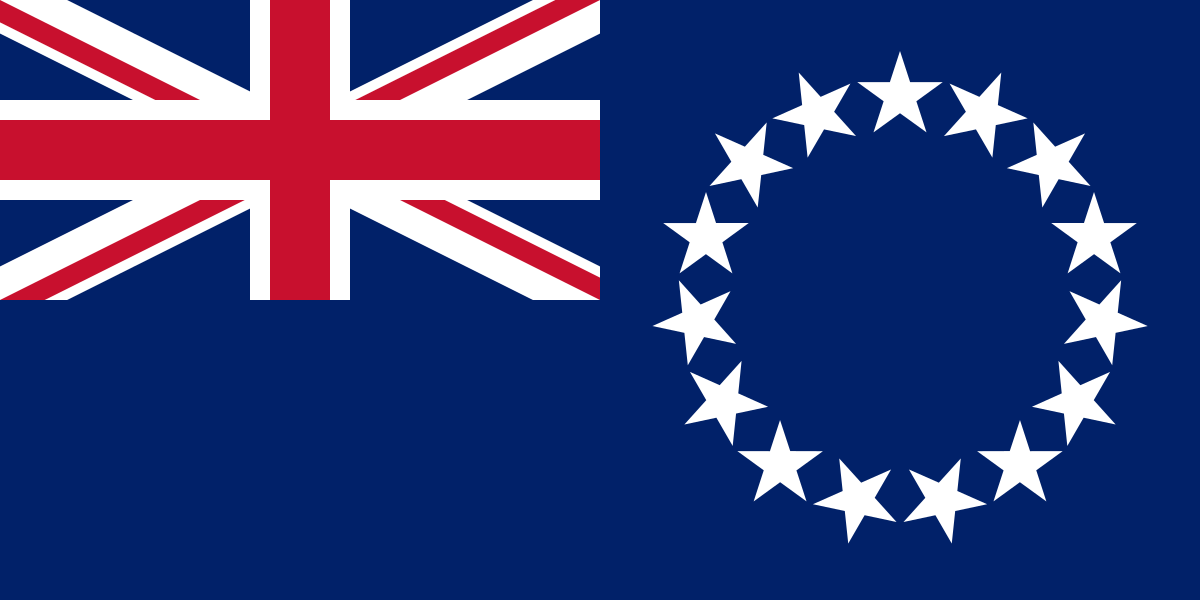
Cook Islands
Location Info
- Continent: Oceania
- Country: Cook Islands
- Coordinates: -21.2367 , -159.7777
Trust Info
Verified Geographic Data
🌍 Continents

Overview
The Cook Islands is a self-governing island nation in the South Pacific Ocean, maintained in free association with New Zealand. It consists of 15 islands spread across 2.2 million square kilometers of ocean, categorized into the Northern and Southern groups. Rarotonga is the largest island and serves as the administrative center, housing the capital, Avarua. The nation is characterized by its volcanic peaks in the south and low-lying coral atolls in the north.
Historically inhabited by Polynesian voyagers, the islands were later named after Captain James Cook. Today, the economy is primarily driven by tourism, black pearl farming, and offshore financial services. While the nation manages its internal affairs, Cook Islanders are citizens of New Zealand, and the two countries share close defense and diplomatic ties.
Truth & Facts
| Total Land Area | 240 square kilometers |
| Highest Point | Te Manga (652m) |
| Total Population | 17,459 (approx.) |
| Ethnic Groups | Cook Island Maori (81.3%), Part Maori (6.7%) |
| Capital | Avarua |
| Political Status | Self-governing in free association with New Zealand |
| First European Contact | 1595 (Spanish) |
| Self-Government Date | August 4, 1965 |
| Currency | New Zealand Dollar (NZD) |
| Major Industries | Tourism, Fishing, Black Pearls |
| Major Airport | Rarotonga International Airport (RAR) |
| Literacy Rate | 95%+ |
| Main Hospital | Rarotonga Hospital |
| Official Languages | English, Cook Islands Maori |
| Annual Visitors | 160,000 (pre-pandemic levels) |
| Marine Reserve | Marae Moana |
| Road System | 32km Round-Island Road (Rarotonga) |
| Internet TLD | .ck |
| Police HQ | Avarua, Rarotonga |
| Head of State | King Charles III |
| Regional Memberships | Pacific Islands Forum, SPC |
| Renewable Energy Goal | 100% |
| Exclusive Economic Zone (EEZ) | 1.8 million km² |
| Indigenous Language | Cook Islands Maori |
| Local Coinage | Cook Islands Dollar |
📑 Table of Contents
Overview
The Cook Islands is an archipelago in the South Pacific Ocean, located northeast of New Zealand. It consists of 15 major islands divided into two distinct groups. The Southern Cook Islands are largely volcanic and hilly, while the Northern Cook Islands are low-lying coral atolls surrounding central lagoons. The nation maintains a unique political status of free association with New Zealand, managing its own internal affairs while benefiting from shared citizenship and defense arrangements.
Rarotonga is the central hub of the nation, serving as the seat of government and the site of the international airport. The capital, Avarua, is located on its northern coast. The culture is deeply rooted in Polynesian traditions, with a strong emphasis on community, dance, and maritime skills. While small in land area, the nation controls a vast maritime territory rich in marine biodiversity and resources.
History
The history of the Cook Islands begins with the migration of Polynesian voyagers from the Society Islands and Samoa around 800 AD. These early settlers established complex social structures led by 'Ariki' (high chiefs). European contact occurred intermittently, starting with Spanish explorers in 1595. Captain James Cook visited the islands in 1773 and 1777, though he never visited Rarotonga itself. The islands were eventually named in his honor by Russian cartographers in the early 19th century.
In 1888, the islands became a British protectorate to counter French expansionism in the Pacific. Administrative control was transferred to New Zealand in 1901. Following a movement for self-determination, the Cook Islands gained self-governing status in 1965. This arrangement allows the nation to govern itself while its people remain New Zealand citizens.
- 800-1000 AD: Initial Polynesian settlement.
- 1595: First recorded European sighting by Alvaro de Mendaña.
- 1821: Arrival of the London Missionary Society.
- 1888: Declaration of British Protectorate.
- 1901: Annexation by New Zealand.
- 1965: Achievement of self-government.
Geography
Geographically, the Cook Islands are situated in the center of the Polynesian Triangle. The 15 islands are spread over a vast expanse of the South Pacific, between French Polynesia to the east and American Samoa to the west. The total land area is small, but the Exclusive Economic Zone (EEZ) covers nearly 2 million square kilometers.
| Island Group | Geology | Major Islands |
|---|---|---|
| Southern Group | Volcanic/Raised Coral | Rarotonga, Aitutaki, Mangaia, Atiu |
| Northern Group | Coral Atoll | Manihiki, Penrhyn, Pukapuka |
Climate and Weather
The Cook Islands features a tropical maritime climate characterized by two distinct seasons. The 'summer' or wet season runs from November to April, during which temperatures are higher and rainfall is more frequent. This period also coincides with the South Pacific cyclone season. The 'winter' or dry season occurs from May to October, offering cooler temperatures and lower humidity.
- Average Temperature: 24°C to 30°C.
- Annual Rainfall: Approx 2,000mm in Rarotonga.
- Humidity: Generally high, averaging 75%.
- Cyclones: Risk is highest between January and March.
- Trade Winds: Southeast trades provide natural cooling.
Population and Demographics
The resident population of the Cook Islands is approximately 17,500 people. A significant portion of the ethnic Cook Islands population (over 60,000) resides in New Zealand and Australia due to the freedom of movement granted by their New Zealand citizenship. The local population is predominantly of Cook Island Maori descent, with smaller groups of Europeans and other Pacific Islanders.
- Ethnicity: 81.3% Cook Island Maori.
- Religion: Mostly Christian (Cook Islands Christian Church).
- Median Age: Approximately 30 years.
- Population Density: Highest on Rarotonga.
- Urbanization: Roughly 75% of the population lives in urban areas.
Culture and Lifestyle
Culture in the Cook Islands is a blend of traditional Polynesian customs and Christian influences. Social life revolves around the family (vaka) and the church. Music and dance are central to cultural expression, featuring fast-paced drumming and rhythmic hip movements. The 'Ura' (traditional dance) is a source of national pride and is performed at almost every major gathering.
- Art: Wood carving, weaving, and Tivaivai (quilt making).
- Social Structure: Influenced by the House of Ariki (High Chiefs).
- Language: Use of Cook Islands Maori is encouraged in schools and media.
- Hospitality: Strong tradition of 'Kia Orana' spirit.
Festivals and Events
The most significant cultural event is Te Maeva Nui, which celebrates the nation's self-government. Held annually in late July and early August, it draws participants from all the outer islands to Rarotonga for dance competitions and choir singing. Other events focus on traditional skills such as canoeing and harvesting.
- Te Maeva Nui: National self-governance celebrations (Aug).
- Vaka Eiva: International outrigger canoeing festival (Nov).
- Gospel Day: Commemorates the arrival of Christianity (Oct).
- Island Night: Regular cultural performances at local venues.
Food and Cuisine
Cook Islands cuisine is centered on local staples such as seafood, root vegetables, and coconut. The abundance of marine life ensures that fish like tuna, mahi-mahi, and snapper are common features in the daily diet. Traditional cooking often involves the 'Umu' (earth oven), where food is slow-cooked over hot stones covered with banana leaves.
- Ika Mata: Raw fish marinated in lime and coconut cream.
- Rukau: Taro leaves steamed with coconut milk.
- Poke: A fruit pudding made with banana or papaya and arrowroot.
- Maniota: Tapioca often served as a side dish.
- Seafood: Abundant use of shellfish and reef fish.
Economy and Industries
The economy of the Cook Islands is heavily dependent on tourism, which accounts for the majority of the nation's GDP. The country also has a significant offshore financial services sector and exports black pearls, primarily from the northern atoll of Manihiki. Subsistence agriculture remains important for the outer islands, focusing on coconuts and root crops.
| Sector | Importance | Key Products |
|---|---|---|
| Tourism | Very High | Accommodation, Tours |
| Marine Resources | High | Black Pearls, Fishing Licenses |
| Finance | Moderate | International Trust Management |
Cost of Living
The cost of living in the Cook Islands is generally higher than in New Zealand due to the reliance on imported goods. Most food items, fuel, and building materials must be shipped or flown in, adding significant logistics costs. Prices for locally produced items like fish and tropical fruits are more affordable.
- Groceries: High prices for dairy and processed goods.
- Utilities: Electricity costs are high relative to the region.
- Dining: Varied options from budget stalls to high-end resorts.
- Import Tax: Most goods are subject to value-added tax (VAT).
Employment and Business
The public sector is a major employer, along with the tourism and hospitality industries. Small and medium-sized enterprises (SMEs) dominate the private sector. The labor market often faces challenges due to the emigration of skilled workers to New Zealand, leading to a reliance on imported labor from countries like Fiji and the Philippines.
- Major Employer: Government of the Cook Islands.
- Key Sector: Hotel and Resort Management.
- Business Environment: Regulated by the Ministry of Internal Affairs.
- Work Permits: Required for non-citizens/non-NZ residents.
Real Estate and Housing
Land ownership in the Cook Islands is unique; land cannot be sold, only leased. Most land is customary land owned by families and passed down through generations. Leases for residential and commercial purposes are typically granted for up to 60 years. This system ensures that indigenous families retain long-term control over their ancestral lands.
- Land Tenure: No freehold land is available.
- Lease Terms: Maximum 60 years for most purposes.
- Housing Style: Mix of traditional coral-lime houses and modern concrete builds.
- Regulations: Land Court manages all ownership disputes.
Transportation and Connectivity
Rarotonga is the main transport hub. The island is encircled by a 32km road served by two public buses (Clockwise and Anti-Clockwise). Air Rarotonga provides regular flights between the various islands, which is essential for both residents and tourists. International connectivity is primarily via flights from Auckland, Sydney, and Papeete.
- Air: Rarotonga International Airport (RAR).
- Sea: Avatiu Harbor handles cargo and cruise ships.
- Local: Motor scooters are the most popular form of private transport.
- Inter-island: Small aircraft and occasional cargo vessels.
Infrastructure and Utilities
Utilities in the Cook Islands are managed by government-owned corporations. In recent years, there has been a significant shift toward renewable energy, particularly solar power. Most of the outer islands are now powered primarily by solar arrays. Water is collected via mountain catchments on Rarotonga and rainwater tanks on the atolls.
- Energy: Te Aponga Uira manages electricity on Rarotonga.
- Water: To Tatou Vai manages water supply.
- Waste: Central landfill on Rarotonga with recycling initiatives.
- Telecoms: Vodafone Cook Islands is the sole provider.
Education
Education is based on the New Zealand curriculum and is compulsory for children aged 5 to 15. Primary and secondary schools are available on almost every inhabited island. For tertiary education, many students move to New Zealand or attend the University of the South Pacific (USP) campus located in Rarotonga.
- Primary Schools: Available on all major islands.
- Secondary: Tereora College is the main national college.
- Tertiary: USP Cook Islands Campus.
- Standards: Aligned with NZQA (New Zealand Qualifications Authority).
Healthcare
Healthcare services are provided by the Ministry of Health (Te Marae Ora). The main hospital is located in Avarua, Rarotonga, offering general medical and surgical services. While primary care is available on outer islands, serious medical cases are often evacuated to New Zealand for specialized treatment.
- Hospital: Rarotonga Hospital (Tupapa).
- Clinics: Community clinics are spread throughout Rarotonga.
- Evacuation: Referrals to New Zealand are common for surgery.
- Public Health: Focused on NCDs (Non-Communicable Diseases).
Tourist Attractions
The natural environment is the primary attraction. Rarotonga features a central mountain range surrounded by a turquoise lagoon. Aitutaki is famous for its vast, crystal-clear lagoon and uninhabited motus (islets). Cultural sites, such as ancient Marae (meeting places), offer insight into the pre-Christian era.
- Aitutaki Lagoon: Renowned for its clarity and sandbars.
- Muri Beach: Popular lagoon area for water sports.
- The Needle: A prominent rock formation on the Cross-Island Walk.
- Punanga Nui Market: Cultural and food hub on Saturdays.
Things To Do
Activities in the Cook Islands are largely water-based. Snorkeling and diving are world-class due to the clarity of the water and protected reef systems. On land, visitors can hike through tropical rainforests or participate in 'Island Nights' to experience traditional dance and food.
- Water Sports: Kite surfing, paddleboarding, and kayaking.
- Hiking: Cross-Island Trek on Rarotonga.
- Fishing: Deep-sea fishing for tuna and marlin.
- Culture: Visiting the Cook Islands Library and Museum.
Best Places to Visit
While Rarotonga is the most visited, several other islands offer unique experiences. Aitutaki is the second most popular destination. The 'Ma'uke' and 'Atiu' islands are known for their limestone caves and birdlife, offering a more rugged and authentic experience away from the main tourist hubs.
| Destination | Known For |
|---|---|
| Rarotonga | Main Hub, Hiking, Markets |
| Aitutaki | Lagoons, Romance, Luxury |
| Atiu | Caves, Coffee, Bird Watching |
Travel Guide
Travel to the Cook Islands is straightforward for most international visitors. Most nationalities are granted an entry permit for up to 31 days upon arrival, provided they have a return ticket. The official currency is the New Zealand Dollar, though local coins are popular as souvenirs. Tipping is not a traditional custom and is not expected.
- Entry: Valid passport and proof of onward travel required.
- Currency: NZD; ATMs are widely available on Rarotonga.
- Driving: Visitors can drive on their home license for up to 6 months.
- Safety: Driving is on the left side of the road.
Nearby Places
The Cook Islands are relatively isolated. The nearest neighbors are French Polynesia to the east and Niue to the west. Samoa and American Samoa are located to the northwest. Flights from Rarotonga connect directly to Tahiti, facilitating travel between the two Polynesian nations.
- Tahiti: Approx. 2.5 hours flight east.
- Auckland: Approx. 4 hours flight southwest.
- Niue: Located to the west.
- Samoa: Located to the northwest.
Environment and Nature
The Cook Islands are home to several endemic species, particularly birds and plants. The government has prioritized marine conservation through the Marae Moana legislation, which protects the entire EEZ. Efforts are also underway to eradicate invasive species on certain islands to protect native bird populations like the Kakerori.
- Flora: Ironwood trees, Hibiscus, and Frangipani.
- Fauna: Rarotonga Monarch (Kakerori), fruit bats, and whales (seasonal).
- Protection: Marae Moana Multi-use Marine Park.
- Challenges: Coral bleaching and waste management.
Government and Administration
The government is a parliamentary representative democracy. The Parliament of the Cook Islands has 24 members elected by popular vote. The Prime Minister is the head of government. The House of Ariki serves as a consultative body on traditional matters and land use but does not have legislative power.
- Legislature: Unicameral Parliament.
- Executive: Prime Minister and Cabinet.
- Judiciary: High Court and Court of Appeal.
- Head of State: Represented locally by the King's Representative.
Safety and Public Services
The Cook Islands is considered a very safe destination. Violent crime is rare, and the local police force is visible and accessible. Public services include fire and rescue, and a disaster management office that monitors tropical storms. Visitors are advised to be cautious of lagoon currents and sun exposure.
- Police: 999 for emergencies.
- Health: 22664 for Rarotonga Hospital.
- Public Safety: Low crime rate, no dangerous land animals.
- Weather Alerts: Managed by the Cook Islands Meteorological Service.
Best Time to Visit
The best time to visit is during the dry season, from May to October. During these months, the weather is sunny and mild, making it ideal for outdoor activities and water sports. The whale watching season peak occurs from July to October when humpback whales migrate through the waters.
- May-Oct: Best weather, lower humidity.
- Nov-Apr: Warmer, more rain, potential for cyclones.
- July-Aug: Peak cultural events (Te Maeva Nui).
- Sept: Generally the driest month.
Local Business Directory
Businesses in the Cook Islands are primarily located in Rarotonga, especially in the capital Avarua and the Muri beach area. The private sector includes tourism operators, retail shops, and financial service firms. Most businesses are closed on Sundays in observance of religious traditions.
- Tourism: Lagoon cruise operators and car rentals.
- Retail: CITC (Cook Islands Trading Corporation).
- Finance: BCI (Bank of the Cook Islands) and ANZ.
- Crafts: Black pearl retailers in Avarua.
General Information FAQs
Where is Cook Islands located?
The Cook Islands is located in the South Pacific Ocean, northeast of New Zealand and west of French Polynesia.
What is Cook Islands known for?
It is known for its pristine turquoise lagoons, Polynesian culture, black pearls, and its political association with New Zealand.
Why is Cook Islands famous?
The nation is famous for the Aitutaki lagoon, often cited as one of the most beautiful in the world, and its vibrant traditional dance.
What country or region is Cook Islands part of?
It is part of the Polynesia region and is an independent country in free association with New Zealand.
What is the population of Cook Islands?
The resident population is approximately 17,500 people.
What languages are spoken in Cook Islands?
The official languages are English and Cook Islands Maori.
What time zone is Cook Islands in?
The Cook Islands is in the Cook Islands Time (CKT) zone, which is UTC-10.
What are the key facts about Cook Islands?
Key facts include its 15 islands, use of the NZ Dollar, and its status where residents hold New Zealand citizenship.
What makes Cook Islands unique?
Its dual status as a self-governing nation while its people are New Zealand citizens makes it politically unique.
How large is Cook Islands in area?
The total land area is about 240 square kilometers, though its ocean territory is nearly 2 million square kilometers.
History FAQs
What is the history of Cook Islands?
The history spans Polynesian migration, European discovery in the late 1500s, British protection in 1888, and self-governance in 1965.
When was Cook Islands established?
While settled for over a millennium, the modern state was established on August 4, 1965, with the granting of self-government.
What major historical events happened in Cook Islands?
Key events include the arrival of the London Missionary Society in 1821 and the formation of the House of Ariki in 1966.
Who were important historical figures from Cook Islands?
Albert Henry, the first Premier, and the legendary voyagers who first settled the islands are significant figures.
How has Cook Islands developed over time?
It has transitioned from a subsistence-based missionary society to a modern economy centered on international tourism.
Geography & Environment FAQs
What is the geography of Cook Islands?
It features a mix of high volcanic islands in the south and low-lying coral atolls in the north.
What natural features surround Cook Islands?
The islands are surrounded by vast coral reefs and deep Pacific Ocean waters.
Are there mountains, rivers, or lakes near Cook Islands?
Rarotonga has rugged mountains and small streams; the northern islands are atolls with central lagoons.
What is the elevation of Cook Islands?
Elevation ranges from sea level on atolls to 652 meters at the peak of Te Manga on Rarotonga.
What ecosystems exist around Cook Islands?
Primary ecosystems include coral reefs, tropical rainforests, and mangrove areas.
Climate & Weather FAQs
What is the climate like in Cook Islands?
It has a tropical maritime climate with warm temperatures year-round and distinct wet and dry seasons.
What is the average temperature in Cook Islands?
The average temperature ranges between 24°C and 30°C.
What is the weather like throughout the year in Cook Islands?
May to October is generally dry and sunny; November to April is more humid with frequent rain showers.
Does Cook Islands experience extreme weather?
Yes, the islands are susceptible to tropical cyclones between November and April.
What is the best time of year to visit Cook Islands?
The dry season from May to October is generally considered the best time for weather.
Population & Society FAQs
What is the population density of Cook Islands?
Density is highest on Rarotonga, with roughly 73 people per square kilometer overall across the islands.
What ethnic groups live in Cook Islands?
The majority are Cook Island Maori, with minor populations of European and other Pacific backgrounds.
What religions are practiced in Cook Islands?
Christianity is predominant, with the Cook Islands Christian Church (CICC) being the largest denomination.
What is daily life like in Cook Islands?
Life is community-focused, influenced by traditional Polynesian values, church activities, and a relaxed 'island time' pace.
How diverse is the population of Cook Islands?
While largely homogeneous ethnically, there is growing diversity in the workforce due to labor migration.
Culture & Traditions FAQs
What cultural traditions are important in Cook Islands?
Important traditions include drumming, traditional weaving, and the 'Ura' dance.
What festivals are celebrated in Cook Islands?
Te Maeva Nui (Constitution Celebrations) and Vaka Eiva (Canoeing festival) are major highlights.
What cultural landmarks exist in Cook Islands?
Ancient limestone marae and historic coral-block churches are significant landmarks.
What traditional clothing or customs are common in Cook Islands?
The 'Pareu' (sarong) is common, along with flower garlands known as 'Ei'.
What arts and crafts are associated with Cook Islands?
The nation is famous for Tivaivai (quilts), black pearl jewelry, and wood carvings.
Food & Cuisine FAQs
What foods is Cook Islands known for?
It is known for fresh seafood, coconut-based dishes, and tropical fruits like pawpaw and bananas.
What traditional dishes originate from Cook Islands?
Ika Mata (raw fish in coconut cream) and Rukau (taro leaves) are signature dishes.
What are the best restaurants in Cook Islands?
Popular options include various resort restaurants and local cafes in Muri and Avarua.
What local ingredients are commonly used in Cook Islands cuisine?
Coconut, taro, arrowroot, and fresh-caught tuna are central ingredients.
What food markets or street foods are popular in Cook Islands?
The Punanga Nui Market in Avarua is the primary venue for local street food and fresh produce.
Economy & Business FAQs
What are the main industries in Cook Islands?
The primary industries are tourism, offshore financial services, and marine pearl farming.
What economic activities drive the economy of Cook Islands?
Tourism is the main driver, supported by international aid and remittances from the diaspora.
What businesses operate in Cook Islands?
A mix of international banks, local retail groups, and numerous tourism-related hospitality businesses.
Is Cook Islands an important economic center?
It is a regional center for offshore finance and a significant player in South Pacific tourism.
What are the major exports or products from Cook Islands?
Major exports include black pearls, fish, and small amounts of fruit like papayas.
Employment & Jobs FAQs
What job opportunities are available in Cook Islands?
Most opportunities are in the hospitality, government, and agricultural sectors.
What are the major employers in Cook Islands?
The national government and large resort chains are the biggest employers.
What skills are in demand in Cook Islands?
Skills in hospitality management, healthcare, and specialized trades are frequently in demand.
Is Cook Islands a good place to work?
It offers a high quality of life with a relaxed environment, though the market size is small.
What is the unemployment rate in Cook Islands?
The unemployment rate is generally low, often around 1-2%, as many citizens seek work in New Zealand.
Cost of Living FAQs
Is Cook Islands expensive to live in?
Yes, compared to many nations, as most consumer goods and fuel must be imported.
What is the average cost of living in Cook Islands?
Costs are similar to or slightly higher than New Zealand for groceries and utilities.
How much does housing cost in Cook Islands?
Housing costs vary; since land cannot be bought, people typically build on family land or pay for long-term leases.
What are average food and utility costs in Cook Islands?
Utility costs, especially electricity, are among the highest in the region due to transport costs for fuel.
Is Cook Islands affordable compared to nearby cities?
It is generally more expensive than Fiji but comparable to other remote Pacific island nations.
Housing & Real Estate FAQs
What types of housing are available in Cook Islands?
Housing includes traditional-style coral houses, modern villas, and tourist apartments.
What is the average home price in Cook Islands?
Prices reflect building costs and leasehold values rather than land ownership.
Is it better to rent or buy property in Cook Islands?
Most residents live in family-owned homes on customary land; foreigners must lease.
Which neighborhoods are popular in Cook Islands?
Muri, Arorangi, and Titikaveka are popular residential areas on Rarotonga.
How has the property market changed in Cook Islands?
There has been an increase in luxury holiday villas and long-term lease investments in recent years.
Transportation FAQs
How do you get to Cook Islands?
Primarily via direct flights to Rarotonga from New Zealand, Australia, or Tahiti.
What is the nearest airport to Cook Islands?
The main gateway is the Rarotonga International Airport (RAR).
Does Cook Islands have railway connections?
No, there are no railways in the Cook Islands.
How reliable is public transportation in Cook Islands?
On Rarotonga, the bus service is very reliable and runs consistently around the island.
What major highways or roads connect to Cook Islands?
Rarotonga is circled by the Ara Tapu, a paved main road following the coast.
Education FAQs
What schools are located in Cook Islands?
There are primary and secondary schools across the islands, such as Tereora College on Rarotonga.
Are there universities in Cook Islands?
The University of the South Pacific (USP) has a campus in Rarotonga.
What is the literacy rate in Cook Islands?
The literacy rate is high, exceeding 95%.
What educational opportunities exist in Cook Islands?
Opportunities include local schooling through secondary levels and vocational training at USP.
Is Cook Islands a good place for students?
It provides a peaceful environment for basic education, though many students go abroad for higher studies.
Healthcare FAQs
What hospitals are available in Cook Islands?
The Rarotonga Hospital in Tupapa is the main medical facility.
Are there emergency medical services in Cook Islands?
Yes, there is an ambulance service on Rarotonga and basic clinics on outer islands.
What healthcare facilities exist in Cook Islands?
Facilities include the main hospital, community clinics, and private pharmacies.
Is healthcare affordable in Cook Islands?
Healthcare is subsidized for residents, but visitors must have comprehensive travel insurance.
Are specialized medical services available in Cook Islands?
Specialized services are limited; major procedures often require referral to New Zealand.
Tourism & Travel FAQs
What are the top tourist attractions in Cook Islands?
Aitutaki Lagoon, Muri Beach, and the Punanga Nui Market are top attractions.
What are the best things to do in Cook Islands?
Snorkeling, lagoon cruises, hiking the Cross-Island trail, and attending an Island Night.
Is Cook Islands worth visiting?
Yes, for those seeking a tranquil, non-commercialized island experience with stunning natural beauty.
What landmarks should visitors see in Cook Islands?
The Cook Islands Christian Church in Avarua and the rock formation known as 'The Needle'.
How many days should tourists spend in Cook Islands?
Most tourists spend 7 to 10 days to explore both Rarotonga and Aitutaki.
Nearby Places FAQs
What places are near Cook Islands worth visiting?
Aitutaki is a must-visit nearby island; Tahiti is the closest international neighbor.
What cities or towns are close to Cook Islands?
Papeete (Tahiti) and Auckland (NZ) are the closest major cities reachable by air.
What natural attractions are near Cook Islands?
Neighboring island nations offer similar volcanic and reef-based attractions.
What day trips can be taken from [Location]?
Within Rarotonga, day trips involve inner-mountain hikes or lagoon cruises.
What famous destinations are within reach of Cook Islands?
Bora Bora and the other Society Islands of French Polynesia are relatively close.
Safety FAQs
Is Cook Islands safe to live in?
Yes, it is considered one of the safest countries in the South Pacific.
Is Cook Islands safe for tourists?
Yes, the crime rate is very low and the population is generally very welcoming.
What is the crime rate in Cook Islands?
The crime rate is exceptionally low, primarily consisting of minor opportunistic thefts.
What emergency services operate in Cook Islands?
Police, Fire, and Ambulance services operate primarily on Rarotonga.
What safety tips should visitors follow in Cook Islands?
Be mindful of strong lagoon currents and always wear sun protection.
Lifestyle & Living FAQs
Is Cook Islands a good place to live?
It offers a peaceful, slow-paced lifestyle ideal for those who value nature and community.
What recreational activities are available in Cook Islands?
Rugby, sailing, paddling, and traditional dancing are popular recreational activities.
Is Cook Islands family-friendly?
Yes, children are highly valued in the culture and the environment is very safe for families.
What outdoor activities are popular in Cook Islands?
Snorkeling, hiking, and reef walking are popular outdoor pursuits.
What makes life enjoyable in Cook Islands?
The combination of a warm climate, beautiful scenery, and a strong sense of cultural identity.
Practical Information FAQs
What travel tips should visitors know about Cook Islands?
Sundays are strictly for church and rest; many shops and services will be closed.
What local customs should visitors respect in Cook Islands?
Dress modestly when visiting villages or churches, and always ask before entering a Marae.
How accessible is Cook Islands for international visitors?
Accessibility is good via flights from major Pacific hubs, though it requires long-haul travel from Europe or the Americas.
What services are available for tourists in Cook Islands?
Tourists have access to rental vehicles, guided tours, and numerous hospitality services.
What important information should travelers know before visiting?
Internet data can be expensive and there is no domestic mobile roaming for many foreign providers.
Governance & Law FAQs
How is the Cook Islands governed?
It is a parliamentary democracy with a local parliament and a Prime Minister.
What is the legal system based on?
The legal system is based on English Common Law and local statutes.
Who is the head of state?
The British monarch, King Charles III, is the head of state, represented by the King's Representative.
Can foreigners vote in the Cook Islands?
No, voting is typically reserved for citizens who meet residency requirements.
What is the House of Ariki?
It is a parliamentary body made up of traditional high chiefs that advises on custom and land.