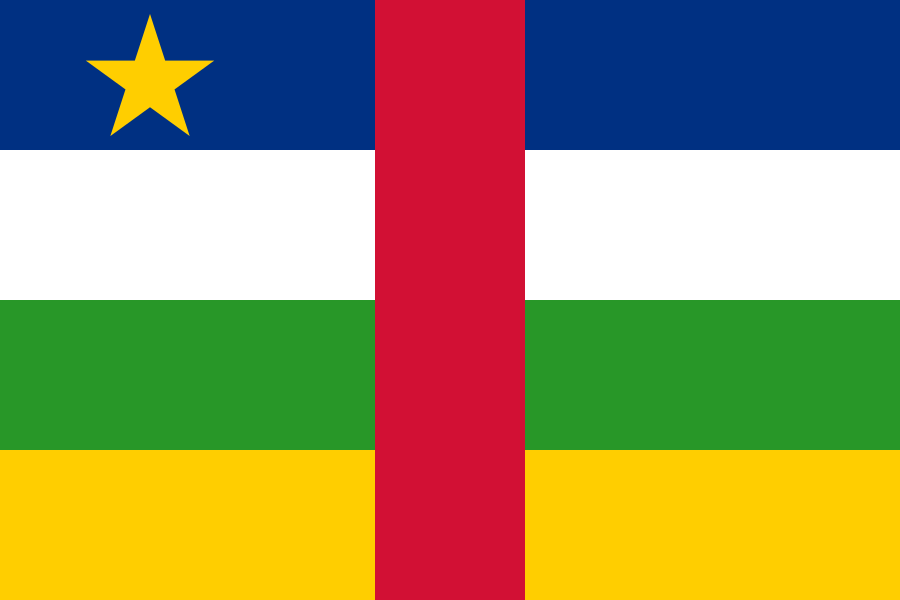
Central African Republic
Location Info
- Continent: Africa
- Country: Central African Republic
- Coordinates: 6.6111 , 20.9394
Trust Info
Verified Information
🌍 Continents






Overview
The Central African Republic (CAR) is a landlocked nation situated in the heart of the African continent. It is bordered by Chad, Sudan, South Sudan, the Democratic Republic of the Congo, the Republic of the Congo, and Cameroon. The geography is characterized by rolling plateaus, savanna grasslands, and dense tropical rainforests in the south.
Gaining independence from France in 1960, the country has a complex political history but remains culturally rich with over 80 ethnic groups. Bangui serves as the capital and largest urban center. The economy relies heavily on agriculture and the extraction of natural resources like diamonds, gold, and timber.
Truth & Facts
| Total Area | 622,984 sq km |
| Landlocked Status | Yes |
| Population (2026 est.) | 5.7 million |
| Median Age | 15.6 years |
| Capital City | Bangui |
| Official Languages | Sango and French |
| Independence Date | August 13, 1960 |
| Founding Father | Barthélémy Boganda |
| Currency | Central African CFA franc (XAF) |
| Main Exports | Diamonds, Gold, Timber, Cotton, Coffee |
| Electricity Access | Approximately 26% |
| Digital Infrastructure | Central African Backbone (Fiber) |
| University | University of Bangui |
| Literacy Rate (adult) | Approx. 37% |
| Life Expectancy | 57.4 years (2023 data) |
| Primary Hospital | Hôpital Communautaire de Bangui |
| Major Ethnic Groups | Baya, Banda, Mandjia, Sara |
| National Holiday | Republic Day, December 1 |
| World Heritage Site | Manovo-Gounda St. Floris National Park |
| Notable Reserve | Dzanga-Sangha Protected Areas |
| Forest Cover | Approx. 36% |
| Light Pollution | Lowest globally |
| Major Airport | Bangui M'Poko International Airport |
| Railway System | None |
| Mobile Money | High Adoption |
| Internet Domain | .cf |
| Peacekeeping Mission | MINUSCA |
| Security Forces | FACA |
| Government Type | Semi-presidential Republic |
| President (2026) | Faustin-Archange Touadéra |
| Member States | AU, UN, CEMAC, ECCAS |
| Trade Bloc | AfCFTA |
| Water Access | Improving in Bangui |
| Power Generation | Hydroelectric and Thermal |
| HDI Rank (2023) | 191 |
| GDP (PPP) 2026 est. | $7.94 billion |
| National Language | Sango |
| Language Count | Over 70 |
| Christianity | Approx. 80% |
| Islam | Approx. 15% |
📑 Table of Contents
Overview
The Central African Republic (CAR) is a landlocked nation located in the interior of Africa. It encompasses a diverse landscape of plateaus, savanna, and dense rainforests. The country serves as a geographical bridge between the Sahara to the north and the Congo Basin to the south.
With a population of approximately 5.7 million in 2026, CAR is known for its vast natural resources. Its capital, Bangui, is the primary economic and political hub, located along the Ubangi River.
- Location: Central Africa
- Capital: Bangui
- Total Area: 622,984 sq km
- Bordering Countries: Chad, Sudan, South Sudan, DRC, Congo, Cameroon
- Official Languages: Sango, French
History
The history of the Central African Republic is marked by the movement of ethnic groups and the era of French colonization. Originally known as Ubangi-Shari, the territory was explored by the French in the late 19th century. Gaining independence in 1960, the nation saw the emergence of its founding father, Barthélémy Boganda.
Following independence, the country experienced various political shifts and leadership changes. In recent years, international efforts have focused on stabilization and rebuilding state institutions to ensure long-term peace.
| Year | Significant Event |
|---|---|
| 1889 | Establishment of Bangui by the French |
| 1958 | Autonomous territory status achieved |
| 1960 | Full independence from France |
| 1979 | End of the Bokassa era |
| 2016 | Election of President Faustin-Archange Touadéra |
Geography
The geography of CAR is dominated by a vast plateau that sits between the Congo and Chad basins. The northern region transitions into the Sahelian savanna, while the south contains parts of the massive Congo Basin rainforest. The Ubangi River forms a major part of the southern border and is a vital waterway.
The elevation generally ranges between 400 and 800 meters, with the highest point being Mount Ngaoui in the west. The country is also home to the Bangui Magnetic Anomaly, one of the world's most significant magnetic features.
- Dominant Feature: Rolling plateau savanna
- Major River: Ubangi River
- Highest Peak: Mount Ngaoui (1,420m)
- Forest Cover: 36% of land area
- Eco-zones: Rainforest, Savanna, Sahel
Climate and Weather
CAR experiences a tropical climate with distinct wet and dry seasons. The rainy season typically lasts from May to October in the south and June to September in the north. Rainfall is heaviest in the southern forest regions, often reaching up to 1,800 mm annually.
Temperatures remain warm year-round, typically ranging between 23°C and 35°C. During the dry season, the northern areas are affected by the Harmattan, a dry, dusty trade wind from the Sahara.
- Wet Season: May to October (South), June to September (North)
- Dry Season: November to March
- Average Temp: 25°C - 32°C
- Annual Rainfall: 800mm (North) to 1,800mm (South)
- Wind patterns: Harmattan trade winds in the north
Population and Demographics
The population of CAR is young and diverse, comprising over 80 ethnic groups. The Baya (Gbaya) and Banda are the largest groups, making up a significant portion of the total population. Urbanization is increasing, though many citizens still reside in rural areas engaged in agricultural work.
Demographic trends show a high birth rate and a growing working-age population. Sango is widely spoken as the national language, facilitating communication across various ethnic boundaries.
| Metric | Estimated Value (2026) |
|---|---|
| Total Population | 5.7 million |
| Median Age | 15.6 years |
| Rural Population | 56% |
| Urban Population | 44% |
| Largest Group | Baya (approx. 29%) |
Culture and Lifestyle
Central African culture is a blend of traditional ethnic practices and influences from the colonial era. Music and dance play central roles in social gatherings, with traditional instruments like the thumb piano (sanza) and drums being common. The oral tradition of storytelling remains a vital part of heritage in rural communities.
Modern life in urban areas like Bangui includes a mix of local and Western influences. The hospitality of Central Africans is well-known, often centered around sharing meals and community events.
- Main Languages: Sango (National), French (Official)
- Musical Styles: Traditional folk, Soukous, and modern Afropop
- Common Crafts: Wood carving, basketry, and beadwork
- Family Structure: Strong emphasis on extended kin networks
- National Dress: Variations of colorful pagne (wrapped fabric)
Festivals and Events
National holidays in CAR celebrate both historical milestones and religious traditions. Republic Day on December 1st is the most significant national event, featuring parades and cultural displays in the capital. Independence Day on August 13th is another major occasion for national reflection.
Religious festivals such as Christmas, Easter, and Eid al-Fitr are observed by the Christian and Muslim populations respectively. These events are typically marked by community feasting and specialized church or mosque services.
- Republic Day: December 1
- Independence Day: August 13
- Martyrs' Day: March 29
- National Youth Day: February 11
- All Saints' Day: November 1
Food and Cuisine
The cuisine of CAR is largely based on starch staples like cassava, yams, and rice. Cassava leaves, known as ngunza, are a common accompaniment, often prepared with peanut butter or palm oil. Proteins include river fish, chicken, and sometimes bushmeat in rural areas.
Street food in Bangui often features grilled meats and fried plantains. Palm wine and millet beer are popular traditional beverages enjoyed during social gatherings.
- Gozo: A thick paste made from cassava flour
- Fufu: Starchy dough eaten with soups and stews
- Ngunza: Stewed cassava leaves, a national favorite
- Maboké: Fish seasoned and cooked in banana leaves
- Kanda: Meatballs or pumpkin seeds wrapped in leaves
Economy and Industries
The economy of CAR is primarily driven by agriculture, which employs over 70% of the workforce. Subsistence farming produces staples like cassava and maize, while coffee and cotton are key cash crops. The mining sector, particularly diamonds and gold, is a major source of export revenue.
The forestry industry also plays a critical role, leveraging the country's extensive tropical forests for timber exports. Economic growth is supported by regional trade within the CEMAC zone.
| Industry | Contribution Level |
|---|---|
| Agriculture | High (approx. 43% of GDP) |
| Mining | Significant (Diamonds and Gold) |
| Forestry | Moderate (Timber exports) |
| Services | Growing (Banking and Telecom) |
Cost of Living
The cost of living in CAR varies significantly between the capital, Bangui, and rural regions. Imported goods are often expensive due to the landlocked nature of the country and transportation costs. Local food items and services are generally affordable for the resident population.
Housing in secure neighborhoods in Bangui commands a premium, particularly for expats and international staff. Utilities like electricity and bottled water can represent a major portion of a household budget in urban areas.
- Housing: High in secure Bangui districts
- Local Food: Relatively inexpensive at markets
- Imported Goods: Very expensive due to logistics
- Utilities: Moderate, though supply can be inconsistent
- Transport: Low-cost for local taxis and motorbikes
Employment and Business
Employment in CAR is dominated by the informal sector and small-scale agriculture. The government and international non-governmental organizations are major formal employers in Bangui. Opportunities in mining and forestry attract both local labor and foreign investment.
The business environment is developing, with efforts to improve transparency and ease of doing business. Recent years have seen growth in the telecommunications and mobile banking sectors.
- Primary Sector: Agriculture and Fishing
- Secondary Sector: Mining and Construction
- Tertiary Sector: Trade, Telecom, and Administration
- Major Employer: Public Service and International Organizations
- Business Hub: Bangui
Real Estate and Housing
Housing in CAR ranges from traditional rural dwellings made of mud and thatch to modern concrete buildings in Bangui. The real estate market in the capital is characterized by a high demand for secure residential and office space. Most land ownership in rural areas follows traditional customary laws.
Modern apartment complexes are limited but present in the city center. Infrastructure such as reliable water and power are key factors in determining property values in urban settings.
- Urban Styles: Concrete villas and low-rise apartments
- Rural Styles: Earth bricks and thatched roofing
- Hotspots: Bangui city center and riverfront areas
- Tenure: Mix of formal titles and customary rights
- Amenities: Security is a primary consideration for upscale rentals
Transportation and Connectivity
Transportation in CAR relies heavily on road and river networks. The Ubangi River is the main waterway for transporting goods to and from the Republic of the Congo. Road conditions vary, with paved surfaces mostly found in and around the capital, Bangui.
Air travel is served by Bangui M'Poko International Airport, connecting the country to regional and international destinations. There is currently no railway system operating within the country.
- River Port: Port of Bangui (Ubangi River)
- Airport: Bangui M'Poko International (BGF)
- Public Transport: Shared taxis and 'moto-taxis'
- Road Network: Vital corridors to Cameroon and Chad
- Connectivity: Expanding mobile network and fiber optics
Infrastructure and Utilities
Infrastructure development is a top priority for the Central African government. The Boali Falls hydroelectric plant provides a large portion of the power for the capital region. Efforts are underway to expand the electrical grid and improve water sanitation systems in provincial towns.
Telecommunications have seen significant growth, with fiber-optic projects like the Central African Backbone aiming to improve internet speed and reliability. Waste management services are primarily managed by municipal authorities in urban centers.
- Power Source: Hydroelectric (Boali Falls) and Diesel
- Water: Managed by SODECA in major towns
- Telecom: Growing 4G and fiber networks
- Internet: Increasing penetration through mobile data
- Sanitation: Ongoing urban drainage and waste projects
Education
The education system in CAR follows a structure of primary, secondary, and tertiary levels. Primary education is compulsory and free in principle, though access remains a challenge in remote areas. The University of Bangui is the country's premier institution for higher education, offering various degree programs.
International organizations often partner with the Ministry of Education to provide school supplies and teacher training. Literacy rates have been a focus of national development plans to improve human capital.
- Primary Institution: University of Bangui
- Language of Instruction: French
- Compulsory Years: Primary cycle (6 years)
- Literacy Goal: Increasing adult literacy through community programs
- Support: UNICEF and World Bank education projects
Healthcare
Healthcare services in CAR are provided through a network of public hospitals, clinics, and health centers. The Hôpital Communautaire in Bangui is the main referral facility. Specialized medical care is often limited, with many residents relying on community health workers for basic needs.
Maternal and infant health are high priorities for the government and international partners. Efforts to combat endemic diseases like malaria and tuberculosis are ongoing throughout the provinces.
- Main Hospital: Hôpital Communautaire de Bangui
- Agency: Ministry of Public Health and Population
- Priority Areas: Vaccination, maternal health, and nutrition
- Partners: WHO, Doctors Without Borders (MSF)
- Challenges: Limited supplies and rural accessibility
Tourist Attractions
CAR offers unique natural attractions for adventurous travelers. The Dzanga-Sangha Protected Areas are a highlight, known for the Dzanga Bai where forest elephants gather in large numbers. The Boali Falls, located north of Bangui, provide a spectacular scenic view, especially during the rainy season.
The Manovo-Gounda St. Floris National Park is a UNESCO World Heritage site featuring diverse wildlife including lions and leopards. Cultural sites include the traditional pygmy settlements in the southern rainforests.
- Dzanga Bai: Elephant viewing clearing
- Boali Falls: 50-meter high waterfalls
- Dzanga-Ndoki: National park for gorilla tracking
- Mbaiki: Gateway to rainforest cultures
- Bangui Market: Vibrant local commerce and crafts
Things to Do
Visitors to CAR can engage in wildlife viewing and eco-tourism activities in the southern reserves. Tracking western lowland gorillas and observing forest elephants are world-class experiences. Boat trips on the Ubangi River offer a different perspective on the landscape and local river life.
In Bangui, exploring the central markets and visiting the Boganda Museum provides insight into the nation's history and crafts. Exploring the surrounding hills offers panoramic views of the capital and the river valley.
- Wildlife Tracking: Gorillas and elephants in Dzanga-Sangha
- River Excursions: Pirogue trips on the Ubangi
- Market Tours: Exploring Bangui's artisanal goods
- Hiking: Climbing the hills around the capital
- Birdwatching: Spotting rare tropical species in the savanna
Best Places to Visit
For nature enthusiasts, the Dzanga-Sangha region is the premier destination in the country. Bangui is essential for understanding the administrative and historical heart of the nation. Mbaiki and the surrounding Lobaye forest offer a look into the equatorial rainforest environment.
The northern savanna regions provide a starkly different landscape from the south, though travel to these areas often requires careful planning and coordination. The Boali region is a popular day trip from the capital.
- Dzanga-Sangha: Nature and wildlife hub
- Bangui: Capital city and river port
- Boali: Waterfalls and power station
- Mbaiki: Forestry and coffee region
- Bayanga: Base for rainforest explorations
Travel Guide
Traveling to CAR requires detailed preparation and adherence to official safety guidelines. Visas are generally required for most nationalities and should be obtained in advance. Vaccination certificates, particularly for Yellow Fever, are mandatory for entry.
It is recommended to use reputable tour operators for trips outside the capital. Communication is best in French or Sango, and carrying local currency (CFA Franc) is essential for most transactions.
- Entry Requirements: Visa and Yellow Fever certificate
- Currency: Central African CFA Franc (XAF)
- Language: French is helpful for officials; Sango for locals
- Connectivity: Local SIM cards are available in Bangui
- Safety: Stay updated on embassy travel advisories
Nearby Places
As a centrally located country, CAR shares borders with several significant African nations. The Democratic Republic of the Congo (DRC) lies directly to the south across the Ubangi River. Cameroon to the west is a major trade partner and transit point for goods.
To the north, Chad and Sudan provide links to the Sahel and East Africa. These neighboring regions share similar ecological zones and trans-border ethnic groups with CAR.
- Zongo (DRC): Directly across the river from Bangui
- Cameroon: Main land route to the Atlantic coast
- Chad: Neighbor to the north across the savanna
- Republic of the Congo: Southward river connection
- South Sudan: Border to the east
Environment and Nature
The natural environment of CAR is highly varied, ranging from semi-arid steppe in the northeast to tropical forest in the southwest. The country is a critical area for biodiversity in Central Africa, housing rare species such as the bongo antelope and giant forest hog. Conservation areas like the Chinko Nature Reserve protect massive tracts of ecosystem.
Environmental challenges include deforestation for timber and land clearing for agriculture. Climate change impacts are observed through shifts in seasonal rainfall patterns and increased frequency of floods.
- Ecoregions: Sudanian savanna, Congolian rainforest
- Protected Areas: Over 10% of land area
- Wildlife: Elephants, Gorillas, Lions, Rhinos
- Rivers: Ubangi, Sangha, Chari, and Kotto
- Threats: Poaching and habitat loss
Government and Administration
The government of CAR is structured as a republic with an executive president and a legislative assembly. The country is divided into prefectures and sub-prefectures for administrative purposes. Bangui acts as the autonomous commune and the seat of all national institutions.
The legal system is based on the French civil law model. Administrative reforms are ongoing to decentralize services and improve the efficiency of provincial governance.
- Executive: President and Prime Minister
- Legislative: National Assembly
- Subdivisions: Prefectures, Sub-prefectures, and Communes
- Legal Basis: Civil Law
- Seat: Palace of the Renaissance, Bangui
Safety and Public Services
Public safety in CAR is managed by national police, gendarmerie, and military forces, often supported by international peacekeeping missions like MINUSCA. Security is generally more established in urban centers, while some rural areas remain volatile. Public services include municipal fire departments and emergency medical responders in the capital.
International organizations play a key role in providing essential services in areas where state presence is recovering. Residents are encouraged to follow local regulations and maintain awareness of their surroundings.
- Primary Force: FACA (Armed Forces) and Gendarmerie
- Peacekeeping: MINUSCA (United Nations)
- Emergency: Police and medical services in Bangui
- Service Access: Higher in urban than rural regions
- Guidelines: Respect checkpoints and carry identification
Best Time to Visit
The optimal time to visit CAR is during the dry season, from November to March. This period offers the most stable weather and easier road travel, as heavy rains can make some paths impassable. Wildlife viewing in the savanna is also enhanced as animals congregate near water sources.
For those interested in gorilla tracking in the southern forests, the dry months of June to August and December to February provide the most comfortable trekking conditions. Clearer skies during the dry season are also ideal for photography.
- Peak Season: November to February
- Wildlife Viewing: Dry season months
- Gorilla Tracking: December to February, June to September
- Weather Note: Very hot and dry in the north during early spring
- Photography: Dry season for clear skies
Local Business Directory
The business landscape in CAR is centered around the capital city, Bangui. Key sectors include banking, telecommunications, and trade. Major companies often have headquarters in the central business district near the riverfront.
Small and medium enterprises (SMEs) thrive in local markets, providing essential goods and services. Digital and mobile money services are increasingly integrated into local commerce.
| Sector | Location |
|---|---|
| Banking | Avenue de l'Indépendance, Bangui |
| Telecom | City Center, Bangui |
| Retail | Central Market (Marché Central) |
| Logistics | Port Area, Bangui |
General Information FAQs
Where is Central African Republic located?
The Central African Republic is a landlocked country located in Central Africa, bordered by Chad, Sudan, South Sudan, the Democratic Republic of the Congo, the Republic of the Congo, and Cameroon.
What is Central African Republic known for?
The country is known for its vast natural resources, including diamonds, gold, and timber, as well as its unique wildlife such as forest elephants and gorillas in the Dzanga-Sangha reserve.
Why is Central African Republic famous?
It is famous for being in the geographical center of Africa and for its rich biodiversity, particularly within its dense tropical rainforests and national parks.
What country or region is Central African Republic part of?
It is a sovereign nation part of the Central African region and a member of the African Union and the Central African Economic and Monetary Community (CEMAC).
What is the population of Central African Republic?
As of 2026 estimates, the population of the Central African Republic is approximately 5.7 million people.
What languages are spoken in Central African Republic?
The official languages are Sango and French. Sango is the national language and lingua franca used across the country's diverse ethnic groups.
What time zone is Central African Republic in?
The country is in the West Africa Time (WAT) zone, which is UTC+1.
What are the key facts about Central African Republic?
Key facts include its landlocked status, its capital Bangui, its primary exports of diamonds and timber, and its independence from France on August 13, 1960.
What makes Central African Republic unique?
Its unique features include the Bangui Magnetic Anomaly, one of the world's largest magnetic anomalies, and having some of the lowest light pollution levels on Earth.
How large is Central African Republic in area?
The country covers an area of approximately 622,984 square kilometers (about 240,535 square miles).
History FAQs
What is the history of Central African Republic?
The history involves migrations of various ethnic groups followed by French colonization in the late 19th century as Ubangi-Shari. It gained independence in 1960 and has since navigated various political transitions and stabilization efforts.
When was Central African Republic established?
It was established as an independent republic on August 13, 1960, after transitioning from an autonomous territory within the French Community.
What major historical events happened in Central African Republic?
Major events include the founding of Bangui in 1889, independence in 1960, the period of the Central African Empire under Jean-Bédel Bokassa (1976-1979), and recent peace agreements like the 2019 accord.
Who were important historical figures from Central African Republic?
Barthélémy Boganda, known as the founding father, and David Dacko, the first president, are key historical figures.
How has Central African Republic developed over time?
Development has shifted from a colonial economy focused on ivory and rubber to a national economy based on timber, mining, and agriculture, with ongoing efforts to modernize infrastructure and governance.
Geography & Environment FAQs
What is the geography of Central African Republic?
The geography features a vast plateau region (elevated savanna) that serves as a divide between the Congo and Nile watersheds, with rainforests in the south and semi-arid conditions in the north.
What natural features surround Central African Republic?
It is surrounded by large river basins and landmasses, specifically the Ubangi River to the south and the savanna hills leading toward the Sahel to the north.
Are there mountains, rivers, or lakes near Central African Republic?
Yes, the Ubangi and Kotto are major rivers. Mount Ngaoui is the highest peak. While there are few large lakes, the country is home to several significant river networks.
What is the elevation of Central African Republic?
Most of the country lies between 400 and 800 meters above sea level.
What ecosystems exist around Central African Republic?
Ecosystems include tropical rainforests in the south, savanna woodlands in the central plateau, and semi-desert conditions in the far northeast.
Climate & Weather FAQs
What is the climate like in Central African Republic?
The climate is tropical, characterized by warm temperatures year-round and distinct rainy and dry seasons.
What is the average temperature in Central African Republic?
The average daily temperature is around 25°C to 28°C, with highs reaching 35°C in the north during the late dry season.
What is the weather like throughout the year in Central African Republic?
The wet season (May-October) brings heavy rain and higher humidity, while the dry season (November-April) is characterized by lower humidity and the dusty Harmattan wind in the north.
Does Central African Republic experience extreme weather?
Extreme weather is primarily limited to heavy torrential rains causing localized flooding during the peak of the wet season.
What is the best time of year to visit Central African Republic?
The best time to visit is during the dry season, from November to March, when roads are most accessible and wildlife is easier to spot.
Population & Society FAQs
What is the population density of Central African Republic?
The population density is relatively low, at approximately 9 people per square kilometer, with the highest concentration in Bangui and the southwest.
What ethnic groups live in Central African Republic?
There are over 80 groups, with the Baya, Banda, Mandjia, and Sara being the most numerous.
What religions are practiced in Central African Republic?
Christianity is the majority religion (approx. 80%), followed by Islam (approx. 15%), and various indigenous beliefs.
What is daily life like in Central African Republic?
In rural areas, life revolves around subsistence agriculture and community markets, while urban life in Bangui is centered on trade, administration, and services.
How diverse is the population of Central African Republic?
It is highly diverse, with dozens of distinct languages and cultural traditions coexisting within the nation's borders.
Culture & Traditions FAQs
What cultural traditions are important in Central African Republic?
Traditional music, dance, and oral storytelling are vital. Rites of passage and community-based agricultural festivals are also deeply embedded in rural culture.
What festivals are celebrated in Central African Republic?
Republic Day (Dec 1) and Independence Day (Aug 13) are the primary national festivals. Religious holidays like Christmas and Eid are also widely celebrated.
What cultural landmarks exist in Central African Republic?
The Boganda Museum in Bangui is a key cultural landmark, preserving the nation's ethnographic history.
What traditional clothing or customs are common in Central African Republic?
Colorful cotton 'pagnes' (wraps) are common, especially among women. Customary law and elders' councils remain influential in rural community governance.
What arts and crafts are associated with Central African Republic?
The country is known for wood carvings, intricately woven baskets, and ebony artwork.
Food & Cuisine FAQs
What foods is Central African Republic known for?
It is known for cassava-based dishes, peanut stews, and various river fish preparations.
What traditional dishes originate from Central African Republic?
Traditional dishes include Gozo (cassava paste), Ngunza (stewed cassava leaves), and Maboké (fish wrapped in leaves).
What are the best restaurants in Central African Republic?
Most established restaurants are located in Bangui, catering to both local favorites and international cuisine.
What local ingredients are commonly used in Central African Republic cuisine?
Common ingredients include cassava, plantains, peanuts, okra, palm oil, and various tropical fruits like papaya and mango.
What food markets or street foods are popular in Central African Republic?
Marché Central in Bangui is popular for fresh produce. Street food includes grilled meat (brochettes) and fried plantains.
Economy & Business FAQs
What are the main industries in Central African Republic?
Main industries include diamond and gold mining, timber production, and agricultural processing of cotton and coffee.
What economic activities drive the economy of Central African Republic?
Subsistence and cash-crop agriculture, mining exports, and the forestry sector are the primary economic drivers.
What businesses operate in Central African Republic?
Businesses range from small-scale traders and farmers to large international telecom and mining firms based in the capital.
Is Central African Republic an important economic center?
While its GDP is small, it is an important regional provider of natural resources like high-quality timber and diamonds within the CEMAC zone.
What are the major exports or products from Central African Republic?
Major exports are diamonds, timber, cotton, and coffee.
Employment & Jobs FAQs
What job opportunities are available in Central African Republic?
Opportunities exist in the public sector, agriculture, mining, and with international aid organizations.
What are the major employers in Central African Republic?
Major employers include the Government of CAR, the UN mission (MINUSCA), and various international NGOs.
What skills are in demand in Central African Republic?
Skills in agriculture management, engineering for infrastructure, health services, and digital telecommunications are in demand.
Is Central African Republic a good place to work?
It offers unique professional opportunities for those in the development, diplomatic, and resource extraction sectors, though it requires adapting to a challenging environment.
What is the unemployment rate in Central African Republic?
Formal unemployment is high, though most of the population is active in the informal economy and agriculture.
Cost of Living FAQs
Is Central African Republic expensive to live in?
For expats requiring imported goods and high-security housing in Bangui, it can be relatively expensive. For locals living on traditional products, costs are lower.
What is the average cost of living in Central African Republic?
The average cost is moderate for local life, but high logistics costs for imported items increase the overall cost for urban residents.
How much does housing cost in Central African Republic?
Rent in secure Bangui neighborhoods can range from a few hundred to over a thousand US dollars per month, while rural housing is very low-cost.
What are average food and utility costs in Central African Republic?
Local food is inexpensive. Utilities like electricity and bottled water can be relatively costly and inconsistent in urban areas.
Is Central African Republic affordable compared to nearby cities?
It is generally comparable to other landlocked Central African cities, though lower than major hubs like Douala or Libreville.
Housing & Real Estate FAQs
What types of housing are available in Central African Republic?
Available housing includes traditional earthen homes, colonial-era villas, and modern concrete buildings in Bangui.
What is the average home price in Central African Republic?
Formal market prices for modern villas in Bangui are significant, while rural property is generally governed by customary negotiations.
Is it better to rent or buy property in Central African Republic?
Most international residents and organizations prefer to rent due to the complexities of land titling.
Which neighborhoods are popular in Central African Republic?
Popular residential areas in Bangui include those near the city center, the riverfront, and the administrative district.
How has the property market changed in Central African Republic?
The market has seen increased demand for high-security commercial and residential space in the capital over the last decade.
Transportation FAQs
How do you get to Central African Republic?
The most common way is via air travel to Bangui M'Poko International Airport, or by road from Cameroon or Chad.
What is the nearest airport to Central African Republic?
The primary airport is Bangui M'Poko International Airport (BGF), located near the capital.
Does Central African Republic have railway connections?
No, there are currently no functional railway systems in the country.
How reliable is public transportation in Central African Republic?
Public transport in Bangui consists of shared taxis and motorbikes, which are frequent but can be crowded. Intercity travel relies on private bus networks.
What major highways or roads connect to Central African Republic?
The main corridor is the road connecting Bangui to Cameroon, which serves as the primary artery for imported goods.
Education FAQs
What schools are located in Central African Republic?
The country has numerous public primary and secondary schools, along with a few private and international schools in Bangui.
Are there universities in Central African Republic?
Yes, the University of Bangui is the main national university.
What is the literacy rate in Central African Republic?
The adult literacy rate is approximately 37%, with ongoing initiatives to improve educational access.
What educational opportunities exist in Central African Republic?
Opportunities include formal schooling, vocational training in agriculture or trades, and higher education at the University of Bangui.
Is Central African Republic a good place for students?
It offers a unique academic environment for those studying Central African history, linguistics, or environmental science.
Healthcare FAQs
What hospitals are available in Central African Republic?
The main hospitals include the Hôpital Communautaire and the Pediatric Hospital in Bangui.
Are there emergency medical services in Central African Republic?
Emergency services are available in Bangui, though they may not be as extensive as in Western countries. International organizations often provide emergency support.
What healthcare facilities exist in Central African Republic?
Facilities include public hospitals, regional health centers, and private clinics in the capital.
Is healthcare affordable in Central African Republic?
Public health services are generally low-cost for residents, though supplies can be limited. Private care is more expensive.
Are specialized medical services available in Central African Republic?
Specialized services are mostly concentrated in Bangui; for complex procedures, medical evacuation to other countries is common.
Tourism & Travel FAQs
What are the top tourist attractions in Central African Republic?
Top attractions include Dzanga-Sangha National Park, Boali Falls, and the Manovo-Gounda St. Floris National Park.
What are the best things to do in Central African Republic?
Things to do include forest elephant watching, gorilla tracking, pirogue trips on the Ubangi, and exploring Bangui's markets.
Is Central African Republic worth visiting?
For travelers interested in rare wildlife and off-the-beaten-path experiences, it is considered one of Africa's most rewarding destinations.
What landmarks should visitors see in Central African Republic?
Visitors should see the Boali Falls and the cathedral in Bangui, along with the various bays (clearings) in the southern rainforests.
How many days should tourists spend in Central African Republic?
A typical trip focusing on wildlife and the capital usually lasts between 7 and 14 days.
Nearby Places FAQs
What places are near Central African Republic worth visiting?
Nearby attractions include the Congo River region in the DRC and the national parks of northern Cameroon.
What cities or towns are close to Central African Republic?
The town of Zongo (DRC) is directly across from Bangui. Garoua-Boulaï (Cameroon) is a key border town.
What natural attractions are near Central African Republic?
The Congo Basin forest extends across its southern borders, and the Adamawa Plateau is located to the west in Cameroon.
What day trips can be taken from Central African Republic?
A popular day trip from Bangui is to the Boali Falls, located about 95 kilometers north of the city.
What famous destinations are within reach of Central African Republic?
Destinations within reach include the Chari River valley and the rainforests shared with the Republic of Congo.
Safety FAQs
Is Central African Republic safe to live in?
Safety varies; Bangui is generally more stable than rural areas. Many international staff live in the capital under specific security protocols.
Is Central African Republic safe for tourists?
Tourists should follow official government travel advisories and typically move within guided tours in secure national park zones.
What is the crime rate in Central African Republic?
Urban areas like Bangui experience common petty crimes; security has improved overall due to increased military and UN presence.
What emergency services operate in Central African Republic?
Police, Gendarmerie, and international medical NGOs provide emergency response services.
What safety tips should visitors follow in Central African Republic?
Avoid travel after dark, respect checkpoints, hire local guides, and stay informed on current local news.
Lifestyle & Living FAQs
Is Central African Republic a good place to live?
It offers a unique, culturally rich lifestyle for those who enjoy central African traditions and working in development sectors.
What recreational activities are available in Central African Republic?
Activities include river boating, local football matches, birdwatching, and traditional dance events.
Is Central African Republic family-friendly?
Life in the capital can be family-friendly with access to international social circles, though recreational infrastructure is limited.
What outdoor activities are popular in Central African Republic?
Outdoor activities center around nature, including hiking in the hills and exploring forest reserves.
What makes life enjoyable in Central African Republic?
The strong sense of community, the vibrancy of local markets, and the proximity to untouched natural beauty make it enjoyable.
Practical Information FAQs
What travel tips should visitors know about Central African Republic?
Carry cash (CFA Francs), learn basic Sango or French phrases, and always carry valid identification.
What local customs should visitors respect in Central African Republic?
Always ask before taking photos of people or government buildings and respect the authority of local elders.
How accessible is Central African Republic for international visitors?
International flights connect to Bangui, though road travel within the country requires a 4x4 vehicle and careful planning.
What services are available for tourists in Central African Republic?
Guided tours, vehicle rentals in the capital, and specialized lodges in the Dzanga-Sangha reserve are available.
What important information should travelers know before visiting Central African Republic?
Ensure all vaccinations are up to date, secure a visa, and monitor local security reports before arrival.
Additional Facts FAQs
What is the national animal of Central African Republic?
While not strictly defined by a single species, the elephant is a primary national symbol appearing on official seals.
What is the literacy rate of Central African Republic?
The literacy rate is approximately 37%, with focused efforts to improve education for the youth.
What are the major rivers in Central African Republic?
The Ubangi, Sangha, Kotto, and Chari are the most significant rivers.
Does Central African Republic have any UNESCO sites?
Yes, the Manovo-Gounda St. Floris National Park is a UNESCO World Heritage site.
What is the currency of Central African Republic?
The currency is the Central African CFA franc (XAF).