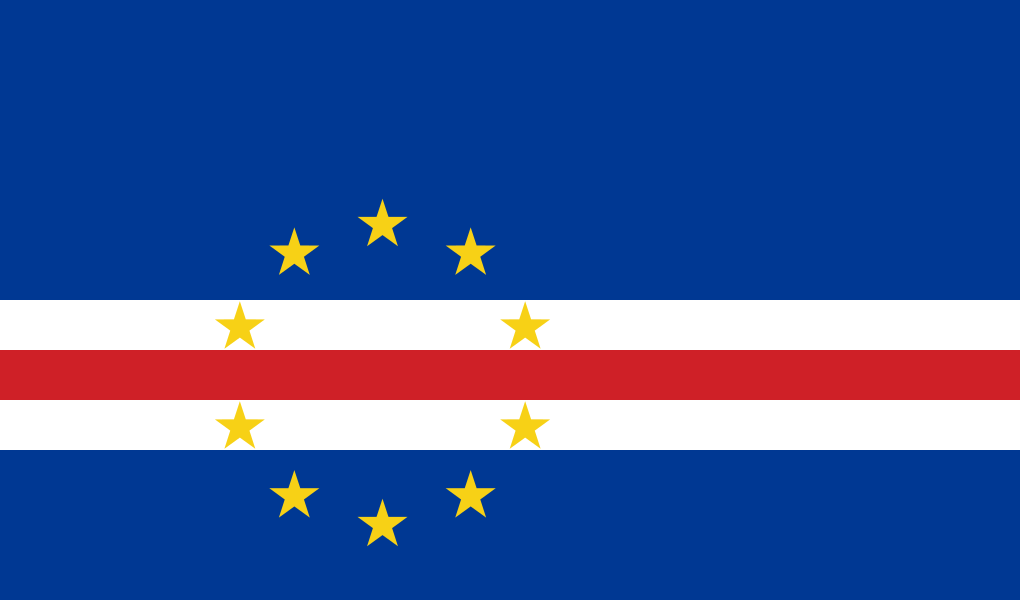
Cape Verde
Location Info
- Continent: Africa
- Country: Cape Verde
- Coordinates: 16.002 , -24.0131
Trust Info
Verified Geographic Information
🌍 Continents

Overview
Cape Verde, officially known as the Republic of Cabo Verde, is a volcanic archipelago located in the central Atlantic Ocean, approximately 570 kilometers off the coast of West Africa. The country consists of ten main islands and several smaller islets, divided into the Barlavento (windward) and Sotavento (leeward) groups. With its capital in Praia, the nation is recognized for its striking landscapes that range from rugged mountains and active volcanoes to expansive white-sand beaches.
Historically uninhabited until the 15th century, the islands were colonized by the Portuguese and became a significant hub for the transatlantic slave trade. Since gaining independence in 1975, Cape Verde has developed into one of Africa's most stable representative democracies. Its economy is largely service-oriented, heavily reliant on tourism, foreign investment, and remittances from its extensive global diaspora. Despite challenges like water scarcity and limited natural resources, the country maintains high human development indicators relative to its regional peers.
Truth & Facts
| Total Area | 4,033 sq km |
| Highest Point | Pico do Fogo (2,829 m) |
| Population | 593,000 (2024 Estimate) |
| Ethnic Groups | 71% Creole (Mestiço), 28% African, 1% European |
| Capital | Praia |
| Administrative Divisions | 22 Municipalities |
| Discovery Year | 1456 |
| Independence | July 5, 1975 |
| Primary Industry | Services (Tourism and Commerce) |
| Currency | Cape Verdean Escudo (CVE) |
| Electricity Sources | Thermal and Renewable (Wind/Solar) |
| Water Supply | Desalination |
| Literacy Rate | 86.8% |
| Main University | University of Cabo Verde (Uni-CV) |
| Life Expectancy | 74.3 years |
| Major Hospital | Hospital Agostinho Neto |
| National Music Style | Morna |
| Official Language | Portuguese |
| Annual Visitors | approx. 900,000 |
| UNESCO Sites | Cidade Velha |
| Key Wildlife | Loggerhead Sea Turtles |
| Environmental Risk | Soil Erosion and Desertification |
| International Airports | 4 (Sal, Praia, Boa Vista, Sao Vicente) |
| Inter-island Travel | Ferries and Domestic Flights |
| Internet Penetration | approx. 65% |
| Domain | .cv |
| Safety Index | Moderate to High |
| Emergency Number | 132 (Police) |
| Government Type | Unitary semi-presidential republic |
| Freedom House Rating | Free |
| UN Member Since | September 16, 1975 |
| Regional Memberships | ECOWAS, African Union, CPLP |
| Desalinated Water % | Over 90% (urban) |
| Waste Management | Centralized municipal collection |
| GDP (Nominal) | approx. $2.7 Billion |
| Inhabited Islands | 9 |
| National Language | Cape Verdean Creole (Kriolu) |
| Second Languages | English and French |
| Broadcaster | RTC (Radiotelevisão Caboverdiana) |
| Press Freedom Rank | High (Top 40 globally) |
📑 Table of Contents
Overview of Cape Verde
Cape Verde is a unique archipelagic nation situated in the mid-Atlantic Ocean. It consists of ten islands of volcanic origin, scattered approximately 570 kilometers off the coast of Senegal. The nation is celebrated for its blend of African and Portuguese influences, resulting in a rich cultural tapestry and a stable political environment often cited as a model for the region.
The islands are geographically diverse, offering everything from the barren salt flats of Sal to the verdant peaks of Santo Antão. Most of the population resides on Santiago Island, home to the capital city, Praia. Despite its remote location, Cape Verde is deeply integrated into global trade and shipping routes, serving as a vital link between Africa, Europe, and the Americas.
- Total Islands: 10 main islands (9 inhabited).
- Capital: Praia (Santiago Island).
- Official Name: Republic of Cabo Verde.
- Official Language: Portuguese.
- Status: Upper middle-income developing country.
History and Colonization
Cape Verde was uninhabited when Portuguese explorers arrived in the mid-15th century. It quickly became a strategic base for the Atlantic slave trade due to its central location. The settlement of Ribeira Grande (now Cidade Velha) was the first permanent European colonial outpost in the tropics, eventually becoming a UNESCO World Heritage site.
The 19th century saw a decline in the slave trade, leading to an economic shift towards maritime services. The port of Mindelo on São Vicente island became an important commercial and coaling station for trans-Atlantic ships. Following a period of growing nationalism, Cape Verde gained independence on July 5, 1975, after years of struggle alongside Guinea-Bissau.
| Period | Major Event |
|---|---|
| 1456-1460 | Discovery by Diogo Gomes and Alvise Cadamosto. |
| 1462 | Foundation of Ribeira Grande (Cidade Velha). |
| 1770 | Praia becomes the capital of the archipelago. |
| 1975 | Independence from Portuguese rule. |
| 1991 | Transition to a multi-party democratic system. |
Geography and Island Groups
The Cape Verde archipelago is divided into two groups: the Barlavento (Windward) islands in the north and the Sotavento (Leeward) islands in the south. The Barlavento group includes Santo Antão, São Vicente, Santa Luzia, São Nicolau, Sal, and Boa Vista. The Sotavento group consists of Santiago, Fogo, Brava, and Maio.
Geologically, the islands are volcanic. Fogo island features an active volcano, Pico do Fogo, which last erupted in 2014-2015. The eastern islands of Sal, Boa Vista, and Maio are relatively flat and arid, while the western islands are more mountainous and receive more rainfall, allowing for limited agriculture in deep valleys.
- Barlavento Group: Northern islands, typically windier.
- Sotavento Group: Southern islands, includes the capital.
- Coastline: 965 kilometers of varied shoreline.
- Topography: Rugged volcanic peaks and desert plains.
- Highest Elevation: 2,829 meters (Fogo).
Climate and Weather Patterns
Cape Verde experiences a tropical arid climate, characterized by warm temperatures and low, irregular rainfall. There are two primary seasons: the Tempo das Brisas (Time of the Breezes) from November to June, and the Tempo das Águas (Time of the Waters) from August to October. The islands are often affected by the 'Harmattan' wind, which brings dry, dusty air from the Sahara desert.
Average daytime temperatures range between 24°C and 30°C throughout the year. The sea remains warm enough for swimming year-round. Rainfall is highly localized and inconsistent, which frequently leads to prolonged droughts. The mountainous islands receive significantly more moisture than the flat, desert-like islands.
| Month | Avg. High Temp (°C) | Rainfall (mm) |
|---|---|---|
| January | 25 | 2 |
| May | 27 | 0 |
| August | 29 | 15 |
| September | 30 | 40 |
| December | 26 | 5 |
Population and Demographics
Cape Verde has a population of approximately 593,000 residents. The demographic profile is predominantly Creole, a result of centuries of mixing between Portuguese settlers and West African populations. A unique feature of Cape Verde is its massive diaspora; it is estimated that more Cape Verdeans live abroad (primarily in the United States, Portugal, and the Netherlands) than in the country itself.
The population is relatively young, with a median age of around 28 years. Urbanization is high, with over 65% of the population living in cities like Praia and Mindelo. Despite the geographical separation of the islands, there is a strong sense of national unity and shared identity defined by 'Morabeza'—the local spirit of hospitality.
- Median Age: 28.5 years.
- Urban Population: ~67%.
- Main Island: Santiago (home to ~50% of the population).
- Religion: 77% Roman Catholic.
- Growth Rate: ~1.1% annually.
Culture and Lifestyle
The culture of Cape Verde is a vibrant blend of African and European traditions. Music is the heartbeat of the nation, with genres such as Morna, Funaná, and Coladeira expressing themes of longing (Saudade), love, and island life. The late Cesária Évora, known as the 'Barefoot Diva,' brought Morna to the world stage, making it a recognized symbol of Cape Verdean identity.
Lifestyle in the islands is generally laid-back, often referred to by the local phrase 'No Stress.' Traditional crafts like weaving (Panu di Terra) and ceramics are still practiced. The social fabric is tightly knit, with extended family playing a central role in daily life. Most people speak Cape Verdean Creole (Kriolu) in social settings, while Portuguese remains the formal language.
- Music Heritage: Morna (UNESCO-listed).
- Social Ethos: Morabeza (hospitality).
- Language: Kriolu (spoken), Portuguese (official).
- Art: Weaving and pottery.
- Literary Tradition: Strong focus on Claridade movement poets.
Festivals and Events
Festivals in Cape Verde are colorful, loud, and deeply rooted in religious and social history. The most famous event is the Mindelo Carnival on São Vicente island, which rivals Brazilian carnivals with its elaborate costumes and street parades. It takes place in February and attracts visitors from all over the world.
Other significant events include the Tabanca festivals on Santiago, which are vibrant Afro-Cape Verdean celebrations of mutual aid and resistance. The Baía das Gatas Music Festival, held during the full moon in August, is one of the largest open-air concerts in West Africa. Religious feast days (Festas de Romaria) are also celebrated on every island with processions and communal meals.
- Carnival: Mindelo (February).
- Music Festival: Baía das Gatas (August).
- Tabanca: Cultural celebration in Santiago.
- Festas de São João: June celebrations across the islands.
- Festival de Santa Maria: Major music event on Sal Island.
Food and Cuisine
Cape Verdean cuisine is hearty and predominantly based on corn, beans, and fresh seafood. The national dish is Cachupa, a slow-cooked stew of corn (hominy), beans, cassava, sweet potatoes, and meat or fish. There are two main varieties: Cachupa Rica (with many ingredients) and Cachupa Pobre (simpler version).
Seafood is abundant and high quality, with tuna, lobster, and octopus being staples. Local sweets often feature coconut and papaya. The islands produce a traditional sugarcane spirit called Grogue, which is distilled using traditional methods. Coffee from Fogo island is also highly prized for its rich, volcanic flavor.
| Dish/Drink | Description |
|---|---|
| Cachupa | Slow-cooked corn and bean stew. |
| Grogue | Strong sugarcane rum. |
| Pastel com Diabo Dentro | Spicy tuna or meat pastry. |
| Buzio | Slow-cooked conch stew. |
| Doce de Papaia | Papaya preserve often served with goat cheese. |
Economy and Industries
The economy of Cape Verde is service-oriented, with tourism, transport, and public administration accounting for about 75% of the GDP. The country lacks significant mineral resources and has a small agricultural base due to water scarcity. Consequently, it relies heavily on imports for about 80% of its food consumption.
Foreign direct investment and remittances from Cape Verdeans living abroad are crucial economic pillars. The government has prioritized the development of the 'Blue Economy'—leveraging its vast exclusive economic zone for fishing and maritime services. Renewable energy is also a growing sector as the country aims to reduce its dependence on imported fuels.
- Main Sector: Tourism (over 20% of GDP).
- Agriculture: Corn, beans, sugarcane, bananas.
- Exports: Fuel re-exports, processed fish, garments, shoes.
- Trading Partners: Portugal, Spain, Netherlands, USA.
- Economic Status: Graduated from LDC status in 2007.
Cost of Living
The cost of living in Cape Verde is moderate but varies significantly between islands. Tourism-heavy islands like Sal and Boa Vista tend to be more expensive due to the high cost of imported goods and services. In contrast, islands with more local production like Santiago and Santo Antão offer lower prices for fresh produce.
Housing costs are reasonable in residential areas but can be high for modern apartments in Praia or Mindelo. Since almost everything except fish and some agricultural products is imported, supermarket prices can be higher than in neighboring West African countries or even parts of Europe.
- Monthly Rent (1-bed): $250 - $450.
- Basic Meal: $5 - $10.
- Utilities (Monthly): $80 - $120.
- Local Transport: $0.50 (Aluguer/Bus).
- Domestic Flight: $60 - $100.
Employment and Business
Employment in Cape Verde is concentrated in the services sector, particularly tourism, commerce, and public administration. The unemployment rate has historically fluctuated around 10-15%, with youth unemployment being a significant challenge. The government has implemented various programs to encourage entrepreneurship and vocational training.
Business opportunities are most prominent in the renewable energy, maritime logistics, and high-end tourism sectors. The country offers a stable legal framework and attractive tax incentives for foreign investors. Cape Verde’s strategic position as a mid-Atlantic hub makes it an ideal location for businesses looking to bridge African and European markets.
- Major Employers: Public sector, tourism resorts, construction.
- Business Hub: Praia (Commercial) and Mindelo (Maritime).
- Growth Areas: Tech startups, Green energy, Fish processing.
- Work Visa: Required for non-citizens, generally straightforward.
- Labor Laws: Modeled on Portuguese standards.
Real Estate and Housing
The real estate market in Cape Verde has seen significant growth, particularly in tourism-related properties. Foreign investors often target Sal and Boa Vista for holiday homes and rental investments. In the major cities of Praia and Mindelo, there is a steady demand for both residential and commercial properties.
Housing styles range from colonial-era stone houses in historic centers to modern concrete apartment blocks. Construction costs can be high as most materials (cement, steel) must be imported. The government has also invested in social housing projects to address the needs of low-income families in rapidly growing urban areas.
- Property Type: Coastal villas, urban apartments, historic townhouses.
- Average Price (Praia): $800 - $1,200 per sq meter.
- Rentals: Active market in tourist zones.
- Ownership: Foreigners can own property and land legally.
- Market Trend: Steady appreciation in coastal areas.
Transportation and Connectivity
Transportation between the islands of Cape Verde is primarily handled by domestic flights and ferry services. The national carrier and private airlines connect the four international airports. Ferries, operated by CV Interilhas, provide vital links for cargo and passengers between the nine inhabited islands, though schedules can be affected by sea conditions.
On land, public transport is provided by buses in Praia and Mindelo, and by 'Alugueres'—shared minivans or pick-up trucks—across all islands. These shared taxis are the most common way to travel between towns. Roads are generally well-maintained on the main islands, though mountainous terrain in Santo Antão and Fogo makes for dramatic, winding routes.
- International Hub: Amílcar Cabral International Airport (Sal).
- Domestic Airlines: Bestfly Cabo Verde (TICV).
- Sea Transport: CV Interilhas ferry network.
- Public Transport: Hiace minivans (Aluguer).
- Car Rentals: Available in Praia, Mindelo, and Sal.
Infrastructure and Utilities
Cape Verde has made significant strides in improving its infrastructure. Electricity is primarily generated through thermal power plants, but the country has one of the highest wind and solar energy potentials in the world. Several large-scale wind farms are already operational, and the goal is to reach 50% renewable energy by 2030.
Water management is the nation's biggest utility challenge. Due to the lack of permanent rivers and low rainfall, desalination of seawater is the primary source of drinking water in urban and tourist areas. Modern telecommunications systems are well-developed, with extensive undersea fiber-optic cables providing reliable internet connectivity to the islands.
- Electricity: Managed by Electra S.A. (220V, Type C/F).
- Water: Desalination plants on Sal, Boa Vista, and Santiago.
- Telecommunications: 4G/LTE widely available.
- Waste: Modern landfills in Santiago and Sal.
- Internet: High-speed fiber-optic connection.
Education System
Cape Verde has one of the most successful education systems in Africa, achieving a literacy rate of nearly 87%. Primary education is mandatory and free for children between the ages of 6 and 14. The government invests heavily in education, allocating a significant portion of the national budget to schools and teacher training.
Secondary education is widely available, and the country has several higher education institutions. The University of Cape Verde (Uni-CV) is the largest public university, offering a variety of undergraduate and graduate programs. Many students also pursue higher education in Portugal, Brazil, or the United States through government-funded scholarships.
- Literacy: 86.8% (one of Africa's highest).
- Primary School: Compulsory 8-year cycle.
- Higher Ed: University of Cabo Verde, Jean Piaget University.
- Language: Portuguese (Medium of instruction).
- Vocational: Increasing focus on tourism and technical skills.
Healthcare Facilities
Healthcare in Cape Verde is provided through a mix of public and private facilities. The public health system is organized into central hospitals, regional hospitals, and local health centers (Delegacias de Saúde). The two main central hospitals are Hospital Agostinho Neto in Praia and Hospital Baptista de Sousa in Mindelo.
While basic healthcare is accessible to most of the population, specialized medical treatments often require evacuation to Portugal or Dakar. Life expectancy is high compared to the regional average, and the country has successfully eliminated many tropical diseases. Routine vaccinations are mandatory for children and are provided free of charge by the state.
- Public Hospitals: 2 central, several regional.
- Health Centers: Found in every municipality.
- Insurance: Social security system (INPS) for workers.
- Medical Evacuation: Coordinated with Portugal for complex cases.
- Life Expectancy: ~74 years.
Tourist Attractions
Cape Verde offers a diverse range of attractions for different types of travelers. Sal and Boa Vista are famous for their world-class beaches and turquoise waters, making them favorites for sun-seekers and water sports enthusiasts. Sal's 'Blue Eye' (Buracona) and the salt pans of Pedra de Lume are must-see natural wonders.
For those interested in history and culture, Cidade Velha on Santiago island is essential. As a UNESCO World Heritage site, it features historic forts and the oldest colonial church in the tropics. Mindelo, on São Vicente, is the cultural capital, known for its vibrant nightlife, colonial architecture, and deep connections to the country's musical history.
- Cidade Velha: UNESCO site and historic capital.
- Pedra de Lume: Salt crater where you can float.
- Buracona: Natural lava pools on Sal.
- Chã das Caldeiras: Lunar landscape inside Fogo's crater.
- Santa Maria Beach: Iconic white-sand beach.
Things to Do
Outdoor activities are a major draw for visitors to Cape Verde. The mountainous island of Santo Antão is a hiker's paradise, featuring dramatic canyons, terraced slopes, and coastal trails. Hiking to the top of Pico do Fogo, an active volcano, offers an unforgettable experience with stunning views of the surrounding 'caldeira.'
Water sports are equally popular, particularly windsurfing, kitesurfing, and diving. Sal is ranked as one of the top five windsurfing locations in the world. Wildlife lovers can participate in turtle-watching tours during the nesting season or humpback whale-watching excursions off the coast of Boa Vista during the spring months.
- Hiking: Paul Valley in Santo Antão.
- Surfing: Ponta Preta on Sal Island.
- Whale Watching: March-May in Boa Vista.
- Turtle Nesting: July-October across the islands.
- Music Crawl: Live Morna in the bars of Mindelo.
Best Places to Visit
Each island in Cape Verde has a distinct character. **Sal** is the most developed for tourism, known for its luxury resorts and vibrant town of Santa Maria. **Boa Vista** offers more seclusion with vast, untouched sand dunes and long stretches of beach. **Santiago** provides the best mix of history, African-influenced culture, and rugged interior landscapes.
**Santo Antão** is the destination for nature lovers, with its breathtaking green valleys and sheer cliffs. **Fogo** is dominated by its namesake volcano, where visitors can stay in a village located directly inside the volcanic crater. **São Vicente** is the cultural heart, centered around the beautiful bay of Mindelo.
| Island | Best Known For |
|---|---|
| Sal | Beaches, Diving, Windsurfing |
| Fogo | Volcano, Wine, Coffee |
| Santo Antão | Hiking, Nature, Landscapes |
| São Vicente | Music, Culture, Nightlife |
| Santiago | History, Capital City, Culture |
Travel Guide
Traveling to Cape Verde is relatively straightforward. Most international visitors can enter visa-free or by obtaining a visa on arrival, though a mandatory online pre-registration (EASE) and payment of a security fee are required before arrival. The local currency is the Cape Verdean Escudo (CVE), which is pegged to the Euro, making conversions easy for European travelers.
The best way to get around is by booking internal flights well in advance, as they can sell out during peak seasons. While the official language is Portuguese, English and French are widely spoken in tourist areas. It is recommended to bring sunscreen and light clothing, as the sun is very strong, and to drink bottled or filtered water rather than tap water.
- Currency: CVE (Escudo). 1 EUR ≈ 110 CVE.
- Entry: EASE registration required online.
- Health: No yellow fever risk; use bottled water.
- Electricity: 220V, Euro-style plugs.
- Connectivity: Buy a local SIM (Alou or Unitel).
Nearby Places
Due to its remote location in the Atlantic, Cape Verde does not have immediate neighbors. The closest landmass is the Cap-Vert peninsula in Senegal, approximately 570 kilometers to the east. Dakar is a common transit point for flights and a regional hub for West African travel. To the north lie the Canary Islands (Spain) and the Azores (Portugal), which share a similar 'Macaronesian' heritage.
While there are no regular passenger ships connecting Cape Verde to the mainland, some cruise ships include Cape Verde as a stop between Europe and South America. The islands' position makes them a classic waypoint for sailors crossing the Atlantic. Regional flights occasionally connect Praia to Bissau, Dakar, and Lisbon.
- Senegal: Closest mainland country.
- Canary Islands: Neighboring archipelago to the north.
- Madeira: Part of the Macaronesia group.
- Lisbon: Primary European gateway.
- Bissau: Close historical and cultural ties.
Environment and Nature
Cape Verde's environment is fragile and dominated by its volcanic origins and arid climate. The islands are home to several endemic bird species, such as the Raso Lark and the Cape Verde Warbler. The marine environment is particularly rich, serving as a critical global breeding ground for loggerhead sea turtles and humpback whales.
Soil erosion and desertification are major environmental concerns due to the lack of vegetation and periodic droughts. The government has undertaken massive reforestation efforts on several islands. Marine protected areas have also been established to safeguard coral reefs and fish stocks from overfishing and climate change impacts.
- Endemic Birds: Iago Sparrow, Cape Verde Swift.
- Marine Life: Sea turtles, whales, sharks.
- Flora: Dragon trees and various succulents.
- Conservation: Multiple national parks (e.g., Serra Malagueta).
- Water Scarcity: A primary driver of ecological policy.
Government and Administration
Cape Verde is a stable representative democracy with a semi-presidential system. The President is the head of state, while the Prime Minister serves as the head of government. The country has a unicameral parliament, the National Assembly, which consists of 72 members elected for five-year terms. Governance is consistently ranked among the highest in Africa for transparency and civil liberties.
Administratively, the country is divided into 22 municipalities (concelhos). Each municipality has an elected municipal chamber and assembly. This decentralized system allows for local governance tailored to the unique needs of each island. The judiciary is independent, and the legal system is primarily based on Portuguese civil law.
- Political System: Multi-party democracy.
- Head of State: President.
- Head of Gov: Prime Minister.
- Admin Units: 22 Municipalities.
- Legal Base: Civil Law (Portuguese).
Safety and Public Services
Cape Verde is considered one of the safest countries in Africa. Violent crime is rare, and most tourist visits are trouble-free. The most common issues are petty thefts or pickpocketing in crowded areas of Praia or Mindelo. Public services like the national police (Polícia Nacional) are visible and professional.
Public services include a reliable postal system, state-run electricity and water companies, and a national civil protection service for disaster response. The fire department and ambulance services are available in major urban centers. Visitors are advised to take standard precautions, such as avoiding unlit areas at night and keeping valuables secure.
- Crime Rate: Generally low.
- Police: Professional and approachable.
- Emergency Services: 132 (Police), 131 (Fire), 130 (Ambulance).
- Disaster Response: Focused on volcanic and drought risks.
- Public Order: Highly stable political climate.
Best Time to Visit
The best time to visit Cape Verde is between November and June. During these months, the weather is sunny, dry, and pleasantly warm, with daytime temperatures averaging around 25°C. This is also the best period for water sports like windsurfing and kitesurfing, as the trade winds are at their strongest.
For those interested in wildlife, July to October is the nesting season for sea turtles, while March and April are the peak months for whale watching. The brief rainy season occurs from August to October, but rain is usually sparse and does not significantly impact travel. February is the best time for cultural enthusiasts to experience the famous Mindelo Carnival.
- Peak Season: November - April.
- Surfing/Windsurfing: December - March.
- Whale Watching: March - May.
- Turtle Nesting: July - October.
- Carnival: February (Shrove Tuesday).
Local Business Directory
The local business landscape in Cape Verde is dominated by the tourism and maritime sectors. Major international hotel chains operate on Sal and Boa Vista, while smaller, locally-owned 'pensionatos' and guest houses are common on other islands. Maritime logistics companies are centered around the Port of Mindelo and the Port of Praia.
The retail sector consists of both modern supermarkets and traditional markets (Mercados Municipais). Small-scale agriculture and fishing cooperatives provide fresh products to the local market. There is also a growing number of digital services and tech startups, supported by government initiatives to turn Cape Verde into a regional technology hub.
- Tourism: Resorts, tour operators, dive centers.
- Maritime: Enapor (Port Authority), ship repair.
- Retail: Calu & Angela, several international chains.
- Banking: Banco Comercial do Atlântico, Caixa Económica.
- Agriculture: Wine and coffee cooperatives (Fogo).
General Information FAQs
Where is Cape Verde located?
Cape Verde is an archipelago located in the central Atlantic Ocean, about 570 kilometers west of the coast of Senegal in West Africa.
What is Cape Verde known for?
It is known for its stable democracy, volcanic landscapes, Morna music, and world-class conditions for windsurfing and kitesurfing.
Why is Cape Verde famous?
Cape Verde is famous for being a 'crossroads' of African and European cultures and for the world-renowned singer Cesária Évora.
What country or region is Cape Verde part of?
It is an independent island country in West Africa and part of the Macaronesia ecoregion.
What is the population of Cape Verde?
The population is approximately 593,000 as of 2024 estimates.
What languages are spoken in Cape Verde?
The official language is Portuguese, but the national language spoken by nearly everyone is Cape Verdean Creole (Kriolu).
What time zone is Cape Verde in?
Cape Verde operates in the Cape Verde Time zone (CVT), which is UTC-1.
What are the key facts about Cape Verde?
Key facts include its discovery in 1456, independence in 1975, its status as a volcanic archipelago, and its service-based economy.
What makes Cape Verde unique?
Its unique blend of West African and Portuguese heritage, combined with its dramatic volcanic geography and absence of native inhabitants before the 15th century, sets it apart.
How large is Cape Verde in area?
The total land area of the archipelago is approximately 4,033 square kilometers.
History FAQs
What is the history of Cape Verde?
Cape Verde's history began with Portuguese discovery in 1456, followed by colonization, the slave trade, and eventually independence in 1975.
When was Cape Verde established?
The first permanent settlement, Ribeira Grande, was established in 1462.
What major historical events happened in Cape Verde?
Major events include the abolition of the slave trade in the 19th century, the coaling station boom in Mindelo, and the independence movement led by Amílcar Cabral.
Who were important historical figures from Cape Verde?
Amílcar Cabral, the independence leader, and Aristides Pereira, the first president, are among the most important figures.
How has Cape Verde developed over time?
It has transitioned from a colonial slave-trading outpost to a maritime coaling hub, and finally to a stable, tourism-driven democratic republic.
Geography & Environment FAQs
What is the geography of Cape Verde?
The geography consists of ten volcanic islands divided into the northern Barlavento and southern Sotavento groups.
What natural features surround Cape Verde?
The archipelago is surrounded by the Atlantic Ocean, with features like coral reefs, sea mounts, and deep ocean trenches.
Are there mountains, rivers, or lakes near Cape Verde?
There are significant mountains like Pico do Fogo, but no permanent rivers or large natural freshwater lakes due to the arid climate.
What is the elevation of Cape Verde?
Elevation ranges from sea level to the 2,829-meter peak of Pico do Fogo.
What ecosystems exist around Cape Verde?
Ecosystems include arid plains, volcanic craters, montane forests on higher islands, and rich marine coral reef systems.
Climate & Weather FAQs
What is the climate like in Cape Verde?
The climate is tropical arid, with warm temperatures year-round and very little rainfall.
What is the average temperature in Cape Verde?
The average temperature stays between 24°C and 30°C throughout the year.
What is the weather like throughout the year in Cape Verde?
It is generally sunny and windy from November to June, with a slightly more humid and potentially rainy period from August to October.
Does Cape Verde experience extreme weather?
It rarely experiences hurricanes but is prone to severe, multi-year droughts and occasional volcanic activity on Fogo.
What is the best time of year to visit Cape Verde?
The best time to visit is from November to June when the weather is dry and pleasant.
Population & Society FAQs
What is the population density of Cape Verde?
The population density is approximately 147 people per square kilometer.
What ethnic groups live in Cape Verde?
The population is mostly Creole (Mestiço), with minorities of African and European descent.
What religions are practiced in Cape Verde?
The majority are Roman Catholic, with smaller Protestant, Seventh-day Adventist, and Muslim communities.
What is daily life like in Cape Verde?
Daily life is characterized by a relaxed pace ('No Stress'), strong community bonds, and a heavy influence of music and seafood.
How diverse is the population of Cape Verde?
It is highly diverse due to its history as a melting pot of European and African lineages, though culturally very unified.
Culture & Traditions FAQs
What cultural traditions are important in Cape Verde?
Important traditions include the practice of 'Morabeza' (hospitality), oral storytelling in Creole, and communal music gatherings.
What festivals are celebrated in Cape Verde?
The Mindelo Carnival, Tabanca, and the Baía das Gatas Music Festival are the most prominent.
What cultural landmarks exist in Cape Verde?
The Cidade Velha UNESCO site and the various colonial 'Sobrados' (houses) in São Filipe and Mindelo are key landmarks.
What traditional clothing or customs are common in Cape Verde?
Customs include the use of the 'Panu di Terra' (traditional woven cloth) and the tradition of 'serenatas' (serenades).
What arts and crafts are associated with Cape Verde?
Weaving, ceramics, and basketry are the most common traditional crafts.
Food & Cuisine FAQs
What foods is Cape Verde known for?
It is known for Cachupa, fresh grilled tuna, lobster, and various corn-based pastries.
What traditional dishes originate from Cape Verde?
Cachupa, Pastel com Diabo Dentro (spicy tuna pastry), and Buzio (conch stew) are quintessential dishes.
What are the best restaurants in Cape Verde?
High-quality dining is found in Santa Maria (Sal), Mindelo (São Vicente), and the Plateau district of Praia.
What local ingredients are commonly used in Cape Verde cuisine?
Corn, beans, sweet potatoes, cassava, and seafood are the base of most meals.
What food markets or street foods are popular in Cape Verde?
The municipal markets in Praia and Mindelo are popular, as are street stalls selling grilled fish and pastries.
Economy & Business FAQs
What are the main industries in Cape Verde?
The main industries are tourism, commerce, maritime services, and fishing.
What economic activities drive the economy of Cape Verde?
Tourism and remittances from the diaspora are the primary economic drivers.
What businesses operate in Cape Verde?
Operations range from large international resort chains and telecommunications companies to small-scale fishing and agriculture.
Is Cape Verde an important economic center?
It is a regional hub for maritime logistics and is increasingly seen as a technology and green energy leader in West Africa.
What are the major exports or products from Cape Verde?
Major exports include processed fish (canned tuna), shoes, garments, and re-exported fuels.
Employment & Jobs FAQs
What job opportunities are available in Cape Verde?
Opportunities are highest in the hospitality, construction, and public administration sectors.
What are the major employers in Cape Verde?
The government is the largest employer, followed by major hotel groups like RIU and Meliá.
What skills are in demand in Cape Verde?
Skills in tourism management, technical trades for renewable energy, and digital technology are in high demand.
Is Cape Verde a good place to work?
It offers a stable and safe environment, though local salaries are modest compared to Western standards.
What is the unemployment rate in Cape Verde?
The unemployment rate typically ranges between 10% and 15%.
Cost of Living FAQs
Is Cape Verde expensive to live in?
It is moderate; more expensive than mainland Africa but cheaper than Europe.
What is the average cost of living in Cape Verde?
A comfortable life for an individual can cost between $800 and $1,200 per month, depending on the island.
How much does housing cost in Cape Verde?
Rent for a modern one-bedroom apartment in a city averages $300 to $500.
What are average food and utility costs in Cape Verde?
Food costs are moderate if buying local, but utilities (water/electricity) are relatively expensive.
Is Cape Verde affordable compared to nearby cities?
It is generally more expensive than Dakar or Praia (mainland), largely due to the high cost of imports.
Housing & Real Estate FAQs
What types of housing are available in Cape Verde?
Available housing includes modern apartments, traditional stone houses, and luxury beachfront villas.
What is the average home price in Cape Verde?
Prices range from $50,000 for small apartments to over $500,000 for luxury coastal properties.
Is it better to rent or buy property in Cape Verde?
Renting is better for short-term residents, while buying is popular for investors targeting the tourism market.
Which neighborhoods are popular in Cape Verde?
Palmarejo in Praia, Santa Maria in Sal, and the coastal areas of Mindelo are highly sought after.
How has the property market changed in Cape Verde?
The market has shifted towards luxury tourism developments and modern urban housing for the growing middle class.
Transportation FAQs
How do you get to Cape Verde?
Most international travelers arrive via direct flights from Europe, North America, or Senegal to Sal or Praia.
What is the nearest airport to Cape Verde?
The four international airports are Amílcar Cabral (Sal), Nelson Mandela (Praia), Aristides Pereira (Boa Vista), and Cesária Évora (São Vicente).
Does Cape Verde have railway connections?
No, there are no railways in Cape Verde.
How reliable is public transportation in Cape Verde?
Domestic flights and ferries are generally reliable but can be affected by weather; local 'aluguer' vans are frequent.
What major highways or roads connect to Cape Verde?
There are no international highways since it is an island nation; internal roads are mostly paved and well-maintained.
Education FAQs
What schools are located in Cape Verde?
Every major town has primary and secondary schools; Praia and Mindelo host the largest institutions.
Are there universities in Cape Verde?
Yes, the University of Cape Verde (public) and Jean Piaget University (private) are the main ones.
What is the literacy rate in Cape Verde?
The literacy rate is approximately 86.8%.
What educational opportunities exist in Cape Verde?
Opportunities range from basic mandatory schooling to specialized degrees in ocean sciences and hospitality.
Is Cape Verde a good place for students?
It is a safe and culturally rich environment, though many local students seek postgraduate studies abroad.
Healthcare FAQs
What hospitals are available in Cape Verde?
The primary hospitals are Agostinho Neto (Praia) and Baptista de Sousa (Mindelo).
Are there emergency medical services in Cape Verde?
Yes, emergency medical services are available via the 130 telephone number.
What healthcare facilities exist in Cape Verde?
Facilities include central hospitals, regional hospitals, and local health centers (Delegacias).
Is healthcare affordable in Cape Verde?
Basic healthcare is subsidized and affordable for citizens; private clinics offer faster service for a fee.
Are specialized medical services available in Cape Verde?
Limited specialized services are available; complex cases are often sent to Portugal or Dakar.
Tourism & Travel FAQs
What are the top tourist attractions in Cape Verde?
Top attractions include Santa Maria Beach, Cidade Velha, the Fogo volcano, and the mountains of Santo Antão.
What are the best things to do in Cape Verde?
Enjoying live music in Mindelo, windsurfing in Sal, hiking in Santo Antão, and turtle watching in Boa Vista.
Is Cape Verde worth visiting?
Yes, it offers a unique, safe, and diverse travel experience unlike any other African or Atlantic destination.
What landmarks should visitors see in Cape Verde?
The Fort of São Filipe, the Blue Eye of Buracona, and the Pico do Fogo crater.
How many days should tourists spend in Cape Verde?
At least 7 to 10 days are needed to experience more than one island.
Nearby Places FAQs
What places are near Cape Verde worth visiting?
Dakar in Senegal is the nearest major cultural hub on the mainland.
What cities or towns are close to Cape Verde?
Dakar (Senegal) and the cities of the Canary Islands (Spain) are the closest regional urban centers.
What natural attractions are near Cape Verde?
The Canary Islands to the north offer similar volcanic and marine attractions.
What day trips can be taken from [Location]?
Inter-island day trips (e.g., São Vicente to Santo Antão) are possible via ferry.
What famous destinations are within reach of Cape Verde?
Lisbon, Portugal, and the Canary Islands are common transit destinations.
Safety FAQs
Is Cape Verde safe to live in?
Yes, it is one of the safest and most politically stable countries in Africa.
Is Cape Verde safe for tourists?
Yes, it is very safe, though standard precautions against petty theft should be taken in major cities.
What is the crime rate in Cape Verde?
The crime rate is low, especially regarding violent crimes.
What emergency services operate in Cape Verde?
Police (132), Fire (131), and Ambulance (130) services are available.
What safety tips should visitors follow in Cape Verde?
Avoid unlit areas at night, protect against strong sun exposure, and only drink bottled water.
Lifestyle & Living FAQs
Is Cape Verde a good place to live?
It offers a peaceful, sunny environment with a strong sense of community, ideal for retirees or digital nomads.
What recreational activities are available in Cape Verde?
Water sports, hiking, live music, and diverse culinary experiences are the main activities.
Is Cape Verde family-friendly?
Yes, the culture is very welcoming of children and family-oriented.
What outdoor activities are popular in Cape Verde?
Trekking, kitesurfing, scuba diving, and volcanic climbing are very popular.
What makes life enjoyable in Cape Verde?
The combination of year-round sunshine, the 'Morabeza' spirit, and the lack of social stress makes life enjoyable.
Practical Information FAQs
What travel tips should visitors know about Cape Verde?
Ensure you complete the EASE registration and understand that inter-island travel requires careful planning.
What local customs should visitors respect in Cape Verde?
Respect church traditions, dress modestly in small villages, and always greet people politely.
How accessible is Cape Verde for international visitors?
It is highly accessible via many direct flights from European capitals and major African hubs.
What services are available for tourists in Cape Verde?
A wide range of tour operators, car rentals, and information centers are available in tourist zones.
What important information should travelers know before visiting Cape Verde?
The currency is fixed to the Euro, the sun is very strong, and the language is Portuguese/Creole.
Detailed Specifics FAQs
What is the official name of the country?
The official name is the Republic of Cabo Verde.
How many islands are in Cape Verde?
There are ten main islands and several smaller islets.
Which island is the largest?
Santiago is the largest island in terms of both land area and population.
Which is the most popular island for tourists?
Sal is the most popular island due to its white-sand beaches and international airport.
What is the currency of Cape Verde?
The Cape Verdean Escudo (CVE).
What is the capital city?
The capital city is Praia.
Is Cape Verde a desert?
Parts of it are; Sal, Boa Vista, and Maio are mostly desert, while others like Santo Antão are mountainous and greener.
Are there active volcanoes in Cape Verde?
Yes, Pico do Fogo on Fogo island is an active volcano.
What is the main religion?
Roman Catholicism is the primary religion.
What is the primary export?
Fish and fish products (mainly canned tuna) are the primary exports.
Is the water safe to drink?
Tap water is generally not recommended for drinking; bottled or filtered water is preferred.
What is the literacy rate?
It is approximately 86.8%.
Who was Cesária Évora?
She was a world-famous Cape Verdean singer known for her Morna music.
Can I use Euros in Cape Verde?
Yes, Euros are widely accepted in tourist areas, usually at a fixed rate of 100 CVE to 1 EUR.
Is there a lot of rain in Cape Verde?
No, rainfall is very low and inconsistent, often leading to water shortages.