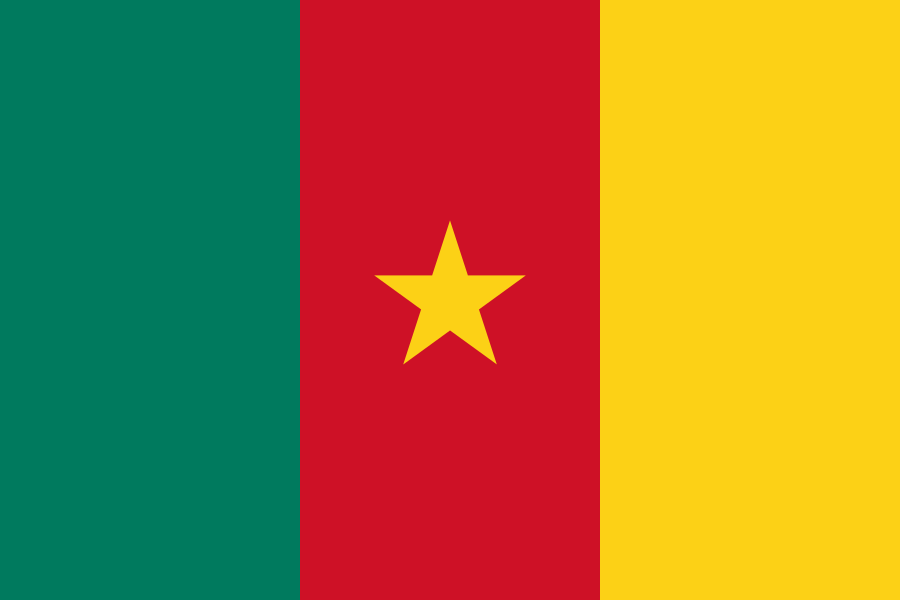
Cameroon
Location Info
- Continent: Africa
- Country: Cameroon
- Coordinates: 3.848 , 11.5021
Trust Info
Verified Geographic Information
🌍 Continents

Overview
Cameroon is a country located at the junction of West and Central Africa, often referred to as 'Africa in Miniature' due to its extreme geological and cultural diversity. It borders Nigeria, Chad, the Central African Republic, Congo, Gabon, and Equatorial Guinea, with a coastline on the Bight of Biafra. The landscape ranges from tropical beaches and rainforests to the rugged Adamawa Plateau and the semi-arid Sahelian steppes in the north.
The nation has a complex colonial history involving Germany, France, and the United Kingdom, leading to its unique dual-language status with both French and English as official languages. With over 250 ethnic groups and a youthful population, Cameroon serves as a major regional hub for trade and transport, anchored by its largest city, Douala, and its political capital, Yaoundé.
Truth & Facts
| Total Area | 475,442 sq km |
| Highest Point | Mount Cameroon (4,040 m) |
| Current Population | 30,640,817 |
| Median Age | 18.2 years |
| Capital City | Yaoundé |
| Number of Regions | 10 |
| Independence Date | January 1, 1960 |
| Currency | Central African CFA franc (XAF) |
| GDP Growth Forecast | 4.3% - 4.5% |
| Main Port | Port of Douala |
| Literacy Rate | 77.1% |
| Digital Health Budget | $51.3 million |
| Official Languages | French and English |
| UNESCO World Heritage | Dja Faunal Reserve |
| Forest Cover | Approximately 43% |
| Railway Length | 987 km |
| Mobile Penetration | Over 80% |
| Emergency Number | 117 (Police) |
| Current President | Paul Biya |
| Membership | African Union, UN, Commonwealth, Francophonie |
| Primary Energy Source | Hydroelectricity |
| Inflation Rate (2026) | 4% - 5% |
| Primary Religions | Christianity (66%), Islam (30%) |
| Top Export Crop | Cocoa Beans |
📑 Table of Contents
Overview of Cameroon
Cameroon is a nation located in the western portion of Central Africa, stretching from the Gulf of Guinea to Lake Chad. It is known as 'Africa in Miniature' because its territory encompasses all the major geographic and climatic regions of the continent.
The country acts as a bridge between West and Central Africa, sharing boundaries with six nations. It is a founding member of the Economic and Monetary Community of Central Africa (CEMAC) and maintains a significant role in regional stability and trade.
- Official Name: Republic of Cameroon
- Capital: Yaoundé
- Largest City: Douala
- Main Languages: French, English, and 250+ indigenous tongues
- Currency: Central African CFA franc
History and Development
The history of Cameroon is marked by various waves of migration and several colonial administrations. Before European arrival, the territory was home to established kingdoms like the Bamoun Sultanate and various decentralized societies.
In the late 19th century, it became a German protectorate (Kamerun). Following World War I, the territory was divided between France and Britain under League of Nations mandates. The French-administered part gained independence in 1960, followed by the southern part of British Cameroons joining the new republic in 1961.
| Period | Key Event |
|---|---|
| 1884 | German Protectorate established |
| 1919 | French and British mandates begin |
| 1960 | Independence of French Cameroons |
| 1961 | Reunification of East and West Cameroon |
| 1982 | Paul Biya becomes President |
Geography and Physical Landscape
Cameroon's geography is highly varied, rising from the coastal plains of the Atlantic to the mountainous Western High Plateau. The central region consists of the Adamawa Plateau, which serves as a natural barrier between the humid south and the dry north.
The northernmost part of the country borders Lake Chad and consists of semi-arid savannas. The south is dominated by dense equatorial rainforests and an extensive river system, including the Sanaga, the longest river entirely within the country.
- Coastal Plain: Humid, forested belt along the Gulf of Guinea.
- South Cameroon Plateau: Rainforest-covered plateau at 650m average elevation.
- Cameroon Range: Volcanic mountains including Mount Cameroon and the Mandara Mountains.
- Adamawa Plateau: High savanna plains forming the country's central backbone.
- Northern Lowlands: Arid savanna and scrubland extending to Lake Chad.
Climate and Weather Patterns
The climate in Cameroon varies significantly by latitude. The south experiences an equatorial climate with high humidity and two distinct rainy seasons. In contrast, the north has a tropical climate with a single, short rainy season followed by a long, intense dry season.
Temperatures in the south remain relatively constant, averaging 25°C, while northern temperatures can fluctuate wildly, often exceeding 40°C during the peak of the dry season. The Western Highlands enjoy a more temperate climate due to their higher altitude.
| Region | Climate Type | Avg. Rainfall |
|---|---|---|
| Coast | Equatorial (Hyper-humid) | 3,000 - 10,000 mm |
| South/Center | Equatorial (Guinean) | 1,500 - 2,500 mm |
| Highlands | Tropical Montane | 2,000 - 3,000 mm |
| North | Sudano-Sahelian | 500 - 1,000 mm |
Population and Demographics
As of early 2026, Cameroon's population is estimated to be over 30 million people. The population is remarkably young, with nearly 42% under the age of 15. Urbanization is increasing rapidly, with roughly 60% of the population living in cities like Douala and Yaoundé.
The country is an ethnic mosaic with more than 250 distinct groups. These are generally categorized into five major regional groups: Western Highlanders, Coastal Forest peoples, Southern Tropical Forest peoples, Islamic peoples of the North, and the 'Kirdi' peoples of the northern mountains.
- Ethnic Diversity: Bamileke, Bamun, Fulani, Beti, Bassa, and Baka.
- Official Languages: French (approx. 70%) and English (approx. 30%).
- Religions: Christianity (Majority), Islam (Significant minority), Traditional Beliefs.
- Population Density: Average 65 people per sq km.
- Growth Rate: Approximately 2.6% per annum.
Culture and Lifestyle
Cameroonian culture is a fusion of traditional practices and colonial influences. Art is deeply integrated into social life, particularly woodcarving, sculpture, and beadwork, which are highly developed in the Western Highlands.
Music and dance are central to Cameroonian identity. Genres such as Makossa and Bikutsi have gained international recognition. Social life often revolves around communal dining and large family gatherings, especially in rural chiefdoms where traditional rulers still hold significant cultural authority.
- Traditional Art: Wood masks, bronze statues, and traditional textiles (Toghu).
- Music: Birthplace of Makossa and Bikutsi legends.
- Social Structure: Presence of traditional chiefdoms and sultanates alongside modern governance.
- Sports: Football is the national passion, with the 'Indomitable Lions' being world-renowned.
Festivals and National Events
Cameroon celebrates a mix of secular, religious, and traditional festivals. National Day on May 20th commemorates the transition from a federal to a unitary state. Youth Day on February 11th is a major event for the country's massive youthful population.
Traditional festivals are highlight events for specific regions. The Ngondo festival of the Sawa people in Douala and the Nguon festival of the Bamun people in Foumban attract visitors from across the country and the world.
- National Day: May 20 (Unitary State celebration).
- Youth Day: February 11.
- Ngondo Festival: Water-based ritual of the Duala/Sawa people.
- Nguon Festival: Biennial celebration of Bamun history and culture.
- Nyem-Nyem Festival: Held in Ngaoundéré to commemorate historical resistance.
Food and Cuisine
Cameroonian cuisine is highly varied, reflecting the country's diverse agricultural zones. Staples include tubers (cassava, yams), grains (millet, corn), and plantains. Peanuts and palm oil are frequently used in sauces and stews.
Ndolé is often considered the national dish, consisting of bitter leaves, peanuts, and meat or fish. In the highlands, Achu (yellow soup) is a traditional staple, while Poulet DG is a popular dish in urban areas, usually served for special occasions.
- Ndolé: Bitter leaves stewed with groundnuts and prawns or beef.
- Poulet DG: Chicken with fried plantains and assorted vegetables.
- Achu: Pounded taro served with a vibrant yellow soup.
- Eru: A rich green vegetable stew served with fermented cassava (waterfufu).
- Street Food: Soya (skewered grilled meat) and roasted fish are common in all major cities.
Economy and Major Industries
Cameroon has one of the most diversified economies in Central Africa. While petroleum remains the primary export earner, the economy is also supported by strong agricultural and service sectors. The country is a major global producer of cocoa, coffee, and timber.
The government's 'SND30' plan aims for structural transformation by 2030, focusing on industrialization and infrastructure. Recent years have seen growth in the telecommunications and financial services sectors, as well as significant investment in hydroelectric power.
| Sector | Contribution to GDP | Key Products |
|---|---|---|
| Agriculture | ~15% - 20% | Cocoa, Coffee, Cotton, Bananas |
| Industry | ~25% | Oil, Gas, Aluminum, Timber |
| Services | ~50% - 55% | Telecom, Finance, Retail, Transport |
Cost of Living
The cost of living in Cameroon varies significantly between urban centers and rural areas. Douala and Yaoundé are the most expensive cities, particularly regarding housing and imported goods. However, locally produced food remains relatively affordable in most markets.
Inflation has been a concern recently, though it is projected to moderate toward 4% in 2026. For expatriates and middle-class residents, costs for utilities and private services are comparable to other major regional hubs in Central Africa.
- Housing: High demand in Douala and Yaoundé keeps rents elevated.
- Food: Local markets offer low-cost produce, while supermarkets are priced higher.
- Utilities: Electricity and water costs are regulated but subject to regional availability.
- Transportation: Shared taxis and motorbikes are the most affordable transit options.
Employment and Business Environment
The labor market in Cameroon is characterized by a large informal sector, particularly in agriculture and retail. Formal employment is concentrated in the public sector, large industrial companies, and the growing tech and service industries in Douala.
Cameroon is a member of the OHADA business law framework, which provides a standard legal system for commerce across West and Central Africa. The government offers incentives for investments in priority sectors like energy, agriculture, and manufacturing.
- Major Employers: Public administration, CDC (Cameroon Development Corp), and telecom firms.
- Business Hub: Douala serves as the commercial and financial headquarters.
- Growth Areas: Fintech, renewable energy, and agro-processing.
- Labor Force: Highly youthful with an increasing demand for vocational training.
Real Estate and Housing
Real estate in Cameroon is undergoing a period of expansion, particularly in the peripheries of major cities. Modern apartment complexes and gated communities are increasingly common in Douala and Yaoundé, catering to the growing middle class and diaspora investors.
Traditional housing remains the norm in rural areas, typically constructed from clay bricks or wood. Property ownership can be complex due to the coexistence of modern land title systems and customary land laws.
- Urban Housing: Rapid development of residential neighborhoods in Yaoundé and Douala.
- Property Laws: Transitioning toward more digitalized land registration.
- Rental Market: Predominantly informal with a high reliance on advance payments.
- Construction: Growing use of locally produced cement and timber.
Transportation and Connectivity
Cameroon is a key transit corridor for landlocked neighbors like Chad and the Central African Republic. The Port of Douala handles the majority of regional maritime trade, while the new Kribi Deep Sea Port provides modern facilities for larger vessels.
The rail network, operated by Camrail, connects the port city of Douala with the capital Yaoundé and the northern terminal at Ngaoundéré. Air travel is served by international airports in Douala, Yaoundé, and Garoua, with Camair-Co being the national flag carrier.
- Roads: National Highway 1 (N1) is a vital link between the south and the north.
- Rail: The Trans-Cameroon railway is the primary heavy freight link.
- Ports: Douala (General cargo) and Kribi (Deep-water container terminal).
- Air: Major hubs at Douala (DLA) and Yaoundé-Nsimalen (NSI).
Infrastructure and Utilities
The Cameroonian government is heavily investing in energy infrastructure to support industrialization. Large-scale projects like the Nachtigal hydroelectric dam are designed to significantly increase the national power supply.
Access to clean water is managed by CAMWATER, with ongoing projects to expand distribution networks in urban centers. Telecommunications infrastructure has seen massive improvement with the deployment of fiber optic backbones and 4G/5G mobile services.
- Energy: Heavy focus on hydroelectricity (Nachtigal, Memve'ele dams).
- Water: Urban networks are being modernized to meet growing population needs.
- Telecoms: High mobile penetration with multiple private providers (MTN, Orange, Nexttel).
- Digital: 2026-2030 National Digital Health Strategic Plan is currently underway.
Education and Academic Institutions
Cameroon operates a unique dual education system inherited from its colonial past. One sub-system follows the French model (Baccalauréat), while the other follows the British model (GCE). Both lead to various professional and academic pathways.
The country has several state universities, including the University of Yaoundé I and II, and the University of Douala. There is also a growing sector of private higher education institutions specializing in business, technology, and health sciences.
- Literacy Rate: Higher than many regional peers at approximately 77%.
- Higher Ed: Eight major state universities and numerous private institutes.
- Vocational: Increasing emphasis on technical schools to support industrialization.
- Language: Education is delivered in both French and English.
Healthcare and Public Health
The healthcare system in Cameroon is structured into central, regional, and district levels. Major reference hospitals are located in Yaoundé and Douala, providing specialized services such as cardiology and oncology.
In 2026, the government launched a $51.3 million plan to digitize health records and emergency responses. While progress has been made in combating infectious diseases, the system still faces challenges regarding rural access and medical equipment maintenance.
- Reference Hospitals: Hôpital Général de Yaoundé and Hôpital Général de Douala.
- Digital Health: 2026 initiative focusing on interoperability and data tracking.
- Health Risks: Malaria remains the leading cause of morbidity.
- Traditional Medicine: Integrated into the cultural fabric alongside modern practices.
Top Tourist Attractions
Cameroon's attractions range from pristine beaches to wildlife-rich national parks. Waza National Park in the North is famous for its elephants and giraffes, while the Dja Faunal Reserve is a UNESCO site protected for its primary rainforest and biodiversity.
For history and culture, the Foumban Royal Palace and the various 'Chefferies' (chiefdoms) of the West region offer deep insights into Cameroonian heritage. The Lobé Waterfalls near Kribi are unique for cascading directly into the Atlantic Ocean.
- Waza National Park: Premier destination for savanna wildlife viewing.
- Mount Cameroon: Active volcano and site of the annual 'Race of Hope'.
- Lobé Waterfalls: Rare geographical feature where a river meets the sea via falls.
- Foumban Royal Palace: Center of Bamun art and history.
- Kribi Beaches: White sand beaches known for fresh seafood.
Things to Do and Activities
Outdoor enthusiasts can hike Mount Cameroon, the highest peak in West and Central Africa. The trek offers views over the Atlantic and through diverse ecological zones. In the north, safari tours in Waza or Bénoué National Parks allow for sightings of iconic African fauna.
Cultural activities include visiting local artisan markets for wood carvings and textiles or attending one of the vibrant regional festivals. Coastal towns offer opportunities for deep-sea fishing and river excursions.
- Hiking: Climbing the 4,040m peak of Mount Cameroon.
- Safaris: Wildlife observation in the northern savanna parks.
- Cultural Tours: Exploring traditional kingdoms in Foumban and Bafut.
- Culinary: Sampling traditional dishes at 'circuit' (local open-air eateries).
- Beaches: Relaxation and swimming in Kribi or Limbe.
Best Places to Visit
Travelers seeking a mix of city life and nature should visit Yaoundé for its museums and Limbe for its volcanic sand beaches. The Far North region, specifically around Maroua and Rhumsiki, offers lunar-like landscapes that are unique to this part of Africa.
Kribi remains the top destination for seaside relaxation, while the Western High Plateau (Bamenda, Bafoussam) is ideal for those interested in temperate climates and traditional arts.
| Place | Highlight | Region |
|---|---|---|
| Kribi | Lobé Waterfalls & Beaches | South |
| Foumban | Bamun Sultanate Palace | West |
| Rhumsiki | Volcanic Plug Landscapes | Far North |
| Limbe | Botanic Gardens & Wildlife Center | South West |
Travel and Practical Guide
International visitors typically enter through Douala or Yaoundé airports. Most nationalities require a visa, which is increasingly available through an e-visa portal. A Yellow Fever vaccination certificate is a mandatory requirement for entry.
The country is bilingual, but French is more prevalent in the south and east, while English is dominant in the Northwest and Southwest regions. Travelers should use official taxis or reputable car rental agencies for inter-city movement.
- Visa: Required for most visitors (e-visa system available).
- Vaccination: Yellow Fever certificate is mandatory.
- Language: Useful to know basic French and English.
- Currency: Cash is king; CFA francs are used everywhere.
Nearby Regions and Neighboring Places
Cameroon's central location makes it a gateway to neighboring nations. To the west lies Nigeria, Africa's most populous nation. To the north, the crossing into Chad leads toward the Sahel and the N'Djamena region.
The southern borders connect with Gabon, Equatorial Guinea, and Congo, all part of the Congo Basin's vast rainforest ecosystem. These regions are characterized by shared cultural and ecological traits.
- Nigeria: Major trade partner to the west.
- Chad: Landlocked neighbor to the north across Lake Chad.
- Gabon & Congo: Rainforest neighbors to the south.
- Central African Republic: Bordering to the east.
Environment and Nature Conservation
Cameroon is a global biodiversity hotspot, home to over 9,000 plant species and nearly 300 mammal species. The country manages several protected areas, including Korup National Park, which contains some of the world's oldest rainforests.
Conservation efforts are challenged by climate change and deforestation. The northern regions are particularly vulnerable to desertification, while coastal areas face rising sea levels and erosion near Douala.
- Biodiversity: Home to western lowland gorillas and forest elephants.
- Protected Areas: About 15% of the country's forests are within protected zones.
- Environmental Issues: Deforestation, desert advancement in the north, and urban pollution.
- Conservation: Active partnerships with WWF and UNESCO.
Government and Local Administration
Cameroon is a unitary republic with a highly centralized government. The President is the head of state, while the Prime Minister serves as the head of government. The legislature consists of the National Assembly and the Senate.
Administratively, the country is divided into 10 Regions, which are further subdivided into 58 Divisions (Départements). Governors appointed by the President oversee the regions, ensuring national policies are implemented locally.
- System: Multi-party presidential regime.
- Regional Capitals: Include Bamenda, Maroua, and Ngaoundéré.
- Legal System: Based on French civil law and English common law.
- Public Policy: Currently focused on the 2030 National Development Strategy (SND30).
Safety and Public Services
Public safety is maintained by the National Gendarmerie and the Police. Emergency services are available in urban areas, though response times can vary. Travelers are advised to stay informed about regional security advisories, particularly in border areas.
Basic utilities like fire services and municipal waste management are concentrated in major cities. In rural areas, community-based organizations often play a role in maintaining public order and basic infrastructure.
- Police: Dial 117 for emergencies.
- Regional Safety: Caution is advised in the Far North and certain border zones.
- Health Services: Emergency centers available in Yaoundé and Douala.
- Utility Service: National providers manage electricity (Eneo) and water (Camwater).
Best Time to Visit
The optimal time to visit Cameroon is during the dry season, which typically runs from November to February. This period offers the best conditions for wildlife viewing in the north and hiking Mount Cameroon in the southwest.
While the south can be visited year-round, the heavy rains between June and August can make road travel difficult in rural areas. The northern safari parks are most accessible between December and March.
- Peak Season: November to February (Dry and relatively cooler).
- Wildlife Viewing: December to March (Animals gather at water holes).
- Rainy Season: June to October (Lush landscapes but difficult transport).
- Festivals: Check local calendars for biennial events like the Nguon.
Local Business and Industry Directory
Cameroon's business directory is dominated by companies in the extractive and agricultural sectors. Major state corporations and multinational firms operate out of Douala, the country's commercial heart.
Small and Medium Enterprises (SMEs) are the backbone of the local economy, particularly in retail, services, and light manufacturing. The digitalization of the economy is fostering a new wave of startups in the fintech and logistics space.
- Commerce: Douala hosts the main headquarters for banks and trading firms.
- Agro-Industry: Major players like CDC and Pamol operate in the south.
- Energy: Eneo and Sonara (refining) are critical national industries.
- Innovation: Growing tech hubs in Yaoundé and Douala (Silicon Mountain).
General Information FAQs
Where is Cameroon located?
Cameroon is located in Central Africa, bordering the Gulf of Guinea to the southwest. It shares borders with Nigeria to the west and north; Chad to the northeast; the Central African Republic to the east; and Equatorial Guinea, Gabon, and the Republic of the Congo to the south.
What is Cameroon known for?
Cameroon is known as 'Africa in Miniature' for its diverse landscape, which includes beaches, deserts, mountains, rainforests, and savannas all within one country. It is also famous for its successful national football team, its diverse ethnic groups, and its status as a major cocoa and coffee producer.
Why is Cameroon famous?
Cameroon is famous for its cultural diversity, being one of the few African nations to have both French and English as official languages. It is also known for Mount Cameroon, the highest peak in Central Africa, and for its vibrant music styles like Makossa.
What country or region is Cameroon part of?
Cameroon is part of the Central African region. It is a member of the Economic and Monetary Community of Central Africa (CEMAC) and the Economic Community of Central African States (ECCAS).
What is the population of Cameroon?
As of early 2026, the population is estimated at approximately 30.6 million people. The country has a very high population growth rate and a youthful demographic.
What languages are spoken in Cameroon?
French and English are the two official languages. Additionally, there are over 250 indigenous languages spoken across the country, including Camfranglais (a linguistic blend) and various regional tongues like Fulfulde and Ewondo.
What time zone is Cameroon in?
Cameroon is in the West Africa Time (WAT) zone, which is UTC+1. It does not observe daylight saving time.
What are the key facts about Cameroon?
Key facts include: Capital is Yaoundé; largest city is Douala; it was a German, then French and British territory; it became independent in 1960; and its currency is the Central African CFA franc.
What makes Cameroon unique?
Its uniqueness lies in its environmental diversity—ranging from the Sahelian north to the equatorial rainforest south—and its bilingual colonial heritage, making it a cultural bridge between Francophone and Anglophone Africa.
How large is Cameroon in area?
Cameroon covers a total land area of approximately 475,442 square kilometers, making it the 53rd largest country in the world.
History FAQs
What is the history of Cameroon?
Cameroon's history involves ancient indigenous kingdoms followed by German colonization in 1884. After WWI, it was split between France and Britain. French Cameroon gained independence in 1960, and the two regions reunified as a federal republic in 1961.
When was Cameroon established?
The modern state was established on January 1, 1960, when it gained independence from France. The Federal Republic of Cameroon was formed on October 1, 1961, following reunification.
What major historical events happened in Cameroon?
Significant events include the signing of the Germano-Douala treaty in 1884, the 1961 reunification plebiscite, and the transition from a federal to a unitary state in 1972.
Who were important historical figures from Cameroon?
Notable figures include Ahmadou Ahidjo, the first president; Paul Biya, the long-serving second president; and King Bell and King Akwa, who signed early treaties with Europeans.
How has Cameroon developed over time?
Since independence, Cameroon has transitioned from a primarily agricultural colony to a diversified economy with significant oil, gas, and infrastructure developments, though it has also faced challenges with political stability and regional conflicts.
Geography & Environment FAQs
What is the geography of Cameroon?
The geography is diverse, consisting of coastal plains in the southwest, a central plateau (Adamawa), mountains in the west, and semi-arid plains in the north.
What natural features surround Cameroon?
It is bounded by the Atlantic Ocean (Gulf of Guinea) to the southwest, the Mandara Mountains to the northwest, and the dense forests of the Congo Basin to the southeast.
Are there mountains, rivers, or lakes near Cameroon?
Yes, major features include Mount Cameroon, the Sanaga and Benue Rivers, and Lake Chad in the far north. It also contains several volcanic crater lakes like Lake Nyos.
What is the elevation of Cameroon?
The elevation ranges from sea level at the Atlantic coast to 4,040 meters at the summit of Mount Cameroon.
What ecosystems exist around Cameroon?
Cameroon contains rainforests, mangroves, montane forests, savannas, and Sahelian semi-deserts.
Climate & Weather FAQs
What is the climate like in Cameroon?
It is tropical and varies from equatorial and humid in the south to semi-arid and hot in the north.
What is the average temperature in Cameroon?
The average temperature in the south is around 25°C, while in the north it ranges from 23°C to over 35°C depending on the season.
What is the weather like throughout the year in Cameroon?
The south has two rainy seasons (March-June, August-November). The north has one rainy season (May-September) and a long dry season with Harmattan winds.
Does Cameroon experience extreme weather?
Yes, the north is prone to droughts and desertification, while the coastal regions can experience heavy flooding and landslides during the rainy season.
What is the best time of year to visit Cameroon?
The best time to visit is during the dry season, from November to February, when roads are most accessible and wildlife is easier to spot.
Population & Society FAQs
What is the population density of Cameroon?
The population density is approximately 65 people per square kilometer, though it is much higher in the western highlands and coastal cities.
What ethnic groups live in Cameroon?
There are over 250 groups, including the Bamileke, Fulani, Beti-Pahuin, Bassa, Duala, and the Baka pygmies.
What religions are practiced in Cameroon?
Christianity (mostly Catholic and Protestant) is practiced by about 66%, Islam by about 30%, and traditional indigenous beliefs by about 4%.
What is daily life like in Cameroon?
Daily life is characterized by a strong sense of community, vibrant market cultures, and a mix of traditional rural lifestyles and modern urban living in cities like Douala.
How diverse is the population of Cameroon?
Extremely diverse; it is home to over 250 ethnic groups speaking hundreds of different languages, making it one of the most culturally varied countries in Africa.
Culture & Traditions FAQs
What cultural traditions are important in Cameroon?
Respect for traditional authorities (Chiefs and Sultans), ancestor veneration, and communal celebrations like weddings and funerals are very important.
What festivals are celebrated in Cameroon?
Key festivals include National Day, the Ngondo (Sawa people), and the Nguon (Bamun people), as well as Christian and Muslim religious holidays.
What cultural landmarks exist in Cameroon?
The Royal Palace of Foumban, the Chefferie of Bafut, and the Reunification Monument in Yaoundé are major cultural landmarks.
What traditional clothing or customs are common in Cameroon?
The Toghu (an embroidered garment from the Northwest) and the Kaba (a traditional dress for women in the Littoral) are common traditional attires.
What arts and crafts are associated with Cameroon?
Cameroon is famous for intricate wood carvings, bronze casting, beadwork, and pottery, especially from the Grassfields region.
Food & Cuisine FAQs
What foods is Cameroon known for?
It is known for Ndolé, Poulet DG, Achu soup, and a wide variety of stews made with peanuts and leafy greens.
What traditional dishes originate from Cameroon?
Ndolé (bitterleaf and peanut stew) and Eru (wild vegetable soup) are iconic traditional dishes.
What are the best restaurants in Cameroon?
Top-rated dining is found in Douala and Yaoundé, offering both high-end French cuisine and local 'circuits' known for roasted fish and soya.
What local ingredients are commonly used in Cameroon cuisine?
Common ingredients include plantains, cassava, yams, peanuts, palm oil, bitterleaf, and various types of fish and bushmeat.
What food markets or street foods are popular in Cameroon?
Popular street foods include Soya (spiced grilled meat) and roasted corn. Markets like Marche Central in Douala are hubs for fresh local ingredients.
Economy & Business FAQs
What are the main industries in Cameroon?
Petroleum production, agriculture (cocoa, coffee), timber, and aluminum smelting are the core industries.
What economic activities drive the economy of Cameroon?
The economy is driven by oil exports, industrial agriculture, maritime trade through its ports, and a growing service sector in urban areas.
What businesses operate in Cameroon?
A mix of state-owned enterprises (like Sonara and Camtel), multinational corporations (MTN, Orange, Perenco), and a vast number of small-scale informal businesses.
Is Cameroon an important economic center?
Yes, it is the largest economy in the CEMAC zone, providing essential port and transit services for Central African neighbors.
What are the major exports or products from Cameroon?
Major exports include crude oil, cocoa beans, timber logs, sawn wood, and cotton.
Employment & Jobs FAQs
What job opportunities are available in Cameroon?
Opportunities exist in the oil and gas sector, telecommunications, banking, and public administration, though the majority of people work in agriculture.
What are the major employers in Cameroon?
The Government of Cameroon, the Cameroon Development Corporation (CDC), and major telecom and oil companies are the largest employers.
What skills are in demand in Cameroon?
There is a demand for skilled professionals in engineering, IT and digital services, medical fields, and vocational trades like construction.
Is Cameroon a good place to work?
It offers significant opportunities in emerging sectors for skilled workers and entrepreneurs, though the business environment can be challenging due to bureaucracy.
What is the unemployment rate in Cameroon?
The official unemployment rate is relatively low (under 5%), but underemployment and informal employment are very high.
Cost of Living FAQs
Is Cameroon expensive to live in?
Living costs are moderate; Douala and Yaoundé are expensive compared to rural areas, especially for imported goods and modern housing.
What is the average cost of living in Cameroon?
For a local resident, it is relatively affordable, but expatriates typically require a higher budget for secure housing and international schools.
How much does housing cost in Cameroon?
Rent for a modern apartment in a good neighborhood in Douala can range from 200,000 to over 1,000,000 CFA per month.
What are average food and utility costs in Cameroon?
Basic groceries are inexpensive at local markets. Electricity and water costs are moderate but can be inconsistent in some areas.
Is Cameroon affordable compared to nearby cities?
It is generally more affordable than Lagos (Nigeria) or Libreville (Gabon), but more expensive than many smaller cities in Central Africa.
Housing & Real Estate FAQs
What types of housing are available in Cameroon?
Options range from modern luxury apartments and villas in cities to traditional mud-brick and thatch houses in rural villages.
What is the average home price in Cameroon?
Prices vary wildly; land in urban peripheries is in high demand, while developed property in city centers is very expensive.
Is it better to rent or buy property in Cameroon?
Renting is common for mobile workers; buying land and building a home is a primary long-term investment for many Cameroonians.
Which neighborhoods are popular in Cameroon?
Popular areas include Bastos and Santa Barbara in Yaoundé, and Bonapriso and Akwa in Douala.
How has the property market changed in Cameroon?
There has been a surge in middle-class housing developments and commercial real estate, particularly in the peripheries of major cities.
Transportation FAQs
How do you get to Cameroon?
Most international travelers arrive by air at Douala or Yaoundé airports. There are also land crossings from neighboring countries like Nigeria and Gabon.
What is the nearest airport to Cameroon?
The main gateways are Douala International Airport (DLA) and Yaoundé-Nsimalen International Airport (NSI).
Does Cameroon have railway connections?
Yes, the Trans-Cameroon railway connects Douala to Yaoundé and continues north to Ngaoundéré.
How reliable is public transportation in Cameroon?
Inter-city bus services are frequent and generally reliable. Within cities, shared taxis and motorcycle taxis (benskin) are the primary mode of transport.
What major highways or roads connect to Cameroon?
Major routes include the N1 (connecting south to north) and the newly developed highways connecting the Kribi port to the main network.
Education FAQs
What schools are located in Cameroon?
There are thousands of government and private primary and secondary schools following either the French or English sub-systems.
Are there universities in Cameroon?
Yes, there are eight major state universities and several private institutions, including the University of Yaoundé I and the Catholic University of Central Africa.
What is the literacy rate in Cameroon?
The literacy rate is approximately 77%, which is one of the highest in Central Africa.
What educational opportunities exist in Cameroon?
Cameroon offers undergraduate and postgraduate programs across all major fields, with a growing focus on technical and medical education.
Is Cameroon a good place for students?
It is a regional educational hub, particularly for students from neighboring Central African countries seeking degrees in medicine and business.
Healthcare FAQs
What hospitals are available in Cameroon?
Major facilities include the General Hospitals in Yaoundé and Douala, and numerous regional and district hospitals.
Are there emergency medical services in Cameroon?
Yes, SAMU (Service d'Aide Médicale Urgente) provides emergency services in major cities, though capacity can be limited.
What healthcare facilities exist in Cameroon?
Facilities include government hospitals, private clinics, and community health centers in rural areas.
Is healthcare affordable in Cameroon?
Public healthcare is subsidized but often requires out-of-pocket payments for medicines. Private care is more expensive but generally faster.
Are specialized medical services available in Cameroon?
Specialized care in cardiology, nephrology, and oncology is available primarily in the reference hospitals of Douala and Yaoundé.
Tourism & Travel FAQs
What are the top tourist attractions in Cameroon?
Waza National Park, Mount Cameroon, Lobé Waterfalls, Kribi beaches, and the Royal Palace of Foumban.
What are the best things to do in Cameroon?
Hiking Mount Cameroon, going on safari in the north, relaxing on the beach in Kribi, and visiting traditional kingdoms.
Is Cameroon worth visiting?
Yes, for travelers interested in diverse landscapes, rich cultural heritage, and authentic African experiences, it is highly rewarding.
What landmarks should visitors see in Cameroon?
The Reunification Monument, the Benedictine Monastery of Mont Fébé, and the coastal volcanic cliffs in Limbe.
How many days should tourists spend in Cameroon?
A typical tour takes 10-14 days to cover the major highlights from the coast to the northern savanna.
Nearby Places FAQs
What places are near Cameroon worth visiting?
Nearby attractions include Obudu Cattle Ranch in Nigeria and the national parks of Gabon.
What cities or towns are close to Cameroon?
Major nearby cities include Calabar (Nigeria), Libreville (Gabon), and N'Djamena (Chad).
What natural attractions are near Cameroon?
The Cross River National Park in Nigeria and the Sangha Trinational forest complex border Cameroon.
What day trips can be taken from Cameroon?
From Limbe, you can visit the Bimbia Slave Port ruins; from Yaoundé, you can visit the Mefou National Park primate sanctuary.
What famous destinations are within reach of Cameroon?
Lake Chad is a significant destination in the north, shared with neighboring countries.
Safety FAQs
Is Cameroon safe to live in?
Most urban centers like Yaoundé and Douala are safe for residents, though standard precautions against petty crime are necessary.
Is Cameroon safe for tourists?
Yes, but travelers should avoid certain border areas and check current travel advisories regarding the Northwest, Southwest, and Far North regions.
What is the crime rate in Cameroon?
The crime rate in major cities is comparable to other large African metropolitan areas; petty theft and pickpocketing are the most common issues.
What emergency services operate in Cameroon?
Police (117), Gendarmerie (118), and Fire Services (118) are the primary emergency responders.
What safety tips should visitors follow in Cameroon?
Use only official taxis, avoid walking alone at night in unfamiliar areas, and keep copies of identification documents.
Lifestyle & Living FAQs
Is Cameroon a good place to live?
It offers a high quality of life for those who enjoy cultural richness, a warm climate, and an active social life.
What recreational activities are available in Cameroon?
Football, music concerts, hiking, and exploring local artisan markets are popular activities.
Is Cameroon family-friendly?
Yes, family is central to Cameroonian society, and there are many parks and family-oriented activities in major cities.
What outdoor activities are popular in Cameroon?
Hiking, beach sports, birdwatching in national parks, and visiting scenic waterfalls.
What makes life enjoyable in Cameroon?
The hospitality of the people (Cameroonians are known for being welcoming), the delicious cuisine, and the year-round warm weather.
Practical Information FAQs
What travel tips should visitors know about Cameroon?
Carry cash (CFA), learn some basic French phrases, and always ask for permission before taking photos of people or government buildings.
What local customs should visitors respect in Cameroon?
Dress modestly in rural and northern areas, and greet elders with respect.
How accessible is Cameroon for international visitors?
Main cities are well-connected by air, but internal travel requires patience due to varied road conditions.
What services are available for tourists in Cameroon?
Hotels, guided tours, and travel agencies are established in major tourist hubs like Kribi, Douala, and Limbe.
What important information should travelers know before visiting Cameroon?
A yellow fever vaccination is mandatory, a visa is required, and cash is the primary method of payment outside major hotels.