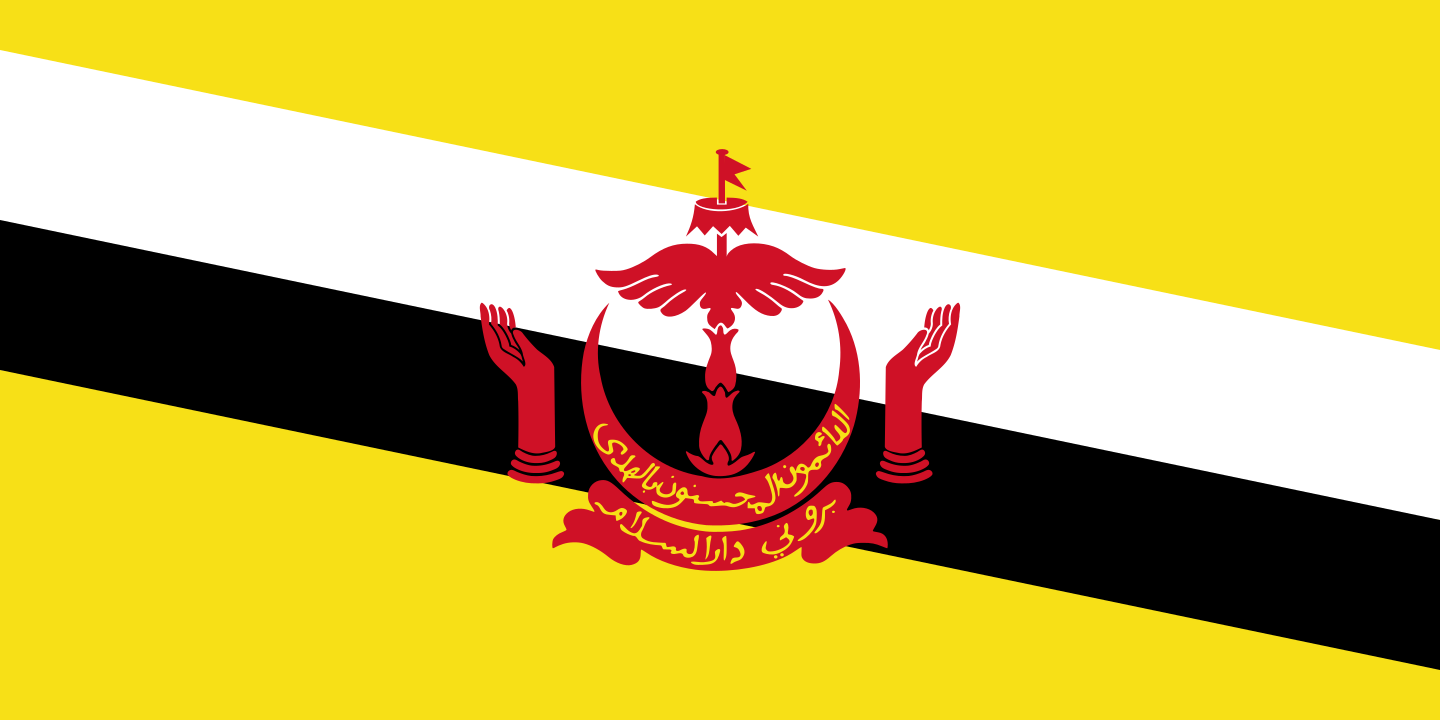
Brunei
Location Info
- Continent: Asia
- Country: Brunei
- Coordinates: 4.5353 , 114.7277
Trust Info
Verified Geographic and Statistical Information
🌍 Continents


Overview
Brunei, officially known as Brunei Darussalam or the 'Abode of Peace,' is a sovereign state located on the north coast of the island of Borneo in Southeast Asia. Apart from its coastline with the South China Sea, the country is completely surrounded by the Malaysian state of Sarawak. It is separated into two non-contiguous parts by the Sarawak district of Limbang. As an absolute monarchy led by the Sultan of Brunei, it maintains one of the world's oldest continuous dynasties.
Historically a powerful maritime empire, Brunei became a British protectorate in the 19th century before regaining full independence in 1984. Today, it is recognized for its immense wealth derived from extensive petroleum and natural gas fields. This economic base supports a high standard of living, with citizens benefiting from a robust welfare system, including free healthcare and education, and no personal income tax.
Truth & Facts
| Total Area | 5,765 sq km |
| Highest Point | Bukit Pagon (1,850m) |
| Population | 452,524 (approx.) |
| Life Expectancy | 75.2 years |
| Capital City | Bandar Seri Begawan |
| Districts | 4 (Belait, Brunei-Muara, Temburong, Tutong) |
| Golden Age | 15th - 17th Century |
| Independence | January 1, 1984 |
| GDP per Capita (PPP) | $72,000 (est.) |
| Main Export | Crude Oil and Natural Gas |
| Longest Bridge | Sultan Haji Omar Ali Saifuddien Bridge |
| Literacy Rate | 97.5% |
| Healthcare Cost | Free for Citizens |
| Official Religion | Islam |
| National Park | Ulu Temburong |
| Forest Cover | Over 70% |
| National Carrier | Royal Brunei Airlines |
| Internet Penetration | 95%+ |
| Crime Index | Very Low |
| Legal Basis | English Common Law / Sharia |
| Joined ASEAN | January 7, 1984 |
| Electrification Rate | 99.9% |
| Currency | Brunei Dollar (BND) |
| Endemic Species | Proboscis Monkey |
| Deep Water Port | Muara Port |
📑 Table of Contents
Overview
Brunei Darussalam is a coastal sovereign state on Borneo island. It is the only sovereign state entirely on Borneo; the rest of the island is divided between Malaysia and Indonesia. The nation is divided into two separate land fragments by the Malaysian district of Limbang.
- Official Name: Negara Brunei Darussalam
- Government: Unitary Islamic Absolute Monarchy
- Capital: Bandar Seri Begawan
- Official Language: Malay
- Currency: Brunei Dollar (BND)
History
The Sultanate of Brunei was once a powerful empire that reached its peak between the 15th and 17th centuries. During this era, its influence extended across the entire island of Borneo and into the southern Philippines. However, internal conflicts and European colonialism led to its gradual decline.
- 1888: Became a British Protectorate.
- 1929: Discovery of oil in Seria revolutionized the economy.
- 1941-1945: Japanese occupation during WWII.
- 1984: Full independence from British administration.
Geography
Brunei's landscape consists of a flat coastal plain that rises to mountains in the east. The country is covered by extensive tropical rainforests, most of which remain pristine and untouched by commercial logging.
| Region | Characteristic |
|---|---|
| Western Brunei | Hilly lowland with major rivers |
| Eastern Brunei | Mountaneous terrain (Temburong) |
| Coastline | 161 km along South China Sea |
Climate and Weather
The climate is tropical equatorial, characterized by high temperatures, high humidity, and heavy rainfall throughout the year. There is no distinct dry season, although the monsoon period brings increased precipitation.
- Average Temperature: 23°C to 32°C
- Heavy Rainfall: October to January
- Humidity: Often exceeds 80%
Population and Demographics
Brunei has a small population with a majority of ethnic Malays. There is also a significant Chinese minority and a transient expatriate population working in the oil, gas, and construction industries.
- Ethnic Groups: 65% Malay, 10% Chinese, 25% Other
- Religion: 78% Muslim (Official), 8% Christian, 7% Buddhist
- Urban Population: 78%
Culture and Lifestyle
Culture is deeply rooted in Islamic values and Malay traditions. The national philosophy, Melayu Islam Beraja (MIB), emphasizes Malay culture, the Islamic faith, and the monarchical system as the foundation of the state.
- Respect for elders and the Sultan is paramount.
- Modest dress is required in public spaces.
- Halal dietary laws are strictly followed.
Festivals and Events
Festivals are largely religious or patriotic in nature. The most significant celebrations involve the opening of the Royal Palace to the public and the observation of Islamic holidays.
- National Day: February 23
- Sultan's Birthday: July 15
- Hari Raya Aidilfitri: Marking the end of Ramadan
- Maulidur Rasul: Birth of the Prophet
Food and Cuisine
Bruneian cuisine is similar to Malay, Indonesian, and Singaporean food but with unique local variations. Rice is the staple, and dishes often feature rich spices and coconut milk.
- Ambuyat: The national dish made from sago starch.
- Nasi Katok: Simple dish of rice, fried chicken, and sambal.
- Kelupis: Steamed glutinous rice in leaves.
Economy and Industries
The economy is almost entirely dependent on the export of crude oil and natural gas. Brunei is one of the largest LNG producers in the world. The government is currently working to diversify the economy through the 'Wawasan Brunei 2035' initiative.
| Industry | Status |
|---|---|
| Oil & Gas | Dominant sector |
| Agriculture | Developing (Rice self-sufficiency) |
| Finance | Islamic Banking focus |
Cost of Living
The cost of living is moderate compared to neighboring Singapore but higher than in many other parts of Southeast Asia. However, the lack of income tax and subsidized utilities significantly offsets daily expenses for residents.
- Housing: Ranges from traditional water villages to modern suburbs.
- Subsidies: Rice, fuel, and housing are heavily subsidized.
- Education: Free for all citizens.
Employment and Business
The public sector is the largest employer in the country. Private sector opportunities are primarily in oil and gas, retail, and construction. Business regulations are influenced by Islamic principles.
- Workweek: Monday to Thursday, and Saturday (Friday/Sunday off).
- Major Employer: Brunei Shell Petroleum (BSP).
Real Estate and Housing
Housing in Brunei varies from the historic Kampong Ayer (Water Village) to modern housing schemes provided by the government. Land ownership is generally restricted to citizens.
- Kampong Ayer: Homes built on stilts over the Brunei River.
- National Housing Scheme: Subsidized homes for qualified citizens.
Transportation and Connectivity
Transportation is dominated by private vehicles, as fuel is cheap and the road network is well-maintained. The Temburong Bridge has significantly reduced travel time between the two parts of the country.
- Aviation: Brunei International Airport (BWN).
- Public Transport: Limited bus services and water taxis.
Infrastructure and Utilities
Brunei boasts high-quality infrastructure, including reliable electricity, clean water supply, and modern telecommunications. Fiber-optic internet is widely available in urban centers.
- Power: Predominantly gas-fired power stations.
- Water: Extensive treatment and distribution network.
Education
The education system follows the British model. The government provides free education from primary to tertiary levels for citizens. International schools are also available for expatriates.
- Universiti Brunei Darussalam (UBD)
- Universiti Teknologi Brunei (UTB)
- Literacy Rate: Among the highest in Asia.
Healthcare
Healthcare is highly accessible. The main public hospital is Raja Isteri Pengiran Anak Saleha (RIPAS) in the capital. Private medical facilities also exist, including the Jerudong Park Medical Centre.
- Primary care is available through local health centers.
- Specialized treatment often subsidized for citizens.
Tourist Attractions
Tourism focuses on Islamic architecture and nature. Notable landmarks include grand mosques with gold-plated domes and pristine rainforests.
- Sultan Omar Ali Saifuddien Mosque
- Jame' 'Asr Hassanil Bolkiah Mosque
- Istana Nurul Iman (Sultan's Palace)
Things to Do
Activities range from exploring the river settlements to trekking in the national parks. Night markets are popular for trying local street food.
- Water Taxi Rides: Tour of Kampong Ayer.
- Nature Trekking: Canopy walks in Temburong.
- Gadong Night Market: Local food exploration.
Best Places to Visit
Key destinations are spread across the four districts, with the capital serving as the primary hub for cultural visits.
- Bandar Seri Begawan: Cultural heart.
- Ulu Temburong: Adventure and nature.
- Seria: Oil industry history and bird watching.
Travel Guide
Visitors should be aware of local laws and customs. Alcohol is not sold in the country, and public behavior is expected to be respectful of Islamic traditions.
- Visa: Many nationalities get visa-free entry.
- Currency: Brunei Dollar (BND) is at par with Singapore Dollar.
Nearby Places
Brunei's location makes it a gateway to other parts of Borneo. The Malaysian state of Sarawak completely surrounds the country.
- Miri, Sarawak: Common land-border destination.
- Kota Kinabalu, Sabah: Accessible by flight or ferry.
- Labuan Island: A duty-free territory nearby.
Environment and Nature
Conservation is a major priority. The country participates in the Heart of Borneo project to preserve the island's biodiversity.
- Habitats: Mangroves, peat swamps, and dipterocarp forests.
- Fauna: Home to the Proboscis monkey and Hornbills.
Government and Administration
The Sultan is both the Head of State and Head of Government. The administrative framework is centralized in the capital.
- Districts are headed by District Officers.
- The Legislative Council provides consultative functions.
Safety and Public Services
Brunei has a very low crime rate. Emergency services are efficient and standard across the urbanized districts.
- Police: Royal Brunei Police Force.
- Emergency Number: 991 (Ambulance), 993 (Police).
Best Time to Visit
The best time to visit is during the dry period from February to March, although events like the Sultan's Birthday in July offer cultural spectacles.
- Weather: Feb-Mar is generally drier.
- Events: July for patriotic celebrations.
Local Business Directory
Business activity is concentrated in Bandar Seri Begawan and the oil town of Kuala Belait. Most large enterprises are state-linked or joint ventures.
- Sectors: Energy, Construction, Retail, Halal Food.
- Authority: Darussalam Enterprise (DARe).
General Information FAQs
Where is Brunei located?
Brunei is located on the north coast of the island of Borneo in Southeast Asia, bordering the South China Sea and the Malaysian state of Sarawak.
What is Brunei known for?
Brunei is known for its vast oil and gas reserves, its wealthy Sultan, stunning Islamic architecture, and pristine rainforests.
Why is Brunei famous?
It is famous for being one of the world's few remaining absolute monarchies and for having a high standard of living with no personal income tax.
What country or region is Brunei part of?
Brunei is an independent country located in the Southeast Asian region.
What is the population of Brunei?
As of 2023, the population is approximately 452,500 people.
What languages are spoken in Brunei?
The official language is Standard Malay. English is also widely spoken and used in business and education.
What time zone is Brunei in?
Brunei is in the Brunei Darussalam Time zone (BNT), which is UTC+8.
What are the key facts about Brunei?
Key facts include its capital Bandar Seri Begawan, its dependence on petroleum, and its official state philosophy of Malay Islamic Monarchy.
What makes Brunei unique?
Its unique features include Kampong Ayer (the world's largest water village) and its non-contiguous territory divided by Malaysia.
How large is Brunei in area?
Brunei has a total land area of approximately 5,765 square kilometers.
History FAQs
What is the history of Brunei?
Brunei was a powerful maritime sultanate that controlled much of Borneo. It later became a British protectorate before achieving independence in 1984.
When was Brunei established?
The current sultanate's roots date back to the 14th century, though the modern independent state was established in 1984.
What major historical events happened in Brunei?
Major events include the discovery of oil in 1929, the Japanese occupation during WWII, and the 1962 Brunei revolt.
Who were important historical figures from Brunei?
Sultan Bolkiah (the 5th Sultan) oversaw the Golden Age, and Sultan Omar Ali Saifuddien III is known as the Architect of Modern Brunei.
How has Brunei developed over time?
It transitioned from a regional maritime power to a British-protected state and finally into a wealthy, oil-driven modern monarchy.
Geography & Environment FAQs
What is the geography of Brunei?
The geography features a flat coastal plain with hills in the west and mountainous terrain in the east (Temburong).
What natural features surround Brunei?
It is surrounded by the South China Sea to the north and the tropical rainforests of Sarawak, Malaysia on all other sides.
Are there mountains, rivers, or lakes near Brunei?
Yes, major features include the Brunei River, the Belait River, and Bukit Pagon, the highest mountain.
What is the elevation of Brunei?
Most of the country is at low elevation near sea level, rising to 1,850 meters at Bukit Pagon.
What ecosystems exist around Brunei?
Ecosystems include mangrove forests, peat swamp forests, and pristine lowland dipterocarp rainforests.
Climate & Weather FAQs
What is the climate like in Brunei?
The climate is tropical equatorial, meaning it is hot, humid, and rainy throughout the year.
What is the average temperature in Brunei?
The average temperature ranges between 23°C and 32°C (73°F to 90°F).
What is the weather like throughout the year in Brunei?
Rainfall occurs year-round, but it is heaviest during the northeast monsoon from October to January.
Does Brunei experience extreme weather?
It is generally outside the typhoon belt, but it does experience heavy thunderstorms and occasional flooding.
What is the best time of year to visit Brunei?
The best time is usually from February to March when rainfall is slightly lower.
Population & Society FAQs
What is the population density of Brunei?
The population density is approximately 79 people per square kilometer, with most living in the Brunei-Muara district.
What ethnic groups live in Brunei?
The main groups are Malays (65%), Chinese (10%), and various indigenous groups and expatriates.
What religions are practiced in Brunei?
Islam is the official religion. Other practiced religions include Buddhism and Christianity.
What is daily life like in Brunei?
Daily life is peaceful and centered around family, religious observances, and a relaxed pace of work.
How diverse is the population of Brunei?
While largely Malay, the country has significant Chinese and South Asian communities, as well as Western expatriates.
Culture & Traditions FAQs
What cultural traditions are important in Brunei?
The 'Adat Istiadat' (royal traditions) and Islamic customs like communal prayers and fasting during Ramadan are very important.
What festivals are celebrated in Brunei?
Key festivals include Hari Raya Aidilfitri, Chinese New Year, and the Sultan’s Birthday celebrations.
What cultural landmarks exist in Brunei?
The Sultan Omar Ali Saifuddien Mosque and the Royal Regalia Museum are significant cultural landmarks.
What traditional clothing or customs are common in Brunei?
Men often wear the Baju Melayu with a sinjang, and women wear the Baju Kurung with a headscarf (tudung).
What arts and crafts are associated with Brunei?
Brunei is known for its silverwork, weaving (Jong Sarat), and kris (traditional dagger) making.
Food & Cuisine FAQs
What foods is Brunei known for?
Brunei is known for Ambuyat, sate (satay), and various spicy beef and chicken dishes.
What traditional dishes originate from Brunei?
Ambuyat (made from sago) is the most famous traditional dish, often served with a variety of side dishes.
What are the best restaurants in Brunei?
Popular dining spots are found in the Gadong and Kiulap areas, ranging from local coffee shops to upscale international dining.
What local ingredients are commonly used in Brunei cuisine?
Common ingredients include coconut milk, lemongrass, galangal, rice, and sago starch.
What food markets or street foods are popular in Brunei?
The Gadong Night Market (Pasar Gadong) is the most popular place for street food like grilled fish and local cakes.
Economy & Business FAQs
What are the main industries in Brunei?
The main industries are oil and gas extraction, liquefied natural gas (LNG) production, and construction.
What economic activities drive the economy of Brunei?
The economy is driven by the export of hydrocarbons, which accounts for the vast majority of government revenue.
What businesses operate in Brunei?
Major businesses include Brunei Shell Petroleum (BSP), Royal Brunei Airlines, and various Islamic banks.
Is Brunei an important economic center?
In the regional context, it is a significant energy supplier and a stable financial environment within ASEAN.
What are the major exports or products from Brunei?
Crude oil and natural gas are the primary exports.
Employment & Jobs FAQs
What job opportunities are available in Brunei?
Jobs are primarily found in the civil service, the oil and gas sector, and the education and medical fields.
What are the major employers in Brunei?
The Government of Brunei is the largest employer, followed by Brunei Shell Petroleum.
What skills are in demand in Brunei?
Skills in petroleum engineering, specialized healthcare, and technical vocational trades are in demand.
Is Brunei a good place to work?
It offers high salaries in certain sectors, no personal income tax, and a very safe environment.
What is the unemployment rate in Brunei?
The unemployment rate has fluctuated around 4-7% in recent years as the government seeks to diversify the economy.
Cost of Living FAQs
Is Brunei expensive to live in?
It is moderately priced. Imported goods can be expensive, but fuel, housing, and utilities are subsidized.
What is the average cost of living in Brunei?
A single person may need around BND 1,000 to BND 1,500 per month for a comfortable lifestyle excluding rent.
How much does housing cost in Brunei?
Rent for a standard apartment can range from BND 500 to BND 1,200 depending on location and size.
What are average food and utility costs in Brunei?
Utilities are very cheap due to subsidies; food costs vary but local markets offer very affordable options.
Is Brunei affordable compared to nearby cities?
It is cheaper than Singapore but generally more expensive than neighboring Malaysian cities like Miri.
Housing & Real Estate FAQs
What types of housing are available in Brunei?
Options include detached houses, apartments, and the traditional stilt houses in Kampong Ayer.
What is the average home price in Brunei?
Home prices vary significantly, but mid-range detached houses often start from BND 200,000.
Is it better to rent or buy property in Brunei?
For expats, renting is standard as land ownership is mostly restricted to Brunei citizens.
Which neighborhoods are popular in Brunei?
Popular areas include Gadong, Kiulap, Berakas, and the residential areas of Kuala Belait for oil workers.
How has the property market changed in Brunei?
There has been an increase in apartment and vertical living developments in recent years to optimize land use.
Transportation FAQs
How do you get to Brunei?
By air via Brunei International Airport or by land/ferry from the Malaysian states of Sarawak and Sabah.
What is the nearest airport to Brunei?
The main hub is Brunei International Airport (BWN) located in Berakas.
Does Brunei have railway connections?
No, there are no public railway systems in Brunei.
How reliable is public transportation in Brunei?
Public buses are available but most residents rely on private cars or app-based ride-sharing.
What major highways or roads connect to Brunei?
The Muara-Tutong Highway and the Sultan Haji Omar Ali Saifuddien Bridge are key transport arteries.
Education FAQs
What schools are located in Brunei?
There are numerous government schools, private religious schools, and prestigious international schools like JIS and ISB.
Are there universities in Brunei?
Yes, including Universiti Brunei Darussalam (UBD) and Universiti Teknologi Brunei (UTB).
What is the literacy rate in Brunei?
The literacy rate is very high, exceeding 97%.
What educational opportunities exist in Brunei?
The state offers scholarships for citizens to study both locally and at top universities abroad.
Is Brunei a good place for students?
It provides a quiet, safe, and well-funded environment for academic pursuits.
Healthcare FAQs
What hospitals are available in Brunei?
RIPAS is the main public hospital. Other districts have their own hospitals like Suri Seri Begawan Hospital.
Are there emergency medical services in Brunei?
Yes, the government operates a free ambulance service accessible via 991.
What healthcare facilities exist in Brunei?
Facilities include government health centers, specialized clinics, and private hospitals.
Is healthcare affordable in Brunei?
For citizens, it is free or nominal. For foreigners, costs are reasonable compared to Western standards.
Are specialized medical services available in Brunei?
Brunei has good cardiac and cancer centers, though some highly complex cases are sent abroad.
Nearby Places FAQs
What places are near Brunei worth visiting?
The nearby city of Miri in Sarawak, Malaysia, and the duty-free island of Labuan are popular nearby destinations.
What cities or towns are close to Brunei?
Limbang and Miri are the closest significant Malaysian urban centers to the Brunei border.
What natural attractions are near Brunei?
Gunung Mulu National Park in Malaysia, a UNESCO World Heritage site, is a short flight or boat/land journey away.
What day trips can be taken from Brunei?
Visitors can take a day trip to Labuan Island via ferry or explore the border towns of Sarawak.
What famous destinations are within reach of Brunei?
Kota Kinabalu in Sabah is reachable by a longer drive or a short 40-minute flight.
Safety FAQs
Is Brunei safe to live in?
Yes, Brunei is statistically one of the safest countries in the world with very low rates of violent crime.
Is Brunei safe for tourists?
Extremely safe. Petty crime like pickpocketing is rare, and the streets are generally safe at night.
What is the crime rate in Brunei?
The crime rate is very low, maintained by strict local laws and a cohesive social fabric.
What emergency services operate in Brunei?
The Royal Brunei Police Force, Fire and Rescue Department, and Emergency Medical Services (RIPAS) are the primary operators.
What safety tips should visitors follow in Brunei?
Follow local laws regarding alcohol and dress modestly to respect the Islamic culture; otherwise, standard travel common sense applies.
Lifestyle & Living FAQs
Is Brunei a good place to live?
It offers a high quality of life, tax-free income, and a family-oriented environment, though the pace of life is slower than in major global hubs.
What recreational activities are available in Brunei?
Golfing, jungle trekking, water sports at Muara beach, and exploring the night markets are common activities.
Is Brunei family-friendly?
Highly so. The country is safe, has excellent schools, and a culture that deeply values family life.
What outdoor activities are popular in Brunei?
Hiking in Tasek Lama Recreational Park and boating in the mangrove swamps to spot wildlife.
What makes life enjoyable in Brunei?
The lack of traffic congestion, clean air, and the balance between modern amenities and pristine nature.
Practical Information FAQs
What travel tips should visitors know about Brunei?
Friday prayers between 12:00 PM and 2:00 PM see almost all businesses close; plan your schedule accordingly.
What local customs should visitors respect in Brunei?
Avoid pointing with your index finger (use the thumb) and always remove shoes when entering a home or mosque.
How accessible is Brunei for international visitors?
Brunei International Airport connects to major hubs like Dubai, London, Melbourne, and Singapore.
What services are available for tourists in Brunei?
Tourism information centers, registered tour guides for rainforest expeditions, and reliable car rental services.
What important information should travelers know before visiting Brunei?
Brunei is a 'dry' country—alcohol is not sold. Non-Muslims may import a limited amount for private consumption subject to customs rules.