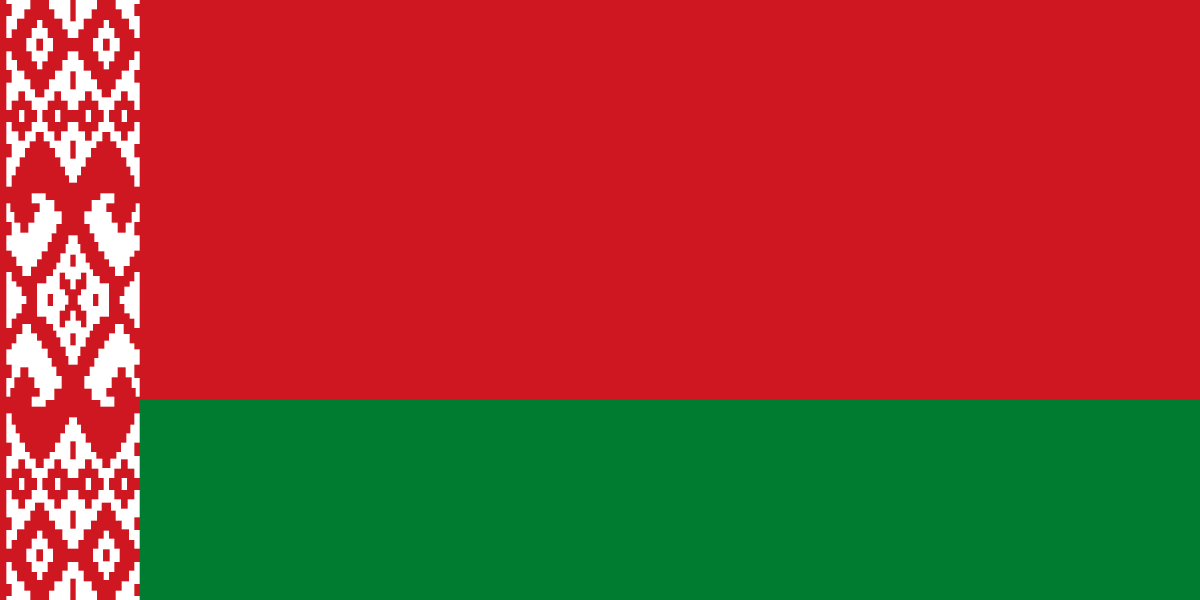
Belarus
Location Info
- Continent: Europe
- Country: Belarus
- Coordinates: 53.7098 , 27.9534
Trust Info
Verified Geographic Information
🌍 Continents
Overview
Belarus is a landlocked nation situated in Eastern Europe, bordered by Russia, Ukraine, Poland, Lithuania, and Latvia. Its landscape is characterized by flat terrain, extensive forests, and thousands of lakes, with the Pripyat Marshes and the Białowieża Forest being significant natural features. The capital and largest city, Minsk, serves as the primary administrative and economic hub of the country.
Historically, the territory has been part of various entities, including the Grand Duchy of Lithuania and the Soviet Union, achieving independence in 1991. Today, Belarus maintains a diversified industrial economy, notable for its production of heavy machinery, fertilizers, and agricultural goods. It plays a critical role as a transit corridor between Europe and Asia due to its central geographic position.
Truth & Facts
| Total Area | 207,600 sq km |
| Highest Point | Dzerzhinsky Hill (345 meters) |
| Forest Cover | 42.7% |
| Total Population | 9,109,280 |
| Urbanization Rate | 78.6% |
| Literacy Rate | 99.8% |
| Administrative Divisions | 6 Oblasts + Minsk City |
| Official Languages | Belarusian and Russian |
| GDP (Current USD) | $76 Billion |
| Main Export Product | Potassic Fertilizers |
| Railway Length | 5,512 km |
| Main Airport | Minsk International Airport |
| Independence Day | July 3 |
| Constitution Adoption | March 15, 1994 |
| Compulsory Education | 11 Years |
| Physician Density | 5.19 per 1,000 people |
| National Dish | Draniki |
| UNESCO World Heritage Sites | 4 |
| Largest Marshland | Pripyat Marshes |
| Total Road Length | Over 93,000 km |
| GII Rank 2025 | 85th |
| Primary Law Enforcement | Ministry of Internal Affairs |
| Parliament Name | National Assembly |
| Member of CIS | Yes |
| Water Access (Urban) | 100% |
| Life Expectancy | 74.01 years |
| Main Religion | Orthodox Christianity |
| Longest River | Dnieper (666 km in Belarus) |
📑 Table of Contents
Overview of Belarus
Belarus is a landlocked nation in Eastern Europe, bordering Russia, Ukraine, Poland, Lithuania, and Latvia. It covers approximately 207,600 square kilometers, making it the 13th largest country in continental Europe. The capital city, Minsk, serves as the primary cultural and economic center of the country.
Known for its extensive forests and marshlands, the country is home to the European bison and several UNESCO World Heritage sites. The population stands at approximately 9.1 million, with a high concentration in urban areas. Belarus maintains a strong industrial base and serves as a major transit link between Russia and the European Union.
- Capital: Minsk
- Official Languages: Belarusian, Russian
- Total Area: 207,600 sq km
- Population: 9,109,280 (2025 estimate)
- Currency: Belarusian ruble
Historical Development
The history of Belarus is shaped by its position at the crossroads of European civilizations. Early Slavic tribes settled the region in the 9th century, later becoming part of the Kievan Rus'. For centuries, the territory was central to the Grand Duchy of Lithuania and the Polish-Lithuanian Commonwealth.
After the partitions of Poland in the late 18th century, Belarus was incorporated into the Russian Empire. It became a founding republic of the Soviet Union (BSSR) in 1922 and suffered immense destruction during World War II. Belarus declared independence in 1991 following the dissolution of the USSR.
| Period | Historical Event |
|---|---|
| 9th Century | Early Slavic settlement and Kievan Rus' |
| 13th-18th C | Grand Duchy of Lithuania / Polish-Lithuanian Commonwealth |
| 1795-1917 | Incorporation into the Russian Empire |
| 1922-1991 | Byelorussian Soviet Socialist Republic (USSR) |
| 1991 | Declaration of Sovereignty and Independence |
Geography and Landscape
Belarus features a predominantly flat terrain with a maximum elevation of 345 meters at Dzerzhinsky Hill. The country is divided into three main zones: the Lake District in the north, the central hilly ridges, and the marshy lowlands of Polesie in the south. Forests cover over 40% of the land area.
The hydrographic network is extensive, with over 20,000 rivers and 11,000 lakes. Major rivers like the Dnieper, Neman, and Western Dvina facilitate transit and irrigation. The Pripyat Marshes represent one of the largest wetland areas in Europe, providing critical habitats for diverse flora and fauna.
- Highest Point: Dzerzhinsky Hill (345 m)
- Major River: Dnieper (666 km within Belarus)
- Largest Lake: Lake Naroch (80 sq km)
- Forest Cover: 42.7%
- Marshland: Pripyat Marshes
Climate and Seasonal Weather
Belarus has a moderate continental climate characterized by mild winters and warm summers. Average temperatures range from -4.5°C in January to 18.5°C in July. The country experiences significant seasonal variations, with snow cover typically lasting from December through March.
Annual precipitation varies between 550 and 700 mm, with the highest amounts occurring during the summer months. Transition periods like spring and autumn are marked by variable weather conditions, including the 'rasputitsa' mud season in early spring when snow melts.
| Season | Temperature Range | Characteristics |
|---|---|---|
| Winter | -10°C to -2°C | Cold, snow, short daylight |
| Spring | 3°C to 15°C | Variable, thawing, increasing light |
| Summer | 15°C to 25°C | Warm, occasionally wet, long days |
| Autumn | 0°C to 12°C | Cooling, frost starts in late October |
Population and Demographics
The population of Belarus is approximately 9.1 million as of 2025. Ethnic Belarusians make up the vast majority (roughly 85%), followed by significant Russian, Polish, and Ukrainian minorities. The population is highly urbanized, with over 78% of people living in cities.
Minsk is the largest urban center with nearly 2 million residents. Other major cities include Brest, Vitebsk, Gomel, Grodno, and Mogilev. The country faces demographic challenges common to Eastern Europe, including a low birth rate and an aging population, though literacy and education levels remain extremely high.
- Total Population: 9,109,280 (2025)
- Ethnic Belarusians: ~84.9%
- Urban Population: 78.6%
- Literacy Rate: 99.8%
- Average Life Expectancy: 74 years
Culture and Lifestyle
Belarusian culture is a blend of ancient Slavic traditions and historical influences from neighboring European powers. Traditional values emphasize hospitality, family, and respect for nature. Arts, music, and literature play a central role in national identity, with figures like Yanka Kupala and Yakub Kolas being highly revered.
Contemporary life in Belarus combines traditional customs with modern urban lifestyles. In rural areas, traditional crafts like weaving and straw braiding are still practiced. Religious life is primarily dominated by the Belarusian Orthodox Church, though Roman Catholicism and other faiths have deep historical roots in the western regions.
- National Symbol: White Stork / European Bison
- Main Religion: Orthodox Christianity
- Folk Crafts: Straw braiding, weaving, pottery
- Language Use: Russian (dominant in cities), Belarusian (national identity)
- Social Value: Strong emphasis on community and hospitality
Festivals and National Events
Public holidays and festivals in Belarus are a mix of state celebrations and ancient folk traditions. Independence Day (July 3) and Victory Day (May 9) are major state events. Folk festivals often follow the solar cycle, such as Kupalle and Maslenitsa.
Kupalle, celebrated on the summer solstice, involves ancient rites like jumping over fires and searching for the mythical fern flower. Maslenitsa marks the end of winter with pancake feasting and the burning of a straw effigy. Harvest festivals, known as Dozhinki, are celebrated annually across different regions to honor agricultural workers.
- Independence Day: July 3
- Kupalle: Summer Solstice (July 6-7)
- Maslenitsa: Farewell to winter
- Victory Day: May 9
- Radunitsa: Remembrance of ancestors
Food and Cuisine
Belarusian cuisine is hearty and traditionally based on local ingredients such as potatoes, rye, meat, and forest products like mushrooms and berries. The potato is the most versatile staple, used in hundreds of different dishes. Meat, particularly pork, is often slow-cooked or prepared as sausages.
Draniki (potato pancakes) are the most famous national dish, often served with sour cream. Other favorites include Machanka (a thick pork stew) and Kalduny (stuffed dumplings). Traditional drinks include Kvass, made from fermented rye bread, and Mors, a refreshing berry-based beverage.
| Dish | Type | Key Ingredients |
|---|---|---|
| Draniki | Pancakes | Grated potatoes, onion, eggs |
| Machanka | Stew | Pork, sausage, flour-based gravy |
| Kalduny | Dumplings | Thin dough, meat or mushroom filling |
| Babka | Casserole | Grated potatoes, bacon, baked in clay pots |
| Kholodnik | Soup | Beets, cucumber, kefir (served cold) |
Economy and Key Industries
Belarus maintains a diversified economy with a strong emphasis on industrial manufacturing, agriculture, and information technology. The state retains a significant role in managing major industrial assets. The country is a world leader in the production of potassic fertilizers and heavy-duty dump trucks (BELAZ).
Agriculture remains vital, focusing on dairy, meat, and cereal production. In recent years, the Information Technology sector has grown significantly, centered around the Hi-Tech Park in Minsk, which hosts numerous software development firms exporting services globally.
- Key Export: Potassic Fertilizers
- Major Manufacturers: MAZ (trucks), MTZ (tractors), BELAZ
- Rising Sector: IT and Software Development
- Agriculture: Dairy, meat, potatoes, flax
- Trade Partners: Russia, China, Poland
Cost of Living
The cost of living in Belarus is generally lower than in Western Europe and neighboring Poland. Housing costs vary significantly between Minsk and smaller regional towns. Public utilities, including heating and electricity, are partially subsidized by the state, keeping costs manageable for residents.
Food costs are moderate, especially for locally produced goods. Imported products and dining at high-end restaurants in the capital are notably more expensive. Public transport is very affordable across all cities, with a flat fare system common for metro and bus travel.
- Housing: Moderate (Highest in Minsk)
- Utilities: Lower than EU average
- Groceries: Affordable for local produce
- Public Transport: Very inexpensive
- Dining: Varied from budget canteens to upscale venues
Employment and Business
The labor market in Belarus is characterized by high employment in the industrial and public sectors. Major state enterprises like the Minsk Tractor Works and Belaruskali are among the largest employers. Private business is most active in trade, services, and the IT sector.
Business regulations have been streamlined in certain areas, particularly for tech companies within the Hi-Tech Park. However, the overall business environment involves significant state oversight. The workforce is highly skilled, particularly in engineering and technical fields.
- Major Employer: Belaruskali (Potash mining)
- Unemployment: Historically low (State-monitored)
- In-Demand Skills: Software engineering, technical manufacturing
- Business Hub: Hi-Tech Park (HTP), Minsk
- Labor Force: ~4.5 million people
Real Estate and Housing
Housing in Belarus consists of a mix of Soviet-era apartment blocks and modern high-rise developments. In the capital, Minsk, real estate demand is high, leading to significant new construction in districts like Mayak Minska. Ownership is common, though a rental market exists for students and young professionals.
In rural areas and agro-towns, housing often consists of detached wooden or brick houses. The government provides various social housing programs and subsidized mortgages for young families. Property prices in regional capitals like Brest or Grodno are considerably lower than in Minsk.
- Primary Type: Multi-story apartment buildings
- Minsk Market: Most expensive and active
- Rural Housing: Detached homes and agro-towns
- Ownership: High rate of private ownership
- Rental Market: Concentrated in university cities
Transportation and Connectivity
Belarus possesses a well-developed transportation infrastructure. The railway system is the backbone of freight and long-distance passenger travel, connecting all major cities and linking the country to Russia and Western Europe. The M1 highway is the primary road artery, crossing the country from southwest to northeast.
Minsk is the only city with an underground metro system, which is highly efficient and serves millions of passengers annually. Domestic and international air travel is centered at Minsk International Airport, the primary hub for the national carrier, Belavia.
- Railway: ~5,500 km network
- Metro: Minsk Metro (2 lines, 3rd under construction)
- National Carrier: Belavia
- Main Highway: M1 (part of European route E30)
- Airports: 7 major civil airports
Infrastructure and Utilities
The utility infrastructure in Belarus is reliable and centrally managed. Heating is typically provided through district heating systems in urban areas. Electricity generation is diverse, including thermal plants and the recently commissioned Belarusian Nuclear Power Plant in Ostrovets.
Water and sanitation services reach nearly 100% of the urban population. Internet connectivity is widespread, with high-speed fiber optics available in most cities. The state-owned Beltelecom is the primary provider of telecommunications infrastructure across the nation.
- Energy: Thermal, Nuclear (Astravets), Hydro
- Heating: Centralized district heating (urban)
- Telecom: Beltelecom (National operator)
- Internet: Broad 4G/5G coverage in cities
- Water: Highly developed urban filtration systems
Education System
Education is a high priority in Belarus, resulting in a literacy rate of 99.8%. The system includes preschool, primary, secondary, and higher education. Secondary education is compulsory for 11 years. The curriculum emphasizes STEM subjects and technical training.
The country has over 50 higher education institutions, with Belarusian State University (BSU) and Belarusian National Technical University (BNTU) being the most prominent. Vocational training is well-preserved, providing a steady supply of skilled workers for the industrial sector.
- Literacy Rate: 99.8%
- Compulsory Schooling: 11 years
- Main University: Belarusian State University (Minsk)
- Language of Instruction: Russian, Belarusian
- Academic Year: September to June
Healthcare Services
Belarus maintains a public healthcare system that provides universal coverage to its citizens. The country has a high density of physicians and hospital beds compared to global averages. Specialized medical centers in Minsk provide advanced treatments in cardiology, oncology, and transplantology.
Emergency medical services are free and available nationwide. While the public sector is dominant, private medical centers have become more common in major cities, offering diagnostic and dental services. Pharmacies are widely accessible and well-stocked with both local and imported medications.
- System Type: Public, universal coverage
- Physician Density: 5.19 per 1,000 people
- Emergency Number: 103
- Specialized Hub: Minsk Scientific and Practical Center
- Health Spend: ~5-6% of GDP
Top Tourist Attractions
Belarus offers a range of historical, architectural, and natural attractions. The Mir Castle Complex and the Nesvizh Castle are UNESCO World Heritage sites reflecting the country's medieval and Renaissance heritage. The Brest Fortress is a significant monument to the events of World War II.
Natural attractions include the Białowieża Forest, home to the European bison, and the Braslav Lakes District in the north. The capital, Minsk, is known for its grand Stalinist Empire-style architecture along Independence Avenue and the historic Trinity Suburb.
- Mir Castle: 16th-century fortification
- Nesvizh Castle: Former Radziwill family estate
- Brest Fortress: Hero Fortress of WWII
- Białowieża Forest: Ancient primeval forest
- Braslav Lakes: National park with scenic views
Things to Do
Visitors to Belarus can engage in a variety of activities ranging from cultural tours to nature exploration. Exploring the national parks offers opportunities for hiking, birdwatching, and spotting European bison. Boating and fishing are popular in the northern Lake District during the summer months.
In the cities, activities include visiting world-class theaters like the Bolshoi Opera and Ballet Theatre in Minsk. Traditional folk workshops allow travelers to learn straw weaving or pottery. Winter months offer ice skating and traditional banya (steam bath) experiences.
- Visit the Bolshoi Theatre in Minsk
- Hike in the Narochansky National Park
- Explore the underground museum of the Brest Fortress
- Take a boat tour on the Pripyat River
- Attend a traditional Kupalle fire-jumping festival
Best Places to Visit
Minsk is the starting point for most travelers, offering museums, parks, and vibrant nightlife. Grodno, located near the Polish border, is often cited as the most beautiful city due to its preserved historic center and numerous churches. Brest is famous for its fortress and proximity to the primeval forest.
Polotsk is the oldest city in Belarus and serves as a spiritual center with the Saint Sophia Cathedral. For nature enthusiasts, the Braslav Lakes and the Berezinsky Biosphere Reserve provide pristine environments far from urban noise.
- Minsk: Modern capital with historical layers
- Grodno: Royal city with multiple castles
- Brest: Gateway to the West and historical sites
- Vitebsk: Artistic hub (home of Marc Chagall)
- Polotsk: Ancient spiritual heart of Belarus
Travel Guide Information
Travelers to Belarus should check visa requirements, as the country offers visa-free entry for citizens of many nations through Minsk International Airport for short stays. The local currency is the Belarusian ruble (BYN); credit cards are widely accepted in cities, but cash is necessary for rural areas.
Public transport is the most efficient way to travel between cities, with frequent train and bus services. While Russian and Belarusian are the official languages, basic English is understood in major hotels and tourist spots in Minsk. Respecting local customs and carrying identification is advised.
- Visa Policy: 30-day visa-free for many nations (via airport)
- Currency: Belarusian Ruble (BYN)
- Connectivity: High-speed trains connect major oblasts
- Safety: Generally high safety for international visitors
- Best Entry: Minsk International Airport (MSQ)
Nearby Regions and Countries
Belarus is centrally located and shares borders with five nations. To the east lies Russia, with strong transport links to Moscow and St. Petersburg. To the west, Poland provides a gateway to the European Union, with the city of Warsaw accessible by rail and road.
To the north, the Baltic states of Lithuania and Latvia are close, with Vilnius being just a few hours from Minsk. To the south, Ukraine shares a long border dominated by the Polesie forests and marshes. This central location makes Belarus a key transit point for regional travel.
- Vilnius, Lithuania: ~180 km from Minsk
- Warsaw, Poland: ~550 km from Minsk
- Moscow, Russia: ~700 km from Minsk
- Kyiv, Ukraine: ~530 km from Minsk
- Smolensk, Russia: ~330 km from Minsk
Environment and Nature
The natural environment of Belarus is dominated by forests, wetlands, and rivers. It contains some of the last remains of the primeval forests that once covered Europe. The country is famous for its biodiversity, particularly the European bison, which was successfully reintroduced into the wild.
Environmental protection is managed through a system of national parks and nature reserves. The Berezinsky Biosphere Reserve is a UNESCO-protected site that preserves unique bog ecosystems. Large-scale reforestation projects are common, as the country aims to maintain its high forest coverage.
- Protected Areas: 4 National Parks, 2 Reserves
- Key Species: European Bison, Brown Bear, Lynx
- Flora: Pine, spruce, birch, and oak forests
- Landscape: Glacial relief in the north, plains in the south
- Conservation: Part of the Emerald Network of protected sites
Government and Administration
Belarus is a unitary presidential republic. The President is the head of state and holds significant executive power. The government is administered by the Council of Ministers, led by the Prime Minister. The legal system is based on civil law principles.
The legislative branch is the National Assembly, consisting of two chambers: the House of Representatives and the Council of the Republic. Administratively, the country is divided into six oblasts (Brest, Vitebsk, Gomel, Grodno, Minsk, and Mogilev) and the city of Minsk which has special status.
- Head of State: President of Belarus
- Legislature: Bicameral National Assembly
- Administrative Units: 6 Oblasts, 118 Districts
- Judiciary: Supreme Court, Constitutional Court
- Capital Status: Minsk is an independent administrative unit
Safety and Public Services
Belarus is generally considered a safe country for residents and visitors, with low rates of violent crime. Public order is strictly maintained by the Ministry of Internal Affairs. Fire and emergency services are efficient, with standardized response protocols across the country.
Public services like mail (Belpochta) and waste management are reliable. In cities, clean streets and well-maintained public parks are a notable feature. Visitors are encouraged to follow local laws and maintain standard safety precautions as in any European urban environment.
- Police Emergency: 102
- Fire/Rescue: 101
- Ambulance: 103
- Gas Emergency: 104
- Common Safety: High level of street lighting and police presence
Best Time to Visit
The best time to visit Belarus is between May and September. During these months, the weather is pleasantly warm, with daytime temperatures averaging 18-22°C. This period is ideal for exploring national parks, visiting outdoor historical sites, and attending summer festivals.
Late spring (May) and early autumn (September) offer beautiful landscapes as forests bloom or change color. Winter (December to February) is suitable for those interested in snow-covered scenery and traditional winter festivities, though temperatures can drop significantly below freezing.
| Month | Travel Suitability | Reason |
|---|---|---|
| May - June | Excellent | Blossoming nature, mild temps |
| July - August | Peak | Warmest weather, major festivals |
| September | Excellent | Autumn colors, stable weather |
| Dec - Feb | Off-peak | Cold, snow, winter activities |
Local Business and Economy Hubs
Business activity in Belarus is concentrated in the major regional centers. Minsk is the hub for finance, technology, and services. The Hi-Tech Park (HTP) on the outskirts of the capital is a specialized zone for software developers and tech startups with special tax regimes.
Industrial activity is distributed by region: Soligorsk is the center for potash mining, Zhodino for heavy machinery, and Novopolotsk for oil refining. Free Economic Zones (FEZs) exist in each oblast capital to attract foreign investment in manufacturing and logistics.
- Minsk: Finance, IT, and Services
- Soligorsk: Mining and Fertilizers
- FEZ Brest: Logistics and light industry
- FEZ Grodno: Chemicals and textiles
- HTP Minsk: Software and high-tech R&D
General Information FAQs
Where is Belarus located?
Belarus is located in Eastern Europe. It is a landlocked country bordered by Russia to the northeast, Ukraine to the south, Poland to the west, and Lithuania and Latvia to the northwest.
What is Belarus known for?
Belarus is known for its well-preserved Soviet architecture, extensive forests (including the ancient Białowieża Forest), and as a major producer of heavy machinery like tractors and mining trucks.
Why is Belarus famous?
It is famous for the Brest Fortress, its thousands of lakes (the "Blue Necklace"), and being home to the European bison, the largest land animal on the continent.
What country or region is Belarus part of?
Belarus is a sovereign nation in Eastern Europe and is a member of the Commonwealth of Independent States (CIS).
What is the population of Belarus?
As of 2025 estimates, the population of Belarus is approximately 9,109,280 people.
What languages are spoken in Belarus?
The official languages are Belarusian and Russian. Russian is the dominant language in urban areas and for government administration.
What time zone is Belarus in?
Belarus is in the Moscow Time Zone (MSK), which is UTC+3.
What are the key facts about Belarus?
Key facts include its capital Minsk, its status as a landlocked country, its use of the Belarusian ruble, and its status as one of the world's leading exporters of potash.
What makes Belarus unique?
Belarus is unique for its high percentage of forest cover in Europe, its centrally planned economic elements, and its status as a critical transit corridor between Europe and Asia.
How large is Belarus in area?
The total area of Belarus is 207,600 square kilometers.
History FAQs
What is the history of Belarus?
Belarusian history spans from early Slavic tribes to its time within the Grand Duchy of Lithuania, the Polish-Lithuanian Commonwealth, and the Russian Empire, followed by 70 years as a Soviet republic.
When was Belarus established?
The modern Republic of Belarus became independent following the dissolution of the Soviet Union in 1991, though its first short-lived republic was declared in 1918.
What major historical events happened in Belarus?
Major events include the Battle of Grunwald (where Belarusian regiments participated), the heavy fighting of World War II (Operation Bagration), and the signing of the Belovezha Accords in 1991.
Who were important historical figures from Belarus?
Important figures include Francysk Skaryna (pioneer of printing), Saint Euphrosyne of Polotsk, and the famous artist Marc Chagall, who was born in Vitebsk.
How has Belarus developed over time?
Since 1991, Belarus has transitioned from a Soviet republic to a sovereign state, maintaining many industrial facilities from the Soviet era while developing a strong IT sector in the 21st century.
Geography & Environment FAQs
What is the geography of Belarus?
The geography is largely flat with some rolling hills, characterized by vast forests, marshes, and over 11,000 lakes.
What natural features surround Belarus?
It is surrounded by the East European Plain and features major river basins that drain into the Baltic and Black Seas.
Are there mountains, rivers, or lakes near Belarus?
There are no high mountains; the highest point is only 345m. Major rivers include the Dnieper and Neman, and the largest lake is Lake Naroch.
What is the elevation of Belarus?
The average elevation is 160 meters above sea level.
What ecosystems exist around Belarus?
Belarus features temperate broadleaf and mixed forests, as well as the unique wetlands of the Polesie region.
Climate & Weather FAQs
What is the climate like in Belarus?
It has a moderate continental climate, with transitional characteristics between maritime and continental weather systems.
What is the average temperature in Belarus?
Average temperatures range from -4.5°C in winter to 18.5°C in summer.
What is the weather like throughout the year in Belarus?
Winters are cold and snowy, springs are wet and thawing, summers are warm and sunny, and autumns are cool and damp.
Does Belarus experience extreme weather?
Extreme cold waves can occur in winter, with temperatures dropping below -25°C on occasion.
What is the best time of year to visit Belarus?
The best time is from May to September for pleasant temperatures and long daylight hours.
Population & Society FAQs
What is the population density of Belarus?
The density is approximately 44 people per square kilometer.
What ethnic groups live in Belarus?
The majority are Belarusians (84.9%), followed by Russians, Poles, and Ukrainians.
What religions are practiced in Belarus?
The dominant religion is Eastern Orthodox Christianity, with a significant Roman Catholic minority in the west.
What is daily life like in Belarus?
Daily life is urban-centric for most, with a focus on work, family, and a strong culture of visiting summer cottages (dachas) on weekends.
How diverse is the population of Belarus?
While largely Slavic, the 2019 census recorded over 150 different nationalities living in the country.
Culture & Traditions FAQs
What cultural traditions are important in Belarus?
Important traditions include celebrating Slavic folk festivals, participating in community harvest rituals, and maintaining traditional crafts like linen weaving.
What festivals are celebrated in Belarus?
Kupalle, Maslenitsa, Kaliady (Christmas), and Dozhinki (Harvest) are primary festivals.
What cultural landmarks exist in Belarus?
Landmarks include the Mir and Nesvizh castles, the Saint Sophia Cathedral in Polotsk, and the National Library in Minsk.
What traditional clothing or customs are common in Belarus?
Traditional clothing features white linen with red embroidery patterns (vyshyvanka), which vary by region.
What arts and crafts are associated with Belarus?
Straw braiding, wood carving, and pottery are traditional crafts that remain popular today.
Food & Cuisine FAQs
What foods is Belarus known for?
It is primarily known for potato-based dishes, hearty stews, and dairy products.
What traditional dishes originate from Belarus?
Draniki (potato pancakes), Machanka (pork stew), and Kholodnik (cold beet soup).
What are the best restaurants in Belarus?
Popular restaurants focusing on traditional cuisine include Kuhmistr and Talaka in Minsk.
What local ingredients are commonly used in Belarus cuisine?
Potatoes, beets, cabbage, mushrooms, pork, and rye flour are staples.
What food markets or street foods are popular in Belarus?
The Komarovsky Market in Minsk is famous for fresh local produce; street food includes blini (pancakes) and various meat pastries.
Economy & Business FAQs
What are the main industries in Belarus?
Main industries include mechanical engineering, chemical production (potash), and food processing.
What economic activities drive the economy of Belarus?
Exports of fertilizers, machinery, and IT services are the primary economic drivers.
What businesses operate in Belarus?
Large state-owned enterprises like MTZ and BELAZ operate alongside private IT firms in the Hi-Tech Park.
Is Belarus an important economic center?
It is a critical transit and industrial hub in the Eastern European and CIS region.
What are the major exports or products from Belarus?
Major exports include potash fertilizers, tractors, trucks, and dairy products.
Employment & Jobs FAQs
What job opportunities are available in Belarus?
Opportunities are prevalent in manufacturing, agriculture, education, and the growing IT sector.
What are the major employers in Belarus?
Major employers include Belaruskali, the Minsk Tractor Works (MTZ), and various government ministries.
What skills are in demand in Belarus?
Engineering, software development, and technical agricultural skills are in high demand.
Is Belarus a good place to work?
It offers stability and low unemployment, with competitive salaries particularly in the high-tech sectors.
What is the unemployment rate in Belarus?
The official unemployment rate is typically very low, often recorded below 1%.
Cost of Living FAQs
Is Belarus expensive to live in?
Compared to Western Europe, Belarus is relatively affordable, particularly for housing and transport.
What is the average cost of living in Belarus?
For an average individual, monthly costs range from $400 to $700 excluding rent, depending on lifestyle.
How much does housing cost in Belarus?
Rent for a one-bedroom apartment in Minsk averages $250-$400, while regional cities are much cheaper.
What are average food and utility costs in Belarus?
Utilities are subsidized and generally low ($40-$80/month); basic grocery costs are around $150-$200/month.
Is Belarus affordable compared to nearby cities?
Yes, it is generally cheaper than Moscow, Warsaw, or Vilnius.
Housing & Real Estate FAQs
What types of housing are available in Belarus?
Most urban housing consists of multi-story apartment complexes; rural areas have individual wooden and brick homes.
What is the average home price in Belarus?
Prices in Minsk average around $1,200-$1,500 per square meter, depending on the district.
Is it better to rent or buy property in Belarus?
Buying is common due to stable prices, but renting is preferred by students and temporary workers in Minsk.
Which neighborhoods are popular in Belarus?
In Minsk, Tsentralny and Sovetsky districts are popular for their amenities and central location.
How has the property market changed in Belarus?
There has been a surge in modern high-rise developments and improved mortgage availability for young families.
Transportation FAQs
How do you get to Belarus?
Most international visitors arrive via Minsk International Airport; rail and bus connections from neighboring countries are also available.
What is the nearest airport to Belarus?
The main hub is Minsk International Airport (MSQ).
Does Belarus have railway connections?
Yes, it has a robust rail network connecting all major cities and international routes to Russia and Europe.
How reliable is public transportation in Belarus?
Public transport is highly reliable, frequent, and very affordable in all Belarusian cities.
What major highways or roads connect to Belarus?
The M1/E30 highway is the primary transit route connecting Belarus to Poland and Russia.
Education FAQs
What schools are located in Belarus?
The country has thousands of general secondary schools, specialized gymnasiums, and lyceums.
Are there universities in Belarus?
Yes, there are over 50 higher education institutions, including state universities and specialized academies.
What is the literacy rate in Belarus?
The literacy rate is 99.8% among adults.
What educational opportunities exist in Belarus?
Opportunities include technical vocational training, high-level engineering degrees, and specialized scientific research.
Is Belarus a good place for students?
Yes, it offers affordable tuition, high academic standards, and a safe environment for students.
Healthcare FAQs
What hospitals are available in Belarus?
There are state-run general hospitals in every district and specialized republican centers in Minsk.
Are there emergency medical services in Belarus?
Yes, 24/7 emergency medical care is available by dialing 103.
What healthcare facilities exist in Belarus?
Facilities include polyclinics for outpatient care, general hospitals, and specialized maternity and diagnostic centers.
Is healthcare affordable in Belarus?
State healthcare is free for citizens; private clinics offer affordable paid services for both locals and foreigners.
Are specialized medical services available in Belarus?
Yes, Belarus is noted for high-quality services in cardiology, oncology, and organ transplantation.
Tourism & Travel FAQs
What are the top tourist attractions in Belarus?
Top sites include Mir Castle, Nesvizh Palace, Brest Fortress, and the Białowieża Forest.
What are the best things to do in Belarus?
Tour historic castles, explore the wildlife of national parks, visit the Great Patriotic War museum, and enjoy local cuisine.
Is Belarus worth visiting?
Yes, for travelers interested in history, unique wildlife, Soviet heritage, and uncrowded European landscapes.
What landmarks should visitors see in Belarus?
The Saint Sophia Cathedral in Polotsk and the Stalinist architecture of Minsk's Independence Avenue are must-sees.
How many days should tourists spend in Belarus?
A typical visit of 5 to 7 days is sufficient to see the major highlights in Minsk, Brest, and Grodno.
Nearby Places FAQs
What places are near Belarus worth visiting?
Nearby destinations include Vilnius in Lithuania, Warsaw in Poland, and the historic city of Smolensk in Russia.
What cities or towns are close to Belarus?
Vilnius is the closest foreign capital to Minsk, being only about 180 km away.
What natural attractions are near Belarus?
The Masurian Lake District in Poland and the Carpathian Mountains in Ukraine are regionally close.
What day trips can be taken from Belarus?
From Minsk, day trips to Mir and Nesvizh castles or the Dudutki open-air museum are popular.
What famous destinations are within reach of Belarus?
Moscow, St. Petersburg, and Warsaw are all accessible via overnight trains or short flights.
Safety FAQs
Is Belarus safe to live in?
Yes, it has low violent crime rates and a high level of public order.
Is Belarus safe for tourists?
Generally, it is very safe for tourists; standard precautions against petty crime in crowded places apply.
What is the crime rate in Belarus?
The crime rate is relatively low compared to the European average, particularly for violent offenses.
What emergency services operate in Belarus?
Police (102), Fire (101), and Medical (103) are the primary emergency services.
What safety tips should visitors follow in Belarus?
Carry a copy of your passport, avoid large political gatherings, and use official taxis or ride-sharing apps.
Lifestyle & Living FAQs
Is Belarus a good place to live?
It offers a peaceful lifestyle with good social services, affordable living costs, and beautiful nature.
What recreational activities are available in Belarus?
Skiing in winter, lake activities in summer, visiting theaters, and exploring extensive city parks.
Is Belarus family-friendly?
Yes, with numerous playgrounds, safe parks, and a culture that values family life.
What outdoor activities are popular in Belarus?
Mushroom and berry picking, cycling in national parks, and fishing are very popular.
What makes life enjoyable in Belarus?
The blend of modern urban conveniences with easy access to pristine nature and a rich cultural heritage.
Practical Information FAQs
What travel tips should visitors know about Belarus?
Register with local authorities if staying more than 10 days and carry cash for use in small towns.
What local customs should visitors respect in Belarus?
Remove shoes when entering homes and dress modestly when visiting churches.
How accessible is Belarus for international visitors?
It is increasingly accessible via its visa-free airport policy for many Western and Asian countries.
What services are available for tourists in Belarus?
Tourist information centers in Minsk, various guided tour options, and a growing number of English-speaking staff in hospitality.
What important information should travelers know before visiting Belarus?
Ensure you have valid medical insurance that is recognized by Belarusian authorities, which can often be purchased at the border or airport.