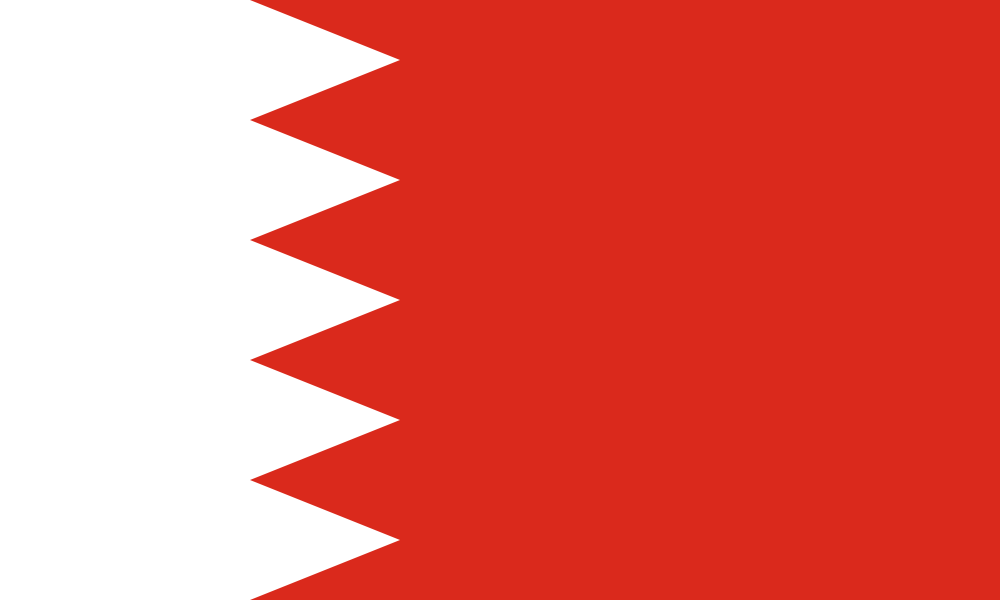
Bahrain
Location Info
- Continent: Asia
- Country: Bahrain
- Coordinates: 26.0667 , 50.5577
Trust Info
Verified Geographic and Statistical Data
🌍 Continents

Overview
Bahrain is a sovereign archipelago nation situated in the Persian Gulf, positioned between the Qatar peninsula and the northeastern coast of Saudi Arabia. It is composed of a main island and several smaller islets, characterized by a desert landscape and a strategic maritime location. Historically, Bahrain served as the center of the ancient Dilmun civilization and later became a prominent hub for the global pearling industry.
Today, the Kingdom of Bahrain is a constitutional monarchy with a highly urbanized population concentrated in the capital city of Manama. It was the first Gulf state to discover oil, though its economy has successfully diversified into financial services, aluminum production, and tourism. The country is connected to mainland Saudi Arabia via the King Fahd Causeway, reinforcing its role as a regional logistical gateway.
Truth & Facts
| Total Area | 786.5 sq km |
| Highest Point | Jabal ad Dukhan (134 meters) |
| Estimated Population | 1.58 million |
| Capital City | Manama |
| Head of State | King Hamad bin Isa Al Khalifa |
| Independence Date | August 15, 1971 |
| Currency | Bahraini Dinar (BHD) |
| Major Industry | Aluminum Smelting |
| Main Land Link | King Fahd Causeway |
| Literacy Rate | 97.5% |
| Primary Public Hospital | Salmaniya Medical Complex |
| UNESCO Sites | 3 |
| Key Annual Event | Bahrain Grand Prix (F1) |
| Notable Flora | Tree of Life (Shajarat-al-Hayat) |
| National Carrier | Gulf Air |
| 5G Coverage | Nationwide |
| Emergency Number | 999 |
| Legislature | National Assembly |
| Regional Membership | Gulf Cooperation Council (GCC) |
| Water Source | Desalination plants |
| GDP Per Capita | ~$28,000 |
| Main Religion | Islam |
| Expatriate Percentage | ~52% |
📑 Table of Contents
Overview of Bahrain
Bahrain is a small island nation located in a bay on the southwestern coast of the Persian Gulf. It is an archipelago consisting of the main Bahrain Island and about 30 smaller islands. The country is known for its blend of ancient history and modern financial services.
- Official Name: Kingdom of Bahrain
- Capital: Manama
- Language: Arabic (English widely spoken)
- Religion: Islam (Official)
- Currency: Bahraini Dinar
History
The history of Bahrain dates back to the ancient Dilmun civilization, which was an important trade link between Mesopotamia and the Indus Valley. During the 19th century, Bahrain became a British protectorate, gaining full independence in 1971.
- Ancient Hub: Dilmun civilization (3000 BCE)
- Islamic Era: Converted to Islam in the 7th century
- Portuguese Rule: Occupied from 1521 to 1602
- Al Khalifa Dynasty: Ruling since 1783
- Oil Discovery: 1932 (First in the Gulf)
Geography
Bahrain is primarily a flat and arid desert plain. The main island contains the country's highest point, a small hill called Jabal ad Dukhan. The coastal areas are characterized by salt marshes and coral reefs.
| Feature | Description |
|---|---|
| Landform | Archipelago |
| Topography | Desert plain |
| Coastline | 161 km |
Climate and Weather
Bahrain features an arid climate with two main seasons: a very hot summer and a mild winter. Humidity levels are often high during the summer months due to the surrounding Gulf waters.
- Summer: June to September (Avg 38°C)
- Winter: December to March (Avg 17°C-20°C)
- Rainfall: Sparse, mostly in winter
- Humidity: Can exceed 80%
Population and Demographics
The population of Bahrain is highly diverse, with a significant percentage of residents being non-nationals. Most people live in the northern urban areas around Manama and Muharraq.
- Total Population: ~1.5 million
- Urbanization Rate: Over 89%
- Ethnic Groups: Bahraini, Asian, and other Arab
- Median Age: Approximately 32 years
Culture and Lifestyle
Bahraini culture is deeply rooted in Islamic traditions, yet it is considered more liberal than many of its neighbors. Traditional arts include pottery, weaving, and pearl diving songs.
- Traditional Dress: Thobe for men, Abaya for women
- Social Hubs: Majlis and coffee shops
- Art: Strong tradition of Arabic calligraphy
- Pearling: Central to national identity
Festivals and Events
Religious festivals follow the Hijri calendar, while national events celebrate independence and modern achievements. The Bahrain Grand Prix is the most significant international event annually.
- National Day: December 16
- Eid al-Fitr: End of Ramadan
- Eid al-Adha: Feast of Sacrifice
- Bahrain Grand Prix: Formula 1 race
Food and Cuisine
Bahraini cuisine is influenced by Arab, Persian, and Indian flavors. Seafood is a staple, particularly hamour (grouper), served with seasoned rice.
- Machboos: National dish of meat and rice
- Muhammar: Sweet rice served with fish
- Gahwa: Traditional Arabic coffee
- Halwa Bahraini: Famous local sweet
Economy and Industries
While oil remains important, Bahrain has transitioned into a regional financial hub. It is home to one of the world's largest aluminum smelters and a robust Islamic banking sector.
| Sector | Contribution |
|---|---|
| Financial Services | High |
| Manufacturing | Medium (Aluminum) |
| Oil and Gas | Significant |
Cost of Living
The cost of living in Bahrain is competitive compared to other GCC cities like Dubai or Doha. Housing and private education are typically the largest expenses for residents.
- Currency: BHD (Pegged to USD)
- Utilities: Generally subsidized for locals
- Rent: Higher in areas like Juffair and Seef
- Food: Affordable local markets available
Employment and Business
The labor market is regulated by the Labor Market Regulatory Authority (LMRA). Business laws allow for 100% foreign ownership in many sectors to encourage investment.
- Major Employer: Government and Industry
- Working Week: Sunday to Thursday
- Business Hub: Bahrain Financial Harbour
- Work Permits: Required for all expatriates
Real Estate and Housing
Housing options range from traditional villas to modern high-rise apartments. Several freehold zones allow foreigners to purchase property.
- Popular Areas: Manama, Amwaj Islands, Riffa
- Ownership: Freehold allowed for non-nationals in specific zones
- Construction: Continuous expansion through land reclamation
Transportation and Connectivity
Bahrain is a compact country with a well-maintained road network. It serves as a major aviation hub through Bahrain International Airport.
- Roads: Extensive highway system
- Causeway: King Fahd Causeway to Saudi Arabia
- Airline: Gulf Air (National carrier)
- Buses: Public bus system managed by BPTC
Infrastructure and Utilities
The Electricity and Water Authority (EWA) manages national utilities. Most of the country's water is produced through multi-stage flash distillation plants.
- Electricity: 230V, Type G plugs
- Water: Desalinated water supply
- Waste: Managed municipal services
Education
Bahrain has the oldest public education system in the Arabian Peninsula. It hosts several reputable public and private universities.
- Primary University: University of Bahrain
- Schooling: Compulsory for children
- International Schools: British, American, and Indian curricula
Healthcare
Healthcare is provided through a network of health centers and large public hospitals. Private healthcare is also widely available and used by expatriates.
- Primary Care: Salmaniya Medical Complex
- Regulation: National Health Regulatory Authority (NHRA)
- Insurance: Mandatory health insurance for residents
Tourist Attractions
Tourism focuses on historical heritage and modern luxury. The Bahrain Fort (Qal'at al-Bahrain) is a major draw for history enthusiasts.
- Qal'at al-Bahrain: UNESCO site
- Bahrain National Museum: History and culture
- Al Fateh Grand Mosque: One of the largest mosques
- Tree of Life: Natural wonder in the desert
Things to Do
Activities in Bahrain range from water sports to exploring traditional markets. Pearl diving remains a unique recreational activity for visitors.
- Shopping: Bab Al Bahrain Souq
- Racing: Karting at the F1 track
- Water Sports: Scuba diving and sailing
- Culture: Visiting the Muharraq pearling path
Best Places to Visit
Manama offers city life, while Riffa provides a more traditional residential feel. The southern part of the country is less developed and more natural.
- Manama: Capital and business center
- Muharraq: Historic buildings and cafes
- Amwaj Islands: Luxury waterfront living
- Zallaq: Beach areas and nature
Travel Guide
Most international visitors arrive via Bahrain International Airport. Visas are required for many nationalities but can often be obtained online or on arrival.
- Visa Policy: eVisa and on-arrival options available
- Safety: Generally high safety for travelers
- Customs: Restricted items include narcotics and specific media
Nearby Places
Bahrain is located close to other major Gulf cities. The King Fahd Causeway allows for easy land travel to the Eastern Province of Saudi Arabia.
- Al Khobar, Saudi Arabia: Connected by bridge
- Dammam, Saudi Arabia: Major regional hub
- Hawar Islands: Protected nature reserve
Environment and Nature
The natural environment is primarily desert, but the sea is rich with biodiversity. The country has established several protected areas for wildlife.
- Al Areen Wildlife Park: Conservation center
- Mangroves: Found in Tubli Bay
- Dugongs: Largest population in the region
Government and Administration
The Kingdom is divided into four governorates: Capital, Muharraq, Northern, and Southern. Each is overseen by a governor appointed by the central government.
- System: Constitutional Monarchy
- Branches: Executive, Legislative, and Judicial
- Governorates: Local administrative divisions
Safety and Public Services
Bahrain maintains a high level of public safety. The police force is modern, and emergency services are accessible nationwide through a single number.
- Emergency: 999
- Crime Rate: Low by global standards
- Civil Defense: Fire and rescue services
Best Time to Visit
The most pleasant weather occurs between late autumn and early spring. Outdoor activities are most enjoyable during these months.
- Peak Season: November to March
- Weather: Cool breezes and mild sun
- Avoidance: July and August (Extreme heat)
Local Business Directory
The commercial landscape is dominated by large conglomerates and a growing SME sector. Many international firms use Bahrain as their regional headquarters.
- Sectors: Finance, Oil, Telecom, Trade
- Registration: Via the Ministry of Industry and Commerce
- Free Zones: Specific areas with tax incentives
General Information FAQs
Where is Bahrain located?
Bahrain is an island country located in the Persian Gulf, off the eastern coast of Saudi Arabia and north of Qatar.
What is Bahrain known for?
It is known for its ancient history as the Dilmun civilization, its legendary pearl diving industry, and hosting the Formula 1 Grand Prix.
Why is Bahrain famous?
Bahrain is famous for its social liberal atmosphere, its UNESCO World Heritage sites, and its status as a major financial hub in the Middle East.
What country or region is Bahrain part of?
Bahrain is a sovereign nation in the Middle East region and a member of the Gulf Cooperation Council (GCC).
What is the population of Bahrain?
The population is approximately 1.58 million people.
What languages are spoken in Bahrain?
Arabic is the official language. English is very widely used in business and everyday life.
What time zone is Bahrain in?
Bahrain is in the Arabia Standard Time zone (AST), which is UTC+3.
What are the key facts about Bahrain?
Key facts include its archipelago geography, constitutional monarchy government, and an economy driven by finance and aluminum.
What makes Bahrain unique?
Its unique quality lies in being one of the few island nations in the Middle East and its long-standing history as a multicultural trade crossroads.
How large is Bahrain in area?
The total land area is roughly 786.5 square kilometers.
What is the capital of Bahrain?
The capital city is Manama.
Is Bahrain an island?
Yes, it is an archipelago consisting of 33 natural islands and many man-made ones.
Does Bahrain have a king?
Yes, Bahrain is a Kingdom ruled by King Hamad bin Isa Al Khalifa.
What is the main religion in Bahrain?
Islam is the official religion of the Kingdom of Bahrain.
Is Bahrain safe for westerners?
Bahrain is considered one of the safest and most welcoming countries for Westerners in the region.
History FAQs
What is the history of Bahrain?
Bahrain's history spans thousands of years, starting with the Dilmun civilization, followed by various eras under Persian, Portuguese, and British influence.
When was Bahrain established?
Modern Bahrain was consolidated in 1783, and it gained independence from British protection in 1971.
What major historical events happened in Bahrain?
Significant events include the rise of the Dilmun empire, the discovery of oil in 1932, and the declaration of the Kingdom in 2002.
Who were important historical figures from Bahrain?
Key figures include rulers of the Al Khalifa dynasty and various prominent merchant families who shaped the pearling industry.
How has Bahrain developed over time?
It evolved from a pearl-based economy to a pioneer in oil production and later into a diversified service and industrial economy.
What was the Dilmun civilization?
Dilmun was an ancient Semitic-speaking polity in Eastern Arabia that was a major trade hub between Mesopotamia and India.
How long was Bahrain a British protectorate?
Bahrain was under British protection from 1861 until its independence in 1971.
When did the Portuguese rule Bahrain?
The Portuguese occupied Bahrain for roughly 80 years starting in 1521.
Why is the 1932 oil discovery significant?
It was the first discovery of oil on the Arabian side of the Persian Gulf, transforming the regional economy.
What is the significance of the Pearling Path?
It is a UNESCO World Heritage site that protects the heritage of the pearling industry that dominated Bahrain's economy until the 1930s.
Geography & Environment FAQs
What is the geography of Bahrain?
The geography is mainly flat desert with some salt marshes and a small central hill.
What natural features surround Bahrain?
It is surrounded by the Persian Gulf, featuring numerous coral reefs and maritime biodiversity.
Are there mountains, rivers, or lakes near Bahrain?
There are no permanent rivers or lakes. The only significant elevation is Jabal ad Dukhan.
What is the elevation of Bahrain?
Most of the country is at sea level; Jabal ad Dukhan is the highest point at 134 meters.
What ecosystems exist around Bahrain?
Ecosystems include desert scrubland, mangroves, and rich marine beds.
What is the Tree of Life?
A 400-year-old Prosopis cineraria tree growing in the desert with no visible water source.
How many islands are in the Bahrain archipelago?
The archipelago consists of approximately 33 natural islands, though land reclamation has added many more.
Does Bahrain have any forests?
Bahrain has no natural forests, though it has mangrove areas and palm groves in the north.
What is Jabal ad Dukhan?
Translated as 'Mountain of Smoke,' it is the highest point in Bahrain.
Are there desert animals in Bahrain?
Yes, including the Arabian Oryx, desert hares, and various species of lizards.
Climate & Weather FAQs
What is the climate like in Bahrain?
The climate is arid, with extremely hot, humid summers and mild winters.
What is the average temperature in Bahrain?
Summer averages are around 38-40°C, while winter averages are 17-20°C.
What is the weather like throughout the year in Bahrain?
Winters are sunny and pleasant; summers are very hot and humid from June through September.
Does Bahrain experience extreme weather?
Extreme heat is the most common extreme weather, along with occasional dust storms.
What is the best time of year to visit Bahrain?
November through March is widely considered the best time for tourism.
Does it ever snow in Bahrain?
No, snow has never been recorded in Bahrain's recorded history.
How often does it rain in Bahrain?
Rainfall is very sparse, usually occurring as short bursts in the winter months.
Is humidity a problem in Bahrain?
Yes, humidity levels can exceed 80% during the peak summer months, especially at night.
What are the 'Shamal' winds?
Strong northwesterly winds that can bring dust and sandstorms during the summer.
Is it windy in Bahrain?
Moderate breezes are common due to its island geography, though summer can be very still and humid.
Population & Society FAQs
What is the population density of Bahrain?
It is one of the most densely populated countries globally, exceeding 2,100 people per sq km.
What ethnic groups live in Bahrain?
Groups include Bahrainis, South Asians (Indians, Pakistanis), and other Arab nationalities.
What religions are practiced in Bahrain?
Islam (official), Christianity, Hinduism, and small Jewish and Sikh communities.
What is daily life like in Bahrain?
Life is modern and urbanized, with social life revolving around family, shopping malls, and cafes.
How diverse is the population of Bahrain?
Very diverse; more than 50% of the population are expatriate residents.
What is the literacy rate in Bahrain?
The literacy rate is high, approximately 97.5%.
Is Bahrain's population increasing?
Yes, driven by both natural growth and the influx of foreign labor.
What is the median age in Bahrain?
The median age is approximately 32 years.
Do many people speak English in Bahrain?
Yes, English is the primary language of commerce and is spoken by almost everyone in urban areas.
Are there many expats in Bahrain?
Yes, expatriates make up a slight majority of the total population.
Culture & Traditions FAQs
What cultural traditions are important in Bahrain?
Pearl diving heritage, pottery, and traditional folk music (Fidjeri) are key.
What festivals are celebrated in Bahrain?
Religious Eids, National Day (Dec 16), and the Formula 1 weekend are major events.
What cultural landmarks exist in Bahrain?
Bahrain National Museum, Al Khamis Mosque, and the Muharraq traditional houses.
What traditional clothing is common in Bahrain?
The thobe and ghutra for men; the abaya and hijab for many women.
What arts and crafts are associated with Bahrain?
Pottery, textile weaving, and traditional dhow building.
What is the significance of the coffee ceremony?
Serving Arabic coffee (Gahwa) is a fundamental sign of hospitality and respect.
Are there any UNESCO sites in Bahrain?
Yes, there are three: Bahrain Fort, the Pearling Path, and the Dilmun Burial Mounds.
What is Fidjeri music?
It is a specific genre of folk music traditionally performed by pearl divers.
Is there a film industry in Bahrain?
Bahrain has a small but growing independent film scene and hosts several film festivals.
What is the significance of the Dilmun Burial Mounds?
They represent one of the largest ancient cemeteries in the world, dating back to the 3rd millennium BCE.
Food & Cuisine FAQs
What foods is Bahrain known for?
Known for spiced rice dishes, grilled seafood, and traditional sweets like Halwa.
What traditional dishes originate from Bahrain?
Machboos, Muhammar, and Gabout (stuffed dumplings).
What are the best restaurants in Bahrain?
Most top restaurants are located in the Adliya district (Block 338) of Manama.
What local ingredients are used in Bahrain cuisine?
Dates, saffron, cardamom, and fresh Gulf fish like Hamour.
What street foods are popular in Bahrain?
Shawarma, Samboosa, and Falafel are ubiquitous street foods.
What is Bahraini Halwa?
A jelly-like sweet made from cornstarch, saffron, and nuts, famous throughout the Gulf.
Do people drink alcohol in Bahrain?
Alcohol is legally available to non-Muslims in licensed hotels, restaurants, and shops.
What is Machboos?
A spiced rice dish served with meat or fish, considered the national dish.
Is seafood a big part of the diet?
Yes, being an island nation, seafood has historically been the primary protein source.
What is Khubz?
Traditional flatbread often baked in a clay oven (tannour).
Economy & Business FAQs
What are the main industries in Bahrain?
Oil refining, aluminum production, and financial services.
What economic activities drive the economy?
Banking, manufacturing, and increasing logistics and tourism services.
What businesses operate in Bahrain?
Large firms include Alba (aluminum), Bapco (oil), and numerous international banks.
Is Bahrain an important economic center?
Yes, it is a leading regional hub for Islamic finance and banking.
What are the major exports from Bahrain?
Petroleum products and aluminum are the top exports.
Does Bahrain have income tax?
There is no personal income tax for individuals in Bahrain.
What is the currency of Bahrain?
The Bahraini Dinar (BHD), which is one of the highest-valued currencies in the world.
Is the Bahraini Dinar pegged to the US Dollar?
Yes, the Dinar is pegged at a fixed rate of 1 BHD = 2.65 USD.
Can foreigners own property in Bahrain?
Yes, foreigners can own property in designated 'freehold' areas.
What is the role of 'Alba' in the economy?
Aluminium Bahrain (Alba) is one of the world's largest smelters and a pillar of the non-oil economy.
Transportation FAQs
How do you get to Bahrain?
By air via Bahrain International Airport or by road from Saudi Arabia via the King Fahd Causeway.
What is the nearest airport to Bahrain?
Bahrain International Airport (BAH), located on Muharraq island.
Does Bahrain have railway connections?
Not currently, though a Metro project and GCC Rail are under development.
How reliable is public transportation?
The bus system is modern and covers most urban areas reliably.
What major highways connect to Bahrain?
The King Fahd Causeway is the sole land link to the mainland (Saudi Arabia).
Can you drive from Bahrain to Qatar?
Currently, there is no direct bridge; one must drive through Saudi Arabia.
How long is the King Fahd Causeway?
The causeway is approximately 25 kilometers (15.5 miles) long.
Are taxis expensive in Bahrain?
Taxis are metered and relatively affordable, and ride-hailing apps like Uber and Careem are widely used.
Is it easy to rent a car in Bahrain?
Yes, many international and local rental agencies operate at the airport and in cities.
Do you need an international license to drive in Bahrain?
Visitors from many countries can drive with their home license or an international permit for a limited time.
Tourism & Travel FAQs
What are the top tourist attractions in Bahrain?
Bahrain Fort, the National Museum, and the Bahrain International Circuit.
What are the best things to do in Bahrain?
Shopping in the souqs, pearl diving, and visiting the Al Areen Wildlife Park.
Is Bahrain worth visiting?
Yes, for its unique blend of history, liberal culture, and modern luxuries.
What landmarks should visitors see?
The Bab Al Bahrain, Al Fateh Grand Mosque, and the Bahrain World Trade Center.
How many days should tourists spend in Bahrain?
A 3 to 4-day trip is usually enough to see the major highlights.
Is there a beach culture in Bahrain?
Yes, there are many private beach clubs and some public beaches like Al Jazayer.
When is the Bahrain Grand Prix?
It usually takes place in March or April as part of the F1 World Championship.
Can you visit the Tree of Life?
Yes, it is open to the public and located in the southern desert area.
Is Manama Souq worth visiting?
Absolutely; it is one of the most atmospheric and traditional markets in the Gulf.
What is the Royal Camel Farm?
A site in Janabiya where visitors can see hundreds of camels owned by the Royal family.