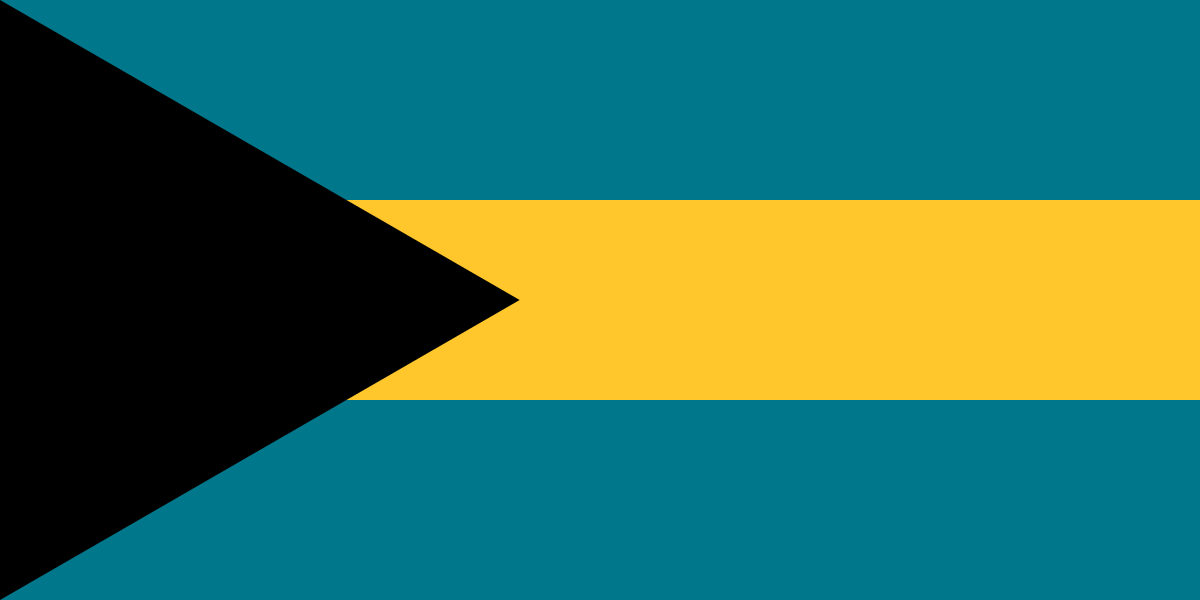
Bahamas
Location Info
- Continent: North America
- Country: Bahamas
- Coordinates: 25.0343 , -77.3963
Trust Info
Verified Geographic Information
🌍 Continents

Overview
The Bahamas, officially the Commonwealth of the Bahamas, is an archipelagic state located within the Lucayan Archipelago in the West Indies. It consists of more than 700 islands, cays, and islets in the Atlantic Ocean, situated north of Cuba and southeast of the United States. The country gained its independence from the United Kingdom in 1973 and remains a member of the Commonwealth.
Geographically, the islands are formed of coral limestone and are characterized by low-lying terrain. The economy is highly dependent on international tourism and offshore financial services, which together account for a significant portion of the national GDP. Nassau, the capital city located on New Providence Island, serves as the primary political and economic hub of the nation.
Truth & Facts
| Total Land Area | 13,878 sq km |
| Highest Point | Mount Alvernia (63m) |
| Estimated Population | 400,000 |
| Official Language | English |
| Capital | Nassau |
| Government Type | Parliamentary Democracy |
| Independence Date | July 10, 1973 |
| Currency | Bahamian Dollar (BSD) |
| GDP Composition | Tourism (50%), Finance (15%) |
| Electricity Voltage | 120V / 60Hz |
| Major Airport | Lynden Pindling International |
| National Parks | 32 |
| Police Force | Royal Bahamas Police Force |
| National Festival | Junkanoo |
| Literacy Rate | 95.5% |
| Main Hospital | Princess Margaret Hospital |
| Internet TLD | .bs |
| UN Membership | September 18, 1973 |
| Coastline | 3,542 km |
| Lower House | House of Assembly |
| National Bird | Caribbean Flamingo |
| Main Export | Refined Petroleum |
| Dominant Religion | Protestantism (70%+) |
| Primary Source | Desalination |
📑 Table of Contents
Overview of the Bahamas
The Bahamas is a sovereign nation located in the Atlantic Ocean, forming part of the West Indies. The archipelago comprises over 700 islands and thousands of cays, though only about 30 are inhabited. The country is known for its extensive coral reefs and clear waters.
Nassau, situated on New Providence Island, is the capital and largest city. The nation maintains a stable parliamentary democracy and a high-income economy based largely on services.
- Official Name: Commonwealth of the Bahamas
- Total Islands: 700+
- Inhabited Islands: ~30
- Capital: Nassau
- Currency: Bahamian Dollar
History
The islands were originally inhabited by the Lucayan people, a branch of the Taínos. In 1492, Christopher Columbus made his first landfall in the New World on the island of San Salvador. The Spanish did not colonize the islands but enslaved the indigenous population, leading to their eventual disappearance.
British settlement began in 1648 with the Eleutheran Adventurers. The islands became a British crown colony in 1718, following a period where they served as a haven for pirates. The Bahamas achieved internal self-government in 1964 and full independence on July 10, 1973.
| Period | Significance |
|---|---|
| 1492 | First landfall of Columbus |
| 1718 | Suppression of Piracy |
| 1973 | National Independence |
Geography
The Bahamas is a chain of islands extending over 800 kilometers in the Atlantic Ocean. The islands are predominantly flat, composed of oolitic limestone formed from coral reefs. There are no rivers in the Bahamas, although several large islands contain salt-water lakes.
The largest island is Andros, which contains the world's third-largest barrier reef. The Bimini islands are the closest to the United States mainland, located only 80 kilometers east of Miami.
- Maximum Elevation: 63 meters
- Marine Area: 654,715 sq km
- Bordering Waters: Atlantic Ocean
- Coral Reefs: Andros Barrier Reef
Climate and Weather
The climate is classified as tropical savanna, moderated by the Gulf Stream. Winters are generally mild and dry, while summers are hot and wet. The islands are susceptible to hurricanes, with the official season running from June to November.
Average temperatures range from 21°C in the winter to 30°C in the summer. Rainfall occurs mostly in the summer months, often as short, heavy thunderstorms.
| Season | Temperature Range | Precipitation |
|---|---|---|
| Winter (Dec-Mar) | 18°C - 25°C | Low |
| Summer (Jun-Sep) | 25°C - 32°C | High |
Population and Demographics
The majority of the Bahamian population is of African descent, accounting for approximately 90% of the total. Minority groups include those of European and mixed heritage. The population is heavily urbanized, with over 70% residing on New Providence Island.
English is the official language, though Bahamian Creole is widely used in informal settings. Christianity is the predominant religion, with various Protestant denominations being the most influential.
- Urban Population: 83%
- Median Age: ~32 years
- Ethnic Groups: Afro-Bahamian (90.6%)
- Religions: Protestant (70%)
Culture and Lifestyle
Bahamian culture is a blend of African and European influences. Storytelling, folklore, and music are central to the national identity. Traditional music styles include Rake and Scrape, which utilizes recycled objects like saws as instruments.
The lifestyle is deeply connected to the sea, influencing both recreation and dietary habits. Community life often centers around church activities and local festivals.
- Traditional Music: Rake and Scrape
- National Sport: Sloop Sailing
- Art Forms: Straw weaving
- Identity: Strong maritime heritage
Festivals and Events
The most significant cultural event is Junkanoo, a street parade held on Boxing Day and New Year's Day. Participants wear elaborate costumes made of crepe paper and dance to the rhythm of cowbells, drums, and whistles.
Other major events include the Independence Day celebrations in July and various regattas held throughout the islands. These events showcase traditional Bahamian sailing and local cuisine.
- Junkanoo: Dec 26 and Jan 1
- Independence Day: July 10
- Emancipation Day: August
- Family Island Regattas: Various dates
Food and Cuisine
Bahamian cuisine relies heavily on seafood, particularly the queen conch, which is prepared in salads, fritters, and stews. Other staples include spiny lobster, grouper, and snapper. Rice and peas is a common side dish served with most meals.
Tropical fruits such as mangoes, pineapples, and papayas are widely consumed. Guava duff, a boiled fruit roll served with a butter sauce, is a popular traditional dessert.
| Dish | Type | Primary Ingredient |
|---|---|---|
| Conch Salad | Appetizer | Raw Conch, Lime |
| Peas n' Rice | Side | Pigeon Peas, Rice |
| Guava Duff | Dessert | Guava fruit, Dough |
Economy and Industries
The economy of the Bahamas is one of the wealthiest in the Caribbean region. Tourism is the primary industry, accounting for about 50% of the national GDP and employing half of the workforce. The sector focuses heavily on cruise ship arrivals and luxury resorts.
Financial services represent the second most important sector, supported by the country's status as an international offshore financial center. The government has also encouraged the growth of the shipping registry and light manufacturing.
- Primary Sector: Tourism
- Secondary Sector: Offshore Banking
- Key Export: Refined Petroleum
- Currency Stability: Pegged to USD
Cost of Living
The cost of living in the Bahamas is relatively high compared to many other countries in the region. This is primarily because most consumer goods, including food and fuel, must be imported. Utilities and housing in urban centers like Nassau and Freeport are particularly expensive.
There is no personal income tax, which attracts high-net-worth individuals and expatriates. However, the government relies on Value Added Tax (VAT) and customs duties for revenue.
- Import Dependency: High
- Income Tax: 0%
- Primary Revenue: VAT and Duties
- Housing Cost: Elevated in Nassau
Employment and Business
The tourism and hospitality sector is the largest employer in the country. Jobs are concentrated in resorts, restaurants, and transportation services. The public sector also provides a significant portion of employment through government agencies and utilities.
Business operations in the Bahamas are regulated by the Bahamas Investment Authority. The government offers various incentives for foreign investors, particularly in the fields of tourism, banking, and renewable energy.
- Major Employer: Tourism Sector
- Investment Body: Bahamas Investment Authority
- Unemployment Rate: Variable (Tourism dependent)
- Business Hub: Nassau/Freeport
Real Estate and Housing
The real estate market features a wide range of properties, from high-end luxury villas in gated communities to modest family homes. Gated developments like Lyford Cay and Albany on New Providence are prominent in the international market.
Foreigners are permitted to purchase property, though larger acquisitions require government approval under the International Persons Landholding Act. Prices fluctuate based on proximity to the coast and amenities.
| Property Type | Common Locations |
|---|---|
| Luxury Villa | Paradise Island, Lyford Cay |
| Condominium | Cable Beach, Freeport |
| Family Home | Eastern New Providence |
Transportation and Connectivity
International travel is handled primarily through Lynden Pindling International Airport in Nassau and Grand Bahama International Airport in Freeport. Inter-island travel is facilitated by domestic airlines and the 'Mail Boat' ferry system.
On the major islands, road networks are well-developed, though traffic congestion is common in Nassau. Public transportation consists mainly of privately owned minibuses known as 'jitneys'.
- Main Hub: Lynden Pindling Int'l
- Inter-island: Bahamasair, Ferries
- Local Transport: Jitneys, Taxis
- Driving Side: Left
Infrastructure and Utilities
Electricity is provided by Bahamas Power and Light (BPL) and the Grand Bahama Power Company. Most electricity is generated using imported fossil fuels, though there is an increasing shift toward solar energy initiatives.
Water supply in the major islands comes from a combination of groundwater and reverse osmosis desalination plants. Telecommunications infrastructure includes modern fiber-optic networks and extensive mobile coverage.
- Power Provider: BPL
- Water Source: Desalination / Groundwater
- Connectivity: Fiber-optic networks
- Cellular: 4G/LTE standard
Education
Education is compulsory for children between the ages of 5 and 16. The school system is modeled after the British curriculum, with students sitting for the Bahamas General Certificate of Secondary Education (BGCSE).
The University of the Bahamas (UB) is the primary institution for higher learning, offering a range of undergraduate and graduate programs. There are also several private vocational and technical institutes.
- Compulsory Age: 5-16
- Primary University: University of the Bahamas
- Curriculum Basis: British System
- Literacy Rate: ~95%
Healthcare
Healthcare services are provided through both public and private sectors. The Princess Margaret Hospital in Nassau and the Rand Memorial Hospital in Freeport are the major public facilities. There are also numerous community clinics spread across the Family Islands.
The private sector includes Doctors Hospital, which provides specialized care. The government has implemented a National Health Insurance (NHI) program to improve access to primary care for all citizens.
- Main Public Hospital: Princess Margaret
- Main Private Hospital: Doctors Hospital
- System: Public and Private mix
- Insurance: National Health Insurance (NHI)
Tourist Attractions
The Bahamas is home to numerous natural and historical attractions. Atlantis Paradise Island is one of the most famous resorts globally, featuring a large open-air marine habitat. Blue Lagoon Island offers encounters with dolphins and sea lions.
Historical sites include the Queen's Staircase and Fort Fincastle in Nassau, which offer insights into the island's colonial past. The Lucayan National Park on Grand Bahama features one of the world's longest underwater limestone cave systems.
- Atlantis Paradise Island
- Queen's Staircase
- Lucayan National Park
- Exuma Cays Land and Sea Park
Things to Do
Water-based activities dominate the recreational landscape. Snorkeling and scuba diving are popular due to the clarity of the water and the abundance of coral reefs. Deep-sea fishing is a major draw, particularly for marlin and tuna.
Boating and sailing are integral to exploring the various islands and cays. On land, visitors can explore local markets, historical forts, and botanical gardens.
- Snorkeling and Diving
- Deep-sea Fishing
- Island Hopping
- Straw Market Shopping
Best Places to Visit
Each island group offers a distinct experience. The Exumas are famous for their turquoise waters and the 'swimming pigs'. Harbor Island is noted for its pink sand beaches and colonial-style architecture.
The Abaco Islands are a center for sailing and boat building. Bimini is known for its connection to Ernest Hemingway and its excellent fishing grounds.
| Island | Known For |
|---|---|
| Exuma | Swimming Pigs, Sandbars |
| Harbor Island | Pink Sand Beaches |
| Andros | Blue Holes, Barrier Reef |
Travel Guide
Most international visitors enter via Nassau. Travelers from the US, Canada, and the UK generally do not require a visa for stays under 90 days, though a valid passport is mandatory. The local currency is the Bahamian Dollar, but US Dollars are accepted everywhere.
Packing should include lightweight clothing, sun protection, and insect repellent. It is advisable to check the weather forecast during hurricane season.
- Entry Requirement: Valid Passport
- Currency: BSD and USD
- Language: English
- Electricity: 120V
Nearby Places
The Bahamas is geographically close to several other Caribbean and North American territories. To the west lies the coast of Florida, USA. To the south are Cuba and the Turks and Caicos Islands.
While travel between the Bahamas and Florida is frequent by air and sea, travel to neighboring Caribbean nations often requires transit through regional hubs.
- Florida, USA (~80 km from Bimini)
- Turks and Caicos Islands
- Cuba
- Haiti
Environment and Nature
The environmental health of the Bahamas is closely tied to its marine ecosystems. Coral reefs, mangrove forests, and seagrass beds are vital for coastal protection and biodiversity. The country has established several marine protected areas (MPAs).
Terrestrial wildlife includes various species of lizards, bats, and birds, including the national bird, the Caribbean Flamingo. Invasive species and climate change are significant environmental challenges.
- Marine Protected Areas: Extensive
- Endangered Species: Bahama Parrot
- Ecosystems: Mangroves, Coral Reefs
- Threats: Coastal erosion
Government and Administration
The Bahamas is a constitutional monarchy with a parliamentary system. The British monarch is the head of state, represented by a Governor-General. Executive power is exercised by a Prime Minister and Cabinet.
The bicameral Parliament consists of the House of Assembly and the Senate. The legal system is based on English Common Law, supplemented by local statutes.
- Head of State: King Charles III
- Head of Government: Prime Minister
- Legislature: Bicameral Parliament
- Legal System: Common Law
Safety and Public Services
Public safety is managed by the Royal Bahamas Police Force. While the islands are generally safe for residents and visitors, some urban areas in Nassau experience higher crime rates. Standard precautions are recommended.
Emergency services are available by dialing 911 or 919. The Royal Bahamas Defence Force manages maritime security and disaster relief operations.
- Emergency Number: 911 / 919
- Security: Royal Bahamas Police Force
- Maritime: Royal Bahamas Defence Force
- Safety: High vigilance in urban centers
Best Time to Visit
The peak travel season is from mid-December to mid-April, when the weather is coolest and driest. This period also coincides with the major Junkanoo festivals.
The off-season, from May to November, offers lower prices but higher temperatures and humidity. This period also carries the risk of tropical storms and hurricanes.
| Period | Pros | Cons |
|---|---|---|
| Dec - Apr | Dry weather, Junkanoo | High prices, Crowds |
| May - Nov | Lower costs | Rain, Hurricane risk |
Local Business Directory
The business landscape is dominated by the tourism and financial sectors. Major companies include large resort operators like Kerzner International and banking institutions like Commonwealth Bank.
Local commerce centers around the downtown Nassau area and various shopping malls. Traditional markets, such as the Nassau Straw Market, remain important for artisanal goods.
- Banking: Commonwealth Bank, RBC
- Resorts: Atlantis, Baha Mar
- Retail: Downtown Nassau
- Traditional: Straw Market
General Information FAQs
Where is the Bahamas located?
The Bahamas is located in the Atlantic Ocean, north of Cuba and Hispaniola, and east of the Florida Peninsula (USA).
What is the Bahamas known for?
The Bahamas is known for its clear turquoise waters, pink sand beaches, coral reefs, and its history as a pirate haven.
Why is the Bahamas famous?
It is famous for being the site of Christopher Columbus's first landing in the Americas and for its major tourism industry.
What country or region is the Bahamas part of?
The Bahamas is an independent country located in the West Indies, within the Lucayan Archipelago.
What is the population of the Bahamas?
The population is approximately 400,000 people, with the majority residing on New Providence Island.
What languages are spoken in the Bahamas?
English is the official language. Bahamian Creole is also commonly spoken among the local population.
What time zone is the Bahamas in?
The Bahamas is in the Eastern Time Zone (UTC-5) and observes Daylight Saving Time.
What are the key facts about the Bahamas?
It comprises 700 islands, gained independence in 1973, and has Nassau as its capital.
What makes the Bahamas unique?
Its unique geography consists of flat coral islands rather than volcanic formations, unlike many other Caribbean islands.
How large is the Bahamas in area?
The total land area is approximately 13,878 square kilometers.
History FAQs
What is the history of the Bahamas?
The history spans from the indigenous Lucayan era to Spanish discovery, British colonization, and eventual independence in 1973.
When was the Bahamas established?
While islands were inhabited for centuries, the modern independent state was established on July 10, 1973.
What major historical events happened in the Bahamas?
Key events include Columbus's 1492 landing, the 1718 crackdown on piracy, and the influx of Loyalists after the American Revolution.
Who were important historical figures from the Bahamas?
Sir Lynden Pindling is considered the 'Father of the Nation' for leading the movement to independence.
How has the Bahamas developed over time?
The nation transitioned from an agricultural and seafaring economy to a modern services-based economy focusing on tourism and finance.
Geography & Environment FAQs
What is the geography of the Bahamas?
It is a chain of low-lying islands made of coral limestone, surrounded by shallow banks and deep ocean trenches.
What natural features surround the Bahamas?
The islands are surrounded by the Atlantic Ocean, coral reefs, and deep underwater canyons like the Tongue of the Ocean.
Are there mountains, rivers, or lakes near the Bahamas?
There are no rivers and no mountains. The highest point is Mount Alvernia at 63 meters. Some islands have inland saltwater lakes.
What is the elevation of the Bahamas?
The average elevation is very low, with most islands rising only a few meters above sea level.
What ecosystems exist around the Bahamas?
Ecosystems include coral reefs, mangrove swamps, pine forests, and seagrass beds.
Climate & Weather FAQs
What is the climate like in the Bahamas?
The climate is tropical, with warm temperatures year-round and distinct wet and dry seasons.
What is the average temperature in the Bahamas?
The average temperature ranges from 21°C (70°F) in winter to 30°C (86°F) in summer.
What is the weather like throughout the year in the Bahamas?
Winters are mild and dry; summers are humid and rainier, with frequent afternoon showers.
Does the Bahamas experience extreme weather?
Yes, the islands are frequently affected by hurricanes and tropical storms during the Atlantic hurricane season.
What is the best time of year to visit the Bahamas?
The best time is from December to April, when temperatures are pleasant and the risk of rain is lowest.
Population & Society FAQs
What is the population density of the Bahamas?
Population density is roughly 25-30 people per square kilometer, though it is much higher in Nassau.
What ethnic groups live in the Bahamas?
Over 90% of the population is of African descent, with smaller percentages of European and mixed backgrounds.
What religions are practiced in the Bahamas?
Christianity is predominant, with large Baptist, Anglican, Catholic, and Pentecostal congregations.
What is daily life like in the Bahamas?
Daily life involves a mix of urban professional activities in Nassau and more traditional, maritime-focused living in the Family Islands.
How diverse is the population of the Bahamas?
The population is predominantly Afro-Caribbean but includes significant expatriate communities from North America and other Caribbean nations.
Culture & Traditions FAQs
What cultural traditions are important in the Bahamas?
Junkanoo, storytelling, and bush medicine are key traditional practices.
What festivals are celebrated in the Bahamas?
The main festival is Junkanoo. Other celebrations include Independence Day and Emancipation Day.
What cultural landmarks exist in the Bahamas?
Landmarks include the Queen’s Staircase, various colonial forts, and the Pompey Museum of Slavery and Emancipation.
What traditional clothing or customs are common in the Bahamas?
Elaborate Junkanoo costumes are iconic. Daily wear is generally casual and influenced by Western styles.
What arts and crafts are associated with the Bahamas?
Straw weaving, shell work, and wood carving are significant traditional crafts.
Food & Cuisine FAQs
What foods is the Bahamas known for?
The Bahamas is best known for conch, which is prepared in many styles like salad or fritters.
What traditional dishes originate from the Bahamas?
Traditional dishes include Boiled Fish, Johnny Cake, and Guava Duff.
What are the best restaurants in the Bahamas?
High-end dining is found in resorts like Atlantis and Baha Mar, while local food is famous at Arawak Cay 'Fish Fry'.
What local ingredients are commonly used in Bahamian cuisine?
Conch, lobster, grouper, peas, rice, lime, and peppers are staples.
What food markets or street foods are popular in the Bahamas?
Arawak Cay and Potter's Cay in Nassau are the primary spots for authentic Bahamian street food.
Economy & Business FAQs
What are the main industries in the Bahamas?
The main industries are tourism and financial services.
What economic activities drive the economy of the Bahamas?
Cruise tourism, resort development, offshore banking, and international shipping registry are the primary drivers.
What businesses operate in the Bahamas?
A mix of international hotel chains, global banks, and local retail and commercial enterprises operate there.
Is the Bahamas an important economic center?
Yes, it is a significant regional hub for banking and maritime commerce.
What are the major exports or products from the Bahamas?
Major exports include refined petroleum (from Freeport), salt, crawfish, and aragonite.
Employment & Jobs FAQs
What job opportunities are available in the Bahamas?
Most opportunities are in hospitality, finance, government, and construction.
What are the major employers in the Bahamas?
The Government of the Bahamas and large resorts like Atlantis and Baha Mar are the biggest employers.
What skills are in demand in the Bahamas?
Hospitality management, financial analysis, specialized construction, and healthcare skills are in demand.
Is the Bahamas a good place to work?
It offers a high quality of life and tax advantages, though work permits for foreigners are strictly regulated.
What is the unemployment rate in the Bahamas?
The rate fluctuates based on the performance of the tourism sector; it typically averages between 8% and 12%.
Cost of Living FAQs
Is the Bahamas expensive to live in?
Yes, it is considered one of the most expensive countries in the Caribbean due to high import costs.
What is the average cost of living in the Bahamas?
Monthly costs can be 30-50% higher than in the US for groceries and utilities.
How much does housing cost in the Bahamas?
Housing varies greatly; rentals in Nassau can range from $1,500 to over $10,000 per month for luxury properties.
What are average food and utility costs in the Bahamas?
Utilities are high due to energy import costs. Food is expensive as most items are shipped from the US.
Is the Bahamas affordable compared to nearby cities?
It is generally more expensive than many cities in Florida but comparable to high-cost urban areas like Miami.
Housing & Real Estate FAQs
What types of housing are available in the Bahamas?
Options include apartments, colonial-style houses, and modern villas in gated communities.
What is the average home price in the Bahamas?
Prices range from $300,000 for small houses to multi-million dollar beachfront estates.
Is it better to rent or buy property in the Bahamas?
Buying is often preferred by long-term residents due to the potential for appreciation and tax benefits.
Which neighborhoods are popular in the Bahamas?
In Nassau: Paradise Island, Cable Beach, and Lyford Cay. In Grand Bahama: Lucaya.
How has the property market changed in the Bahamas?
The market has seen steady growth in the luxury segment, driven by international demand and resort developments.
Transportation FAQs
How do you get to the Bahamas?
Most people arrive by air via Nassau or Freeport, or by cruise ship and private boat.
What is the nearest airport to the Bahamas?
Lynden Pindling International Airport (NAS) in Nassau is the main international gateway.
Does the Bahamas have railway connections?
No, there are no railways in the Bahamas.
How reliable is public transportation in the Bahamas?
Jitneys are reliable for daytime travel in Nassau. Inter-island transport depends on ferries and small planes.
What major highways or roads connect to the Bahamas?
Each island has its own road system. There are no bridges or tunnels connecting the islands to the mainland.
Education FAQs
What schools are located in the Bahamas?
There is a mix of public and private primary and secondary schools throughout the islands.
Are there universities in the Bahamas?
Yes, the University of the Bahamas is the primary institution of higher education.
What is the literacy rate in the Bahamas?
The literacy rate is estimated at approximately 95.5%.
What educational opportunities exist in the Bahamas?
Opportunities exist in academic fields, vocational training, and specialized marine and tourism studies.
Is the Bahamas a good place for students?
It offers a stable environment for local students and specialized research opportunities in marine biology.
Healthcare FAQs
What hospitals are available in the Bahamas?
Major hospitals include Princess Margaret and Doctors Hospital in Nassau, and Rand Memorial in Freeport.
Are there emergency medical services in the Bahamas?
Yes, ambulance services operate in the major islands, though services in remote islands may be limited.
What healthcare facilities exist in the Bahamas?
Facilities range from major tertiary care hospitals to local island community clinics.
Is healthcare affordable in the Bahamas?
Public healthcare is subsidized for citizens; private care is expensive and usually requires insurance.
Are specialized medical services available in the Bahamas?
Most basic specialties are available, but complex cases may be medevaced to Florida.
Tourism & Travel FAQs
What are the top tourist attractions in the Bahamas?
Top spots include Atlantis, Baha Mar, the Exuma Cays, and the Pink Sand Beach on Harbor Island.
What are the best things to do in the Bahamas?
Swimming with pigs in Exuma, diving the Andros Barrier Reef, and exploring the Blue Holes.
Is the Bahamas worth visiting?
Yes, it offers some of the best beaches and diving spots in the world.
What landmarks should visitors see in the Bahamas?
Fort Fincastle, the Cloisters on Paradise Island, and the Glass Window Bridge in Eleuthera.
How many days should tourists spend in the Bahamas?
A typical visit lasts 4 to 7 days, though longer is needed for island hopping.
Nearby Places FAQs
What places are near the Bahamas worth visiting?
The Turks and Caicos Islands and the Florida Keys are relatively close.
What cities or towns are close to the Bahamas?
Miami and Fort Lauderdale in the USA are the closest major international cities.
What natural attractions are near the Bahamas?
The Everglades in Florida and the coral reefs of the Turks and Caicos are nearby.
What day trips can be taken from the Bahamas?
Day trips from Nassau to Exuma or Harbor Island by fast ferry or small plane are common.
What famous destinations are within reach of the Bahamas?
Key West, Florida and Havana, Cuba are within a short flight distance.
Safety FAQs
Is the Bahamas safe to live in?
Yes, generally, though residents must be aware of crime in certain urban neighborhoods.
Is the Bahamas safe for tourists?
The majority of visits are trouble-free. Tourists should stay in well-traveled areas and use common sense.
What is the crime rate in the Bahamas?
The crime rate in Nassau is higher than in the Family Islands, mostly involving localized incidents.
What emergency services operate in the Bahamas?
The police (RBPF), fire services, and medical ambulances are available.
What safety tips should visitors follow in the Bahamas?
Avoid walking alone in isolated areas at night and keep valuables in hotel safes.
Lifestyle & Living FAQs
Is the Bahamas a good place to live?
It offers a relaxed island lifestyle with high connectivity to North America.
What recreational activities are available in the Bahamas?
Sailing, fishing, golfing, and beach activities are very popular.
Is the Bahamas family-friendly?
Yes, the culture is very family-oriented and there are many child-friendly attractions.
What outdoor activities are popular in the Bahamas?
Boating, diving, bird watching, and hiking in national parks.
What makes life enjoyable in the Bahamas?
The warm climate, natural beauty, and strong sense of community.
Practical Information FAQs
What travel tips should visitors know about the Bahamas?
Tipping is expected (usually 15%) and the sun is very strong, necessitating high SPF protection.
What local customs should visitors respect in the Bahamas?
Dress is modest outside of beaches; island time is real, so expect a slower pace.
How accessible is the Bahamas for international visitors?
It is highly accessible with many direct flights from major US and European cities.
What services are available for tourists in the Bahamas?
Extensive services including guided tours, car rentals, and visitor information centers.
What important information should travelers know before visiting?
Check the hurricane forecast and be aware that US Dollars are used interchangeably with local currency.