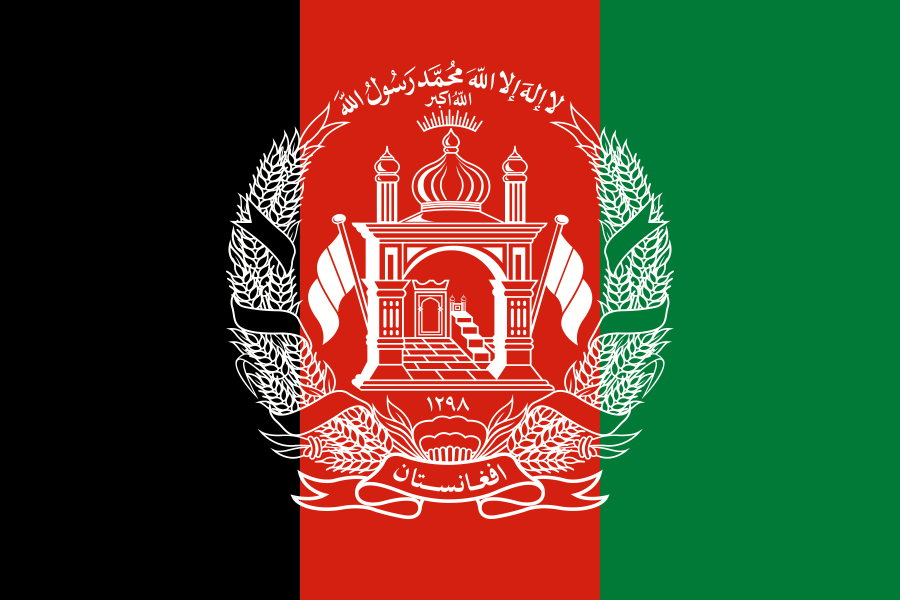
Afghanistan
Location Info
- Continent: Asia
- Country: Afghanistan
- Coordinates: 33.9391 , 67.71
Trust Info
Verified Geographic and Statistical Information
🌍 Continents

Overview
Afghanistan is a landlocked country located at the intersection of Central and South Asia. It is bordered by Pakistan to the east and south, Iran to the west, Turkmenistan, Uzbekistan, and Tajikistan to the north, and China to the northeast. The country's geography is dominated by the Hindu Kush mountain range, which covers about two-thirds of its territory. Kabul serves as the capital and largest city, acting as the primary political and economic hub.
Historically, Afghanistan has been a significant transit point for trade and migration along the ancient Silk Road. It has seen the influence of various empires, including the Achaemenids, Greeks, Kushans, and Timurids. In 2026, the country continues to rely heavily on an agricultural economy, while possessing substantial untapped mineral resources. The population is ethnically diverse, with major groups including Pashtuns, Tajiks, Hazaras, and Uzbeks.
Truth & Facts
| Total Area | 652,860 sq km |
| Highest Point | Noshaq (7,492 m) |
| Population | 45,047,069 |
| Median Age | 17.4 years |
| Capital City | Kabul |
| Provinces | 34 |
| Durrani Empire Founded | 1747 |
| Independence from UK | 1919 |
| GDP Growth Rate | 4.3% (Projected) |
| Currency | Afghani (AFN) |
| Transport Terminals | 40 Projects Underway |
| Literacy Rate | 37% (Overall) |
| People in Need | 14.4 million |
| Official Languages | Dari and Pashto |
| World Heritage Sites | 2 |
| Climate Vulnerability | High |
| Active Airports | 68 |
| Mobile Network Coverage | Major Cities |
| Explosive Ordnance Incidents | ~50 per month |
| Ruling Entity | Islamic Emirate of Afghanistan |
| Bordering Countries | 6 |
| Electricity Import | High |
| Life Expectancy | 66.8 years (Avg) |
| Renewable Potential | Significant |
| Wheat Production | ~5.2 million metric tons |
📑 Table of Contents
Overview
Afghanistan is a landlocked nation located in South-Central Asia, famously known as the 'Graveyard of Empires' due to its history of resisting foreign conquest. The country features a diverse landscape, ranging from the towering peaks of the Hindu Kush to the arid plains of the south. It serves as a vital bridge between the Indian subcontinent, Central Asia, and the Middle East.
- Strategic Location: Gateway between major Asian regions.
- Land Area: Approximately 652,860 square kilometers.
- Capital City: Kabul, located in the east-central part of the country.
- Administrative Units: 34 provinces.
- Neighboring Nations: Borders 6 countries including China and Iran.
History
The history of Afghanistan is characterized by its role as a crossroads for empires. Ancient civilizations like the Kushans and Timurids left behind a rich archaeological legacy. The modern state was founded in 1747 by Ahmad Shah Durrani, who unified various tribes into a single kingdom.
- Silk Road Hub: Center for trade between East and West.
- Anglo-Afghan Wars: Resisted British expansion in the 19th century.
- Sovereignty: Recognized as independent in 1919.
- 20th Century: Experienced periods of monarchy, republic, and communist rule.
- Recent Era: Transitioned to de facto rule by the Islamic Emirate in 2021.
Geography
Afghanistan's geography is defined by high mountains and deep valleys. The Hindu Kush range extends from the northeast to the southwest, dividing the country into three distinct regions: the central highlands, the northern plains, and the southwestern plateau. These geographic barriers have historically influenced the settlement patterns of various ethnic groups.
| Region | Characteristic |
|---|---|
| Hindu Kush | Rugged peaks, glaciers, highest elevation |
| Northern Plains | Fertile steppes, agricultural hub |
| Southwestern Plateau | Desert terrain, arid climate |
| Wakhan Corridor | Narrow panhandle bordering China |
Climate & Weather
The country experiences a continental climate with significant variations between seasons and regions. Summers are typically hot and dry, while winters can be extremely cold, especially in the highlands. Precipitation is generally low, occurring mostly as snow in the mountains during winter and spring.
- Arid Conditions: Average annual rainfall is roughly 300mm.
- Extreme Heat: Southern regions can exceed 45°C in summer.
- Extreme Cold: Highlands may drop below -40°C in winter.
- Seasonal Peak: Most rainfall occurs between January and April.
- Drought Risk: Frequent cycles influenced by La Niña events.
Population & Demographics
Afghanistan has a rapidly growing population estimated at over 45 million in 2026. The society is highly diverse, composed of numerous ethnic groups with distinct languages and customs. Approximately 73% of the population resides in rural areas, relying on subsistence agriculture.
- Major Ethnic Groups: Pashtuns, Tajiks, Hazaras, and Uzbeks.
- Languages: Dari (Afghan Persian) and Pashto are the official tongues.
- Urbanization: Roughly 27% live in urban centers like Kabul.
- Age Profile: Median age is around 17 years, indicating a young workforce.
- Fertility Rate: Among the highest in the region at ~4.6 children per woman.
Culture & Lifestyle
Afghan culture is deeply rooted in Islamic traditions and tribal customs. Concepts such as 'Pashtunwali' (the tribal code of conduct) and extreme hospitality to guests are central to social life. The country is renowned for its intricate carpet weaving and distinctive traditional music.
- Hospitality: Known for welcoming strangers with tea and food.
- Dress: Perahan Tunban (traditional tunic and trousers) is common.
- Arts: Long history of calligraphy, poetry, and mosaic tiles.
- Sports: Cricket and Buzkashi (goat dragging) are highly popular.
- Social Structure: Families are typically large and patriarchal.
Festivals & Events
Religious holidays dominate the Afghan calendar, reflecting the country's Islamic heritage. These are times for community gathering, prayer, and feasting. Nowruz, the Persian New Year, is also traditionally celebrated, particularly in the northern regions.
- Eid al-Fitr: Celebrates the end of Ramadan.
- Eid al-Adha: Commemorates the sacrifice of Ibrahim.
- Nowruz: The spring equinox celebration, famous in Mazar-i-Sharif.
- Independence Day: Observed on August 19th.
- Ashura: Significant for the Shia community.
Food & Cuisine
The cuisine of Afghanistan is a blend of flavors from Central Asia, Persia, and the Indian subcontinent. It is characterized by the use of fresh herbs, dried fruits, and various grains. Rice dishes are the centerpiece of most meals, often accompanied by meat and flatbread.
- Kabuli Pulao: National dish made of rice, lamb, raisins, and carrots.
- Naan: Leavened flatbread baked in traditional tandoor ovens.
- Bolani: Fried flatbread stuffed with potatoes or leeks.
- Mantu: Steamed dumplings filled with spiced meat.
- Chai: Green or black tea is the staple beverage of daily life.
Economy & Industries
The Afghan economy is primarily agrarian, with agriculture employing nearly 60% of the workforce. Despite significant challenges, the country possesses massive mineral wealth, including lithium, copper, and iron ore, which are seen as critical for future development.
- Agriculture: Key crops include wheat, saffron, nuts, and grapes.
- Minerals: Estimated $1 trillion in untapped natural resources.
- Carpet Export: High-quality hand-woven rugs are a major trade item.
- Energy: Increasing focus on solar and hydroelectric potential.
- Trade Partners: Major trade links with Pakistan, Iran, and China.
Cost of Living
The cost of living in Afghanistan is relatively low compared to international standards, but it is high relative to local income levels. Prices for staple goods like bread and fuel can fluctuate based on border conditions and global market trends.
| Item | Typical Cost (AFN) |
|---|---|
| Bread (Naan) | 10 - 20 |
| 1kg Rice | 90 - 120 |
| 1L Gasoline | 65 - 80 |
| Monthly Rent (1BR) | 10,000 - 15,000 |
Employment & Business
The labor market is dominated by the informal sector and small-scale farming. Large-scale employment is mostly found in the public sector, construction, and telecommunications. Small and medium enterprises (SMEs) are the backbone of local commerce in cities.
- Key Sectors: Construction, agriculture, and retail trade.
- Skills in Demand: Engineering, technical vocations, and digital literacy.
- Business Environment: Challenges include regulatory uncertainty and infrastructure gaps.
- Returnee Integration: Migrants returning from neighboring countries are seeking jobs.
- Workforce: High percentage of youth seeking entry into the market.
Real Estate & Housing
Housing in Afghanistan ranges from modern apartment blocks in Kabul to traditional mud-brick 'qalas' in rural areas. The return of millions of refugees has increased the demand for housing in urban centers, leading to rising property prices in specific neighborhoods.
- Urban Centers: High density in Kabul, Herat, and Mazar-i-Sharif.
- Rural Styles: Multi-generational homes with thick walls for insulation.
- Market Trend: Rising interest in new residential developments in suburbs.
- Tenure: High rate of owner-occupancy in rural regions.
- Infrastructure: Many new housing projects struggle with consistent utilities.
Transportation & Connectivity
Road transport is the primary means of moving goods and people across the country's rugged terrain. The 'Ring Road' connects major cities, though it requires constant maintenance. Rail and air connections are expanding to improve regional trade links.
- Ring Road: Major highway connecting Kabul, Kandahar, and Herat.
- Air Travel: Kabul International Airport is the main global gateway.
- Railways: Existing lines link to Uzbekistan, Iran, and Turkmenistan.
- Public Transit: Urban bus systems and shared taxis are common.
- Infrastructure: Ongoing construction of 40 new transport terminals.
Infrastructure & Utilities
Access to modern utilities remains a challenge for many Afghans, particularly in remote mountainous areas. The country relies heavily on electricity imports from neighboring Central Asian states to meet the needs of its growing cities.
- Electricity: Primarily imported from Uzbekistan and Tajikistan.
- Water Access: Rely on wells and traditional karez (canal) systems.
- Telecoms: High mobile phone penetration across most provinces.
- Internet: 4G services expanding in major urban areas.
- Sanitation: Modern systems are mostly limited to new urban districts.
Education
The education system in Afghanistan is facing significant structural hurdles. While primary education for boys and girls remains active, higher education and secondary schooling for girls face restrictions under current policies. Literacy rates remain among the lowest globally.
- Primary Schools: Active across most districts for young children.
- Literacy Rate: Approximately 37% overall in 2026.
- Learning Poverty: Over 90% of 10-year-olds struggle with basic reading.
- Vocational Training: High male enrollment in technical schools.
- Tertiary Education: Universities exist but face funding and policy shifts.
Healthcare
Public health services are largely supported by international humanitarian organizations. Many healthcare facilities have closed due to funding shortages, leaving millions with limited access to essential medical care, particularly in rural and border regions.
- Key Providers: Red Cross, WHO, and UNICEF support major hospitals.
- Malnutrition: Significant levels of child wasting due to food insecurity.
- Epidemiology: Regular outbreaks of measles and acute watery diarrhea.
- Rural Access: Long travel times to reach basic health clinics.
- Infrastructure: Over 400 facilities closed recently due to funding gaps.
Tourist Attractions
Despite the lack of a formal tourism industry, Afghanistan holds world-class historical and natural sites. These include ancient Islamic architecture, Buddhist remnants, and stunning alpine lakes. Most sites are located in the provinces of Bamiyan, Herat, and Ghor.
- Bamiyan Valley: Site of the former giant Buddha statues.
- Friday Mosque: Famous for its turquoise mosaics in Herat.
- Minaret of Jam: A 12th-century brick tower in remote Ghor.
- Band-e Amir: A series of deep blue natural lakes.
- Herat Citadel: Ancient fortress with roots to Alexander the Great.
Things to Do
Recreational activities in Afghanistan are often traditional or outdoor-focused. Community-based sports and visiting historical gardens are popular ways for locals to spend their leisure time. Exploring local bazaars is a central part of the daily experience in cities.
- Garden Visits: Relaxing at the Gardens of Babur in Kabul.
- Bazaar Shopping: Visiting the Chicken Street for antiques.
- Watching Sports: Attending cricket matches or Buzkashi games.
- Mountain Hiking: Exploring the foothills of the Hindu Kush.
- Traditional Dining: Sharing large meals at local guesthouses.
Best Places to Visit
Kabul, Herat, and Mazar-i-Sharif are the most accessible cities with significant cultural value. Each city offers a unique glimpse into different eras of Afghan history, from Mughal gardens to Timurid mosques and Soviet-era urban planning.
- Kabul: The vibrant, historic capital city.
- Herat: The cultural and artistic heart of the west.
- Mazar-i-Sharif: Home to the stunning Blue Mosque.
- Kandahar: Historical and political center of the south.
- Bamiyan: Center for ancient history and natural beauty.
Travel Guide
Traveling to and within Afghanistan requires careful preparation and awareness of current local conditions. Most international travelers arrive via Kabul International Airport. Domestic travel is primarily done by road or limited internal flights.
- Visas: Required for almost all foreign nationals.
- Currency: Carry cash (AFN), as card systems are limited.
- Dress Code: Modest attire is mandatory for both men and women.
- Safety: Travelers must monitor local security updates constantly.
- Language: Basic knowledge of Dari or Pashto is highly beneficial.
Nearby Places
Afghanistan's proximity to various Central and South Asian hubs makes it a strategic point for regional travel. Major cities in neighboring countries are connected by key land routes and occasional air services from Kabul.
- Peshawar, Pakistan: Major hub just across the Torkham border.
- Mashhad, Iran: Religious and economic center near the western border.
- Termez, Uzbekistan: Northern transit point across the Amu River.
- Dushanbe, Tajikistan: Accessible via the northern mountainous borders.
- Quetta, Pakistan: Southern trade link near Kandahar.
Environment & Nature
The natural environment of Afghanistan is diverse but fragile. It is home to rare wildlife, such as the snow leopard in the Wakhan Corridor. However, the country faces severe environmental challenges, including deforestation, desertification, and decreasing water levels.
- National Parks: Band-e Amir was the first established park.
- Fauna: Rare species include the Marco Polo sheep.
- Water Sources: Glacier melt from the Hindu Kush is vital.
- Deforestation: Significant loss of pistachio and cedar forests.
- Natural Hazards: High risk of earthquakes and flash floods.
Government & Administration
The government operates under the de facto authority of the Islamic Emirate of Afghanistan. The administration is centralized, with a focus on enforcing religious laws and maintaining security. Administrative divisions follow a hierarchy of provinces, districts, and villages.
- Leadership: Based primarily in Kandahar and Kabul.
- Legal System: Predominantly based on Islamic Sharia law.
- Revenue: Mostly derived from customs duties and domestic taxes.
- Provinces: 34 provincial governors appointed by the central authority.
- International Status: Governance is not universally recognized globally.
Safety & Public Services
Security has stabilized in terms of large-scale active conflict, but risks remain from unexploded ordnance and sporadic incidents. Public services such as fire departments and police are operational in cities but lack modern equipment and funding.
- Security Forces: Maintain a visible presence in urban centers.
- Emergency Services: Dialing 100 for police or 102 for ambulance.
- Ordnance Risk: Danger from mines in rural and former conflict areas.
- Utilities: Services like trash collection vary by municipality.
- Humanitarian Aid: Vital for filling gaps in public service delivery.
Best Time to Visit
The transitional seasons of spring and autumn offer the most comfortable weather for travel. April to June and September to October are ideal, as they avoid the extreme heat of summer and the heavy snows of winter.
| Season | Months | Condition |
|---|---|---|
| Spring | March - May | Mild temperatures, blooming flora |
| Summer | June - August | Very hot in lowlands, pleasant in mountains |
| Autumn | Sept - Nov | Cool and dry, harvest season |
| Winter | Dec - Feb | Heavy snow in North/East, cold nationwide |
Local Business Directory
Local commerce is concentrated in traditional markets and along major city avenues. Banking and financial services are centered in Kabul, while regional cities specialize in trade related to their neighboring countries.
- Banking: Azizi Bank and Da Afghanistan Bank are primary institutions.
- Telecoms: Major providers include Roshan, AWCC, and Etisalat.
- Logistics: Firms specializing in transit to Iran and Pakistan.
- Handicrafts: Centers for carpet weaving in Mazar and Herat.
- Retail: Large wholesale markets in Mandawi, Kabul.
General Information FAQs
Where is Afghanistan located?
Afghanistan is a landlocked country located in South-Central Asia, bordered by Pakistan, Iran, Turkmenistan, Uzbekistan, Tajikistan, and China.
What is Afghanistan known for?
Afghanistan is known for its rugged mountains, rich history as a Silk Road hub, high-quality carpets, saffron, and its diverse ethnic groups.
Why is Afghanistan famous?
The country is famous for its strategic geopolitical importance, ancient cultural heritage sites like Bamiyan, and its long history of independence.
What country or region is Afghanistan part of?
Afghanistan is geographically part of Central Asia and South Asia, often described as a bridge between these regions.
What is the population of Afghanistan?
As of mid-2026, the estimated population of Afghanistan is approximately 45 million people.
What languages are spoken in Afghanistan?
The official languages are Dari (Afghan Persian) and Pashto. Other regional languages include Uzbek, Turkmen, and Balochi.
What time zone is Afghanistan in?
Afghanistan operates in the Afghanistan Time (AFT) zone, which is UTC+4:30.
What are the key facts about Afghanistan?
Key facts include its landlocked status, a 652,860 sq km area, Kabul as the capital, and an economy heavily dependent on agriculture.
What makes Afghanistan unique?
Its unique geography featuring the Hindu Kush, its mix of ethnic cultures, and its history of remaining unconquered by major 19th-century empires make it distinct.
How large is Afghanistan in area?
Afghanistan covers an area of approximately 652,860 square kilometers, making it the 41st largest country in the world.
History FAQs
What is the history of Afghanistan?
The history of Afghanistan spans ancient empires, Islamic conquests, and a modern era defined by the Durrani Empire founded in 1747.
When was Afghanistan established?
The modern state was established in 1747 by Ahmad Shah Durrani, though it became fully sovereign from British influence in 1919.
What major historical events happened in Afghanistan?
Major events include the Silk Road trade, the Anglo-Afghan Wars, the 1979 Soviet invasion, and the 2021 shift in political authority.
Who were important historical figures from Afghanistan?
Significant figures include Ahmad Shah Durrani, the philosopher Al-Biruni, the poet Rumi (born in Balkh), and King Amanullah Khan.
How has Afghanistan developed over time?
It has transitioned from a tribal kingdom to a constitutional monarchy, a republic, and is currently governed as an Islamic Emirate.
Geography & Environment FAQs
What is the geography of Afghanistan?
It is a mountainous, landlocked country dominated by the Hindu Kush range and arid southern plateaus.
What natural features surround Afghanistan?
It is surrounded by high mountains, the Amu Darya river in the north, and desert plains to the south and west.
Are there mountains, rivers, or lakes near Afghanistan?
Yes, the Hindu Kush mountains, the Kabul and Helmand rivers, and the Band-e Amir lakes are major features.
What is the elevation of Afghanistan?
The average elevation is around 1,885 meters, with Noshaq peak reaching 7,492 meters.
What ecosystems exist around Afghanistan?
Ecosystems range from alpine tundra and coniferous forests in the mountains to arid deserts and steppes in the lowlands.
Climate & Weather FAQs
What is the climate like in Afghanistan?
Afghanistan has a continental climate with cold winters and hot, dry summers.
What is the average temperature in Afghanistan?
Average temperatures range from -5°C in winter to 33°C in summer, though extremes can vary greatly by altitude.
What is the weather like throughout the year in Afghanistan?
Winter brings heavy snow to the north/east, spring is mild and rainy, summer is very dry and hot, and autumn is cool.
Does Afghanistan experience extreme weather?
Yes, the country is prone to severe droughts, flash floods, and extreme cold during the winter months.
What is the best time of year to visit Afghanistan?
The best times are spring (April-June) and autumn (September-October) when the weather is mild.
Population & Society FAQs
What is the population density of Afghanistan?
The population density is approximately 69 people per square kilometer in 2026.
What ethnic groups live in Afghanistan?
Major groups include Pashtuns, Tajiks, Hazaras, Uzbeks, Turkmens, Aimaks, and Baloches.
What religions are practiced in Afghanistan?
The vast majority of the population practices Islam, with approximately 85-90% being Sunni and 10-15% Shia.
What is daily life like in Afghanistan?
Daily life is centered on family, community work, and religious observances, with many people working in agriculture.
How diverse is the population of Afghanistan?
The population is extremely diverse, with over a dozen distinct ethnic groups each possessing their own linguistic and cultural heritage.
Culture & Traditions FAQs
What cultural traditions are important in Afghanistan?
Hospitality, respect for elders, tribal codes like Pashtunwali, and communal celebrations of religious holidays are vital.
What festivals are celebrated in Afghanistan?
The primary festivals are Eid al-Fitr, Eid al-Adha, Nowruz (New Year), and Independence Day.
What cultural landmarks exist in Afghanistan?
Major landmarks include the Blue Mosque in Mazar-i-Sharif, the Herat Citadel, and the Gardens of Babur.
What traditional clothing or customs are common in Afghanistan?
The Perahan Tunban (shirt and trousers) is common. Customs include the sharing of tea and communal dining on floor mats.
What arts and crafts are associated with Afghanistan?
Hand-woven carpets, intricate embroidery, lapis lazuli jewelry, and pottery are famous crafts.
Food & Cuisine FAQs
What foods is Afghanistan known for?
It is known for rice dishes like Kabuli Pulao, flatbreads (Naan), and a variety of kebabs and dumplings (Mantu).
What traditional dishes originate from Afghanistan?
Dishes include Kabuli Pulao, Mantu, Ashak (leek dumplings), and Bolani (stuffed flatbread).
What are the best restaurants in Afghanistan?
Kabul and Herat host many traditional restaurants serving authentic Afghan cuisine, though names change frequently.
What local ingredients are commonly used in Afghanistan cuisine?
Common ingredients include lamb, rice, raisins, carrots, yogurt, pomegranates, and fresh cilantro.
What food markets or street foods are popular in Afghanistan?
Markets like Mandawi sell fresh produce; popular street foods include Bolani and fried fish.
Economy & Business FAQs
What are the main industries in Afghanistan?
The main industries are agriculture, textile manufacturing (carpets), and small-scale mining.
What economic activities drive the economy of Afghanistan?
Farming, livestock rearing, transit trade, and the export of fruits and nuts drive the economy.
What businesses operate in Afghanistan?
Businesses range from small family shops to larger telecommunications firms and export agencies for carpets and saffron.
Is Afghanistan an important economic center?
It is a regional transit hub connecting Central Asia with the Arabian Sea, giving it significant transit potential.
What are the major exports or products from Afghanistan?
Major exports include saffron, carpets, coal, talc, grapes, almonds, and pomegranates.
Employment & Jobs FAQs
What job opportunities are available in Afghanistan?
Opportunities exist in agriculture, construction, teaching, and logistics related to trade.
What are the major employers in Afghanistan?
The public sector and international humanitarian organizations are among the largest formal employers.
What skills are in demand in Afghanistan?
Technical trades, healthcare, agricultural management, and language translation are highly valued skills.
Is Afghanistan a good place to work?
The work environment is challenging due to economic constraints, but there is a great need for skilled professionals in development.
What is the unemployment rate in Afghanistan?
Precise data is difficult to verify, but underemployment remains very high, particularly among the youth.
Cost of Living FAQs
Is Afghanistan expensive to live in?
It is generally inexpensive for foreign currency holders, though basic goods can be costly for local residents.
What is the average cost of living in Afghanistan?
The cost varies by region, but a basic lifestyle can be sustained on a fraction of Western costs.
How much does housing cost in Afghanistan?
Rent in urban areas like Kabul can range from 10,000 to 25,000 AFN for an apartment, depending on the district.
What are average food and utility costs in Afghanistan?
Food costs are low for locally produced goods; utility costs are moderate but services are often inconsistent.
Is Afghanistan affordable compared to nearby cities?
It is generally more affordable than major cities in Iran or Pakistan, but has less developed infrastructure.
Housing & Real Estate FAQs
What types of housing are available in Afghanistan?
Housing includes modern high-rise apartments in Kabul and traditional mud-brick courtyards in rural areas.
What is the average home price in Afghanistan?
Prices vary wildly; a modern home in a secure Kabul neighborhood can cost several thousand dollars.
Is it better to rent or buy property in Afghanistan?
Most locals prefer to own property within family-held land; foreigners and NGOs typically rent.
Which neighborhoods are popular in Afghanistan?
In Kabul, Shahr-e-Naw and Wazir Akbar Khan are traditionally popular for business and residents.
How has the property market changed in Afghanistan?
The market has seen significant fluctuations recently due to political changes and migration patterns.
Transportation FAQs
How do you get to Afghanistan?
Most international arrivals are via air to Kabul. Land crossings exist with all six neighboring countries.
What is the nearest airport to Afghanistan?
Kabul International (KBL) is the primary gateway, with other major airports in Herat and Mazar-i-Sharif.
Does Afghanistan have railway connections?
Yes, there are limited rail links to Uzbekistan, Turkmenistan, and Iran for freight and transit.
How reliable is public transportation in Afghanistan?
Reliability is low; shared taxis and private buses are the main forms of inter-city transport.
What major highways or roads connect to Afghanistan?
The Ring Road (A01) connects major cities; international highways lead to Peshawar and Quetta (Pakistan).
Education FAQs
What schools are located in Afghanistan?
There are public and private primary schools, though many suffer from a lack of resources and qualified teachers.
Are there universities in Afghanistan?
Yes, major universities include Kabul University and Nangarhar University, though policies on attendance have changed.
What is the literacy rate in Afghanistan?
The literacy rate is estimated at 37% overall as of 2026.
What educational opportunities exist in Afghanistan?
Opportunities include primary schooling and vocational training in technical fields for men.
Is Afghanistan a good place for students?
Students face significant challenges due to limited resources and restrictions on female education.
Healthcare FAQs
What hospitals are available in Afghanistan?
Hospitals are available in major cities, such as the Indira Gandhi Children's Hospital in Kabul.
Are there emergency medical services in Afghanistan?
Basic emergency services exist in cities, but rural areas often lack access to urgent care.
What healthcare facilities exist in Afghanistan?
Facilities include government hospitals, private clinics, and centers run by NGOs like ICRC.
Is healthcare affordable in Afghanistan?
Public healthcare is theoretically free but under-resourced; private care is expensive for the average citizen.
Are specialized medical services available in Afghanistan?
Specialized services are very limited; many Afghans travel abroad for complex medical procedures.
Tourism & Travel FAQs
What are the top tourist attractions in Afghanistan?
Top sites include Band-e Amir National Park, the Blue Mosque in Mazar, and the Herat Citadel.
What are the best things to do in Afghanistan?
Activities include visiting historical landmarks, exploring the Kabul bazaars, and attending a Buzkashi match.
Is Afghanistan worth visiting?
For historical and cultural researchers, it offers unparalleled heritage, though safety remains the primary concern.
What landmarks should visitors see in Afghanistan?
Visitors should see the Minaret of Jam, the Bamiyan Buddhas site, and the Gardens of Babur.
How many days should tourists spend in Afghanistan?
A comprehensive tour typically requires 7 to 10 days to cover major hubs like Kabul and Herat.
Nearby Places FAQs
What places are near Afghanistan worth visiting?
Nearby destinations include the historic city of Samarkand in Uzbekistan and Peshawar in Pakistan.
What cities or towns are close to Afghanistan?
Close cities include Termez (Uzbekistan), Mashhad (Iran), and Peshawar (Pakistan).
What natural attractions are near Afghanistan?
The Karakoram mountains in Pakistan and the Pamir mountains in Tajikistan are close to the borders.
What day trips can be taken from Afghanistan?
Day trips from Kabul include Paghman Valley and the Qargha Reservoir.
What famous destinations are within reach of Afghanistan?
Destinations like the Swat Valley in Pakistan are geographically within reach from the eastern borders.
Safety FAQs
Is Afghanistan safe to live in?
Security varies by province; while major combat has subsided, economic and humanitarian risks are high.
Is Afghanistan safe for tourists?
Most governments advise against all travel to Afghanistan due to security threats and the lack of consular services.
What is the crime rate in Afghanistan?
Petty crime occurs in cities; however, official crime statistics are not consistently published.
What emergency services operate in Afghanistan?
Police (100) and Ambulance (102) are the primary emergency contacts in urban areas.
What safety tips should visitors follow in Afghanistan?
Travelers should dress modestly, maintain a low profile, and always follow local advice and government travel warnings.
Lifestyle & Living FAQs
Is Afghanistan a good place to live?
It offers a unique culture and strong sense of community, but infrastructure and economic challenges are significant.
What recreational activities are available in Afghanistan?
Cricket is the most popular sport, followed by football and traditional games like Buzkashi.
Is Afghanistan family-friendly?
Afghan society is very family-oriented, though opportunities for children's entertainment are limited.
What outdoor activities are popular in Afghanistan?
Hiking in the mountains and visiting public parks for picnics are popular outdoor pursuits.
What makes life enjoyable in Afghanistan?
Strong social bonds, traditional hospitality, and the natural beauty of the countryside are aspects many find enjoyable.
Practical Information FAQs
What travel tips should visitors know about Afghanistan?
Always carry cash, respect local customs regarding gender and religion, and avoid photography of government buildings.
What local customs should visitors respect in Afghanistan?
Respect Islamic traditions, dress conservatively, and avoid discussing sensitive political topics in public.
How accessible is Afghanistan for international visitors?
Accessibility is low due to limited flight options and complex visa processes.
What services are available for tourists in Afghanistan?
Services are minimal; some local agencies offer guided historical tours in safer regions.
What important information should travelers know before visiting Afghanistan?
Check the latest security reports, ensure your insurance covers the region, and register with your home embassy.
Additional Facts FAQs
What is the national animal of Afghanistan?
The national animal is the snow leopard.
What is the national sport of Afghanistan?
Buzkashi is the traditional national sport.
What is the highest mountain in Afghanistan?
Noshaq is the highest point at 7,492 meters.
What is the longest river in Afghanistan?
The Helmand River is the longest river in the country.
What are the major cities of Afghanistan?
Kabul, Kandahar, Herat, Mazar-i-Sharif, and Jalalabad are the largest urban centers.
What is the literacy rate of men in Afghanistan?
The male literacy rate is approximately 52%.
What is the literacy rate of women in Afghanistan?
The female literacy rate is approximately 27%.
What are the main agricultural products?
Wheat, grapes, apricots, pomegranates, and nuts like almonds and walnuts.
Does Afghanistan have any islands?
No, Afghanistan is a landlocked country with no ocean coastline or major offshore islands.
What is the national bird of Afghanistan?
The golden eagle is considered the national bird.
What is the currency of Afghanistan?
The currency is the Afghani (AFN).
Is the internet accessible in Afghanistan?
Yes, though speeds are generally slow and access is concentrated in urban areas.
What are the main exports to India?
Dry fruits, nuts, and medicinal herbs are major exports to India.
What are the main imports into Afghanistan?
Fuel, capital goods, and food staples like wheat and sugar are the main imports.
Who founded the modern state of Afghanistan?
Ahmad Shah Durrani founded the state in 1747.